
Our behavioral health billing team works your aged A/R the way it actually built up, by level of care, payer, and denial reason, and goes after the old claims most billers have already given up on. Hand us the aging report by itself, or the whole revenue cycle behind it.
Everything from the aging report to patient balances runs through one team and a single monthly scorecard. Point us at the oldest A/R first, or hand over the entire operation.
Start with the free billing audit if you want to know what is recoverable, request the pricing and packages guide if you want numbers first, or book a call if you would rather just talk it through. Any of the three gets you a straight answer on your aging A/R.
You go through your aging report, your payer mix, and your levels of care directly with the billers who will run the recovery, and you walk away with a prioritized plan scoped to your programs and claim volume.
We start with the buckets closest to their timely-filing deadlines and the highest-dollar aged claims, then keep the cycle current so revenue stops aging out. From month one you get a scorecard showing what has come back and what is still open.
In most cases, yes. Old does not mean uncollectible. We pull your aging report, sort the open claims by payer, denial reason, and how close each one is to its timely-filing deadline, then work the accounts with real recoverable dollars first. Some are one clean resubmission away. Others need an appeal with the right documentation. On your free billing audit we will tell you honestly what is still recoverable and what has genuinely aged out.
Whichever you need. Plenty of clients hand us only the aging report and keep everything else in house. Others bring us in to clear the old A/R first, then have us run the full cycle so it stops building back up. You can start with the piece that is bleeding and add the rest whenever you are ready.
You do. Handing off the A/R work does not hand off the authority. You approve the write-offs and payment plans, you set which payers and aging buckets we chase first, and you can pull up every open claim and its status on the platform whenever you want. Our job is the labor and the follow-up. The decisions that matter stay yours, and the monthly scorecard keeps the whole picture in front of you.
Because behavioral health claims deny for reasons general medical billers are not watching for. Concurrent authorization reviews can cut approved days in the middle of a detox or residential stay. PHP and IOP claims run into session-frequency and utilization limits that change week to week. Level-of-care transitions get coded wrong. Each of those becomes a denial that sits, and every payer has its own timely-filing clock ticking behind it. We work the claim the way it actually aged, not with a generic follow-up script.
Usually, yes. Recovering aged A/R does not mean ripping out the systems you already run. Our team works directly inside whatever behavioral health EHR and billing tools your practice uses today, and where a data connection helps, our own platform links to the partner EHRs it supports. It is not a replacement EHR and does not need to be. Your audit call is where we confirm your specific setup fits before any work starts.
Behavioral health accounts receivable recovery services find and collect the money a treatment provider has already earned but has not been paid. The work covers the full open ledger: claims rejected on technicalities and waiting to be corrected and resubmitted, denials that need an appeal backed by clinical documentation, level-of-care and coding errors that have to be fixed before a payer will reconsider, and underpayments where the plan paid less than its contract allowed. A behavioral health team runs this differently from a general medical biller. It reads a denied detox day as a likely authorization dispute, a rejected IOP session as a frequency or utilization rule, and a coding mismatch as a level-of-care transition that was billed wrong. Every open claim gets read for what specifically went wrong, then routed to the correction, appeal, or resubmission that fits it.
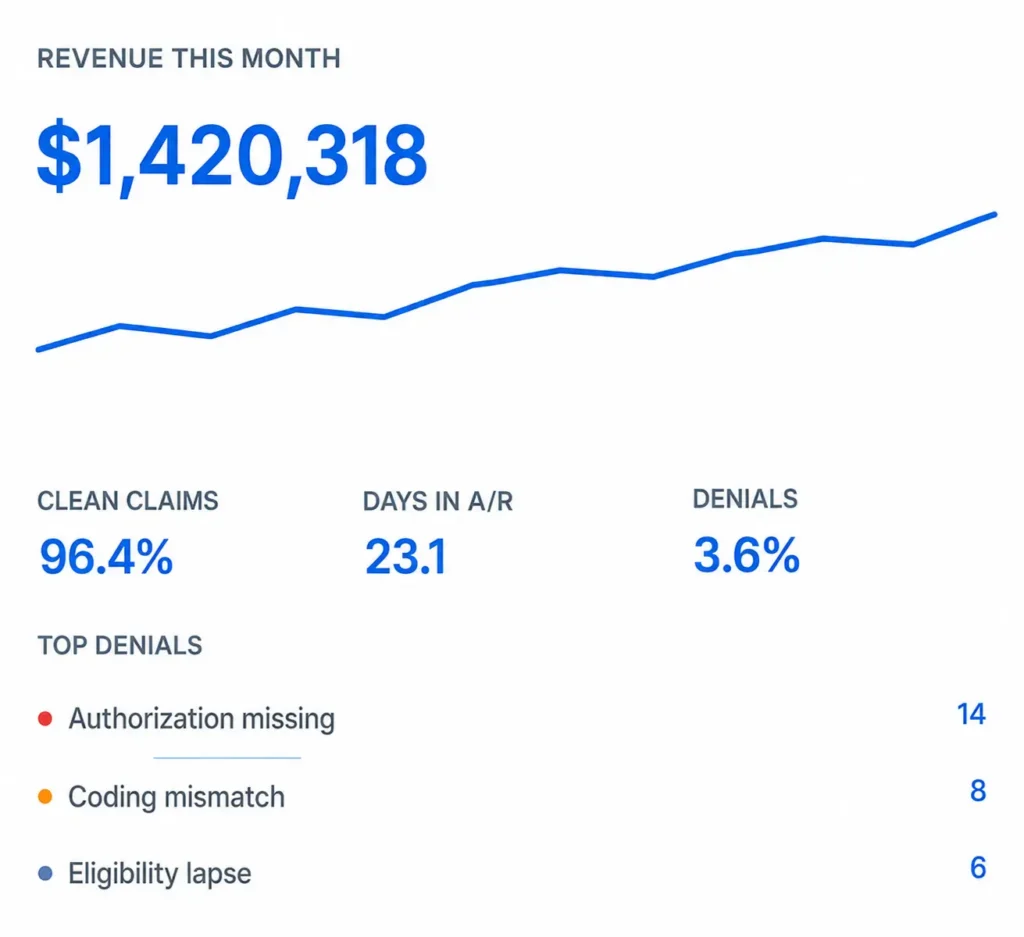
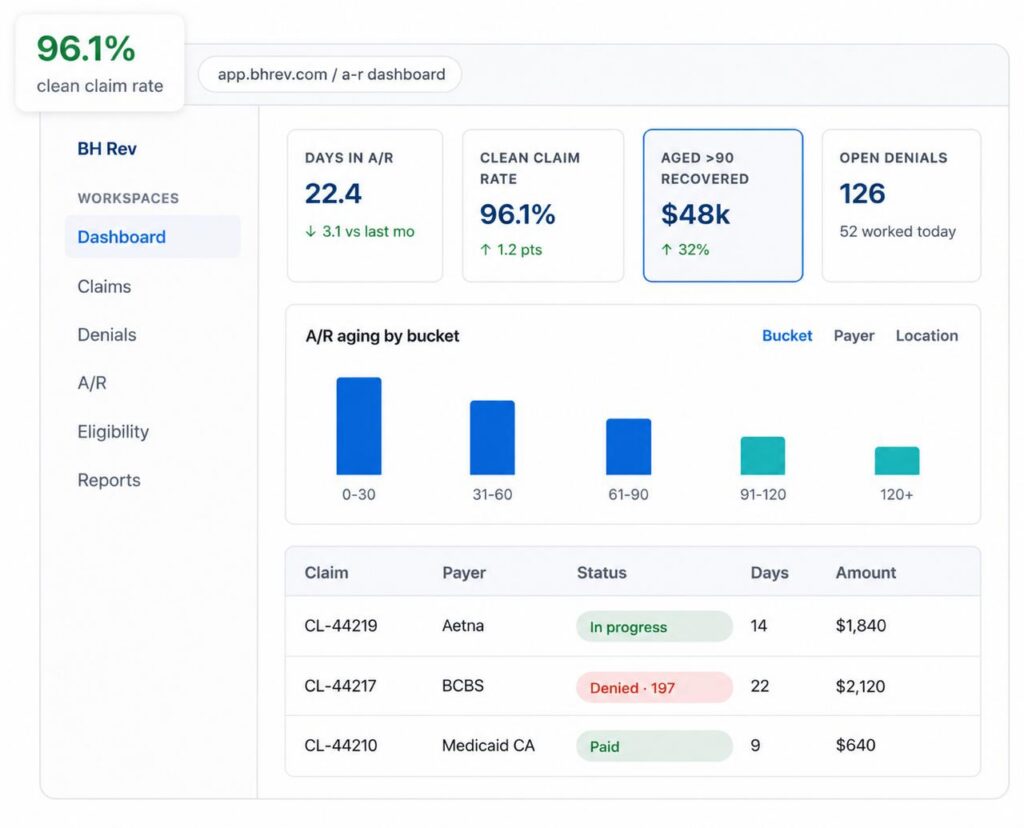
Behavioral health claims land in aged A/R for reasons tied to how the care is authorized and paid. Take a detox stay: it bills as a per-diem against an authorization the payer keeps reviewing while the client is still in treatment, so a single concurrent review can trim the approved days mid-stay and leave a high-dollar claim in dispute for weeks. PHP and IOP run into session-frequency and utilization limits that change what counts as a clean claim from one week to the next. Outpatient carries the volume problems instead: recurring visits, telehealth place-of-service codes, and coordination of benefits across more than one plan. As an industry pattern, these back up fastest when a billing team is short-staffed or has turned over and the oldest accounts stop getting touched. Behind each claim a payer’s timely-filing deadline keeps running, and those deadlines are not the same from one payer to the next.
Recovery starts by working the aging report in priority order, one bucket at a time. Open claims are segmented into 30, 60, 90, and 120-plus day buckets, then ranked inside each bucket by dollar value, by how the payer tends to behave, and by how close the claim is to its filing deadline. High-dollar detox and residential claims and anything near timing out go to the front of the queue. Each account then gets a root cause and a matching action: a corrected resubmission for a technical rejection, a coding fix for a level-of-care mismatch, or a documented appeal for a denial. On authorization and medical-necessity denials, that appeal is built around the criteria payers apply to behavioral health care, the ASAM levels for substance use and the plan’s own utilization rules, and it often moves through a peer-to-peer or utilization review rather than a paper form. Medicaid appeals follow their own sequence and commercial payers follow another, so the work moves claim by claim.

BH Rev handles behavioral health accounts receivable with one named team working on its own behavioral health platform. The model is national and delivered remotely, so a program anywhere in the country can hand off its aging report without switching systems or adding local staff. You can give the team only the aged A/R, or the entire revenue cycle behind it, from credentialing and eligibility through coding, submission, denials, and patient balances. Whatever the scope, the aging stays visible: every open claim and every bucket shows on the platform, and a monthly scorecard reports days in A/R, aging by bucket, and denials worked. Patient balances are handled by behavioral-health-trained reps using payment plans that keep people in care. A free billing audit reviews the aging, the open denials, and the claims sitting past 90 days, and it is the standard first step for a program that wants to see where its revenue is stuck before it commits to anything.