
Our billers run substance use disorder revenue cycles every day, on our own behavioral health platform. Hand us the whole thing, credentialing through collections, or just the piece that is costing you the most right now.
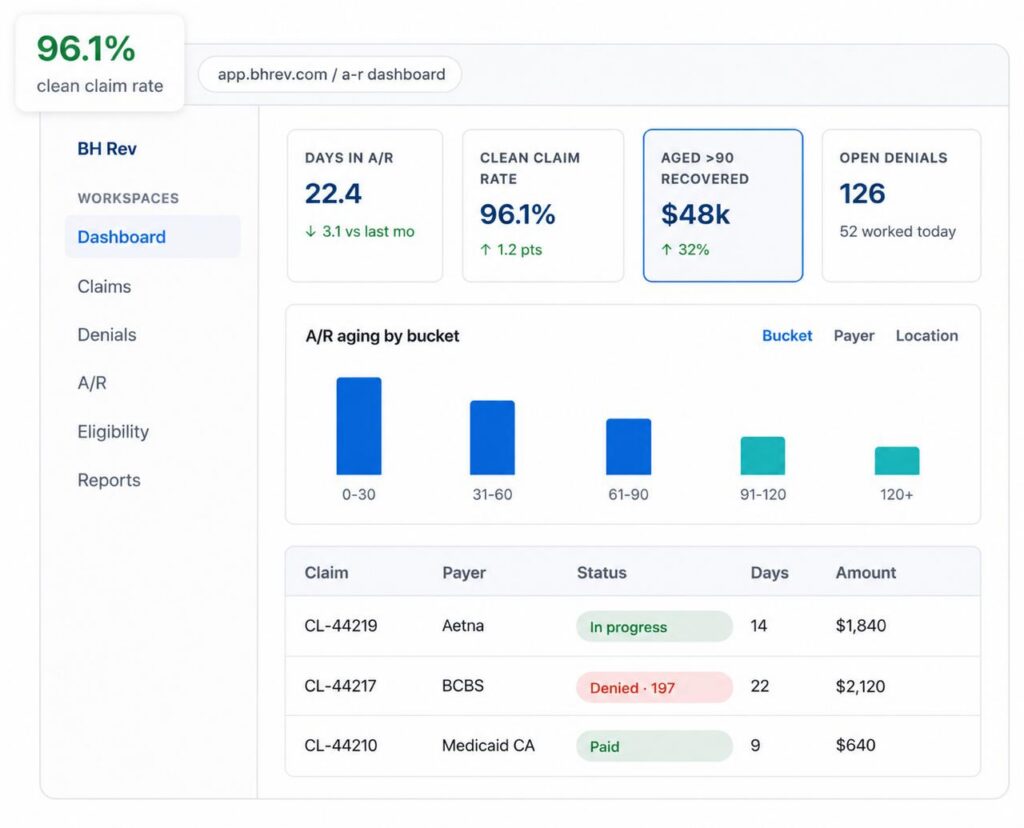
Handing off SUD billing doesn't hand off control; it hands off the grunt work. The decisions are still yours to make. What you gain is a clearer view: a named team you can call, live dashboards on every claim and dollar in A/R, and a monthly executive scorecard. You will likely know your numbers better than you do running it in-house.
Start from the staff you have. With no biller in-house, we run the full SUD revenue cycle for you; with a biller you want to keep, we take only the overflow, usually authorizations, denials, or aged A/R. You decide what stays inside, and we carry the rest.
The line is in-house versus done-for-you. Run it yourself with BH Rev Software and your team gets SUD-ready tools: real-time eligibility, scrubbing, denial workflows, and live A/R dashboards. Let us run it with BH Rev Services and our team takes the full cycle, credentialing through A/R, measured against your KPIs. Same platform beneath both, so combining them later is easy.
That is where we begin. Your open denials and aged A/R hold the recoverable money, so the free billing audit works those first, ahead of the rest. Once the backlog is moving, the remaining cycle comes over in phases, and current SUD claims keep going out the whole time.
Yes, in the large majority of cases, and you keep your current system. We work inside the SUD billing and clinical software your program already uses, and our platform links to partner EHRs rather than replacing them. If your setup is unusual, the billing audit call is where we settle the details.
Substance use disorder billing services cover the full revenue cycle for addiction-treatment providers: verification of benefits, prior and concurrent authorizations, CPT and ICD-10 coding, behavioral-health-specific claim scrubbing, submission, denial management and appeals, A/R follow-up, and patient billing. What separates a SUD billing team from a general medical biller is everything that happens before the claim goes out: benefits and medical necessity confirmed at intake, ASAM level-of-care coding matched to the program actually delivering care, and authorization requirements tracked against the treatment plan instead of discovered after the fact.
The pattern we see most when a treatment center hands us its billing is that the denials doing the damage were preventable. An authorization that covered detox but was never extended into residential. A concurrent review the payer requested and no one answered in time. A commercial plan that reset its SUD benefits at the new year. Each one surfaces as a denial weeks later, once the payer is holding the money and the appeal clock is already running. Specialist SUD billing moves those checks to the front of the cycle, with addiction-treatment rules built into the platform the work runs on, so commercial and Medicaid claims go out clean the first time.
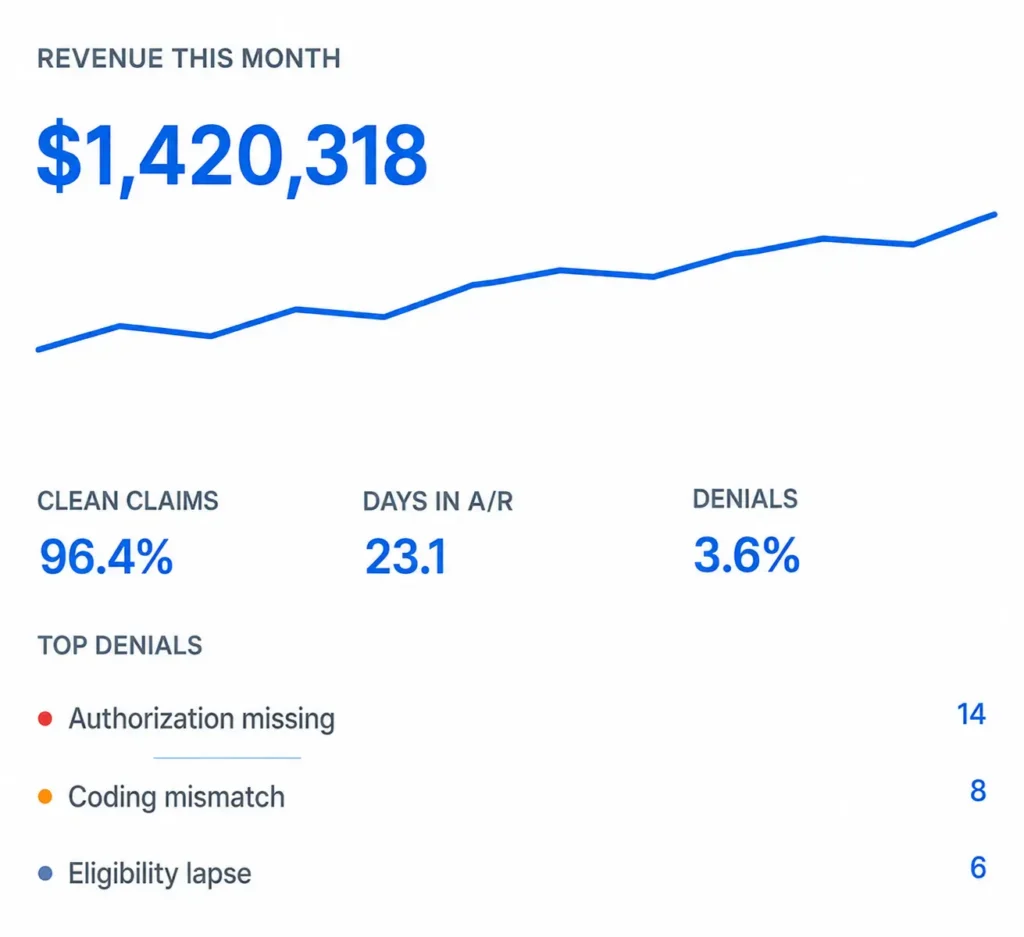
It is one of the most common conversations in addiction treatment: admissions are steady, the clinical team is delivering, and the deposits keep shrinking. Nobody can point to the leak. The billing person says claims are going out. The reports say revenue is down. And every month the gap between care delivered and money collected gets a little wider while everyone works harder.
If your SUD program’s collections are dropping and you cannot see why, the first step is a billing audit: a structured review of your billing, denials, and aging A/R that shows exactly where revenue is leaking and how much of it is still recoverable. In most programs the answer is not one dramatic failure. It is a stack of small ones: unworked denials, missed concurrent-authorization renewals, level-of-care downgrades that were never rebilled, aged claims drifting past filing windows, the kind no single person had time to chase. Get the findings first, then decide what to do about them. They are yours either way.
Detox and residential bill in per-diems against authorizations the payer keeps reviewing while treatment is still happening. PHP and IOP live on concurrent reviews, session-frequency limits, and utilization rules that change what a clean claim looks like week to week. Outpatient and MAT run on volume: recurring visits, telehealth place-of-service codes, medication management, and coordination of benefits at scale. Each level of care is its own billing discipline, and most SUD claim denials trace back to the transitions between them.
A step-down from detox to residential, or from PHP to IOP, is where we most often find weeks of misbilled or unbilled days, because the authorization, the level-of-care codes, and the claim format all change the day the client moves, and nobody told the billing process. A SUD billing team tracks the authorization calendar, the ASAM level-of-care coding, and the payer’s utilization requirements together, so revenue follows the client through the continuum instead of getting lost between levels.
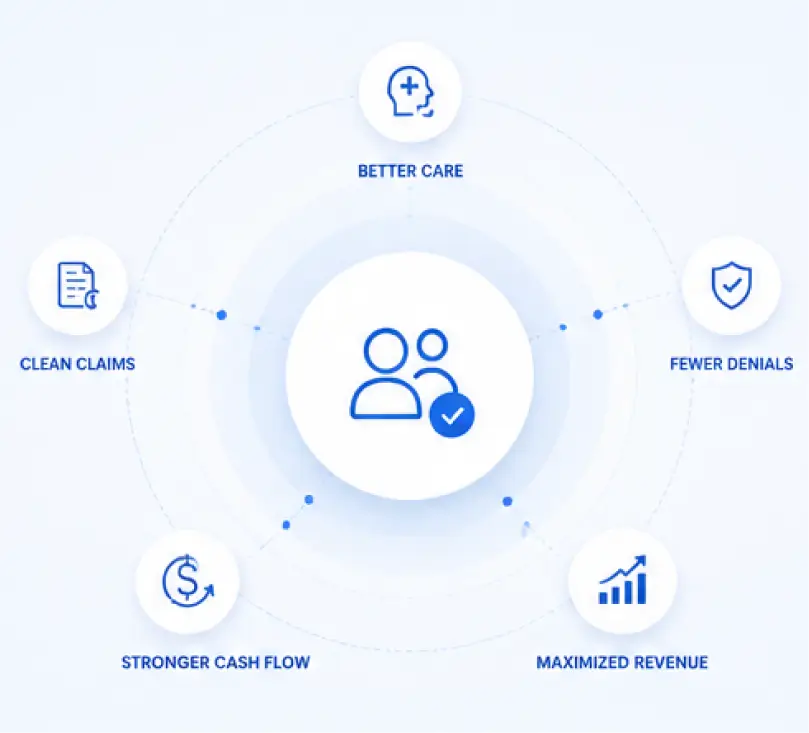

BH Rev runs substance use disorder billing with one named team handling credentialing and payer enrollment, verification of benefits, prior and concurrent authorizations, coding, claim scrubbing and submission, denial management and appeals, A/R follow-up, and patient billing, end to end on its own behavioral health platform. One team owning the whole cycle means no handoffs between vendors where claims fall through, no single point of failure when a biller leaves, and one set of numbers everyone answers to.
That accountability is visible, not promised. Every claim, denial, and outstanding dollar can be watched live, and a monthly executive scorecard puts collections, denial trends, and A/R aging in one place across every program and location. Most billing relationships run on a monthly report you cannot question. This one runs in the open, whether we handle your full revenue cycle or a single service, and we staff to your volume as your census grows.