
We handle insurance billing for practices that deliver therapy, from paneling and eligibility through claims, denials, and collections, on a platform built only for behavioral health. Take the whole revenue cycle off your plate, or just the part that keeps coming back denied.
We bill the full range of outpatient behavioral health work: individual, group, and family psychotherapy, intake and diagnostic evaluations, and telehealth visits. That means the session-length codes, the group codes, add-ons like interactive complexity, and the telehealth place-of-service and modifier rules are all handled the way each payer wants them, so the claim goes out clean the first time instead of coming back for a coding fix.
You keep all of it, and usually gain some. You get more visibility than most practices ever had in-house. Every claim and outstanding dollar shows on the platform, you get a monthly scorecard you can actually read, and you work with a real team you can reach by name instead of a call center. You stay in charge of the decisions; we do the work and keep it all in front of you.
Both setups are fine. Some practices turn over the entire billing cycle and skip hiring a biller at all. Others keep the biller they have and add us only where the backlog is worst, often credentialing, denials, or aged accounts. We work around the setup you already run instead of making you change it.
In behavioral health it is usually the details a general biller misses: a session that ran past its authorized frequency, a telehealth visit coded with the wrong place of service, coordination of benefits that was never checked, or a lapsed payer credential. Because we work only in behavioral health, we catch those before the claim goes out, and when denials do land we work them and appeal them instead of writing them off. The free billing audit is where we usually start, because it shows exactly where the denials are coming from.
Yes. Credentialing and payer enrollment are part of what we do: CAQH setup, commercial and Medicaid applications, and keeping re-credentialing on a calendar so those deadlines don't slip and cost a therapist their panel status or billable time. It is one of the services practices most often hand us first, and it fits whether you want full billing or just help getting paneled.
Therapy billing services are how a practice hands its insurance work to an outside team instead of carrying it in-house. With BH Rev that team is behavioral health only, so the session, frequency, and telehealth rules a general medical biller tends to miss are set correctly before a claim is submitted. The engagement can be as complete or as narrow as a practice needs. A full engagement covers paneling and payer enrollment, benefit and eligibility checks, coding for individual, group, family, and telehealth sessions, claim scrubbing and submission, denial management and appeals, aged accounts receivable, and patient statements. A narrower engagement might be just credentialing, or just the denials that keep coming back, with the practice’s own biller keeping the rest.
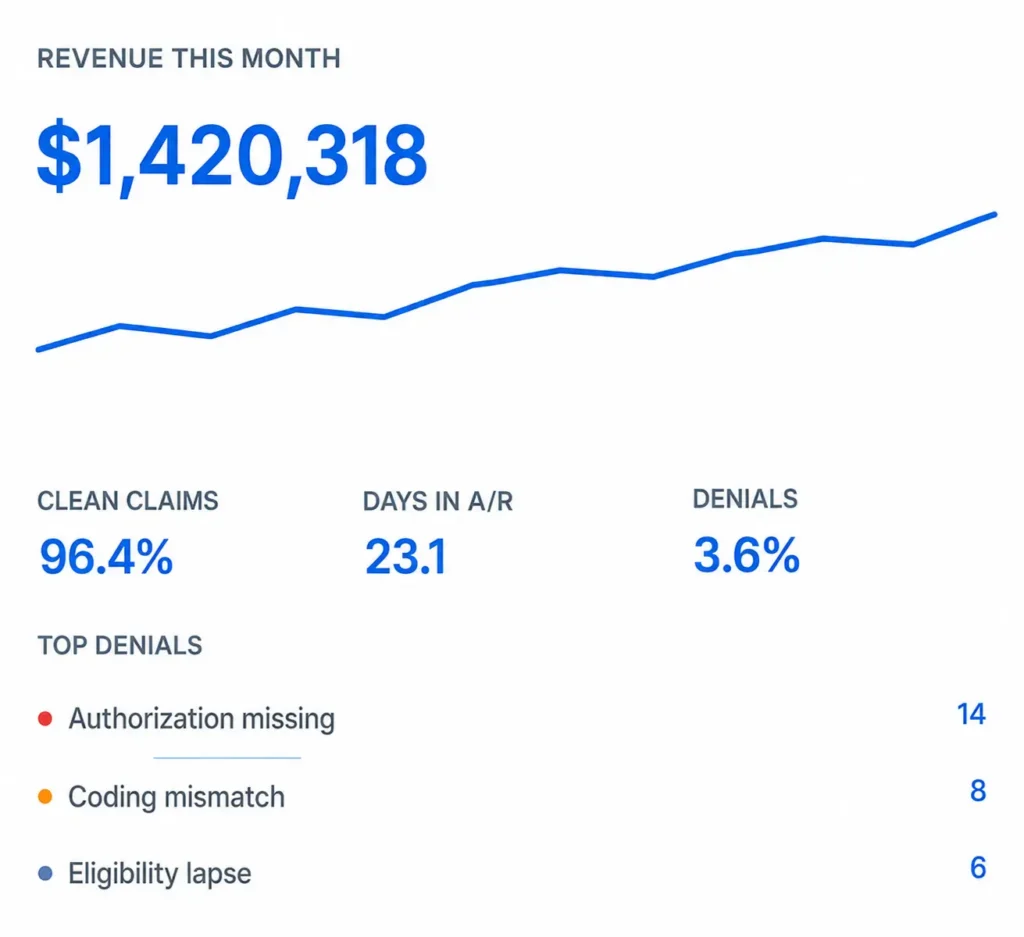
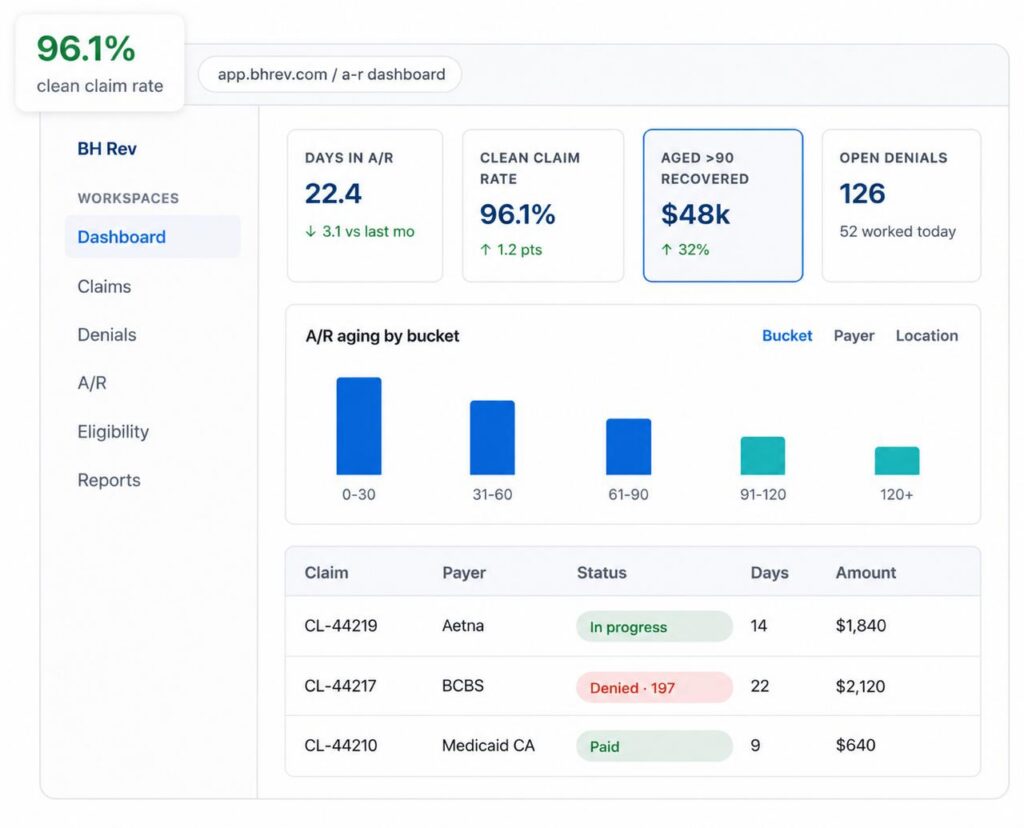
BH Rev bills only behavioral health, and therapy claims turn on details a general medical biller rarely handles. Psychotherapy is billed in timed units, so the code has to match how long the session actually ran and what the note supports; group and family sessions use their own codes; add-ons like interactive complexity apply only in specific cases; and a telehealth visit needs the right place of service and modifier for each payer. Many plans also cap covered sessions in a period and expect coordination of benefits to be settled up front, and parity rules govern how behavioral health has to be covered at all. Our billers work these rules every day, so a claim gets set up the way the payer will read it instead of going out and coming back for a coding correction.
A therapy practice usually loses revenue to insurance through a series of small denials it never traces back to a cause. Sessions that run past a plan’s authorized frequency get denied, and telehealth visits go out under the wrong place-of-service code and bounce. If coordination of benefits was never confirmed at intake, the primary payer sends the claim back. And when a therapist’s credential lapses, weeks of that clinician’s sessions cannot be billed at all. Because none of these looks like a crisis on its own, a practice can go months without spotting why its deposits keep shrinking. The free billing audit is where BH Rev starts: a structured review of your billing, denials, and aging accounts receivable that shows where the revenue is going and how much of it is still recoverable. BH Rev works the aged claims and active denials first, because that is where most of the recoverable revenue is.


Practices consolidate their billing with BH Rev for accountability: one named behavioral health team owns the entire cycle, so work does not get dropped in the handoffs between the separate vendors many practices use for enrollment, coding, and collections. Nothing stalls because the one person who understood your payers is out, and there is one set of numbers on a monthly scorecard rather than reports from several systems that do not reconcile. That team runs on BH Rev’s own behavioral health platform, and a practice that would rather keep billing in-house can run the same scrubbing rules and denial playbooks in the BH Rev software instead.