
Our team runs the billing for your partial hospitalization program on a platform built for behavioral health. Bring us everything from enrollment through the final collected dollar, or point us at the one spot that is bleeding, whether that is stuck authorizations, denied days, or claims aging out.
Why PHP Operators Trust Us With Their Billing
Everything a partial hospitalization program needs to get paid, run by one team and shown on one scorecard. Take all of it, or begin with the single process that is hurting you most.
Start wherever gets you an answer quickest: run a free billing audit, book a quick call with the team, or grab our pricing and packages guide.
You will talk through your programs, your payer mix, and your monthly volume directly with the billers who would own the account, and you walk away knowing exactly what we would take on and how the switch would happen for a program like yours.
We move the work over in stages, so your claims keep moving while the handoff happens. Your monthly scorecard reporting is set up from the start.
The decisions stay yours; what changes is how much you can see. Every call on your billing is still yours to make, while our named billers run it day to day and keep all of it in front of you: a scorecard each month, dashboards that show where each claim, authorization, and open dollar stands, and people you can reach by name rather than a queue. Most programs end up with more visibility into their PHP revenue than they had running it in-house.
We do, and we handle it as core billing work from day one. Before a client starts, we confirm benefits and lock in the prior authorization; while they are in the program, we hold the approved days against the treatment plan and get ahead of every concurrent and utilization review so we work to keep an approval from lapsing mid-stay. When a payer pushes back on medical necessity, the paperwork that supports the stay is ready.
Yes. A partial hospitalization per-diem does not behave like a standard outpatient claim, and it shifts again from payer to payer. The per-diem terms, the level-of-care rules, how telehealth sessions are coded, and how benefits coordinate across plans all change what counts as a clean claim. Behavioral health is all we bill, so we already work in those rules every day.
It usually moves fast, because the first place we look is the money already stuck: your open denials and your oldest receivables, where a PHP's high day-rate means even a short backlog is a large number. The free billing audit shows us which claims to chase first, and we work those before we phase in the ongoing cycle, so your live claims keep moving through the transition.
Yes, on both. If you want to keep your billers, we slot in only where you need us and leave the rest with your team; if you want us to run all of it, we do. Either way we operate in the systems your program already uses to chart and bill, and the BH Rev platform links up with the partner EHRs you already run, so we make sure everything lines up with your setup before a single claim moves.
PHP billing services handle the full revenue cycle for a partial hospitalization program: credentialing and payer enrollment, verification of benefits, prior authorization, CPT and ICD-10 coding, claim scrubbing and submission, denial management and appeals, aged A/R follow-up, patient billing, and monthly reporting. BH Rev runs all of it as one team on its own behavioral health platform, so a program can hand over the whole cycle or keep its staff and add only the parts it needs.
Partial hospitalization does not bill the same way as intensive outpatient, though the two are often grouped together. A PHP day requires more treatment hours and stronger documented medical necessity than an IOP day, it carries its own per-diem and authorization requirements, and payers scrutinize it more closely because it is a more intensive level of care. A biller who works across many specialties tends to process both as routine outpatient claims, and PHP days get underpaid or denied as a result. A behavioral-health-only team already knows the coding, the payer expectations, and the appeal language for each level of care, so those PHP days are billed correctly the first time.
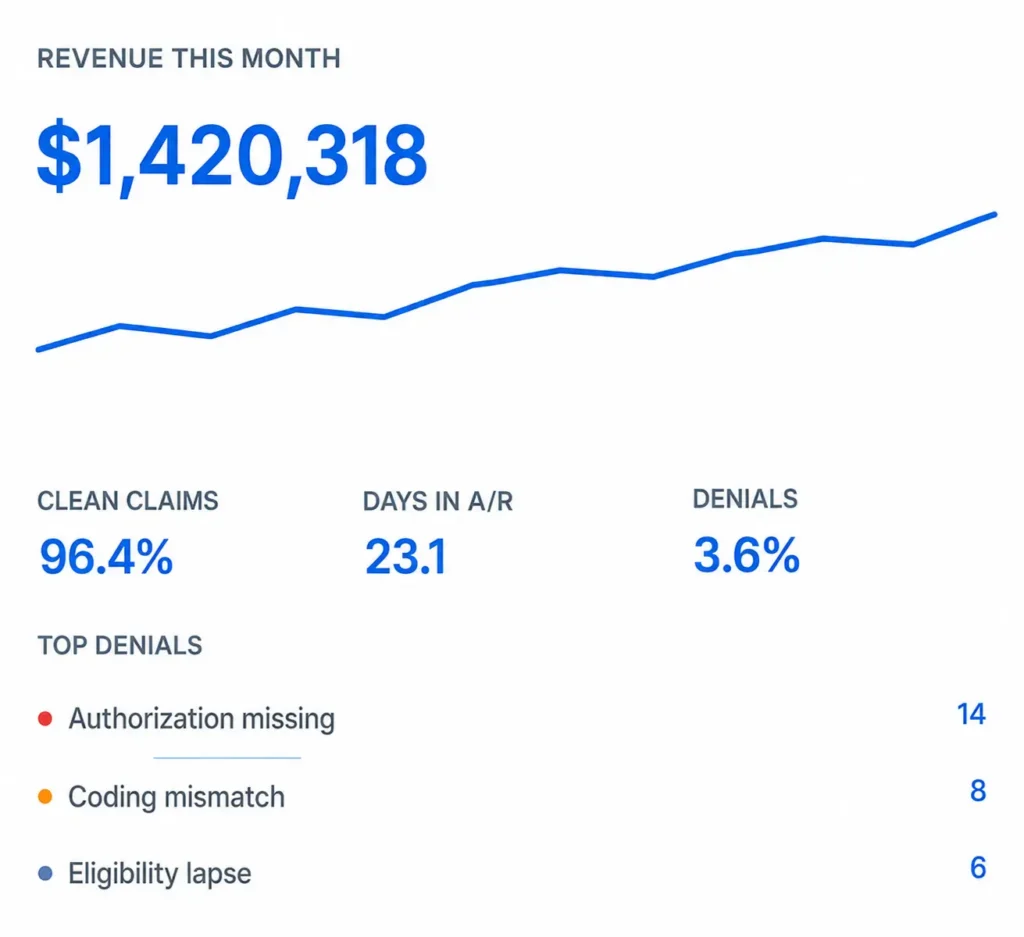
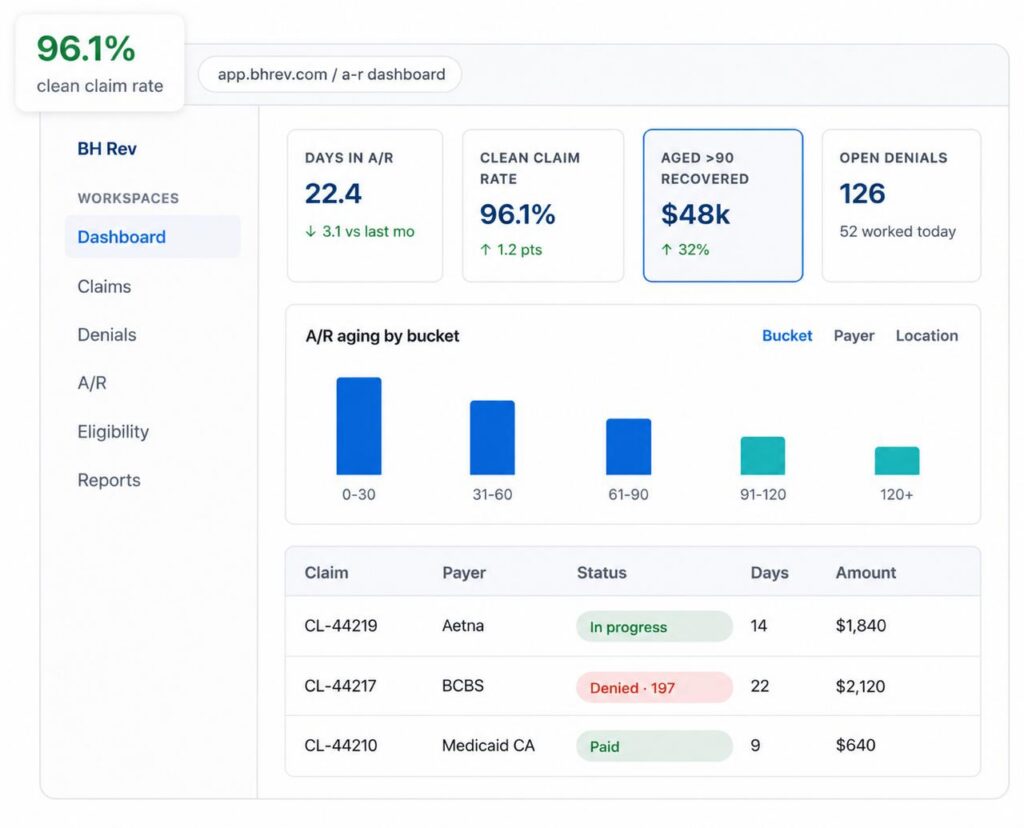
When a partial hospitalization program is full but its collections keep dropping, the money is usually leaking in the authorization and level-of-care details that a general biller does not watch. A concurrent review shortens an approved stay partway through and the reduction is never appealed. A client moves from residential into PHP, or from PHP into IOP, and the authorization is never re-verified for the new level of care. A high-dollar PHP per-diem claim sits in an aging bucket until it passes timely filing. Each of these is small on its own, which is why a program rarely spots them from the inside.
A behavioral-health-only team catches these because it is looking for them. At BH Rev the same named team works the program’s whole cycle and keeps every claim and every authorization on one platform, so a trimmed authorization or a lapsed re-auth surfaces while there is still time to appeal or refile. Because that team bills the client across residential, PHP, and IOP, the authorization moves with the level of care instead of breaking at each transition. A program can hand over the full cycle or start with only the denials and aged A/R that are costing it the most.
For a partial hospitalization program, payment depends heavily on authorization, and the authorization is not a single event. Before treatment starts, the program verifies benefits and secures prior authorization for PHP, which most commercial payers require before they will cover the level of care. During treatment, the payer runs concurrent review at set intervals to decide whether continued PHP is still justified, and those reviews come around more often for PHP than for a lower level of care because the payer is approving a more intensive and more costly program.
Each review turns on the clinical documentation. If the notes do not clearly show that the client still meets PHP medical-necessity criteria, the payer can cut or deny the remaining days, sometimes for care that has already been provided. Billing that is built for this verifies benefits and authorization before the first day goes out, tracks approved days against the treatment plan, and prepares for each concurrent review ahead of its deadline so coverage does not lapse in between. It also watches the session-frequency and utilization limits that change what a clean PHP claim looks like from one week to the next. When the authorization and the documentation stay in step with the level of care, the program loses fewer days to denials and spends less time on appeals.
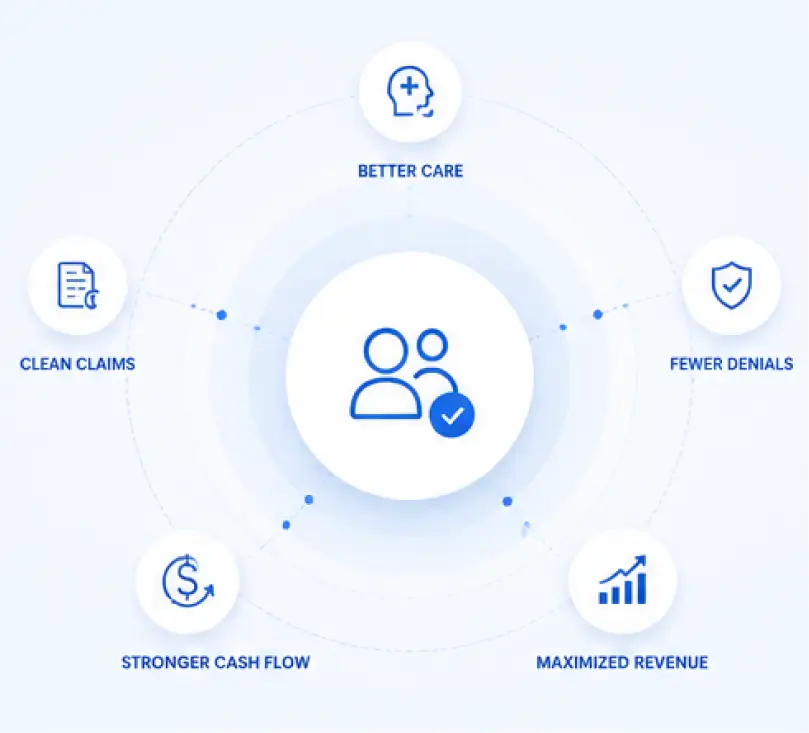

BH Rev runs PHP billing as one named team that owns every stage of the cycle: credentialing and payer enrollment, verification of benefits, prior authorization, coding, claim scrubbing and submission, denial management and appeals, A/R follow-up, and patient billing. Most programs instead juggle a credentialing service in one place, a billing service in another, and a collections vendor somewhere else, and a claim can drop at any handoff between them with no one able to account for the full number.
Keeping the work under one team keeps it connected. A program’s authorization status, denials, aged A/R, and KPIs sit on a single monthly scorecard and live dashboards, so the people running the program can check where revenue stands without pulling numbers from several vendors. Because the same team bills every level of care, the billing follows a client from residential into PHP and from PHP into IOP or outpatient without dropping the authorization at each step. A program can use this for its entire revenue cycle or for its partial hospitalization billing alone.