
A billing team that works only in behavioral health takes over the claim work for your residential program, from verification and coding through submission, denials, and aged A/R follow-up, on a platform built for how residential care is actually paid. You set the scope: some residential programs move their whole billing operation to us, while others keep their team and hand off only the one function that has gotten away from them.
You do not, and in practice outsourcing the billing tends to tighten your grip on it rather than loosen it. Nothing about how your program runs moves out of your hands. What leaves your plate is the daily billing work, while the full picture stays in front of you: billers who pick up when you call, the dashboards where each residential claim and pending authorization shows where it stands, and a monthly scorecard that reports the figures you run the program by. We handle the billing, and none of it happens somewhere you cannot see.
On the billing side, an authorization is a live document, not a one-time checkbox. Before admission we confirm the benefits and get the initial authorization on file, then our billers stay on the continued-stay and concurrent reviews as they come up during the stay, matching each one to what the treatment plan documents. If a payer downgrades the level of care or denies days, that goes to our behavioral health appeal process as claim-level work. Keeping the authorization current is how residential denials are prevented before they happen in the first place.
We can move on it quickly, and it is where we tend to begin. The dollars still within reach on a residential program are mostly tied up in claims that have aged out and denials no one has circled back to, often sizeable because per-diem stays add up. Once the free billing audit shows us which of those are live, we go after them ahead of everything else, then phase the rest of the billing in behind that, so the cash already owed to you keeps landing while the change is underway.
The difference is who operates the platform, not what the platform does. With BH Rev Software, the keyboard stays with your team: they work the live A/R dashboards, the denial workflows, the behavioral-health scrubbing rules, and real-time eligibility, and run the residential billing themselves. With BH Rev Services, our billers take that seat and own the residential cycle end to end, handling authorizations, denials, and A/R along with the credentialing and intake behind them, and answering to the KPIs you set. Underneath either choice it is the same behavioral health platform, wired into the EHR you already use rather than swapping it out, and a program can run the software now and bring in the service later, or do it the other way around.
Yes. Plenty of programs keep the billers they have and use us only for the parts of the claim work they have fallen behind on, whether that is the appeals backlog, the aging report, or the authorization tracking. Others hand the whole claim operation over. We slot into however your billing is set up now, and put more billers on as your census grows.
Residential treatment billing services are the outsourced billing operation for a residential or detox program, covering credentialing and payer enrollment, verification of benefits, prior authorization, coding, claim scrubbing and submission, denial management, aged A/R recovery, and patient billing. A residential day is not billed like an office visit. It is billed as a per diem on a UB-04 institutional claim, and the per-diem and revenue codes have to match the documented level of care, for example the residential codes H0018 and H0019, which are set against the ASAM Criteria at Level 3, or Level 3.7 for medically monitored withdrawal management, with room and board often carved out from the clinical portion of the claim. BH Rev’s billers work behavioral health claims only, so those level-of-care rules are already part of their daily work. Residential billing is usually treated as a separate discipline from outpatient claim work.
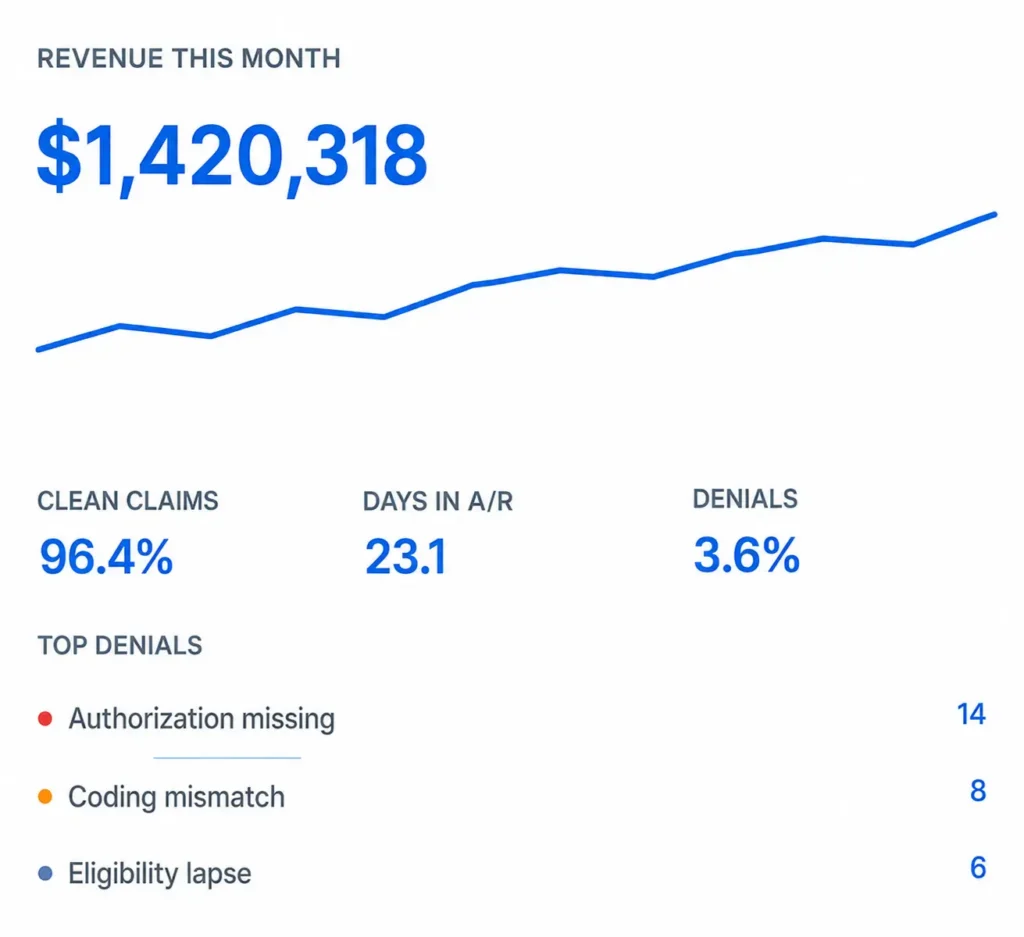
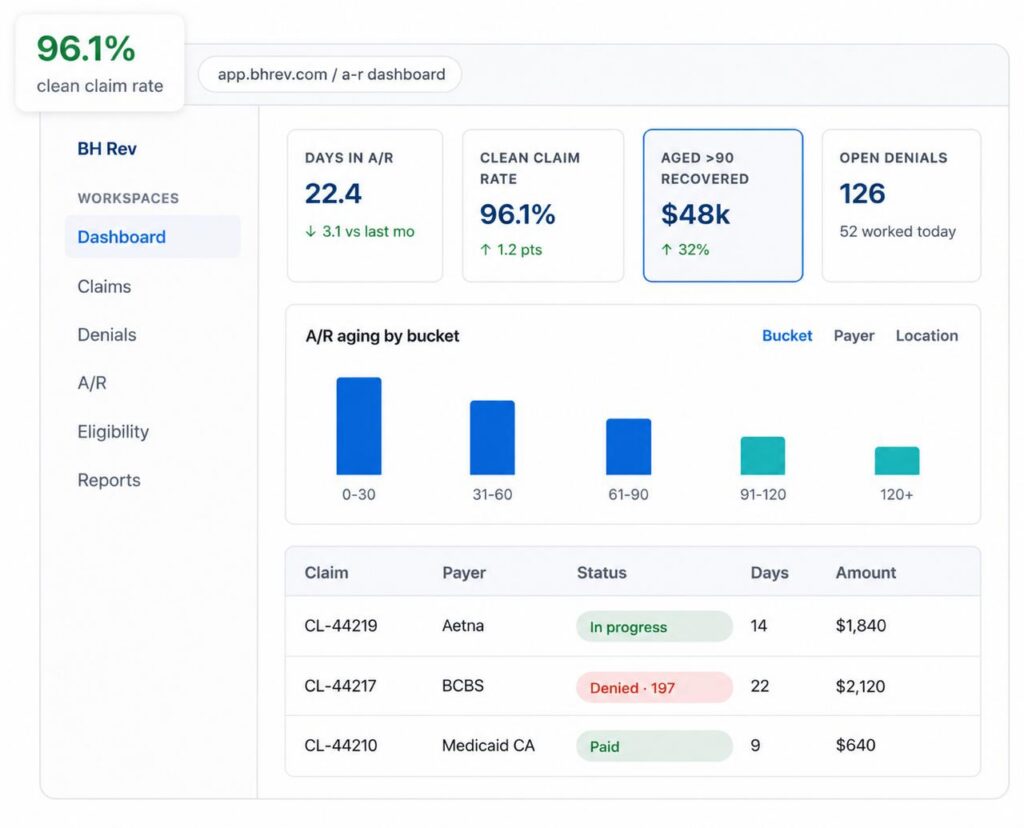
On a residential claim, the authorization matters as much as the coding, and it has to stay current the whole time the client is in care. Payers review the stay concurrently against published criteria such as the ASAM Criteria, so a single continued-stay review can downgrade the level of care or stop approving days while the client is still in treatment. BH Rev bills behavioral health only, so tracking each concurrent and continued-stay review against the treatment plan is part of the daily billing work, and each open authorization, with its current status, stays visible to the program on BH Rev’s platform. Appealing a level-of-care downgrade means arguing it against the payer’s medical necessity criteria and, where a plan limits behavioral health more tightly than medical and surgical care, the parity protections of the federal Mental Health Parity and Addiction Equity Act. A lapsed authorization or a missed continued-stay review can turn already-delivered days into a denied or downgraded claim, billed back weeks after the care was given, with the per-diem days at stake adding up to a high-dollar amount.
Billing a residential program means following the client through every level of care, because a client in residential rarely stays at one level and each move is a new authorization. BH Rev bills all of those levels for a program on one behavioral health platform, so the same team stays on the claim as the client moves between them. Many clients start in detox, move into residential, then step down to a partial hospitalization program, an intensive outpatient program, and standard outpatient, and a re-authorization that arrives late or not at all at one of those step-downs can turn a payable claim into a write-off. Payer type adds to the work, because commercial plans, state Medicaid programs, and Medicare each apply their own authorization and documentation rules to the behavioral health levels of care they cover, and out-of-network stays often run on single case agreements negotiated one at a time. Those transitions between levels are one of the most common points where a residential claim is lost.

The first thing worth checking in a residential billing partner is whether they work in behavioral health at all, because residential billing carries obligations general medical billing does not. Two of those are the HIPAA and 42 CFR Part 2 rules that govern the confidentiality of substance use treatment records, which a biller outside the field rarely handles daily. It is also worth asking whether you can see the numbers yourself, since a program should be able to read its own days in accounts receivable, net collection rate, clean claim rate, and denial rate at any time, not only in a monthly report. BH Rev bills residential claims from credentialing through collections as one team on its own behavioral health platform, which connects to a program’s existing EHR instead of replacing it. On takeover, the aged A/R and open denials sitting on high-dollar per-diem claims are usually where the recoverable revenue is, so where a biller chooses to start is worth knowing before any claims change hands.