
Detox revenue is unforgiving: short stays, per-diems the payer re-checks mid-detox, and no room for a slow claim. We run all of it on a behavioral health platform we built, whether that means the entire cycle, enrollment to collections, or only the stretch that keeps leaking.
No. You keep every clinical and admissions decision; we run the billing behind it. You get a named team you can reach, live dashboards for A/R, denials, and payer activity, and a monthly scorecard, so at any point you can see exactly where a claim or an authorization stands. Outsourcing the work does not mean losing sight of it.
Both work. Some detox programs hand the whole operation over and step away from billing for good. Others keep their existing staff and pass us only what has jammed up: a backlog of denials, receivables that have quietly aged past anyone's reach, or authorizations stuck in review. And since we size the team to your census as it rises and falls, you are never short-staffed during a surge or paying for empty seats when things are quiet.
Detox is billed in per-diems against authorizations the payer keeps reviewing while your client is still in withdrawal, so the work is day to day, not one and done. We verify benefits before or at admission, secure the initial authorization, and track each continued-stay window so re-authorizations go in on time with the current withdrawal picture documented. When a client steps down to residential, PHP, or IOP, we code the transition to the right date and level of care, since a mis-timed transition is one of the most common reasons a detox claim denies.
We take over in phases, built to keep claims and authorizations moving while the work shifts to us. We start with your aged buckets and active denials, because that is where recoverable revenue is sitting, and your monthly scorecard starts in month one. The Free Billing Audit is the fastest way to see what is recoverable before you commit to anything.
No. Our behavioral health platform connects to partner EHRs rather than replacing them, so we work with the system your clinical team already uses. We are a billing and revenue cycle team, not an EHR, and we plug into yours.
Detox billing services are revenue cycle management for medical detox and withdrawal management programs: the work of getting a detox stay verified, authorized, coded, submitted, and collected, from benefits checked before admission through denials, appeals, and aged A/R. The setting decides how the stay is billed, so these services span medically managed and medically monitored inpatient withdrawal (ASAM 4.0 and 3.7-WM), residential and subacute withdrawal management, and ambulatory detox (2-WM and 1-WM), and they carry the claim through when the client steps down into residential, PHP, or IOP care. BH Rev provides these services for detox programs on its own behavioral health platform, either as the full revenue cycle or as the single piece a program most needs handled, so credentialing, verification, coding, submission, denial work, and collections all answer to one team.
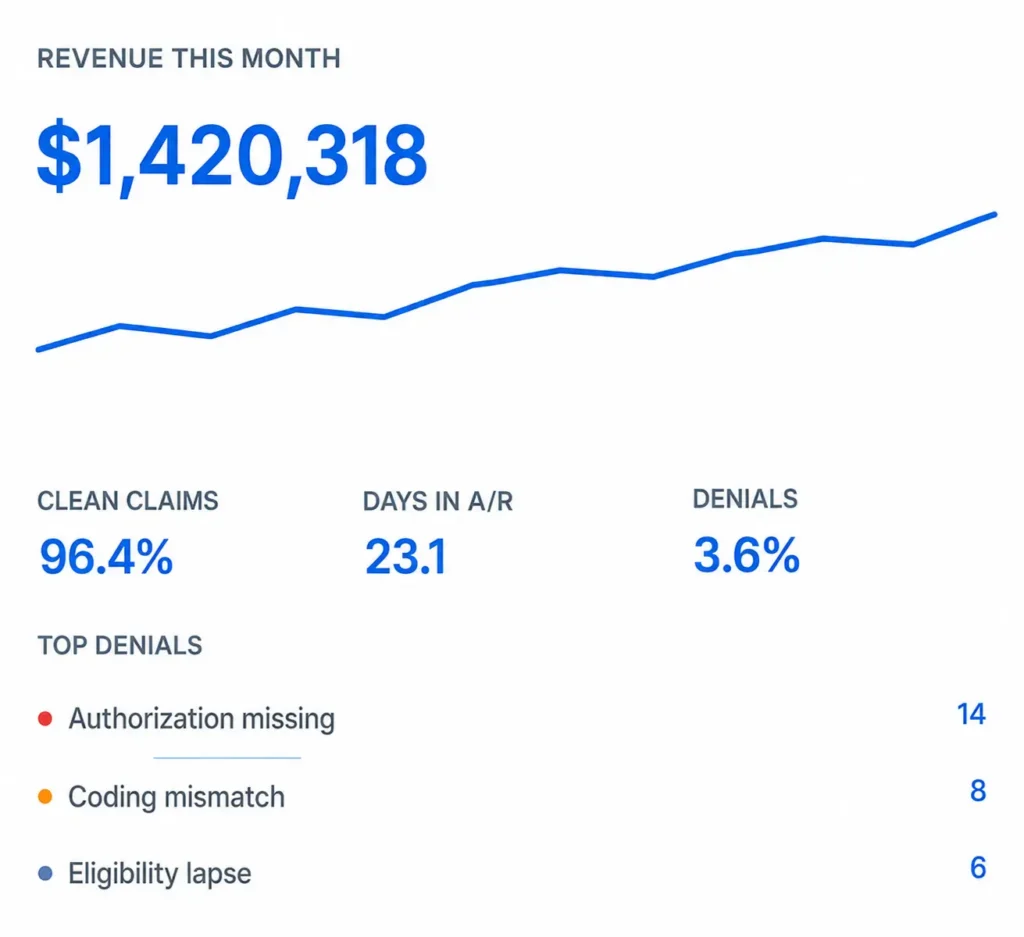
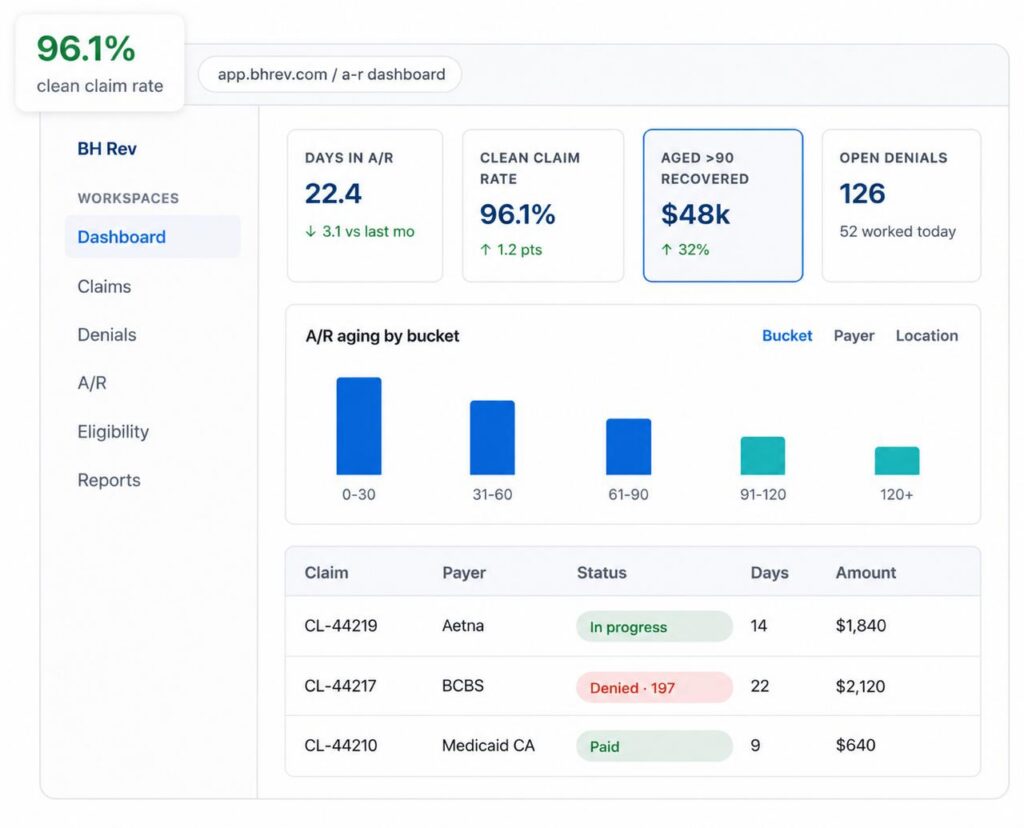
Inpatient detox is usually paid as a per-diem or bundled rate rather than fee-for-service, and the payer keeps reviewing that authorization while the client is still in withdrawal. A clean detox claim starts with verification of benefits before or at admission, since detox admissions are often urgent and after-hours, moves to an initial authorization, and then runs on continued-stay (concurrent) reviews that weigh medical necessity against ASAM criteria and can cut an approved stay short mid-treatment. BH Rev’s named, behavioral-health-only team secures the initial authorization and then owns each continued-stay window, filing re-authorizations on time with the client’s current withdrawal picture documented rather than the picture at intake. When a payer challenges medical necessity or argues for a lower level of care, that same team assembles the records, holds the timely-filing deadlines, and coordinates the peer-to-peer review through the appeal.
A single detox stay usually produces two claims that have to agree: an institutional per-diem claim for the facility (UB-04 / 837I) and a professional claim for physician oversight (CMS-1500 / 837P). Because the coders are behavioral-health-only, both are built to the same level of care and submitted together, so the facility and physician sides do not contradict each other and trigger a review, and the diagnoses across F10 through F19 carry the right withdrawal specifiers. Toxicology gets extra attention, so urine drug screening is coded to the definitive-versus-presumptive and unit-limit rules that most often send those charges to denial. The highest-risk moment is the handoff between levels of care: when a client steps from detox down to residential, PHP, or IOP, a mis-timed transition date or a level-of-care code that does not match the authorization is one of the most common ways a detox claim denies, so BH Rev codes that transition to the right date and level. When a claim denies anyway, for a missed concurrent review, exhausted days, or thin records, it is worked through first-level, second-level, and external appeals rather than written off.

Detox billing has to satisfy rules that reach beyond ordinary medical claims: HIPAA, the added confidentiality of 42 CFR Part 2 for substance use records, mental health parity under MHPAEA, and the No Surprises Act, all under the real threat of payer audits, clawbacks, and special-investigation review. One behavioral-health-only team runs the whole cycle, credentialing and payer enrollment through coding, submission, denials, and collections, on the behavioral health platform BH Rev built, which connects to the partner EHR a clinical team already uses instead of replacing it. A monthly scorecard and live dashboards keep the program able to see where any claim or authorization stands. When the goal is to move a program in network, that begins with credentialing and payer enrollment, and a free billing audit of aged claims and denials is the fastest way to see what is still recoverable.