
Our billing team runs your entire revenue cycle on a platform built for behavioral health. Take the full service from credentialing through collections, or hand off only the piece that is costing you the most right now.
No. You gain visibility most in-house setups never had. You get a named team you know by name, live dashboards showing every claim and dollar outstanding, and a monthly executive scorecard. You stay in charge of the decisions; we do the work and show you everything.
Whichever your situation calls for. Some organizations hand us the entire revenue cycle; others keep their team and plug us in for the pieces that are drowning them: credentialing, denials, or aged A/R. We fit the operating model you want.
BH Rev Software is a behavioral-health-specific billing platform your own team runs: real-time eligibility, claim scrubbing, denial workflows, and live A/R dashboards, so you keep billing in-house with better tools. BH Rev Services is our team running the entire revenue cycle for you, from credentialing and intake through billing, denials, and A/R, accountable to your monthly KPIs. Both run on the same BH-built platform, and many practices start with one and add the other.
Quickly. Denials and aged A/R are usually where we start, because that's where recoverable revenue is sitting. After a billing audit we prioritize your aged buckets and active denials first, then take over the day-to-day cycle in phases so nothing falls through mid-transition.
In most cases, yes. We work inside the EHR and billing platforms behavioral health providers already use, and our platform connects to partner EHRs. On your billing audit call we'll confirm fit with your specific setup.
Behavioral health billing services run the full revenue cycle for treatment providers so the clinical team can stay focused on care. In practice that means credentialing and payer enrollment, verification of benefits, prior authorization, CPT and ICD-10 coding, claim scrubbing and submission, denial management and appeals, aged A/R follow-up, patient billing, and the monthly reporting that shows where every dollar sits. The list looks the same on paper for any biller. What sets behavioral health billing services apart is everything that has to happen before a claim ever leaves the building.
Behavioral health has its own rules, and the money leaks in the details a general medical biller rarely sees. Session caps get checked at intake, authorization requirements get tracked against the treatment plan, and level-of-care coding gets validated against the program actually delivering the care. A biller who splits time across twenty specialties does not carry those rules in their head, so denials a specialist would have caught early quietly pile up. Choosing a team that only works in behavioral health means the payer rules, the denial patterns, and the appeal language are already familiar, not learned on your claims.
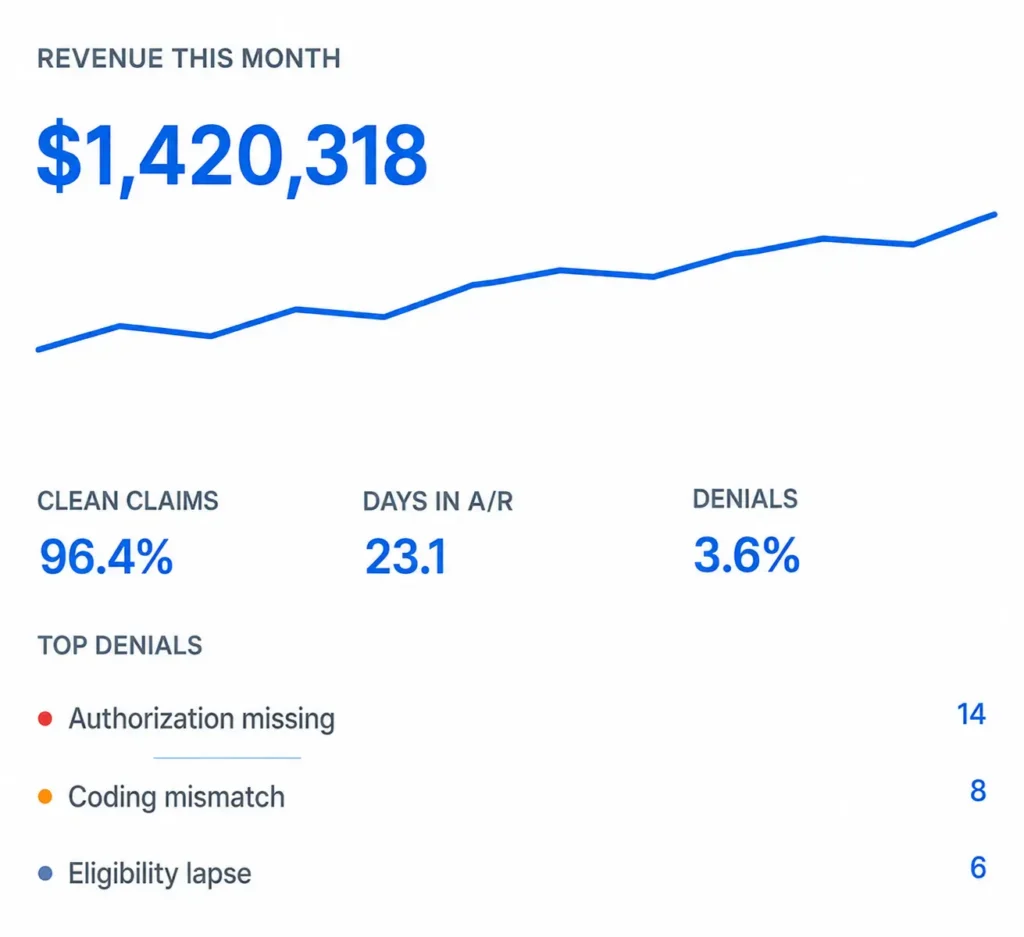
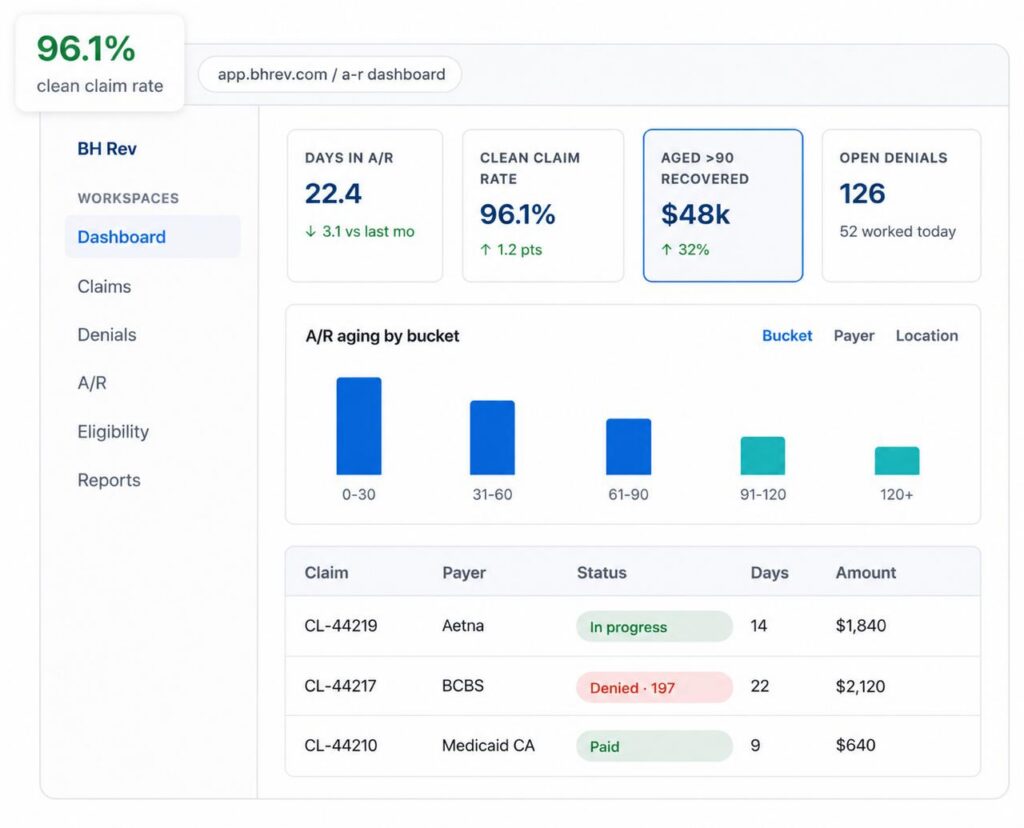
It is one of the most common reasons a practice starts looking for new billing services. The beds are full, the clinicians are delivering, and the deposits keep shrinking anyway. Nobody can point to a single break. The billing person says claims are going out, the reports say revenue is down, and every month the gap between the care delivered and the money collected widens while everyone works harder.
The reason it is so hard to fix from the inside is that the loss is rarely one big failure. It is a stack of small ones: a denial that never got appealed, an authorization that lapsed, a claim that missed timely filing, an aging bucket nobody has touched in weeks. From your seat it is nearly impossible to tell which is costing you the most. That is exactly what a billing audit is for. A structured look at your denials, your aged A/R, and your authorization process usually surfaces where the revenue is leaking and how much of it is still recoverable. See the findings first, then decide what to do about them.
Behavioral health is not one billing problem, it is several stacked on top of each other. Detox and residential providers bill per-diems against authorizations that payers review while treatment is still happening, so a single concurrent review can cut approved days mid-stay. PHP and IOP programs live on session-frequency and utilization limits that change what a clean claim looks like from one week to the next. Outpatient runs on volume, with recurring sessions, telehealth place-of-service codes, and coordination of benefits at scale. Each level of care is its own discipline, and a large share of behavioral health denials trace back to the transitions between them.
That is where behavioral health billing services earn their keep. A team that only works in this space already knows which payers scrutinize which levels of care and where claims tend to stall, so the work follows the client cleanly as they step up or down in care. We bill across every level on one behavioral health platform and keep the whole picture on a single monthly scorecard, so nothing gets lost when a client moves between programs or a new service line comes online.
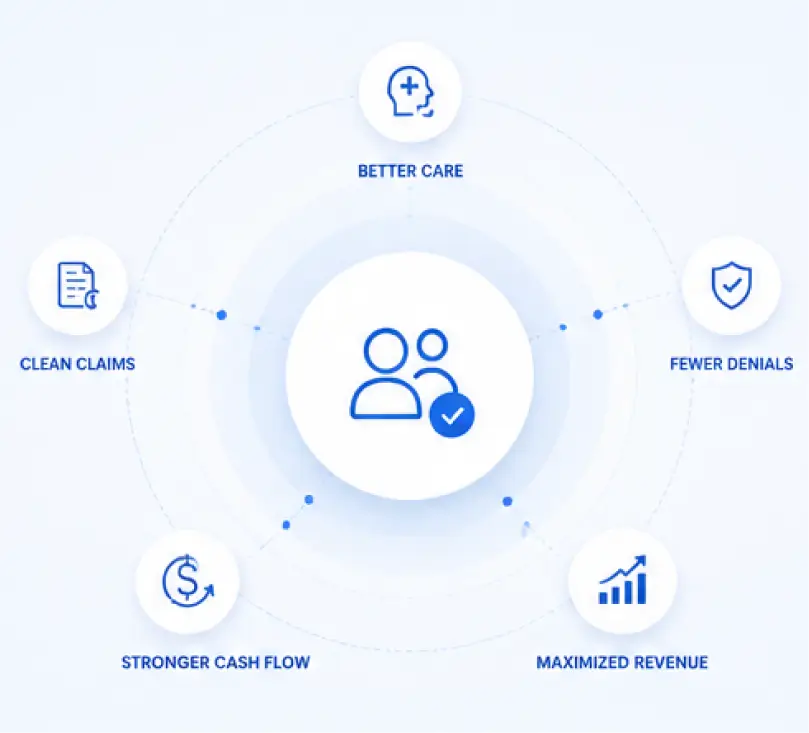

The alternative to one accountable team is vendor sprawl: a credentialing service in one place, a billing service in another, a collections vendor somewhere else, and no one who owns the result. Every handoff is a place for a claim to fall through, and when a number looks wrong there is nobody who can answer for the whole picture. BH Rev delivers behavioral health billing services as one named team running credentialing and payer enrollment, verification of benefits, prior authorization, coding, claim scrubbing and submission, denial management and appeals, A/R follow-up, and patient billing, end to end on its own behavioral health platform.
That accountability is visible, not promised. Your enrollment status, your denials, your aged A/R, and your KPIs stay in the open on a monthly executive scorecard and live dashboards instead of living in one person’s inbox. Whether we run your entire revenue cycle or a single service, you always know where your revenue stands, and we staff to your volume as you add programs, providers, and locations. The simplest way to see the difference is to let us look at your billing first.