
We run your entire revenue cycle on our own behavioral health platform, credentialing through collections, and put the numbers in front of you every month. Take the whole cycle, or hand off the one service that is costing you the most right now.
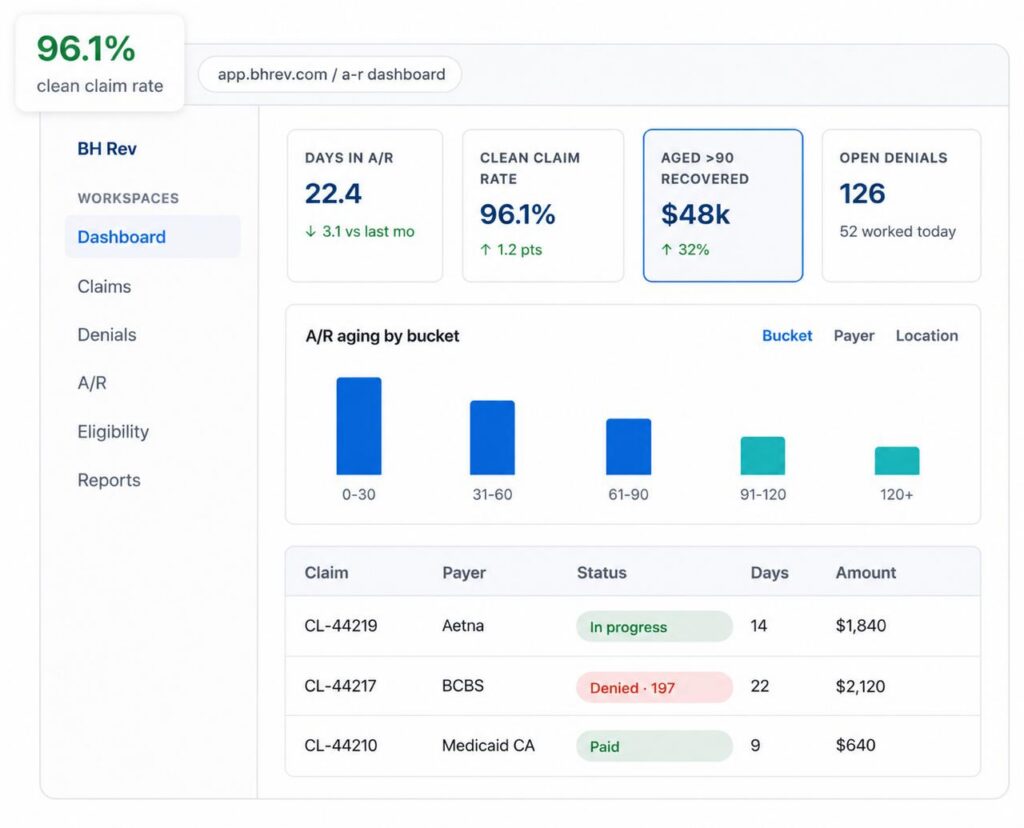
You keep it. Every decision on your revenue cycle stays yours; what changes is how much you can see. Instead of a black box, you get a named team you can reach, dashboards that show each claim and outstanding dollar as it moves, and a monthly executive scorecard. Handing off the work isn't handing off the visibility, and most programs end up seeing more than they did in-house.
Both models work. If you'd rather not run a billing operation at all, we take the entire cycle end to end. If you have people you want to keep, we slot in around them and own only the stages that keep backing up: credentialing, denials, or aging A/R. You decide how much of the cycle stays in-house, and we build the engagement around that.
The split is who operates the cycle. With BH Rev Services, our team runs the whole revenue cycle for you, from credentialing and intake through coding, denials, and A/R, answering to your monthly KPIs. BH Rev Software is the same behavioral-health platform, but your own team drives it: real-time eligibility, claim scrubbing, denial workflows, and live A/R dashboards. It's one system underneath, so plenty of programs begin on one side and add the other later.
Fast, because that's the first place the money is. A free billing audit maps your open denials and aged A/R, and we go straight at those buckets before anything else, since recoverable dollars don't wait well. The rest of the cycle transitions in stages after that, so the day-to-day keeps running and nothing sits unworked during the handover.
Usually. Your team keeps the EHR it already runs on: we work inside the systems behavioral health programs use day to day, and our own platform connects to partner EHRs rather than replacing them. Where a setup is unusual, the billing audit call is where we confirm the fit.
Behavioral health revenue cycle management is the whole financial cycle of a treatment program, run as one connected system instead of a string of disconnected tasks. It starts before a single claim is billed, with credentialing and payer enrollment, and it does not end until the last recoverable dollar is collected and reported. In between sits verification of benefits, prior authorization, CPT and ICD-10 coding, behavioral-health-specific claim scrubbing, submission, denial management and appeals, A/R follow-up, patient billing, and the monthly reporting that tells you whether any of it is working.
What makes behavioral health RCM its own discipline is everything that has to happen before the claim leaves. Session caps get checked at intake, authorization requirements get tracked against the treatment plan, and level-of-care coding gets validated for the program actually delivering care. A general medical biller manages a cycle built for office visits and procedures. A behavioral health revenue cycle runs on episodes of care, concurrent reviews, and payer rules that change by level, and it breaks in different places. Managing it well means owning those front-end checks as deliberately as the back-end collections, because in behavioral health the two are the same story told sixty days apart.
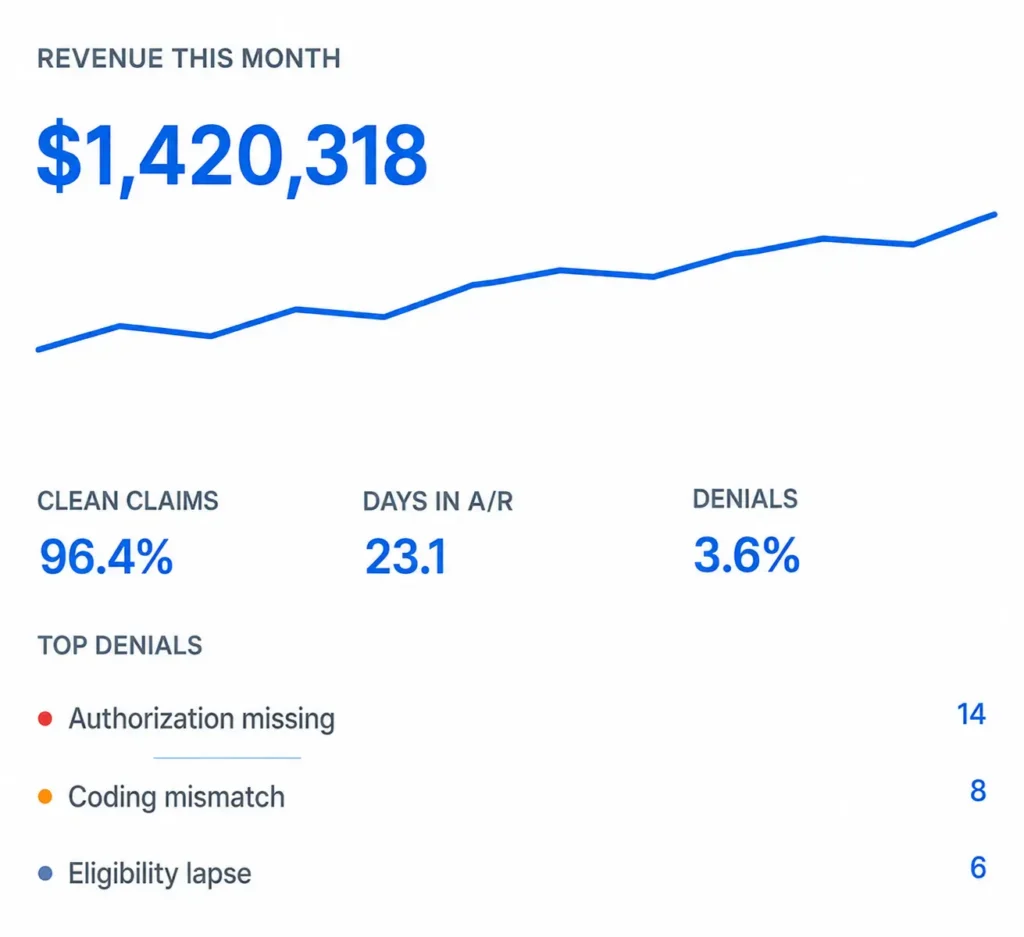
The hardest revenue problem in behavioral health is the one no one can name. The beds are full, the clinicians are delivering, and the monthly deposit keeps shrinking anyway. When collections fall below the care a program is actually providing, the cause is rarely one broken thing. It is friction scattered across the cycle, each piece too small to catch on its own and expensive only once it adds up: eligibility that was never re-checked after a plan year rolled over, an authorization that quietly expired while the client was still admitted, a queue of denials that sat because nobody had a spare hour to work them.
Those gaps almost always live in the handoffs, which is why running the cycle as one system is what fixes them. Verification sets up the authorization, the authorization drives the coding, the coding decides whether the claim goes out clean, and a slip at any of those seams stays silent until it resurfaces two months later as a denial, with the payer already holding the money and the filing window closing. That is the case for a free billing audit: a structured read of your billing, denials, and aging A/R that pinpoints where the money is escaping and how much of it can still be pulled back. The findings are yours either way, before you decide anything.
Most behavioral health organizations are not running one revenue cycle. They are running several in parallel, one for each level of care, and no two bill by the same rules. A detox or residential bed is billed as a daily rate against an authorization the payer keeps re-reviewing while the client is still admitted. PHP and IOP turn on concurrent review, frequency limits, and utilization criteria that can redraw the line between a clean claim and a denial from one week to the next. Outpatient is a volume game: standing appointments, telehealth place-of-service rules, and benefit coordination repeated across a large caseload. Push all of that through one generic billing playbook and the errors stack up where no one is watching.
The costliest failures are not inside any single level of care. They are in the moves between them. When a client steps down from PHP to IOP, the authorization, the codes, and the claim format all change on the same day, and the billing process is usually the last to hear about it, which is precisely where weeks of days get billed wrong or never billed at all. Doing revenue cycle management properly means holding the authorization calendar, the level-of-care coding, and each payer’s utilization rules in one view, so revenue travels with the client through the program instead of dropping into the gaps between phases. A vendor paid to push claims is not built for that coordination. One team accountable for the entire cycle is.
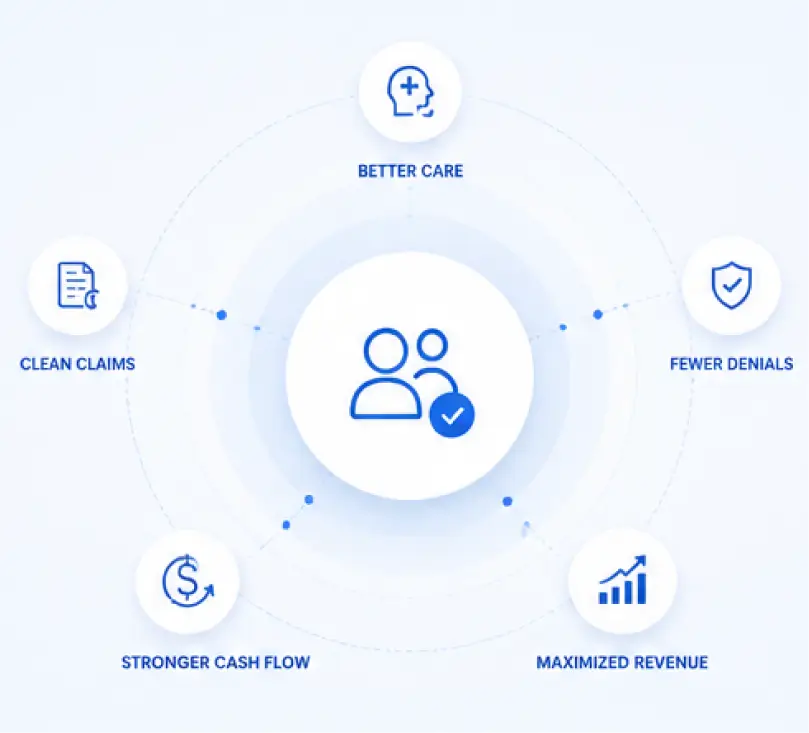

With BH Rev, a single named team owns the cycle end to end: credentialing and payer enrollment, verification, authorization, coding, claim scrubbing and submission, denial management, A/R follow-up, and patient billing, all of it run on our own behavioral health platform. Keeping the whole cycle under one team is a deliberate design choice, not a convenience. Nothing gets thrown over a wall to a second vendor and lost in the toss, no single departure walks out with the knowledge that keeps claims moving, and there is exactly one number the whole operation is measured against. Outsourcing a stack of tasks and managing a revenue cycle are not the same thing, and the difference is ownership.
That ownership is measurable rather than asserted. You can watch claims, denials, and outstanding balances move in real time, and each month an executive scorecard pulls collections, denial patterns, and A/R aging across every program and location into one view you can actually act on. The usual billing arrangement sends a monthly summary you have no way to interrogate. This one is built to be questioned, whether we are running your entire cycle or a single service, and it scales with your census as you grow. For the person who owns the revenue line, that transparency is the whole point: you know where your revenue stands, and you know why.