
Our billing team runs your revenue cycle on our own behavioral health platform, built for how addiction treatment actually bills. Hand us the whole thing, from credentialing through collections, or just the piece that is costing you the most right now.
Control stays with you; the workload is what moves. You approve the decisions, and a named team runs the day-to-day of your addiction treatment billing out in the open. Live dashboards show every claim and outstanding dollar, a monthly executive scorecard lands on schedule, and nothing happens in a place you can't check. Most programs end up tracking their revenue more closely with us than they did in-house.
We scale to fit. A program with no billing staff can move its whole addiction treatment revenue cycle to us; one with a capable biller can keep them and pass over only the parts that pile up, like authorizations, denials, or aged A/R. Whatever you keep in-house sets where we start.
Same platform, two ways to use it. Keep billing in-house and BH Rev Software gives your team the addiction-treatment tools: real-time eligibility, claim scrubbing, denial workflows, and live A/R dashboards. Prefer to hand it off and BH Rev Services puts our team on the entire revenue cycle, credentialing through A/R, held to your monthly KPIs. Programs often start on one and add the other.
We start there on purpose. Open denials and aged A/R hold the revenue you can still recover, so the free billing audit prioritizes them before anything else. Once those are moving, the rest of the cycle shifts to us in stages, and your day-to-day billing never goes dark during the change.
Yes in most setups, and nothing about your EHR changes. We operate inside the addiction treatment billing and clinical systems you already run, and our platform ties into partner EHRs rather than replacing them. Anything unusual gets confirmed on the billing audit call.
Addiction treatment billing services cover the full revenue cycle for substance use disorder providers: verification of benefits, prior authorizations, CPT and ICD-10 coding, behavioral-health-specific claim scrubbing, submission, denial management and appeals, A/R follow-up, and patient billing. What separates a team that bills addiction treatment from a general medical biller is what happens before the claim ever leaves. Session caps are checked at intake, authorization requirements are tracked against the treatment plan as the client moves between levels of care, and coding is validated for the program actually delivering care, whether that is detox, residential, PHP, IOP, or outpatient. In addiction treatment, most denials are decided at intake and during utilization review, not in the clearinghouse, so that is where the work has to start.
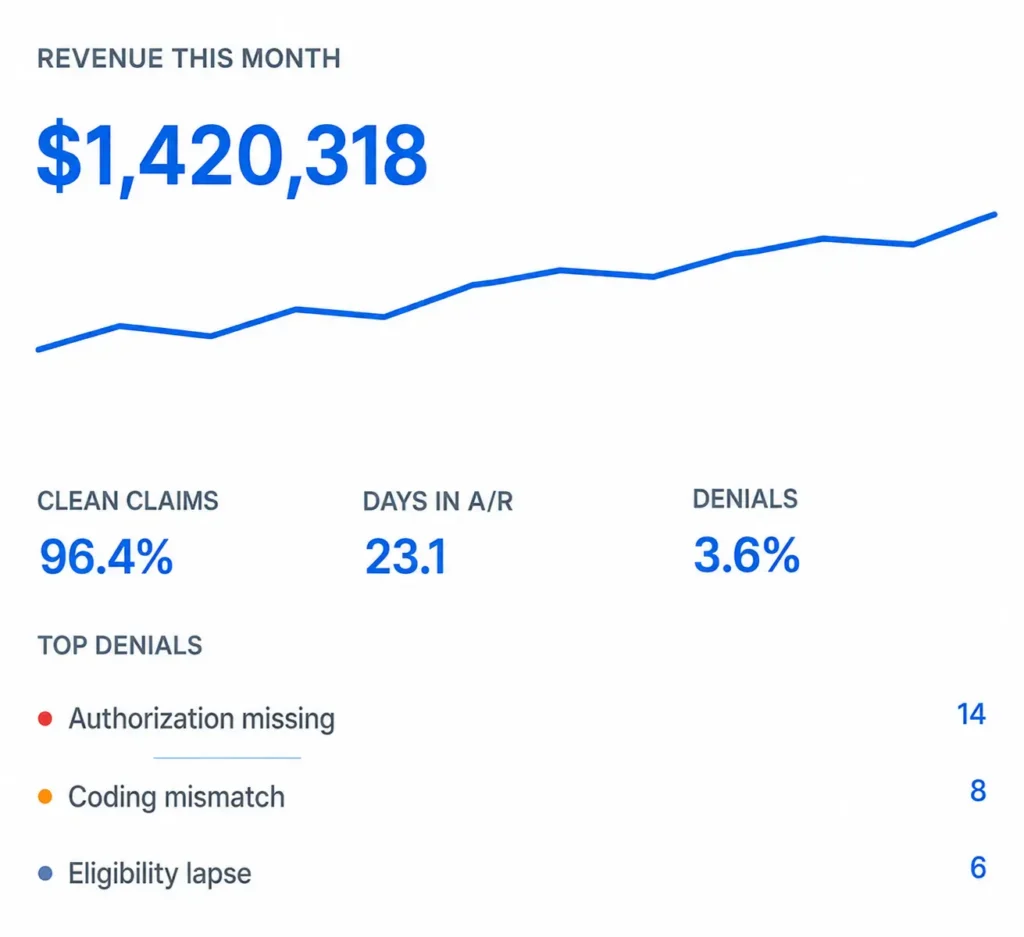
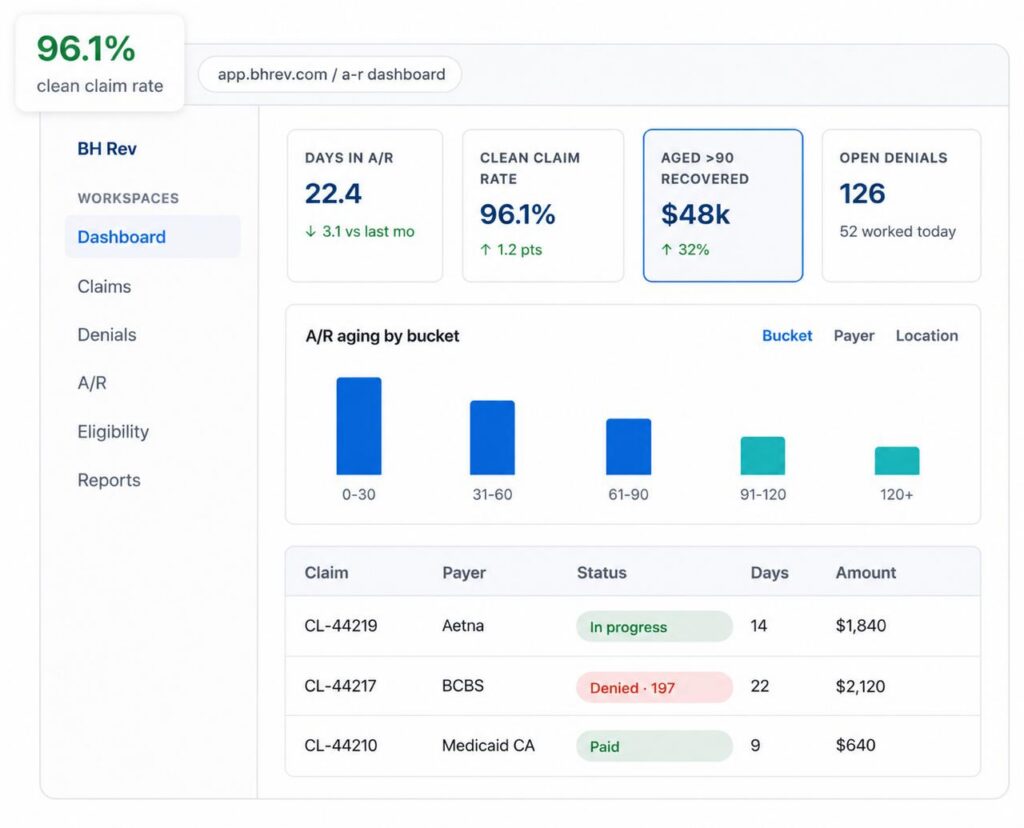
It is one of the most common conversations in addiction treatment: the beds are full, the clinical team is delivering, and the deposits keep shrinking. Nobody can point to the leak. The billing person says claims are going out. The reports say revenue is down. In substance use disorder billing the leak usually hides where general billers do not look: a missed concurrent review, an authorization that lapsed when a client stepped down from residential to PHP, a per-diem denied for medical necessity, an aged claim that quietly crossed timely filing. Every month the gap between care delivered and money collected gets a little wider while everyone works harder.
Detox and residential bill in per-diems against authorizations that payers review while treatment is still happening. PHP and IOP live on concurrent reviews, session-frequency limits, and utilization rules that change what a clean claim looks like from week to week. Outpatient runs on volume: recurring sessions, telehealth place-of-service codes, and coordination of benefits at scale. Each level of care in addiction treatment is its own billing discipline, and most denials trace back to the transitions between them, when a client steps down and the authorization, the codes, and the medical-necessity documentation all have to move with them. BH Rev bills the whole continuum on one platform, so nothing falls through when a client moves.
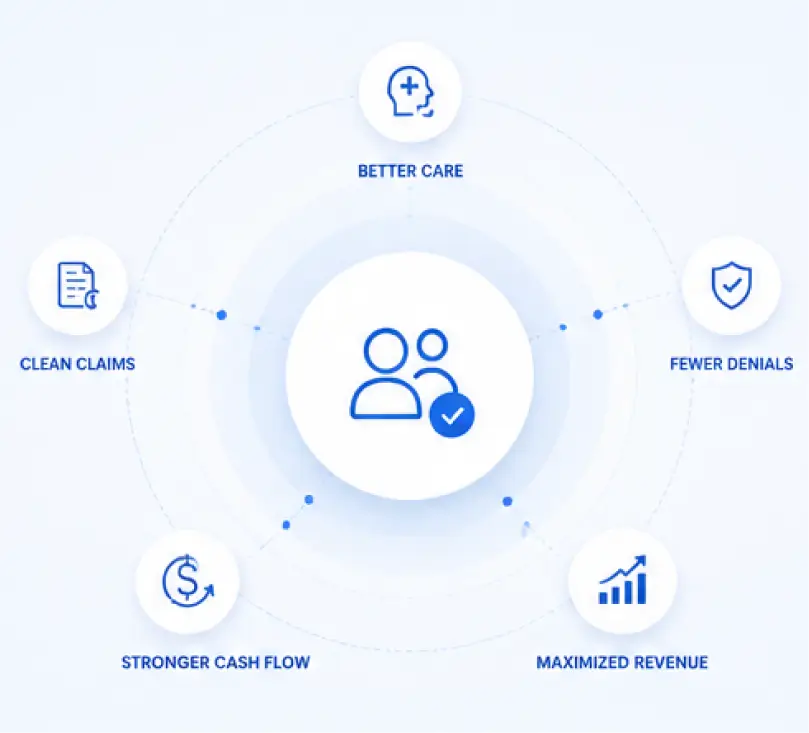

BH Rev provides addiction treatment billing services with one named team handling credentialing and payer enrollment, verification of benefits, prior authorizations, coding, claim scrubbing and submission, denial management and appeals, A/R follow-up, and patient billing, end to end on its own behavioral health platform. One team owning the whole cycle means no handoffs between vendors where claims fall through, no single point of failure when a biller leaves, and one monthly scorecard everyone answers to. It is billing built for how addiction treatment actually gets reimbursed, run by people who have done the work.