
Our team reviews your denials, aged A/R, authorizations, and coding on a platform built for behavioral health, then shows you where revenue is slipping and how much of it is still recoverable. See the findings first, then decide what to fix.
A billing audit reviews the parts of your revenue cycle where behavioral health money usually leaks: denials by payer and reason, aged A/R and what is still collectible, authorizations matched against the claims that used them, level-of-care and time-based coding, timely-filing gaps, and underpayments against your contracted rates. You get a plain read of what we found and how much looks recoverable, not a sales deck.
Yes, and no. The audit is free and there is no obligation to change anything. Plenty of operators use the findings to tighten their own in-house billing. If you do want help, you can hand off a single service or the whole cycle, but that is your call after you see the numbers.
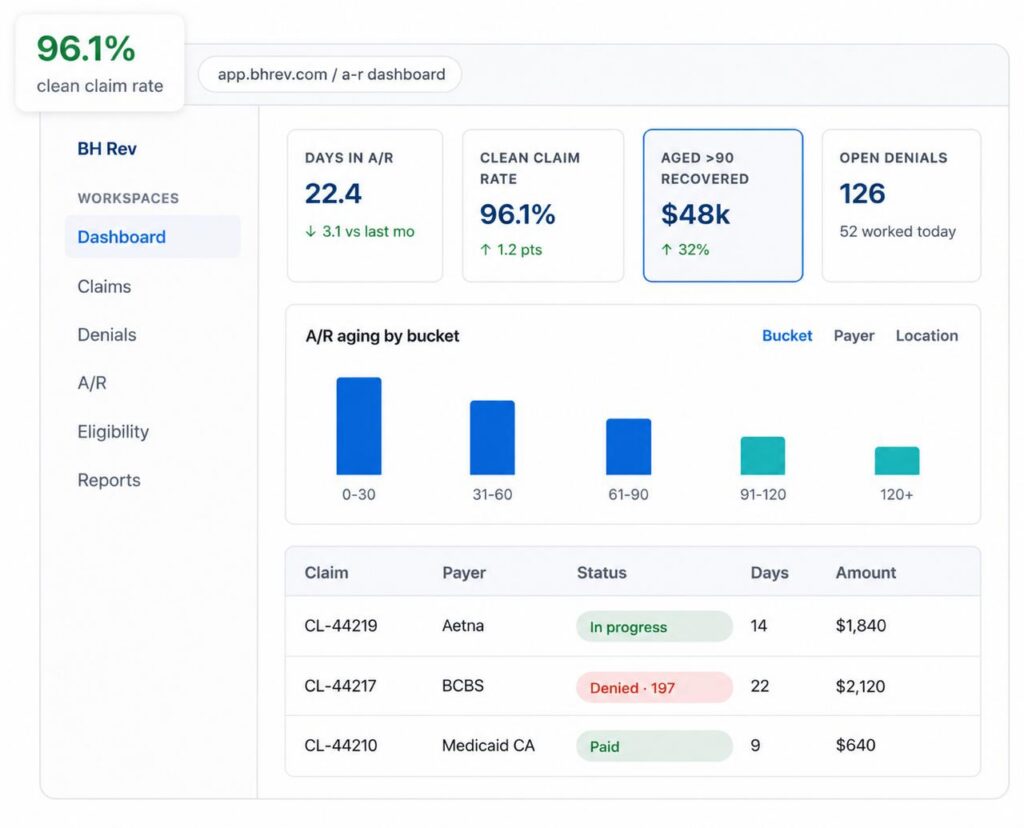
Control usually increases, not the reverse. Most in-house setups cannot see their own claims clearly, and bringing in an outside team is what changes that: you get people you can reach by name, dashboards that show every open claim and outstanding dollar, and a monthly scorecard that pulls it together. The decisions stay yours. We do the work and keep all of it in front of you.
Yes. If one piece is drowning you, we can scope the audit to it: denial patterns and appeals, or aged A/R and what is recoverable. If the audit points to problems upstream, at intake, authorizations, or coding, we will show you that too, because that is usually where the denials start.
Almost always. Behavioral health providers run on a range of EHR and practice-management systems, and an audit works within whatever you already have, so getting reviewed never means switching platforms. Our own system connects to partner EHRs instead of standing in for them, and we confirm it lines up with your setup while the audit is underway.
A behavioral health billing audit is a claim-by-claim review of your revenue cycle that shows where payment is being lost and why. Coding is usually the first stop, because so much behavioral health revenue turns on it: whether an intake was billed as a 90791 or 90792 evaluation, whether the time-based psychotherapy codes (90832, 90834, 90837) match the session length in the note, whether group therapy billed as 90853 was supported, and whether IOP per-diems such as H0015 and any crisis codes were captured correctly. From coding the review works outward through eligibility and verification, prior authorizations matched against the claims that used them, denial reasons grouped by payer, aged accounts receivable ranked by how collectible it still is, timely-filing exposure, and payments checked against contracted rates for underpayment.
Underneath all of it is documentation. A behavioral health billing audit reads progress notes and treatment plans for the medical-necessity and level-of-care language payers require, and marks the places a note would not hold up if records were requested. What lands on your desk at the end is a written breakdown with a dollar figure on each problem area and the specific claims behind it.
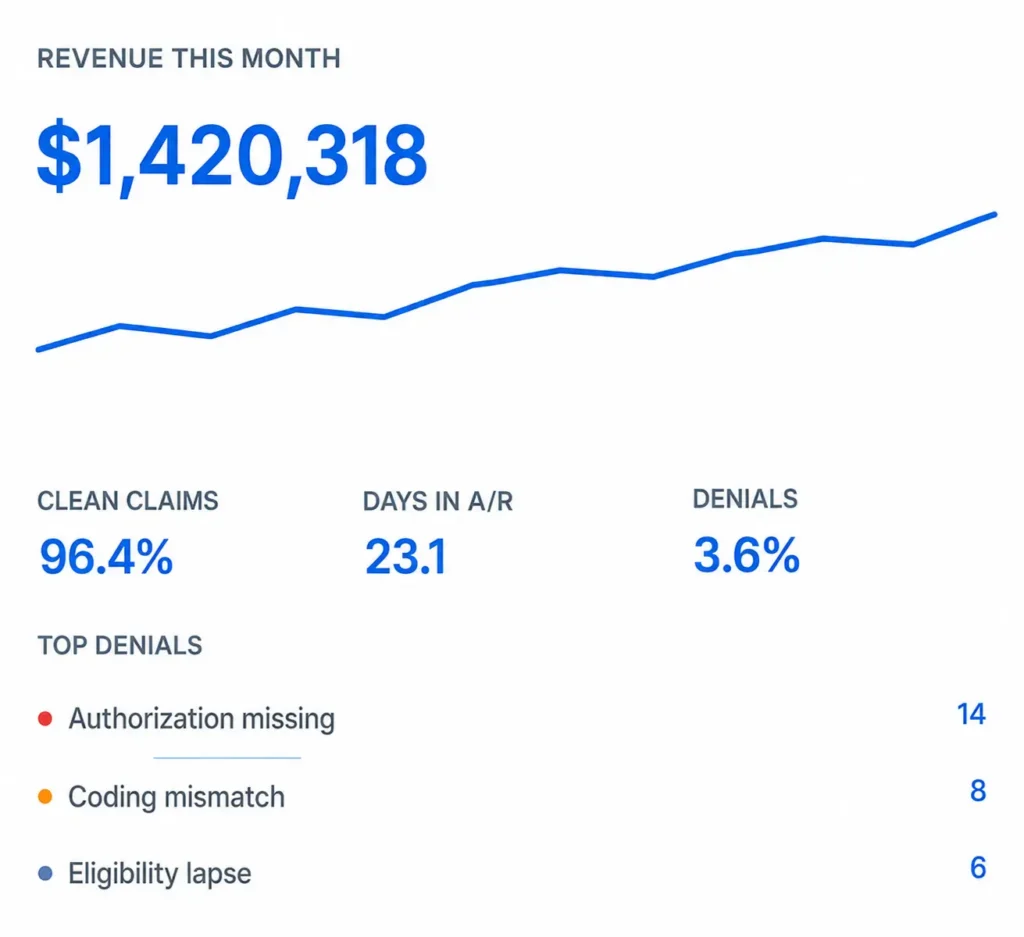
Most behavioral health claims do not adjudicate where a general biller assumes they will. Commercial plans routinely carve their behavioral health benefits out to a managed behavioral health organization, so a claim that looks like it belongs to the primary insurer actually runs through Optum Behavioral Health, Carelon, or a state Medicaid MCO’s behavioral carve-out, each with its own authorization rules and fee schedule. A biller rooted in general medicine sends the claim to the wrong entity, or to the right one under the wrong assumptions, and then misreads the denial that comes back.
Level of care makes it harder. Detox and residential bill per-diems against concurrent authorization review that can shorten an approved stay while the client is still in treatment. PHP and IOP live inside session-frequency and utilization limits, with per-diem H-codes carrying much of the SUD volume. Parity protections under MHPAEA shape what a payer is even allowed to do with those limits. An audit built only for behavioral health reads each denial against the payer that actually adjudicated it and the level-of-care rules that governed it, so balances a general review marks as final get reopened and worked.
When the money coming in falls behind the care a program is delivering, the cause is rarely one failure an owner can name. It is spread thin: denials that were never appealed inside the timely-filing window, authorizations that lapsed as a client moved between levels of care, sessions coded a step under what the documentation would have supported, and an aging bucket that rolled past the point where most of it is still collectible. Any one of them is easy to miss, and an in-house team rarely has the time to chase all of them down at once.
A billing audit also weighs a kind of loss that never shows up in the collections report: payer-audit exposure. Coding that runs high can invite recoupment or a clawback when a payer reviews claims backward, and coding that runs low, or notes that do not carry the medical-necessity and level-of-care justification a payer expects, both forfeits revenue and leaves a weak position if records are ever pulled. A behavioral-health-specific review puts a dollar figure on the revenue going unworked and on the compliance risk sitting in the documentation.


What an operator does with the findings depends on what the audit turns up. If the problems are fixable in-house, the report is enough on its own, pointing the billing team at the flagged denials, the coding patterns that need correcting, and the gaps at intake and authorization. Sometimes a single function is the whole problem, usually denial work or aged A/R, and handing off that one piece while keeping the rest is the practical move. When the review instead shows revenue falling through the seams between separate credentialing, billing, and collections vendors, moving the whole cycle to one team is what closes those seams.
That last path is where BH Rev fits. It runs behavioral health billing as a single named team, from credentialing and payer enrollment through verification of benefits, authorization, coding, claim scrubbing, denial management, aged A/R, and patient billing, all on its own behavioral health platform. Enrollment status, denials by payer, aged balances, and monthly KPIs then sit on one scorecard and a set of live dashboards, rather than scattered across separate vendors’ inboxes.