
We are the billing company behind behavioral health practices that would rather hand the revenue cycle to specialists than build one in house. Everything runs on the behavioral health platform we built ourselves. Bring us the entire cycle, from getting a program credentialed to collecting the last aging balance, or hand off only the stage that keeps stalling.
If you are comparing billing companies, a few questions separate a behavioral health specialist from a general medical company with a behavioral health page. Here is what to ask, whoever you talk to.
Do they bill behavioral health only, or is it one specialty among many? Level-of-care coding, session limits, and authorization rules are where a general biller quietly loses claims, so ask whether behavioral health is the whole business or a side desk.
Do they own the whole cycle, or just submit claims? Revenue leaks at credentialing, authorizations, denials, and aged A/R, not at submission. Ask whether one team owns credentialing through collections, or the work is split across vendors and handoffs.
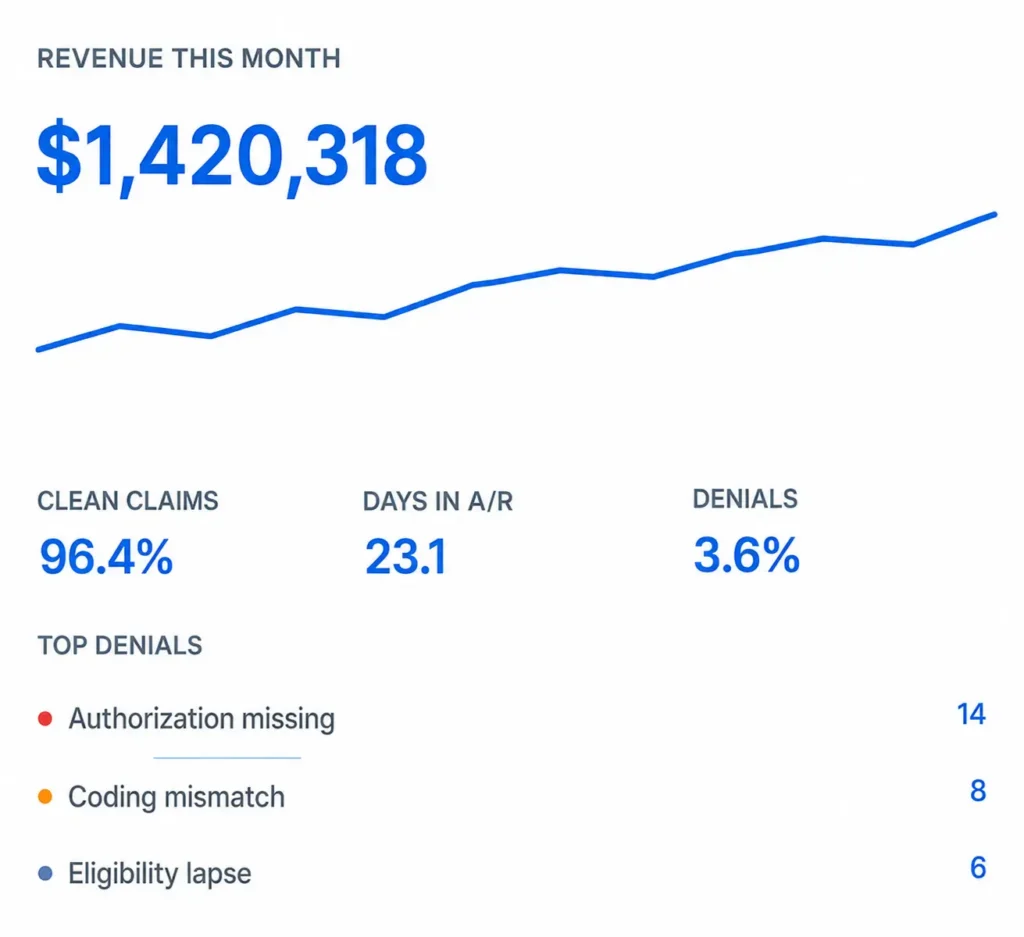
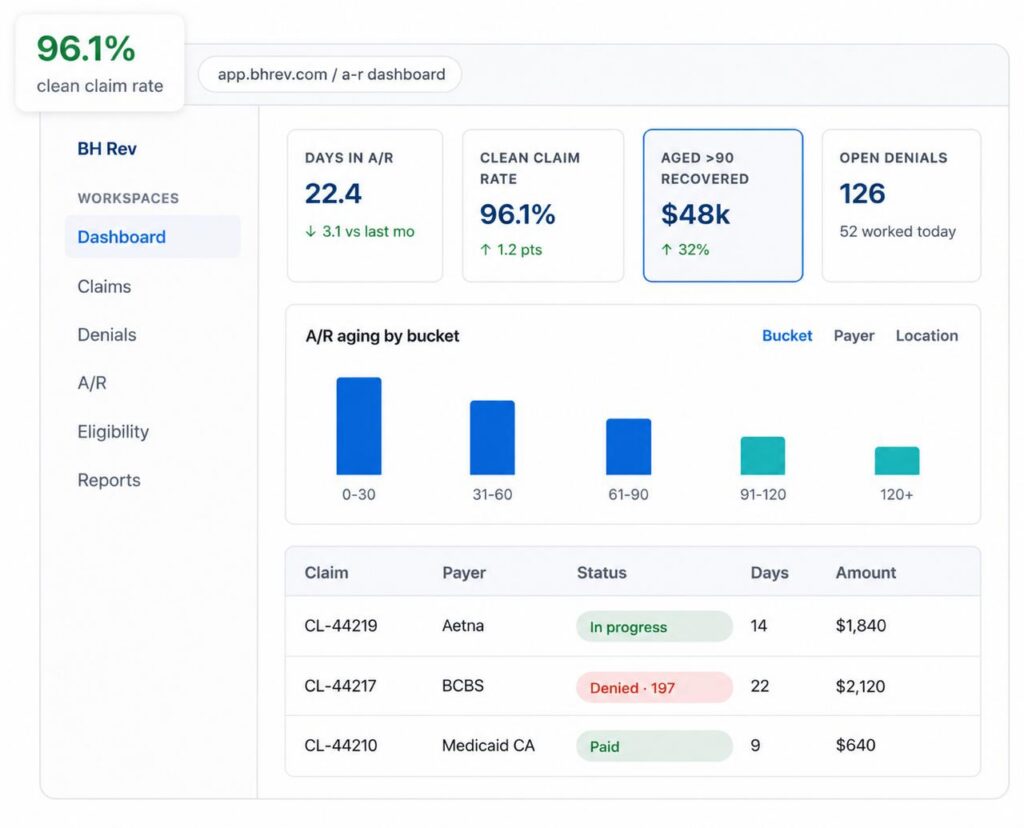
Will you actually see your own numbers? Ask what reporting you get. A monthly scorecard and live dashboards let you question the numbers; a report you cannot open is not visibility.
Are they built for behavioral health compliance? Behavioral health billing carries obligations general medical billing never sees, including the 42 CFR Part 2 rules that protect substance use treatment records. Ask how they handle them.
Can they take over without dropping a claim? Ask how they move your open claims and authorizations, and how fast they start on your aged A/R and active denials.
Why BH Rev. BH Rev is a behavioral health billing company and nothing else, built and staffed by people who have run behavioral health practices and billing teams. One named team owns your revenue cycle from credentialing through collections, on a platform built for behavioral health, and you get a monthly scorecard and live dashboards so you always know where your revenue stands. Take the whole cycle, or just the piece that is stalling.
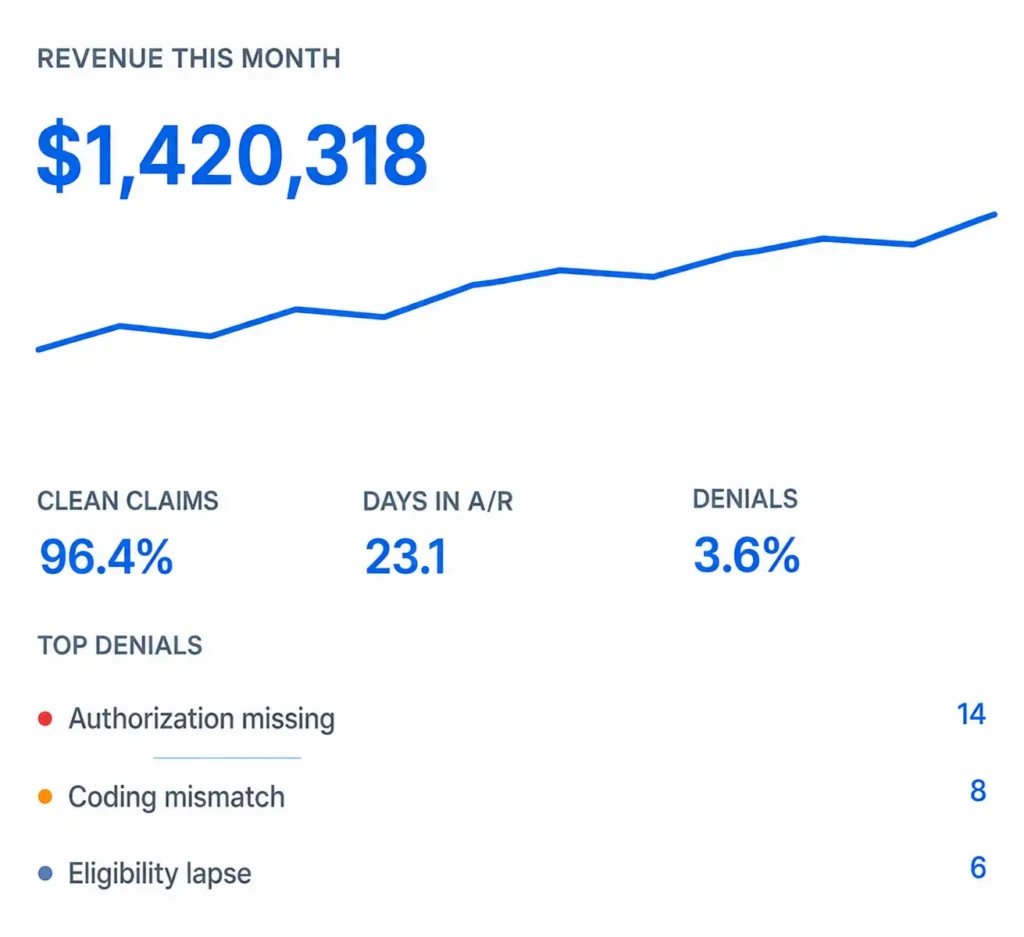
No, and the setup is designed to give you more visibility than an in-house team, not less. You keep every decision. A named team does the work in the open, with dashboards that show each claim and each open authorization and a monthly scorecard you can question line by line. Nothing about your revenue becomes a black box you cannot open.
Behavioral health is billed differently from the ground up. Facility levels of care are often billed as per diems on institutional claims, medical necessity is judged against behavioral health criteria, and confidentiality rules like 42 CFR Part 2 govern substance use records. A general medical biller rarely works with any of that, which is why behavioral health claims belong with a company that bills nothing else.
Both are on the table. Some practices move the entire revenue cycle to us and step out of billing; others keep their in-house billers and bring us in only where things back up, usually credentialing, authorizations, denials, or aged A/R. We shape the engagement around how your practice already runs.
Fast, because that backlog is usually the first thing we touch. Aged receivables and unworked denials are where the recoverable money sits, so after a billing audit we go after your oldest buckets and stuck authorizations first, then phase in the day-to-day work so your billing keeps moving through the handoff.
Usually, yes. Our team works inside the behavioral health EHR and practice management systems providers already use, and our own platform connects to your partner EHRs instead of replacing them. We confirm exactly how it fits your setup on the audit or consultation call.
A behavioral health billing company runs the full revenue cycle for treatment providers, from credentialing and verification of benefits through prior authorization, coding, claim submission, denial management, accounts receivable follow-up, and patient billing, built for how behavioral health care is actually reimbursed. What separates it from a general medical biller happens before the claim ever goes out. Facility levels of care such as detox, residential, partial hospitalization, and intensive outpatient are often billed as a per diem, a single daily rate that bundles the day’s services, on a UB-04 institutional claim rather than itemized per session, and each level carries its own coding, authorization, and medical necessity rules. BH Rev bills behavioral health only and runs all of this on one platform, verifying benefits and authorizations at intake, tracking continued-stay reviews while a client is still in treatment, and matching level-of-care coding to the program that is actually delivering the care.
Behavioral health billing carries obligations that general medical billing never touches. Substance use disorder treatment records are protected by the federal 42 CFR Part 2 confidentiality rules, which sit on top of HIPAA and govern how that information can be handled and disclosed. Because a billing company handles protected health information for the practices it serves, it acts as a HIPAA business associate and works under a business associate agreement, the standard contract that binds it to HIPAA when it handles that information. Medical necessity for behavioral health is judged against published criteria rather than a general medical standard: the ASAM Criteria for substance use levels of care, and tools such as LOCUS or a payer’s InterQual or MCG guidelines for mental health. The federal Mental Health Parity and Addiction Equity Act gives billers a basis to appeal denials when a plan treats behavioral health less favorably than medical care. At BH Rev, appeals are written from the payer’s own medical necessity criteria and the parity law, and substance use claims are handled under the 42 CFR Part 2 confidentiality requirements.
Behavioral health rarely runs at a single level of care, and the billing changes at each one. Detox and residential are billed in per diems against authorizations that payers review while treatment is still in progress. Partial hospitalization and intensive outpatient run on concurrent reviews and on session-frequency and utilization limits that must be tracked against each authorization. Outpatient runs on recurring visits, telehealth place-of-service codes, and coordination of benefits. The payer mix adds another layer, because commercial plans, state Medicaid programs, and Medicare each cover behavioral health under their own authorization and documentation rules, and out-of-network episodes often depend on single case agreements. Denials frequently occur at the transitions between levels of care, where a re-authorization comes due or a code set changes. BH Rev runs every level and every payer on one system, so a single team reconciles the authorization, the codes, and the payer rules at each step-down instead of reopening the file every time a client moves between programs.

A behavioral health billing partner you can hand the entire revenue cycle to keeps one named team accountable for the numbers, rather than splitting the work across a chain of vendors where claims fall through the handoffs. At BH Rev, one team owns credentialing and payer enrollment, verification of benefits, prior authorization, coding, scrubbing and submission, denial management, accounts receivable follow-up, and patient billing, and reports all of it on a monthly scorecard and live dashboards that show every claim, every open authorization, and every aging dollar. The platform connects to the EHR and practice management systems a practice already uses rather than replacing them. A transition runs in phases: the team first works the aged accounts receivable and open denials, then moves the open authorizations across so none lapse during the switch, and finally takes over the day-to-day cycle once the backlog is cleared.