
We manage your claims end to end on our own behavioral health platform. Each one is created clean, scrubbed against behavioral health rules, submitted, tracked through the clearinghouse and the payer, and worked until it is paid. Take the full revenue cycle or hand us claims alone.
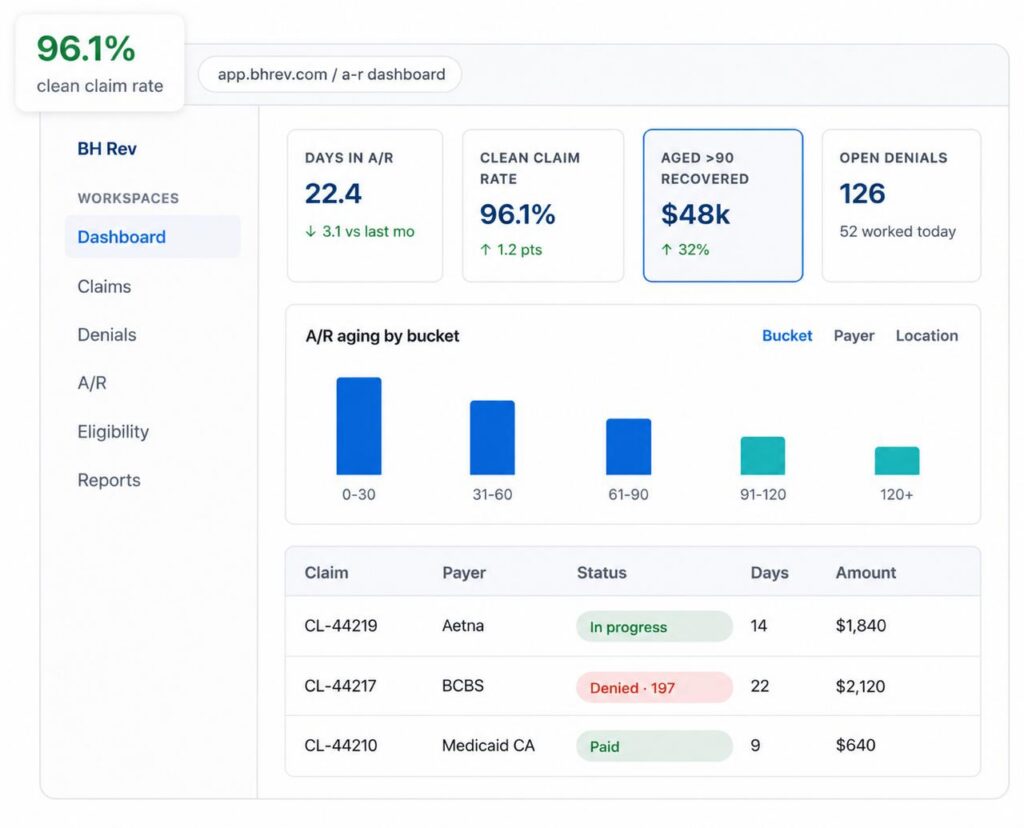
No. Most operators see more after the handoff than they did before. You get live dashboards showing where every claim stands, from submission through payment, a monthly scorecard with your clean-claim rate and days in A/R, and a named team you can call. You keep the decisions. We handle the work, and you see all of it.
A rejection happens before a payer ever reviews the claim. It fails a format, data, or eligibility check at the clearinghouse or the payer's front door and never reaches adjudication, so it has to be corrected and resubmitted fast. A denial means the payer did review the claim and declined to pay under its rules, which calls for documentation, an authorization check, or an appeal. They look alike on a report and need completely different work, so we track them separately and neither one sits.
Usually inside the one you have. Our platform is built to sit alongside the EHRs behavioral health providers run, so your team is not forced to re-platform to work with us. Before we touch anything, your audit call includes a check of your exact software stack so we both know what fits and what, if anything, has to change.
By catching errors before the claim goes out, not after it comes back. Every claim runs through behavioral health scrubbing rules that check coding, modifiers, place of service, units against session limits, and authorization status for the level of care being billed. Fewer claims bounce at the clearinghouse, fewer come back denied, and more get paid on the first pass.
Claims alone is a real option, not a lead-in to a bigger contract. If you want to keep credentialing, patient billing, and the rest in-house, we will own only the claim work: scrubbing, submission, status tracking, and the rejection and resubmission loop. Practices that would rather hand off everything from credentialing to collections can do that too. You draw the line where it helps you.
Behavioral health claims management services carry a claim through its entire life: CPT and ICD-10 coding, behavioral-health-specific scrubbing, submission through the clearinghouse, acceptance and rejection handling, payer adjudication, denial work and appeals, status tracking, resubmission inside timely-filing windows, and A/R follow-up until the claim is paid. BH Rev runs all of it on our own behavioral health platform: every claim is checked against BH-specific scrubbing rules before it leaves, and its status stays visible to you from submission to payment on a monthly scorecard. What separates a behavioral health claims team from a general medical biller is the work that happens before a claim ever goes out: session limits checked against the authorization, level-of-care coding matched to the program delivering care, and payer rules for detox, residential, PHP, IOP, and outpatient applied up front. A clean first pass is the goal, because every claim that bounces or denies is cash that sits while your team reworks it.
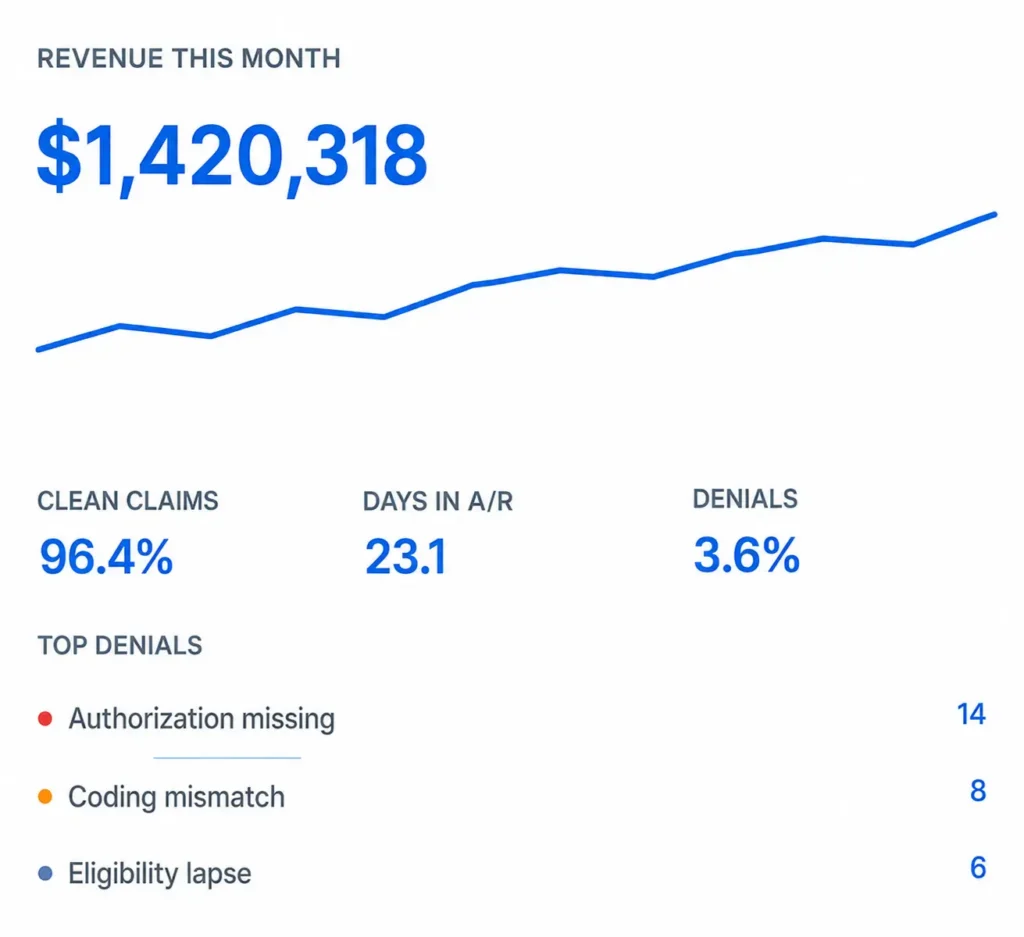
Two claims can both read as unpaid on a report and still need completely different work. A rejected claim never reached the payer: it failed a format, data, or eligibility check at the clearinghouse or the payer’s front door, so it was never adjudicated. The fix is to correct the error and resubmit quickly, before the filing deadline runs out. A denied claim did reach the payer, got reviewed, and was declined under the plan’s rules, often over authorization, medical necessity, or a level-of-care mismatch. That one needs documentation, an authorization check, or a formal appeal, not just a resubmission. Treating a denial like a rejection, or the reverse, is how a claim gets worked twice and still goes unpaid. We separate the two the day they come back and route each to the right playbook, so rejections get fixed fast and denials get the appeal they need.
In claims management the number that matters most is the clean claim rate: the share of claims a payer accepts and pays on the first submission, with no rejection, denial, or request for more information. The industry generally treats 95 percent and above as strong. It carries that weight for a plain economic reason: a claim that pays the first time costs almost nothing to collect, while a claim that bounces has to be tracked down and reworked by a person before it goes back out, and some miss the filing deadline on the second pass. BH Rev reports this rate on a published revenue-cycle dashboard, broken out by payer. First-pass rate usually erodes first at the level of care: authorization-driven per-diem claims and frequency-limited PHP and IOP claims pull the average down long before the drop in deposits is obvious. Seen that way, the rate points you to the payers and the levels of care costing you first-pass dollars, instead of guessing.

Behavioral health claims stall in predictable places, and most of them trace back to the level of care. Detox and residential bill in per-diems against authorizations a payer can review while the client is still in treatment, so a single concurrent-review cut can turn a paid week into a denied one. PHP and IOP run on session-frequency and utilization limits that change what a clean claim looks like week to week. Outpatient and telehealth run on volume, place-of-service codes, and coordination of benefits. Every payer also sets a timely-filing deadline, and a rejected or denied claim that is not corrected and resubmitted before that window closes becomes money you cannot get back. This is the work BH Rev’s team owns on your behalf: we watch each claim against its filing deadline, rework rejections the week they land, build the level-of-care coding into the scrub before submission, and keep the aged bucket from quietly aging out while your clinical team stays focused on care.