
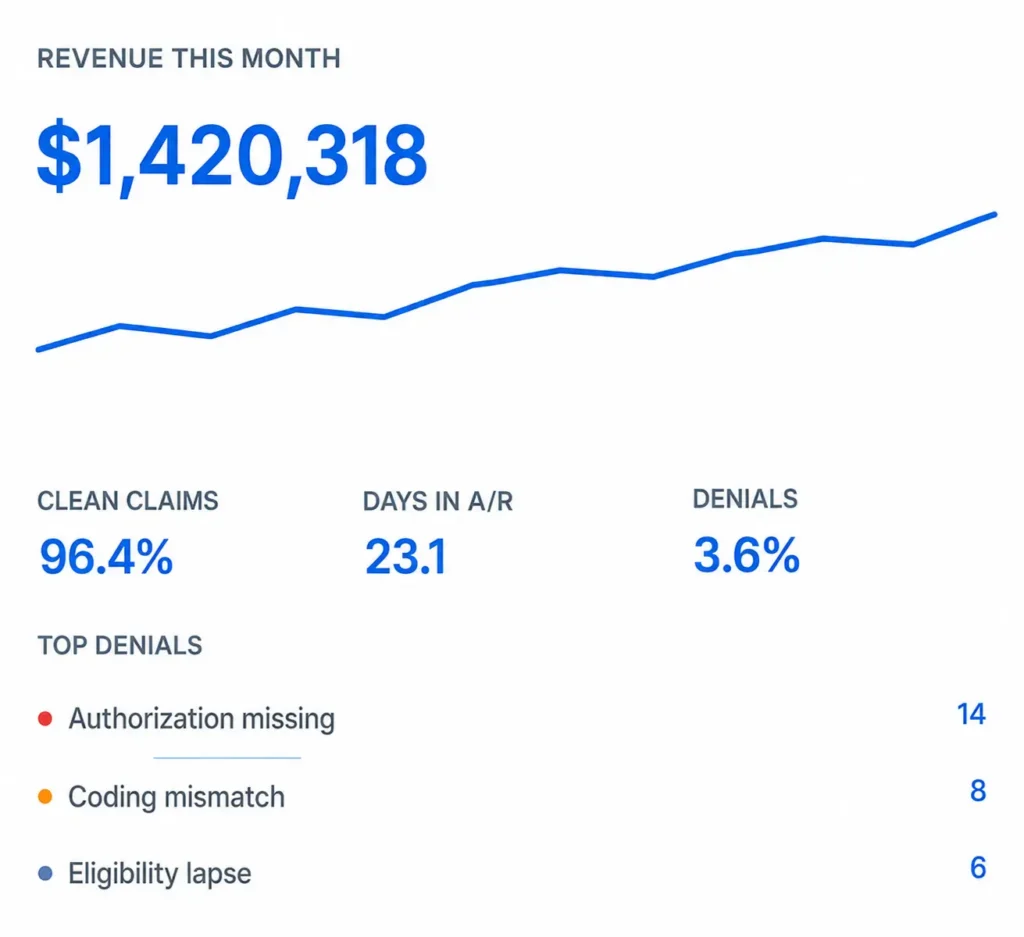
Your entire revenue cycle, credentialing through collections, is handled by our team on a platform we built for behavioral health, and reported back to you on the metrics that matter: clean claim rate, days in A/R, and denials. Hand over all of it, or bring us in for the one stage where the money is slipping.
No, and that surprises people. Handing off the work usually gives you a clearer view of your revenue than you had running it yourself, because everything we do reports back to you in one place instead of living in a biller's head. The decisions stay yours. We run the day-to-day and keep the full picture in front of you.
This is where behavioral health billing lives or dies. We verify benefits at intake, track visit and session frequency limits and authorization and concurrent-review rules against the treatment plan, and code time-based services and telehealth place-of-service correctly, so more claims go out clean the first time instead of coming back as denials weeks later.
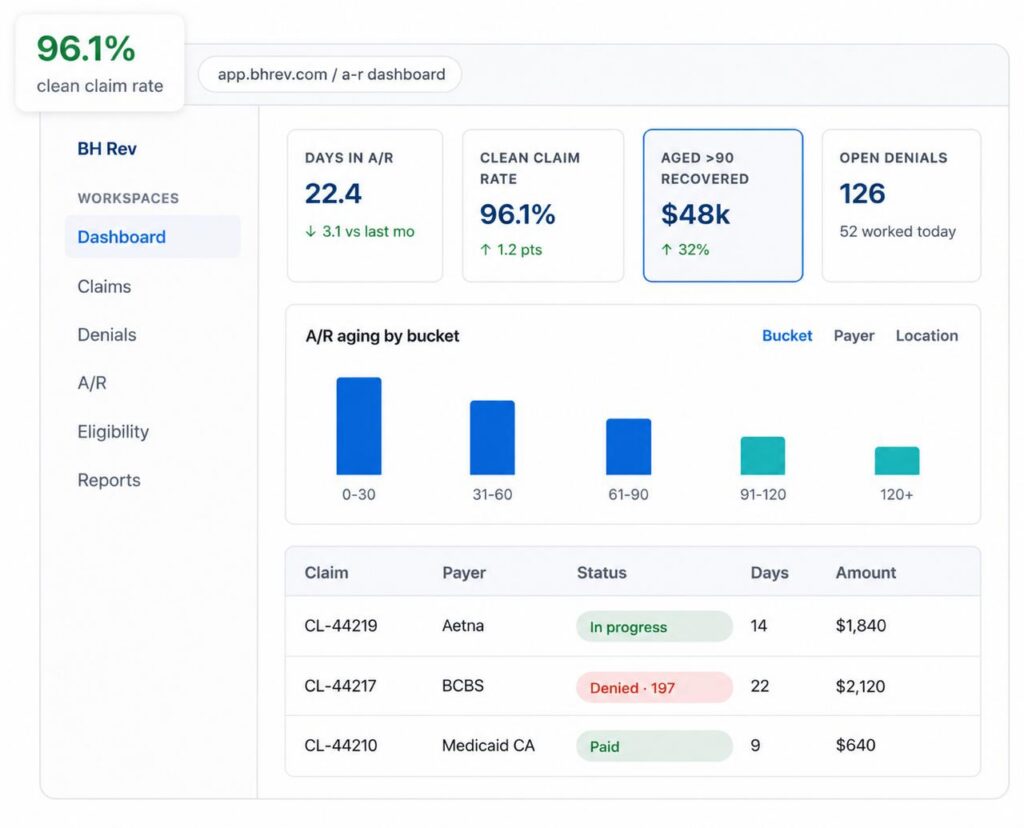
Every month you get an executive scorecard aimed at the people watching the money: clean claim rate, days in A/R, denial rate, and how much aged money we have pulled back. Under it, live dashboards let you drill into any single claim or open balance whenever you want, so you are never waiting on a report you cannot dig into.
Yes. You do not have to move the whole cycle at once. Plenty of practices bring us in for a single piece first, and the most common one is denials plus the aged claims that have been sitting unpaid. We start there because that revenue is already earned and often still collectable. A billing audit tells us how much of it is worth chasing, we go after it, and you decide later whether to hand off anything else.
In almost every case. Rather than replacing anything, our platform links to the partner EHRs behavioral health practices run on, and our billers work right inside the systems you already have. BH Rev is not a full EHR, so your clinical records and workflows stay exactly where they are while we take the billing off your plate. We check the specifics of your setup during the assessment call.
Mental health revenue cycle management is everything that turns a delivered session into collected revenue, handled as one connected process from first credential to final payment. It begins before a patient is ever seen, with credentialing and payer enrollment, and runs through eligibility and benefit checks, prior authorization, coding, claim submission, denial work, A/R follow-up, and patient balances.
For a mental health practice, the hardest part sits at the front of that process. A biller has to confirm each plan’s visit and session limits, keep authorizations and concurrent reviews current against the treatment plan, apply the correct time-based service codes, and use the right telehealth place-of-service, POS 02 or 10, before a claim ever reaches the payer. When one of those is off, the denial usually surfaces weeks later, long after the session was delivered.
BH Rev handles this entire process on its own behavioral health platform and takes nothing but behavioral health, so those rules sit inside the default workflow.
When a mental health practice is fully booked but deposits keep shrinking, the money is almost always getting lost inside the billing process. Claims appear to go out on time; the payments just come back slower and smaller than they should.
A handful of specific things drive it in behavioral health. Sessions get billed past the number a payer authorized. A diagnosis and a procedure code fail to line up, or a time-based code is billed at a level the clinical note cannot support. Telehealth claims leave without the place-of-service or modifier the payer now requires. And claims that sit too long in A/R quietly cross a timely-filing deadline, at which point a slow payment becomes a permanent loss.
Because BH Rev works only in behavioral health, these are the first places we look. We open on active denials and the oldest A/R, because that is where the recoverable revenue is actually sitting.
A mental health revenue cycle works differently at each level of care, and the billing rules move with it. At the outpatient and telehealth end, the work is volume: recurring individual and group sessions where the claim turns on place-of-service coding and coordination of benefits. Step up to intensive outpatient or partial hospitalization and the payer begins reviewing care as it happens, with concurrent authorization and session-frequency limits that can tighten mid-treatment. Residential, detox, and inpatient care is billed per diem, so each covered day depends on an authorization the payer is still reviewing while the patient is admitted.
Most of the losses happen in the seams between these levels of care: an authorization that lapses when a client steps down, or a day that gets billed before the payer approves it. Medicaid and commercial plans manage those transitions on different timelines and with different documentation, and behavioral health adds its own layer, from mental health parity under MHPAEA to the 42 CFR Part 2 rules governing substance use records. BH Rev bills the full continuum, so those distinctions are already built into how claims are scrubbed and followed up.
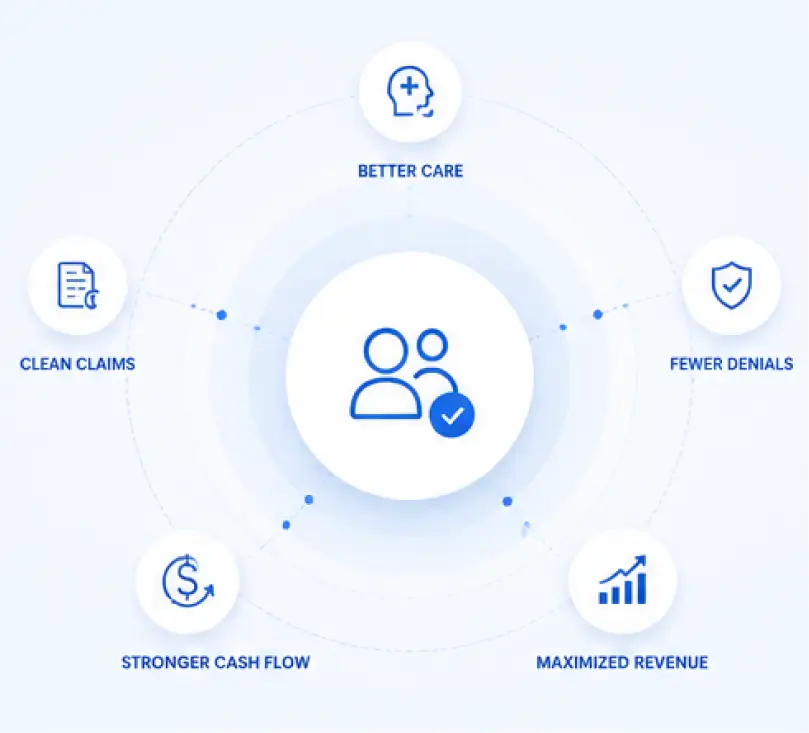

With BH Rev, a single named team runs your entire mental health revenue cycle end to end. The same team credentials your providers, verifies benefits, manages authorizations, codes and submits claims, works denials and appeals, recovers aged A/R, and handles patient balances, all on BH Rev’s own behavioral health platform.
Keeping the whole cycle with one team is what makes it accountable. When claims pass between a clearinghouse, an outside coder, and an in-house biller, some get missed at the handoffs and never get worked. Because the same team owns all of it, every claim has a clear owner and your reporting comes from one source. Each month you get an executive scorecard covering clean claim rate, days in A/R, denial rate, and aged-bucket recovery, backed by live dashboards showing every open claim and dollar, and a team you can reach by name for a same-day answer.
You can take the whole cycle or just the single service you cannot keep staffed. If you want the specifics before a conversation, the pricing and packages guide has them.