
Behind the schedule your clinicians keep is a stream of claims that has to be verified, coded, submitted, and chased until it pays, and we run that outpatient revenue cycle on our own behavioral health platform. Take the entire cycle, from credentialing and enrollment through final collections, or bring us in for only the stage that hurts most, usually eligibility, denials, or aged A/R.
Outsourcing the work does not mean giving up control, and it usually means seeing more than you did before. You still make every decision. What changes is that a named team handles the day to day while you get live dashboards on each claim and a monthly scorecard on the metrics a practice owner tracks, like clean-claim rate and days in A/R. None of your billing happens somewhere you cannot see it.
This is where outpatient billing is won or lost. Outpatient is a high volume of lower-dollar claims, so the money is in getting each one right the first time. We verify eligibility and coordination of benefits before each episode of care, code each session correctly with the right place of service for in-person and telehealth visits, run behavioral health scrubbing rules before claims go out, and work denials and secondary claims so nothing small quietly ages out. At volume, a few points of clean-claim rate is real money.
Either way works. If you want the whole outpatient revenue cycle off your plate, we take all of it. If your team is solid but one or two stages keep backing up, whether that is eligibility, denials, secondary claims, or aged A/R, we run just those and leave the rest with you. You set the split and we work to it.
Yes, and both are where outpatient revenue quietly leaks. We code telehealth visits with the correct place of service and modifiers so they hold up to payer review, and we file and follow secondary and coordination-of-benefits claims instead of writing them off. For a busy outpatient practice, that is often a meaningful share of what was slipping away.
Usually, yes. Most behavioral health practices keep the EHR and practice management system they already run on, and we bill inside it. Where our own platform comes in, it links to those partner systems instead of replacing them, so it is not another EHR you have to switch to. We confirm the exact fit with your setup on the audit call.
Outpatient behavioral health billing services manage the full revenue cycle for a practice that treats clients in standard outpatient care, from verification of benefits and coordination of benefits through per-session coding, claim submission, denial management, accounts receivable follow-up, and patient billing. Outpatient bills differently from higher levels of care: instead of a bundled daily per diem, each visit is its own professional claim, coded with time-based psychotherapy codes such as 90832, 90834, and 90837, diagnostic evaluation codes 90791 and 90792, group therapy code 90853, and evaluation and management codes with psychotherapy add-ons for medication management. Coding those visits correctly, on the right claim type, across a high volume of lower-dollar sessions is ordinary behavioral health billing work, and it is different enough from general medical billing that it belongs with a team that works only in behavioral health.
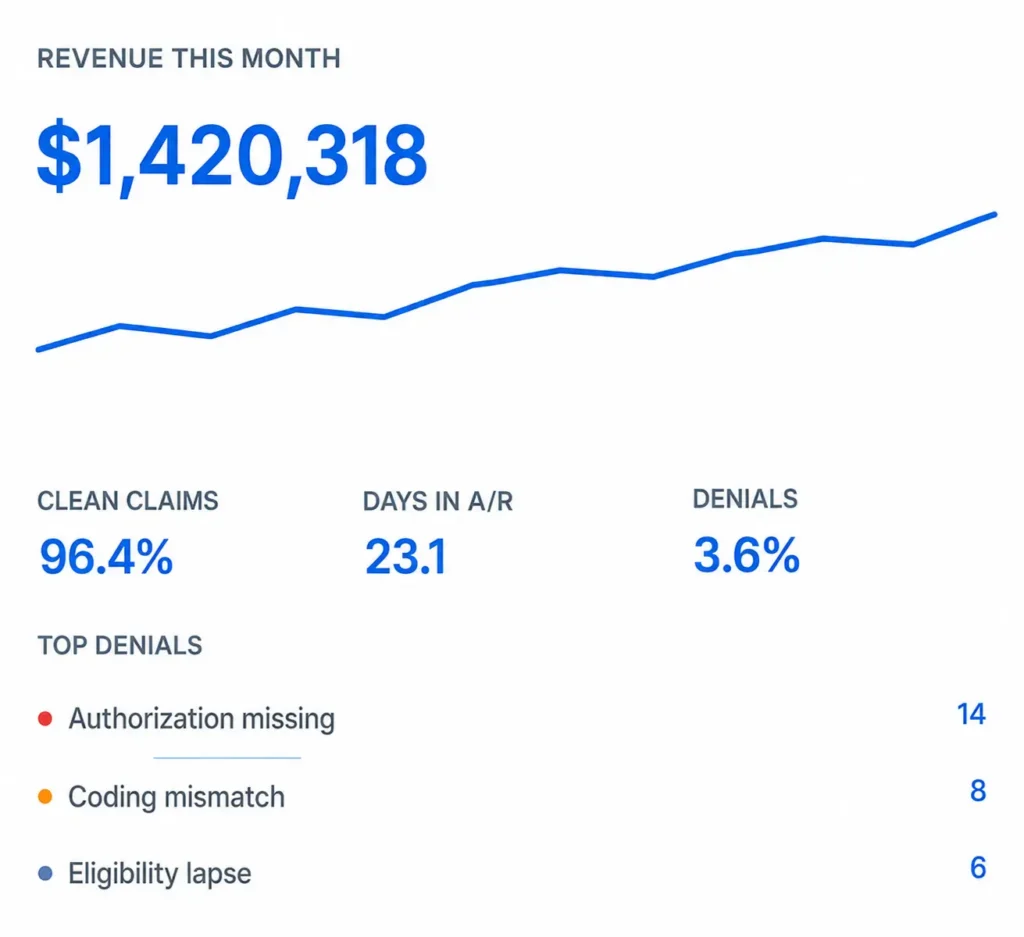
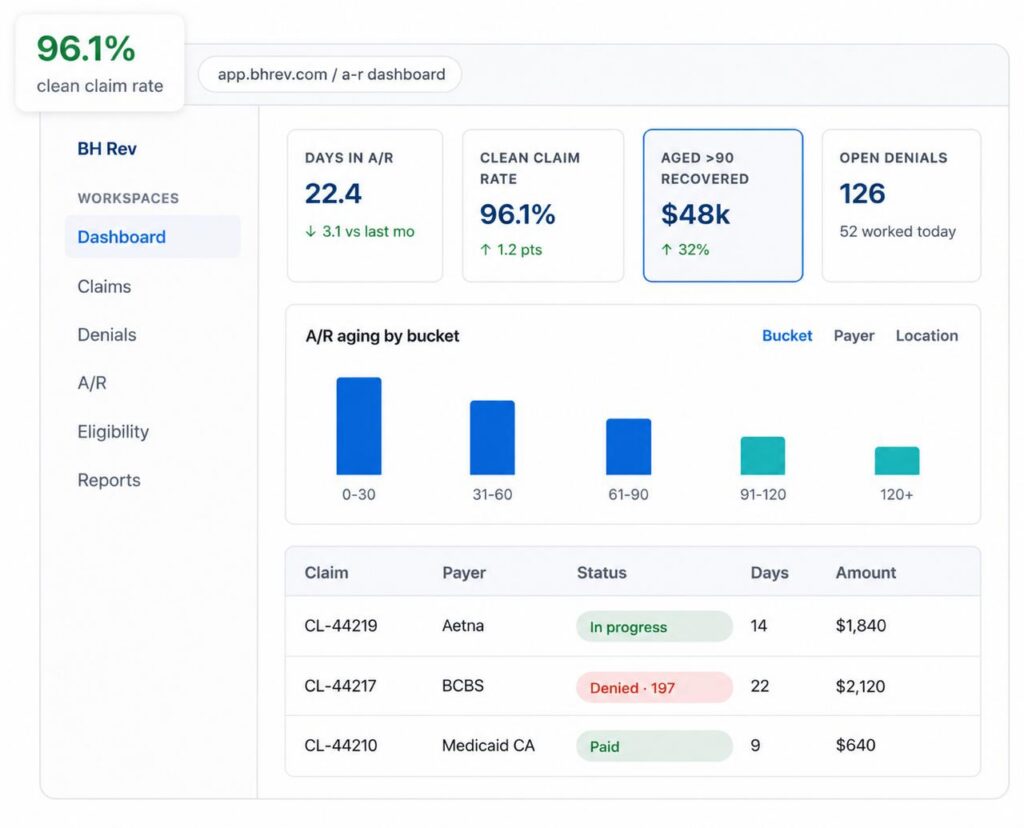
For outpatient behavioral health, most of what a practice collects is decided before and during coding, not in collections. Coverage changes constantly, so benefits and coordination of benefits have to be verified before each episode of care, or claims deny for eligibility and secondary payers get missed. Each session has to carry the correct time-based code and diagnosis, and telehealth visits need the right place of service, in the home, outside the home, or in the office, with the correct audio-video or audio-only modifier, or payers reject them. Credentialing matters just as much, because a licensed clinician who is not enrolled with the payer is denied no matter how good the note is. BH Rev runs these eligibility, coding, and telehealth checks before claims go out and works the denials that still happen through behavioral health denial playbooks and scrubbing rules built for outpatient claims, the payer-specific knowledge a general medical biller does not carry.
Outpatient is where many behavioral health clients continue care after a partial hospitalization or intensive outpatient program, and it is usually the longest billing relationship a practice has. At the step-down, coverage often has to be re-verified and any required authorization re-obtained for the new level of care, because the visit type and the plan’s rules change. In the months that follow, recurring weekly or biweekly sessions produce a steady stream of lower-dollar claims, and coordination of benefits shifts as plans renew and secondary coverage changes. Commercial plans, Medicaid, and Medicare each cover outpatient behavioral health under their own authorization and documentation rules, so an active outpatient book usually spans several payers at once. A biller that already handles every behavioral health level of care can re-verify coverage at each step-down and keep those recurring claims current, rather than treating outpatient as a separate book.
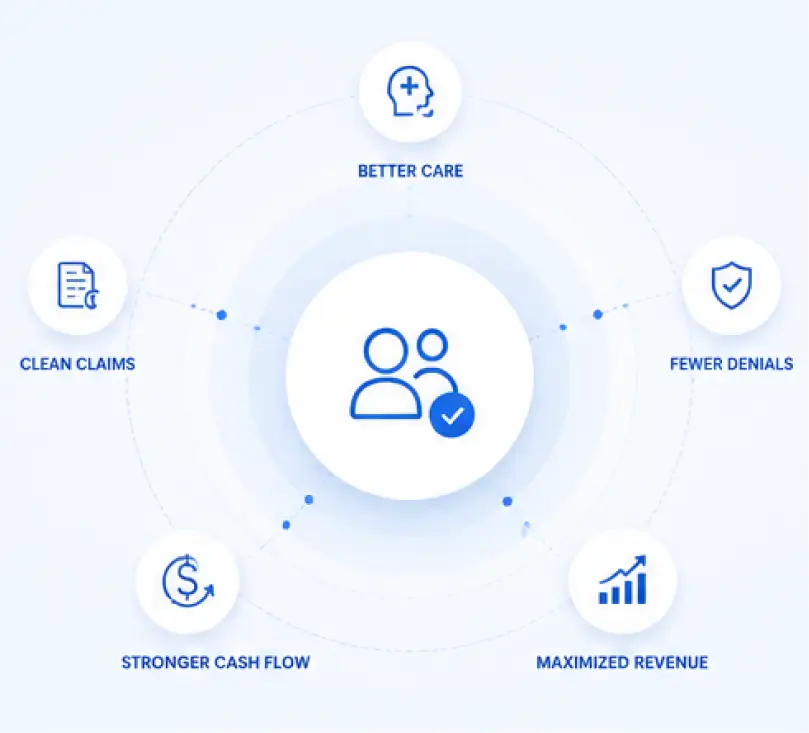

The right outpatient billing partner is a behavioral health specialist you can hand the entire revenue cycle to, from credentialing and payer enrollment through collections, with one named team accountable for the numbers instead of a chain of vendors where small claims fall through the handoffs. Behavioral health billing also carries obligations general medical billing never sees, including HIPAA and the 42 CFR Part 2 confidentiality rules that protect substance use treatment records, so the team handling those claims has to be built for behavioral health from the start. A strong partner gives the practice real visibility, a monthly scorecard and live dashboards that show clean claim rate, days in accounts receivable, denials, and every claim in flight, and connects to the EHR the practice already uses instead of forcing a change. When you evaluate a service, ask whether it works only in behavioral health, whether it handles eligibility, telehealth coding, and denials or simply submits claims, and how it will take over your outpatient book without dropping a claim.