
Handing off your billing does not have to mean handing off the visibility. We take over as much of your mental health revenue cycle as you want, from credentialing and eligibility through coding, denials, and collections, and run it on our own behavioral health billing platform. Give us everything, or start with the one stage that keeps backing up, and watch every claim move the whole way through.
Just the opposite. Most practices end up seeing more than they did when billing was in-house. Your leadership keeps every decision, while a named team does the work in the open: dashboards that show each claim and each pending authorization, and a monthly scorecard you can question line by line. Outsourcing moves the work off your desk, not the visibility.
Because mental health does not bill like general medicine. Time-based psychotherapy codes, session and visit limits, prior authorization for higher levels of care and psychological testing, telehealth place-of-service rules, and parity-based appeals are everyday work for a behavioral health team and edge cases for a general one. We bill behavioral health and nothing else, so those rules sit at the center of the job, not off to the side.
We do both, so the honest answer is that it depends on what you want. If you would rather be out of billing completely, we become the department and run it end to end. If you have a biller you rely on, we slot in behind them on just the trouble spots, most often prior authorizations, denials, and receivables that have gotten old. You tell us which of those two you are, and we build around it.
Usually right away, because the backlog is where the fastest wins are. Old receivables and denials nobody has worked are money still on the table, so once the free audit shows us the shape of it, we start with your oldest and most stuck claims. The routine day-to-day work then moves over in phases, which keeps current billing flowing while the older mess gets cleaned up.
Usually yes to both. Your team can keep working in whatever behavioral health EHR and practice-management tools it already has; where our own platform comes in, it links up with those systems instead of asking you to switch. On the security side, every claim is handled under HIPAA, plus the extra 42 CFR Part 2 confidentiality protections that kick in whenever substance use treatment records are involved. The audit call is where we confirm exactly how all of that maps to your setup.
Outsourcing mental health billing means handing your full revenue cycle to a team that bills only behavioral health, so verification of benefits, prior authorization, coding, claim submission, denial management, accounts receivable follow-up, and patient billing get run for you instead of by you. It pays to use a specialist because mental health does not bill like general medicine. Reimbursement runs on time-based psychotherapy codes, 90791 and 90792 for evaluations, 90832, 90834, and 90837 for individual sessions, 90846 and 90847 for family, 90853 for group, and 90839 and 90840 for crisis, plus psychological testing in the 96130 range, and the code has to match the session length and the documentation every time. Higher levels of care and testing usually need prior authorization, telehealth visits carry their own place-of-service codes and the 95 modifier, and many denials turn on mental health parity. Handed to a specialist, that whole cycle runs off your desk while the coding and authorization rules that trip up general billers get handled as routine.
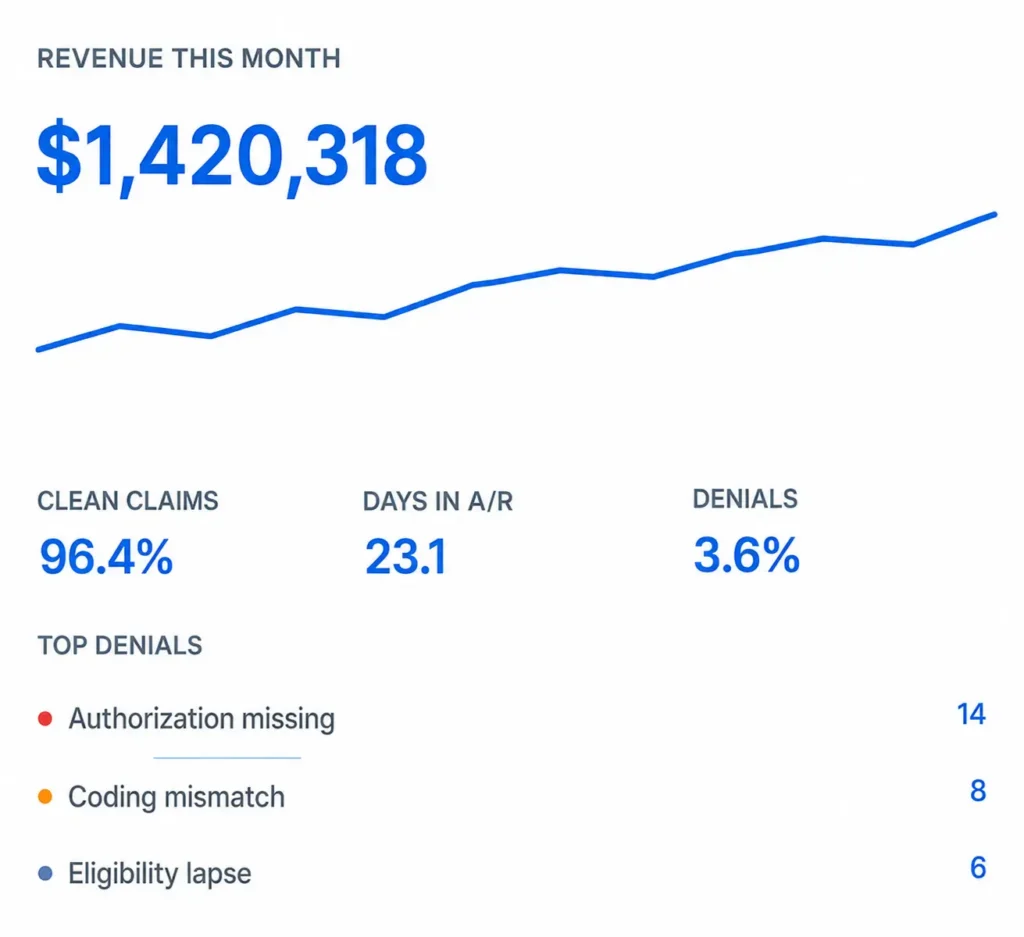
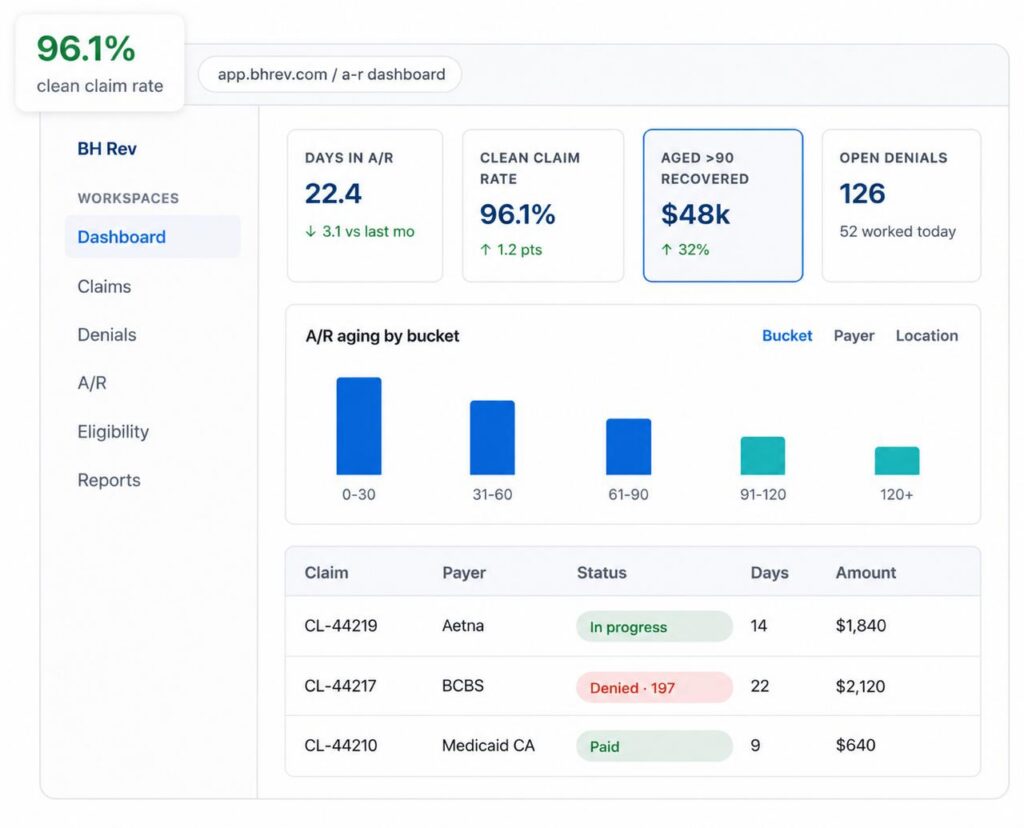
For a mental health practice, the in-house-versus-outsourced question usually gets decided by what happens the week the one biller is out. Authorizations lapse mid-treatment, a concurrent review gets missed, and by the time anyone notices, carve-out claims have aged past timely filing. That fragility is the real cost of keeping billing in-house, on top of the salary, the benefits, and the billing software a single hire carries. An outsourced behavioral health team removes that single point of failure. The work keeps moving when someone is on leave, parity and medical-necessity denials get appealed rather than left sitting, and capacity grows as you add clinicians and new levels of care without another biller to hire and train. It also changes what you can see: instead of one person’s spreadsheet, you get a monthly scorecard and a named team you can put questions to directly. What running it this way costs is set out in the pricing and packages guide.
The claims a mental health practice files run through rules a general medical biller rarely has to touch, and that gap is where revenue leaks out. Much mental health coverage sits with managed behavioral health carve-outs, payers such as Optum, Carelon, Magellan, and Evernorth, and each sets its own authorization and medical-necessity bar. Intensive outpatient and partial hospitalization are measured against criteria like LOCUS or a payer’s InterQual or MCG guidelines, with concurrent reviews that have to stay current while a client is still in care. Denials frequently hinge on mental health parity, which is the legal footing for appealing them, and any records that touch substance use fall under the 42 CFR Part 2 confidentiality rules on top of HIPAA. A behavioral-health-only biller already works from those rules, so authorizations are secured up front and parity denials get appealed instead of written off.

Switching your mental health billing to an outside team is safe when the handoff happens in stages that protect every open claim and authorization, rather than all at once. A good partner starts by auditing your current billing, then works your oldest receivables and stuck denials first, since that is where the recoverable money is sitting, and keeps the existing and new work running in parallel while it learns your payer mix and authorization patterns. Credentialing and payer enrollment should come across in the same move, so a new clinician is not left unbillable for months while enrollment sits open. As you compare partners, look for a team that works only in behavioral health, that actually works authorizations and denials, that reports back with a scorecard and a named contact, and that fits inside the systems you already use. Mapping that handoff to your own practice is what a consultation is for.