
Our billers run your PHP revenue cycle on a platform built for behavioral health, carrying each day from verification and authorization through denials and aging A/R. Give us the whole partial hospitalization cycle from credentialing to collections, or start with the single piece draining your program right now.
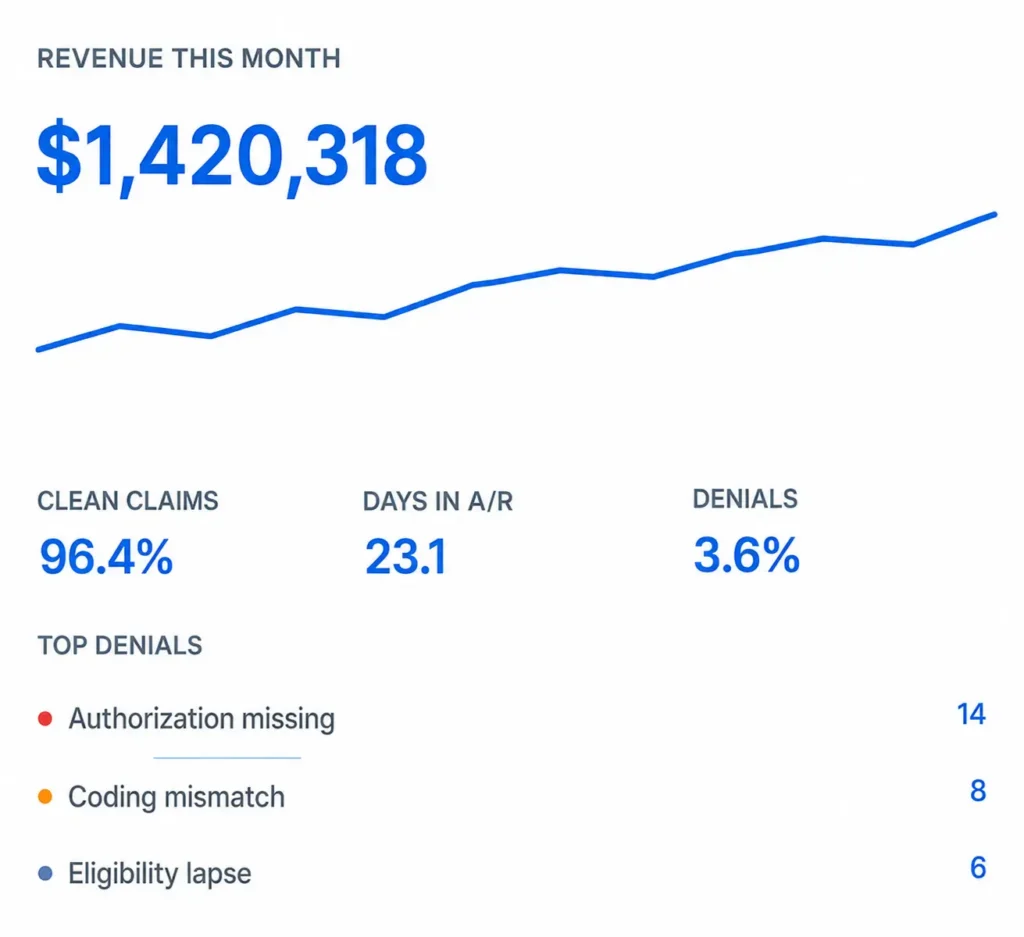
No, you usually end up seeing more than you did in-house. Your program keeps the final call on every decision while we handle the work, and you watch it happen through assigned billers you can reach directly, dashboards that show each claim and open authorization in real time, and a monthly executive scorecard on the numbers a program director tracks.
This is where partial hospitalization billing is won or lost. We confirm benefits and secure authorization before admission, track concurrent and continued-stay reviews against the treatment plan while the client is still in the program, and keep the medical-necessity documentation lined up with the level of care being delivered. Getting the authorization and the documentation right up front is what prevents those denials in the first place.
Level-of-care downgrades are one of the most common pressures on partial hospitalization claims. We document medical necessity against the payer's own criteria, keep concurrent reviews current, and appeal downgrades with the clinical record behind them. When a step-down to intensive outpatient is genuinely appropriate, we bill the transition cleanly so a change in care does not have to become a lost claim.
You choose the scope. Plenty of programs move their whole PHP cycle to us; plenty of others keep the biller they have and route only the pieces that have piled up, usually credentialing, denials, or aged A/R, to our team. Whatever split you want, we build around it.
Usually right away, because your backlog is where the fastest recoverable dollars sit. We open with a billing audit, work the oldest buckets and any open authorizations first, then bring the ongoing PHP cycle over in stages, one piece at a time, so collections keep moving throughout.
Partial hospitalization billing services run the full revenue cycle for a partial hospitalization program: verification of benefits, prior authorization, coding, claim submission, denial management, accounts receivable follow-up, and patient billing, built for how PHP is actually reimbursed. Partial hospitalization is a defined level of care, generally at least twenty structured treatment hours a week across five or more days, and it is usually billed as a per diem, a single daily rate that bundles the day’s group, individual, and family programming rather than itemizing each service, filed on a UB-04 institutional claim. That per-diem structure is reported with a partial-hospitalization revenue code in the 091X behavioral health series and a per-diem HCPCS code such as S0201 or H0035, and payers layer their own coverage rules on top of it, with Medicare requiring physician certification of the level of care and condition code 41 on the institutional claim before it will pay. A billing team that works only in behavioral health codes each partial hospitalization per-diem day to the level of care actually delivered and documented. The practical consequence is that the whole bundled day stands or falls on a single claim, so the authorization, the certification, and the documentation all have to be right before it goes out, because there is no per-session line left to recover if the day is denied.
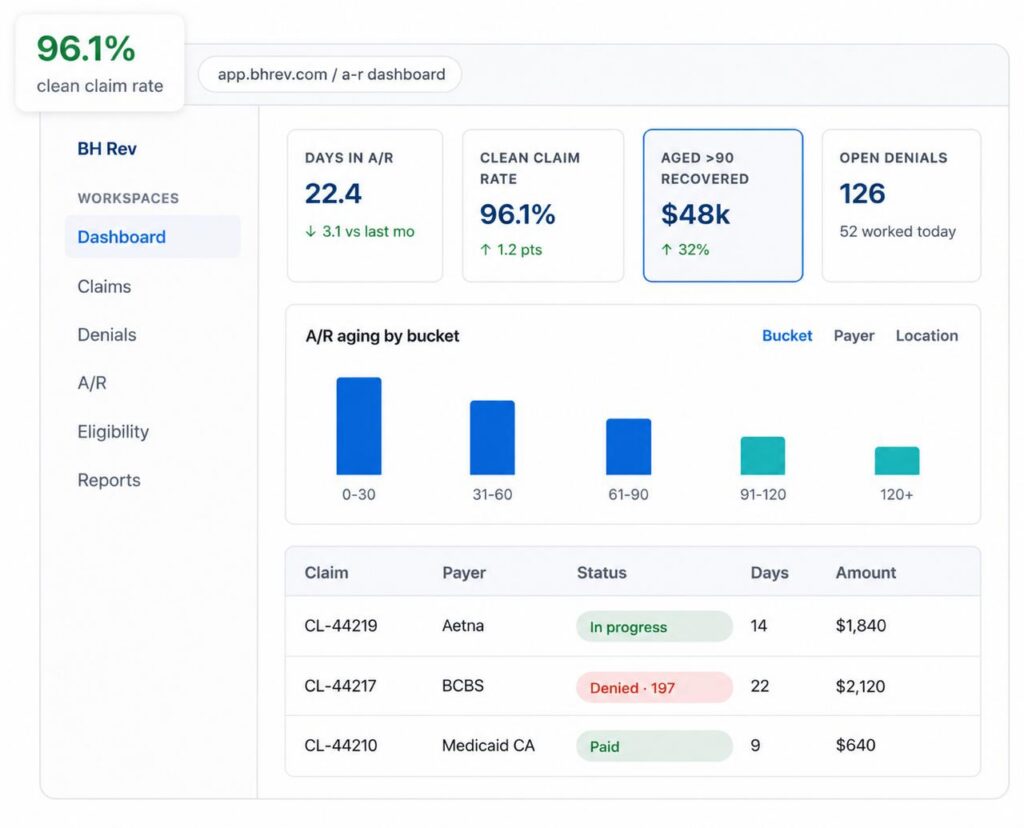
Authorization and medical-necessity documentation are the levers that determine whether a partial hospitalization claim gets paid, so PHP billing depends on verifying benefits, securing authorization before admission, and keeping continued-stay authorizations current while the client is still in the program. Because partial hospitalization sits just below inpatient and residential care, payers scrutinize it and run frequent concurrent reviews, judging medical necessity against published criteria: the ASAM Criteria for substance use, where partial hospitalization maps to Level 2.5, and LOCUS or a payer’s InterQual or MCG guidelines for mental health. Two preventable failure modes recur on PHP claims, a continued-stay review that lapses while care is still being delivered and a claim that misses the payer’s timely-filing window during a drawn-out authorization back-and-forth, and a third pressure is the payer that pushes to step the client down to intensive outpatient. A team that already knows these payer rules and the denial patterns behind them, rather than a general biller meeting them for the first time on your claims, is what turns a concurrent review into an approved day instead of a downgrade. When an appeal is needed, it argues the clinical record against the criteria the payer applied, supported where it fits by the federal Mental Health Parity and Addiction Equity Act.
Partial hospitalization rarely stands alone in a client’s care, and the handoffs between levels of care are where billing quietly breaks, because each step is a new authorization, sometimes a new code set, and a new medical-necessity justification. A client may step down from detox or residential into a partial hospitalization program, then into intensive outpatient and standard outpatient, and a re-authorization missed or delayed at any one of those handoffs can lose an otherwise payable day. The payer mix compounds it, because commercial plans, state Medicaid programs, and Medicare each cover partial hospitalization under their own authorization and documentation rules, so a program admitting clients across several states and plan types is effectively billing several rule sets at once, with out-of-network episodes often riding on single case agreements. Handling that well means one behavioral health team treating every level-of-care change as its own billing event and opening the authorization for the next level before the current one closes, so the day a client moves is billed cleanly instead of falling into the seam between two programs.
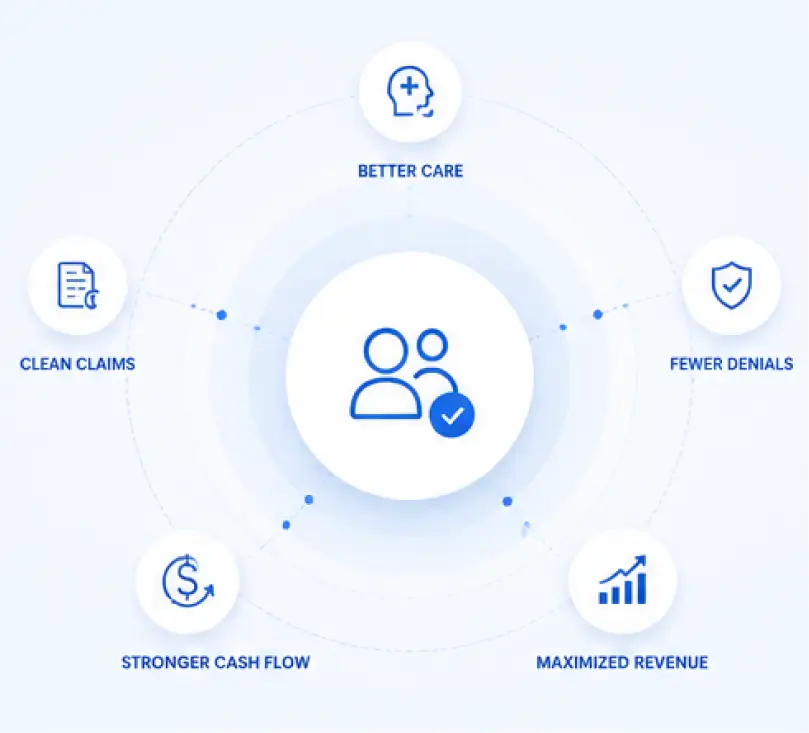

The right partial hospitalization billing partner is a behavioral health specialist that runs the whole revenue cycle, credentialing through collections, and can prove what it is doing with your claims, not a general biller that only files claims and forwards the denials back to you. A program can test that in a few questions. Does the vendor work only in behavioral health, since the per-diem rules, the concurrent-review patterns, and the level-of-care appeals are exactly the parts a generalist gets wrong. Does it actually work authorizations, concurrent reviews, and appeals, or does it stop at submission. Partial hospitalization billing also carries obligations general medical billing never has to weigh, including HIPAA, a signed business associate agreement, and the 42 CFR Part 2 rules that protect substance use records, so a partner not built for behavioral health is a compliance exposure before it is a billing one. Then ask the question that matters most: how would it take over your open authorizations and aged claims without dropping one mid-transition, and how would it show you the result, every claim and open authorization in the open rather than a monthly summary you cannot question.