
Your program fills beds and runs groups. Whether a claim actually gets paid comes down to authorizations, level-of-care rules, and payer behavior that general medical billers were never built for. We can run your whole revenue cycle for you, on a billing platform built around behavioral health, everything from credentialing and coding to denials and collections, or step in on just the stage where your revenue is stalling.
No, and most programs come away with more oversight than they had in-house. You work with the same billers every time, not a rotating pool, you can pull up any claim and see exactly what is outstanding, and once a month you get an executive scorecard on the whole operation. The decisions stay yours. We run the work and put all of it in front of you.
We treat authorization as an ongoing control on dates and units, not a one-time admission task. We track approved days and units against the active treatment plan and flag continued-stay reviews before they lapse, so a detox or residential claim does not get denied for care that continued past the approved window.
Yes. We bill detox and residential on their per-diem and bundled rules, PHP and IOP on session-frequency and utilization limits, and outpatient and medication-assisted treatment on volume, place-of-service, and coordination-of-benefits rules. We also watch the transitions between levels, which is where a lot of addiction treatment revenue quietly leaks.
Yes. Credentialing and payer enrollment are part of the service: CAQH, applications, the re-credentialing calendar, and roster management. Getting a program in-network with the right payers is usually where the durable revenue is, and it is where we focus.
Carefully. Our reps are trained for behavioral health, and patient billing is built around keeping people in care: clear statements, online payment, and payment plans that do not force a choice between a balance and treatment.
Substance abuse billing services run the full revenue cycle for an addiction treatment program: benefits verification, provider credentialing, authorization, level-of-care coding, claim scrubbing and submission, denial work, aged A/R recovery, and patient billing. BH Rev runs all of it on one behavioral health platform, so every claim stays visible from intake through payment on a single monthly executive scorecard. Two things make substance use disorder claims their own animal. First, SUD records fall under 42 CFR Part 2, a federal privacy rule stricter than HIPAA that requires patient consent before those records can be disclosed, so our benefits team builds that consent into verification instead of tripping over it after a claim is out the door. Second, payment turns on medical necessity matching a documented level of care, which means a plan that says behavioral health is covered is not the same as a payable claim. A team that only bills behavioral health checks both before the claim goes out, at intake.
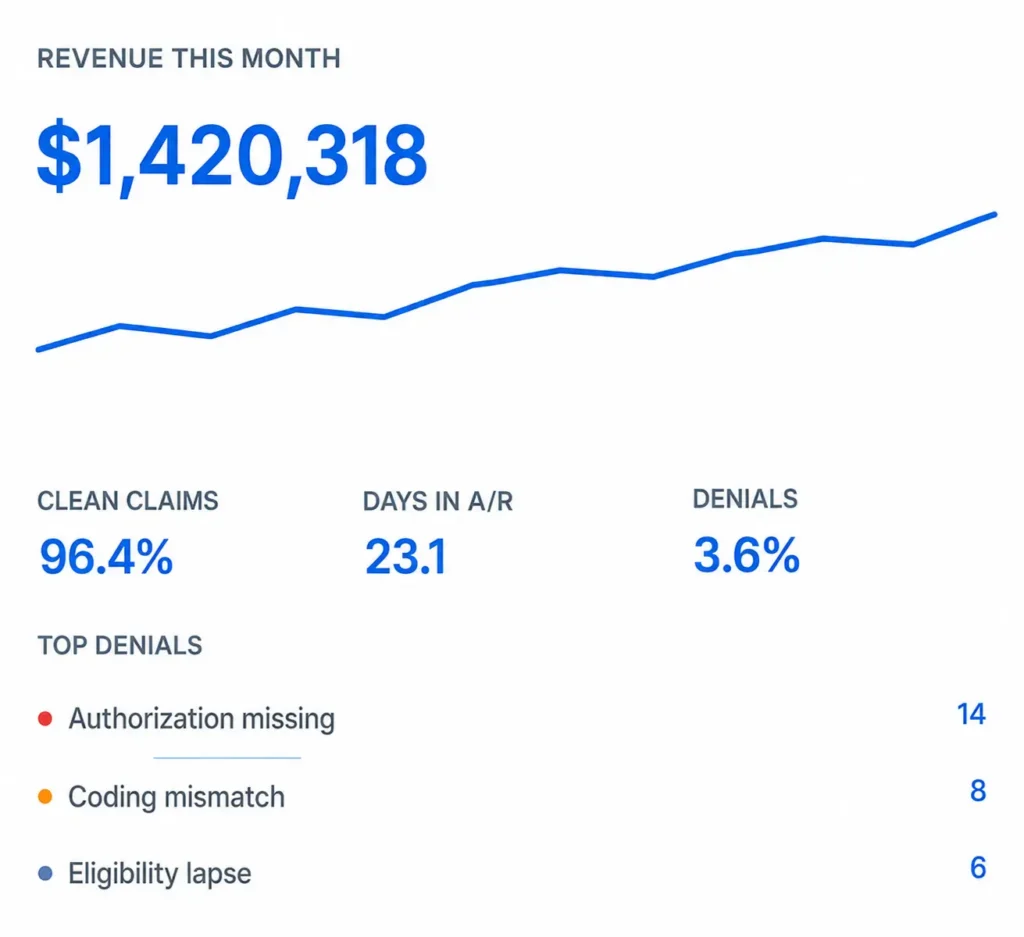
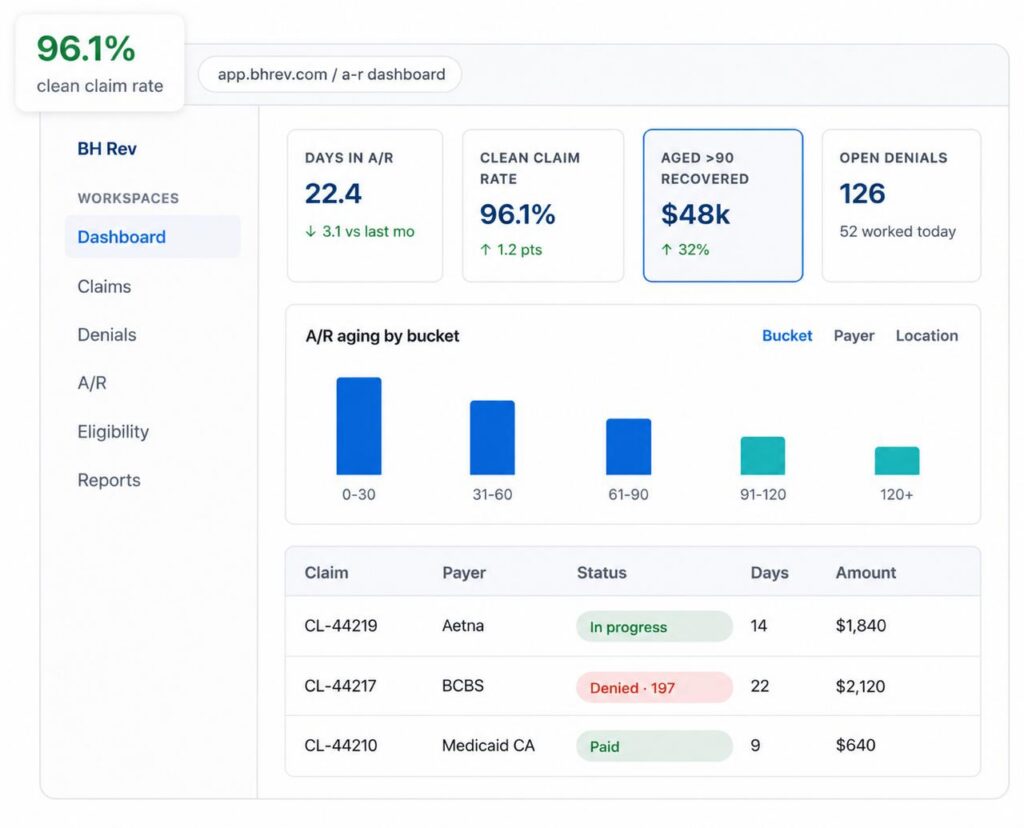
For detox, residential, PHP, and IOP, a payer approves a set number of days or units up front and then requires a concurrent or continued-stay review to extend them. Denials pile up when care keeps going past the approved window because the clinical notes, the utilization-review dates, and the billed dates no longer line up. A named, behavioral-health-trained team at BH Rev tracks approved days and units against the active treatment plan and flags each continued-stay review before it lapses, so the level of care that was authorized is the level of care that gets billed. On a longer detox or residential stay, that review can recur several times, and each one has to be documented and billed to match the exact days the payer approved.
Detox and residential are billed mostly on per-diem and bundled rates, and those days are tied to concurrent authorization review that can shorten an approved stay partway through. Step down to PHP or IOP and the rules change: now it is session-frequency and utilization limits that decide whether a week of programming is a clean claim. Outpatient and medication-assisted treatment shift again, toward visit volume, telehealth place-of-service codes, and coordination of benefits when a patient carries more than one plan. Each time a patient moves between levels, the payer wants a fresh authorization and matching documentation, and a claim that still carries the prior level of care gets denied. BH Rev’s behavioral health scrubbing rules check the level of care on each claim against the authorization on file before it goes to the payer.

Recovery starts with triage. A specialized substance abuse billing team sorts aged A/R by what is actually collectible and works the oldest recoverable claims first, rather than reworking everything at once. BH Rev pairs that with behavioral health appeal playbooks for the denials worth fighting, and with credentialing and payer enrollment that move a program in-network, where the steadier revenue sits. Patient balances get handled with the same care the clinical side expects. Reps trained in behavioral health work the statements, and payment plans are set up so a balance never becomes the reason someone leaves treatment. The free billing audit is where most programs start: it reviews the current book of denials and aged claims and identifies what is still collectible.