
Home / Revenue Cycle Management Checklist for Behavioral Health Practices

Behavioral health practices often face unique billing challenges due to frequent sessions, complex coding, and higher denial rates compared to general medicine.
Here’s what you need to know:
High Denial Rates: Mental health claims are denied 15%-25% of the time, compared to 8%-12% in general medicine. Up to 65% of these denials go unappealed, resulting in permanent revenue loss.
Documentation Issues: Time-based CPT codes (e.g., 90832, 90834, 90837) require precise session times. Vague notes like “about an hour” can lead to downcoding, costing up to $35 per claim.
Authorization Challenges: Behavioral health services need prior authorization 5.4 times more often than other medical services.
Preventable Errors: Mistakes during patient intake, such as missing carve-out payers, can cost practices thousands monthly.
The solution?
A structured checklist for every stage of revenue cycle management – from patient intake and eligibility checks to claim submission and denial appeals. Practices that implement these processes can achieve clean claim rates of 95%+ and keep denial rates below 5%.
This guide breaks down actionable steps to streamline billing, improve documentation, and recover lost revenue effectively.
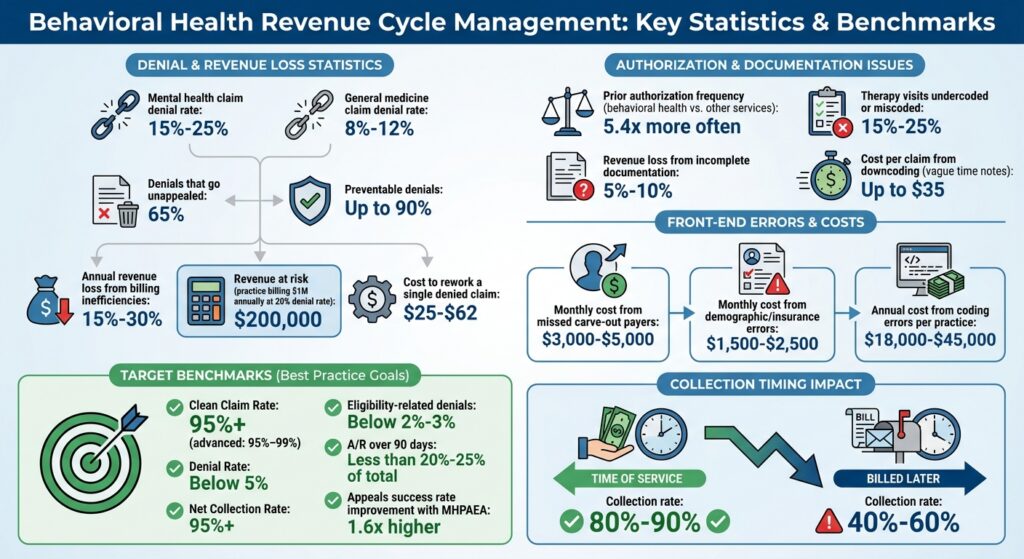
Preventable denials often come down to errors in front-end data.
Mistakes made during intake – like incomplete or inaccurate information – are one of the biggest culprits behind claim denials [9].
For example, failing to identify a behavioral health carve-out can cost $3,000 to $5,000 in billing errors each month, which might not even surface for 30 to 60 days [12].
Similarly, demographic and insurance data mistakes during scheduling can rack up $1,500 to $2,500 in monthly claim issues [12].
Addressing these early errors is essential for maintaining a smooth revenue cycle, hitting clean claim rates, and keeping denials low.
The key lies in verifying patient information at every stage.
This means capturing complete details during scheduling, double-checking eligibility 48 to 72 hours before appointments, and staying on top of prior authorizations. Below are actionable steps to improve data accuracy and streamline authorization processes.
Start by collecting the essentials: full legal name, date of birth, Social Security number, address, and contact preferences.
These details are crucial to avoid rejections [2][10]. Train front-desk staff to record insurance details – like member ID, group number, and subscriber relationship – exactly as they appear on the insurance card [2].
Pay special attention to behavioral health carve-outs. These benefits are often managed by separate entities.
Look for behavioral health logos (e.g., Magellan, Optum Behavioral Health, or Carelon) on the back of the insurance card to ensure claims go to the correct payer.
To reduce errors, standardize data entry in your EHR system. Use mandatory fields for critical information like date of birth and member ID [2].
During intake, also collect signed financial responsibility forms, HIPAA privacy notices, and releases of information [2][10].
Gathering clinical context – such as reasons for seeking treatment, past behavioral health history, and current medications – can also help support documentation of medical necessity later on [10].
Once patient data is complete, shift your focus to verifying insurance details. Checking eligibility only at intake isn’t enough.
Reverify coverage 48–72 hours before each appointment to catch any changes, lapses, or deductible resets [4]. This “72-Hour Gatekeeper Protocol” ensures you’re aware of any coverage shifts before the patient arrives.
For behavioral health, eligibility checks go beyond confirming active coverage. Verify session limits, authorized CPT codes, and telehealth guidelines. Ask payers about specific mental health payers, outpatient versus intensive outpatient (IOP) coverage, and concurrent treatment policies [13].
Create quick-reference sheets for major payers.
These sheets should outline authorization requirements, common exclusions, and documentation needs [13]. Enter benefit details into structured EHR fields instead of free-text notes to make it easier to track patients nearing their visit limits [13].
Set triggers to reverify benefits at key moments – like the start of a new calendar year, after a job change, or before beginning intensive services like IOP or partial hospitalization (PHP) [3].
Use your scheduling software to enforce an “Auth-Lock Protocol”, which blocks scheduling if there’s no active authorization on file [4]. This ensures that appointments can’t move forward without proper approvals.
Prepare detailed packets for authorization reviews. Include DSM-5 diagnoses, objective severity scores (e.g., PHQ-9, GAD-7), and a clear rationale for the level of care, using frameworks like ASAM [14][6]. Incorporate findings from all six ASAM dimensions to meet payer review criteria [6][16].
Start reauthorization when 25% to 30% of authorized units remain or 14 days before the current authorization expires [14][13][4]. Set system alerts 5 to 7 days before expiration to ensure timely submissions [6][16].
Maintain a detailed grid showing which services (e.g., 90837, IOP, PHP) require prior authorization for each payer and plan [14][15].
Organizations with mature processes often keep their “no-auth” denial rates under 1% [14].
Incomplete documentation can lead to revenue losses of 5%–10%, often due to downcoding, recoupments, or denials from insufficient details [3].
Audits reveal that 15%–25% of therapy visits are either undercoded or miscoded [18]. To address this, clinical notes must clearly connect symptoms, interventions, and outcomes.
Record precise session times – use specific start and stop times like “1:00 PM to 1:45 PM” instead of just noting the duration. Configure your EHR to require clock times before allowing note closure. Beyond timekeeping, include these essential details in each note:
The therapy modality used (e.g., CBT, DBT)
The patient’s response to the intervention
A risk assessment
Any updates to the treatment plan [3]
Tie your documentation directly to DSM-5 diagnoses. For example, when coding a chronic condition, avoid labeling it as a single mild episode [17]. Always specify symptom severity, functional impairments (e.g., at work or home), and clinical risks in your notes [13]. Avoid vague phrases like “patient made progress”, as payers may question the medical necessity. Similarly, steer clear of repetitive or “cloned” notes, which could suggest a lack of individualized care [2].
Here’s a quick reference for session duration requirements using CPT codes:
|
CPT Code |
Service Description |
Time Threshold |
|---|---|---|
|
90832 |
Short Psychotherapy |
16–37 minutes |
|
90834 |
Standard Psychotherapy |
38–52 minutes |
|
90837 |
Extended Psychotherapy |
53+ minutes |
Accurate timekeeping is the foundation for proper coding and reimbursement.
Clinical documentation must not only record session times but also justify the care provided. Medical necessity requires more than a checkbox – it demands a clear narrative. Each note should explain why the service was needed on that day and detail the specific interventions provided. For extended sessions (90837, 53+ minutes), include justification for the additional time and describe the extra interventions performed [17]. Embedding prompts in your EHR, such as “Why was extended time clinically necessary today?” can help ensure thorough documentation.
Establish standards for diagnosis-driven documentation by defining baseline assessment content and key elements for follow-ups. For instance, documentation for mood disorders may differ from that for substance use cases [13]. Every session note should reference the treatment plan goals addressed and provide a rationale for the session’s frequency and duration [18]. Regular internal audits – reviewing 10–20 charts per provider – can help ensure compliance with payer standards.
Proper session segmentation is critical for accurate coding and billing. Only face-to-face time is billable for psychotherapy – time spent on pre-visit chart reviews or post-visit documentation doesn’t count [18]. When billing for both medication management and therapy in the same visit, separate the note into distinct sections:
The “Medical E/M” section should cover history, medications, and labs.
The “Psychotherapy” section should focus on the therapeutic modality, session content, and time spent.
Use a modifier (typically -25) on the E/M code to signal it as a separate service.
For crisis services (90839/90840), ensure your documentation includes details about the triggering event, interventions, collateral calls, and disposition. Keep an eye on provider billing patterns – if one clinician codes 90837 for 90% of their sessions while peers average 30%, this could trigger payer scrutiny [17]. Configuring your EHR to suggest the correct CPT code based on start and stop times can minimize errors and improve accuracy [17][18].
Accurate charge capture and coding are fundamental to protecting your revenue stream. These steps, following effective documentation and streamlined front-end processes, ensure your revenue cycle management stays on track. Did you know coding errors can cost behavioral health practices between $18,000 and $45,000 annually? These losses often stem from mistakes in time thresholds, diagnosis specificity, or service intensity [19]. Here’s a critical reminder: your ICD-10 code must always justify the intensity of the CPT code you’re using [19].
Precision matters with time-based codes. For example, documenting a 52-minute session as CPT 90837 would be considered upcoding since this code requires at least 53 minutes of face-to-face time [19]. To avoid such errors, ensure your EHR records exact session times (e.g., “2:15 PM to 3:08 PM”) to help determine the appropriate charge capture code. Using an automated time-to-CPT crosswalk can further simplify this process by suggesting the correct code based on the session’s duration [17].
Specificity in diagnosis is equally important. By the third visit, your documentation should clearly establish both the severity and chronicity of the condition to avoid issues with flagged ICD-10 codes, such as F32.9 [19]. Tools like the PHQ-9 can support your coding decisions. For instance, a score of 15 or higher aligns with a severe major depressive disorder code (F32.2), while scores between 10 and 14 indicate moderate severity (F32.1) [19].
Be mindful of outlier billing patterns. For example, if one clinician codes 90837 for 90% of their sessions while peers average around 30%, payers may scrutinize this discrepancy [17]. Regular internal audits can help ensure coding patterns align with practice norms. Also, confirm that CPT codes match provider licensure – psychologists, for example, should avoid billing for medication management codes like 90792 [6]. Lastly, include the correct modifiers to add essential details about service delivery.
Modifiers provide additional context about how and where services were delivered. For example, the HQ modifier is used for group therapy sessions, which typically have lower reimbursement rates than individual sessions [20].
Certain modifiers are program-specific and can distinguish overlapping services. For example, use HF for substance abuse programs and HE for mental health programs when the same codes apply to both populations [20]. Some state Medicaid programs even define unique U1-U9 modifiers, so maintaining a payer-modifier matrix for your top insurers can be helpful [20].
To reduce manual errors, consider embedding logic into your EHR. For instance, when scheduling a “Telehealth-Home” appointment, the system could automatically assign the correct Place of Service code and any necessary modifiers.
Telehealth services come with their own coding guidelines, particularly for Place of Service (POS) codes and modifiers. Use POS 10 for sessions conducted from a patient’s home and POS 02 for other locations [21].
Modifiers also play a key role. Most commercial payers require Modifier 95 for synchronous audio-video telehealth services, while some older Medicare plans still use GT [21]. For audio-only sessions, when permitted, apply Modifier 93 [4].
Documentation is critical for telehealth claims. Make sure to include patient consent, the technology platform used, the locations of both participants, and precise session start and end times [21]. Many payers delegate behavioral health billing to third-party managers, such as Optum or Magellan, so check insurance cards for carve-out logos to submit claims correctly [4].
While Medicare has extended audio-only telehealth options for mental health through 2026, commercial payer rules can vary. Training your front-desk staff to perform real-time eligibility checks 72 hours before appointments can help catch changes in telehealth coverage. Additionally, payers are increasingly using AI to flag missing details, such as functional impairment language or cloned notes. Pairing telehealth codes with quantified assessment scores can further validate medical necessity [4]
After ensuring accurate charge capture and coding, the next step in protecting your revenue is proper claim submission and actively working to prevent denials. Behavioral health organizations often lose 5% to 10% of potential revenue due to claim denials, with industry-wide denial rates ranging from 15% to 25% [22][4]. The upside? Up to 90% of denied claims can be avoided [23]. The key is catching errors before the payer does.
Every claim should be meticulously reviewed before submission. Start by verifying patient demographics – name, date of birth, and member ID – to ensure they perfectly match the payer’s records. Even a small typo, like a swapped digit, can lead to an immediate rejection [2]. Confirm that behavioral health benefits are active, as mental health coverage is often managed by separate entities like Optum or Magellan, which standard medical checks might miss [2][6].
Make sure the prior authorization number in Box 23 matches the billed CPT codes and units exactly. Configuring your system to block claims without this field completed can save time and prevent rejections [2][6]. Check that CPT codes align with session times and that ICD-10 diagnosis pointers are correctly linked to each service line [6][13]. Also, verify rendering provider NPIs, taxonomy codes, and credentialing status for each payer [2][6].
Automated tools, like National Correct Coding Initiative (NCCI) edits, can help flag bundling conflicts [6]. For telehealth claims, double-check that modifiers (95 or GT) and Place of Service codes (02 or 10) meet payer requirements [2][6]. Lastly, ensure progress notes are signed and include start and stop times for time-based codes [2][13]. Submitting claims daily allows you to quickly identify and fix any issues [22].
Beyond these steps, addressing common denial triggers can significantly reduce claim rejections.
Eligibility issues are the most frequent cause of preventable denials [4]. Train front-desk staff to carefully review insurance cards for behavioral health carve-out logos – this simple habit can prevent claims from being sent to the wrong payer and missing filing deadlines [4]. Conduct eligibility checks 72 hours before appointments to catch potential issues early [4][24].
Errors in time-based coding are another common problem. Ensure session times meet CPT requirements to avoid upcoding flags [4][24]. Payers like Optum and Aetna now use AI to monitor 90837 usage, so always document exact start and stop times in session notes [4]. Medical necessity denials (CO-50) often occur due to vague progress notes or cloned templates. Include measurable assessment scores, such as PHQ-9 or GAD-7, and clearly link diagnoses to treatment goals with specific outcomes [4][24].
Credentialing lapses (CO-252) are another frequent cause of denials. These occur when CAQH profiles aren’t attested or provider licenses expire. Set reminders 30 days before attestation deadlines to avoid disruptions. For a practice billing $1 million annually, a 20% denial rate puts $200,000 in revenue at risk. Reworking a single denied claim can cost between $25 and $62 [4], making prevention critical. Aim for a clean claim rate of 90% to 95% to keep operations running smoothly [1][6].
Once these triggers are addressed, keeping a close eye on claim status helps resolve any remaining issues quickly.
It’s important to distinguish between rejections and denials. Clearinghouse rejections should be fixed the same day, while adjudicated denials require formal appeals [2].
Use tools like Electronic Data Interchange (EDI) and Electronic Remittance Advice (ERA) to track payments in real time and catch underpayments or delays immediately [6][11]. Maintain a centralized denial tracker that logs payer details, denial codes (CARC), service types, providers, and root causes [13][11]. This helps identify patterns and systemic issues rather than isolated errors. Monthly reviews with intake, billing, and clinical teams can address top denial categories and improve processes upstream [13].
Set alerts to notify staff 5 to 7 days before an authorization expires or when 25% to 30% of approved sessions remain [13][6]. Submit claims within 3 business days of the service date to avoid timely filing denials [6]. Keep Days in Accounts Receivable under 40 days and eligibility-related denials below 2% to 3% of total charges [6][13]. Claims denied for more than 60 days are much harder to recover, so prompt action is essential [6].
Even with the best prevention strategies in place, denials are bound to happen. This checklist outlines systematic steps to handle and recover denied claims effectively. The difference between practices that thrive and those that struggle often lies in how quickly and efficiently they address denials. For instance, about 65% of claim denials are never pursued, leading to an estimated 3% loss in net revenue [28]. Interestingly, claims denied for medical necessity are often overturned during independent external reviews [6].
Start by reviewing the Explanation of Benefits (EOB) or Electronic Remittance Advice (ERA) to pinpoint the specific Claim Adjustment Reason Code (CARC). Common examples include CO-197 for missing authorization and CO-50 for medical necessity [16][25]. Group denials into categories – such as front-end issues, authorization errors, coding mistakes, clinical documentation gaps, credentialing problems, or payer-system errors – to differentiate between isolated mistakes and broader process flaws [2][16][26].
Keep a detailed denial log that tracks critical information like the date of denial, payer name, claim amount, reason code, category, and actions taken [26]. Spotting patterns is key. For example, in February 2026, a solo Licensed Clinical Social Worker discovered 40% of her denials stemmed from eligibility issues with a single payer, highlighting a gap in her intake process [26]. Similarly, a provider offering Children’s Therapeutic Services and Supports (CTSS) identified a spike in managed care denials caused by staff selecting incorrect note types in the EHR. After retraining, their denial rates normalized within two claim cycles [26].
A feedback loop is essential – share findings with the relevant teams [2][16]. Assign each denial to a specific individual for resolution within a seven-day cycle [16]. Additionally, conduct audits of clinical documentation to confirm that session times align with billed CPT codes [24].
These steps lay the groundwork for structured appeals and ongoing analysis of trends.
A well-organized appeal process is crucial for recovering revenue. When preparing an appeal, gather all necessary documentation, including medical records, progress notes, authorization approvals, test results, and referral letters. Include a formal provider letter explaining the medical necessity of the services and referencing clinical criteria like DSM-5 or ASAM [6][29]. Payers often require evidence of measurable functional impairment along with clear treatment goals.
Whenever possible, prioritize peer-to-peer calls, especially for complex or high-value cases. If a denial reflects stricter behavioral health criteria compared to medical benefits, use the Mental Health Parity and Addiction Equity Act (MHPAEA) as leverage during calls or formal appeals. The 2024 final rule has strengthened enforcement, giving providers additional tools to challenge unfair treatment limitations. In cases where commercial payers impose overly restrictive standards, consider filing a formal complaint with the state insurance commissioner [6].
Focus on addressing the oldest and highest-dollar claims first to avoid missing timely filing deadlines [24]. Differentiate between “soft” denials (e.g., administrative errors that can be corrected) and “hard” denials (e.g., clinical issues requiring formal appeals) [27][28][29]. Using standardized appeal templates tailored to common denial reasons can streamline the process. Aim to meet benchmarks like resolving 85% of denials within 30 days, as recommended by the Healthcare Financial Management Association (HFMA) [27].
Regularly analyzing denial trends can help shift from reactive responses to preventive measures. Create a “denial-to-fix” map linking common denial codes (like “CO-11 Diagnosis Inconsistent”) to corrective actions, such as updating ICD-10 pointers in the EHR [2].
Keep a close eye on accounts receivable aging. If claims in the 90+ day bucket exceed 20–25% of total receivables, it may signal a breakdown in denial follow-up processes. Claims older than 90 days are significantly harder to recover [7]. Set goals like maintaining a denial rate below 5%, achieving a clean claim rate of 95% or higher, and overturning at least 50% of denials [6].
Preventive audits – conducted annually or quarterly – can uncover documentation trends and ensure accurate coding before payers initiate recoupment efforts [30]. Set automated alerts for authorization expiration dates and unit counts to trigger notifications 5–7 days before they expire [2][6]. Tracking trends can also reveal if specific payers consistently downcode or deny certain CPT codes, allowing for targeted contract reviews or escalation. Many modern revenue cycle management (RCM) systems now use AI to classify denial reasons, retrieve necessary attachments, and compile appeal packets automatically, enabling faster and more effective responses [2].
Collecting payments after a visit is often much harder than doing so at the time of service.
As Vortex Consulting explains:
The goal is to shift from reactive billing to proactive strategies that secure payments while maintaining a positive patient relationship. Below are practical steps to help manage patient payments and reduce outstanding balances.
Verify insurance eligibility before each visit. Insurance coverage can change between appointments, and assuming it’s still active can lead to unpaid balances and patient frustration [11][6]. Confirm details like active insurance, behavioral health benefits, coinsurance, deductibles, and copay requirements before every session. This simple step can prevent over half of rejected claims [11].
Collect payments upfront at check-in. Waiting until after the session – or relying on mailed statements – reduces the likelihood of getting paid [31][2]. Train front-desk staff to use empathetic but firm scripts that make upfront payments feel like a normal part of the process. For added efficiency, consider using a “credit card on file” (CCOF) system. Secure tools can automatically process copays and deductibles, streamlining the entire process [31][2].
For patients with large balances, offer structured payment plans early instead of waiting for accounts to age. Use digital reminders like SMS or email, and display clear office signage to set expectations that payment is due at the time of service [31].
Once copays are collected at the visit, the next step is issuing clear and timely statements to ensure the remaining balances are paid promptly.
Send statements immediately after insurance payment is posted. Delayed statements are a major cause of payment delays and confusion [2]. Automate statement generation through your revenue cycle management (RCM) software so that, as soon as a patient balance is identified, a clear statement is sent [2][13].
Use clear, patient-friendly language. Replace technical terms like “CPT 90834” with understandable descriptions such as “Individual Psychotherapy (45 minutes).” Include itemized services with dates and descriptions [2]. This level of transparency reduces follow-up questions and encourages faster payments. Since behavioral health patients may feel sensitive about financial matters, ensure your language is supportive and avoids sounding punitive [2].
For patients with high balances, include payment plan options directly on the statement. If possible, capture credit card details during intake to make paying the remaining balance easier [8]. Be mindful of carve-outs, where a patient’s behavioral health benefits may be managed by a separate entity from their medical insurance. Identifying this during intake can prevent incorrect statements and avoid collection delays [2][13].
Effective patient collections are a vital part of maintaining a healthy revenue cycle. Track outstanding balances in aging categories (e.g., 0–30 days, 31–60 days, 61–90 days, and 90+ days). Prompt follow-up on overdue payments can resolve up to 95% of accounts within 60 days [2][35][34]. Ideally, accounts older than 90 days should make up less than 15% of your total accounts receivable (A/R). If this percentage exceeds 20–25%, it’s a sign of deeper billing issues [6][7].
Stay consistent with follow-ups. For accounts where more than 10% of the balance is overdue beyond 90 days, classify them as high-risk and escalate collection efforts [33].
Automate invoice reminders and consider offering early payment discounts, such as 2% off if paid within 10 days [35]. Since 75% of patients prefer paying medical bills online, ensure your practice offers an easy-to-use online payment portal [32]. For accounts that remain delinquent, applying late penalties or interest charges can encourage timelier payments [35].
Behavioral health practices must carefully manage compliance with both HIPAA and 42 CFR Part 2 regulations. Missing even a single step could lead to audits, recoupments, or even federal violations. To keep revenue workflows smooth, maintaining strict regulatory compliance is non-negotiable.
Accurately document session start and stop times. Medicare and Medicaid psychotherapy codes are tied to specific time thresholds:
90832: 16–37 minutes
90834: 38–52 minutes
90837: 53+ minutes
“Selecting codes based on scheduled appointment time rather than actual documented time represents a common error that triggers audits and payment recoupment” [1].
Using an EHR that automatically records session times can help protect your practice from audits and overpayment recovery.
For combination visits, separate clinical notes are required. When billing both an E/M code (with modifier 25) and a psychotherapy add-on, ensure your documentation clearly separates the medical evaluation (e.g., history, labs) from the therapeutic intervention. Using templates can simplify this process.
Verify behavioral health carve-outs during eligibility checks. Many patients have behavioral health benefits managed by an entity separate from their primary insurance. Confirming this upfront avoids claim delays and ensures billing compliance. For telehealth services, use the correct Place of Service (POS) codes – POS 10 for the patient’s home or POS 02 for other locations – and include the necessary modifier (95 or GT) as required by the payer.
Set automated alerts to notify staff when 25%–30% of authorized sessions remain. This helps avoid service interruptions or claim denials due to expired authorizations.
Secure patient consent before submitting SUD claims. Under 42 CFR Part 2, explicit patient consent is required for claims involving SUD diagnosis codes (ICD-10 codes F10–F19).
“Submitting a claim with SUD diagnosis codes without a valid Part 2 consent is a federal regulatory violation, not just a billing error” [5].
To avoid this, configure your EHR to block claims if consent is missing, expired, or revoked. Track consent details – such as effective dates, authorized recipients, and revocation status – in a dedicated system module.
Keep SUD records separate from general medical records. This minimizes the risk of accidental disclosure via health information exchanges or patient portals. Quarterly audits of clinical notes against payer-specific medical necessity criteria are also essential to ensure documentation aligns with the billed level of care. These steps help your practice stay compliant while safeguarding patient privacy.
Start credentialing early – 90 to 150 days before the provider’s start date. Credentialing can take anywhere from 60 to 180 days [37][38], and delays can cost your practice between $5,000 and $15,000 per provider each month [37]. Including this lead time in your hiring plan ensures new providers are ready to bill as soon as they begin seeing patients.
Keep CAQH ProView profiles updated and monitor exclusion lists regularly. Providers must re-attest their profiles at least every 120 days [36][38], as incomplete profiles are the top cause of credentialing delays – sometimes adding over 30 days to the process [37]. Monthly checks of the OIG LEIE and SAM.gov exclusion lists are critical for practices billing federal programs [38]. Additionally, track re-credentialing cycles (usually every 2 to 3 years) and set system alerts 90, 60, and 30 days before licenses, DEA registrations, and malpractice insurance policies expire [37].
Tracking KPIs effectively can set high-performing behavioral health practices apart from those struggling to meet revenue goals. Without consistent monitoring, practices risk overlooking bottlenecks, revenue losses, and the impact of process changes. The benchmarks below provide a practical framework for evaluating financial health.
By combining structured revenue cycle management (RCM) processes with measurable KPIs, practices can gain the clarity needed for ongoing improvement.
The Net Collection Rate (NCR) reflects the percentage of collectible revenue received after contractual adjustments. A strong NCR should be 95% or higher, while anything below 90% points to deeper issues in billing workflows [39][1].
Days in Accounts Receivable (A/R) measures the average time it takes to receive payment after providing services. The target range for behavioral health practices is 30 to 45 days [39][1]. If claims remain unpaid for 90 days or more, the chances of recovery drop significantly, and those over 120 days often result in complete write-offs [7].
To lower Days in A/R, submit claims daily instead of batching them weekly. Analyze the time it takes to finalize notes and submit claims to uncover delays on the provider side [39]. Keeping an eye on A/R aging buckets (30, 60, 90, and 120+ days) can help identify where cash flow slows down. Ideally, claims over 90 days should make up no more than 20% to 25% of total receivables [7]. For example, a behavioral health organization with $5 million in annual revenue and a 14% denial rate could lose around $700,000 in initial denials [5].
The Denial Rate highlights the percentage of claims rejected by payers. Behavioral health practices often see denial rates between 12% and 15%, which is about twice the rate in general medical billing (5% to 8%) [5]. However, aiming for a denial rate under 5% is achievable with the right processes [39].
The Clean Claim Rate measures how many claims are submitted error-free on the first attempt. High-performing practices aim for rates between 90% and 95%, with advanced systems pushing closer to 95% to 99% [39][1][40]. To improve this, conduct eligibility checks before every visit and use standardized documentation templates to ensure essential details – like start and stop times for psychotherapy codes – are included [39][2].
Break down denials by root causes, such as eligibility, authorization, or coding errors, to create targeted solutions for staff [2]. Small details, like documenting 53 minutes instead of 52 for psychotherapy, can mean the difference between a $120 and $160 reimbursement [5].
Beyond claim submission and denial management, these KPIs focus on patient collections and the effectiveness of appeals.
The Patient Collection Rate measures how well your practice collects copays, deductibles, and self-pay balances. Collecting payments at the time of service results in 80% to 90% collection rates, compared to just 40% to 60% when billed later [12]. As high-deductible insurance plans become more common, tracking patient balances and collection rates is essential for maintaining financial health [1][2].
The Appeals Success Rate tracks how often denied claims are successfully recovered. Unfortunately, about 65% of denied behavioral health claims are never resubmitted or appealed [12]. Building appeal templates based on denial reasons can streamline the process and improve outcomes [2]. Appeals referencing the MHPAEA (Parity Act) are about 1.6 times more likely to succeed than standard medical necessity appeals [12].
Other metrics to monitor include Revenue per Clinician, which provides insights into provider performance, client retention, and the timeliness of claim submissions [39]. Additionally, track Lag Time (DOS to Submission) – the time between the date of service and claim submission – as longer delays increase the risk of denials due to late filing [2].
Real-time dashboards can help track pending claims, denial reasons, and payment trends [40][24]. Set alerts for authorization expirations and A/R aging to prevent revenue losses.
Revenue cycle management (RCM) in behavioral health isn’t just a task to check off – it’s the backbone of your practice’s financial health.
Without an efficient system, practices can lose between 15% and 30% of their collectible revenue every year due to billing inefficiencies. Each missed dollar represents lost opportunities to expand services or hire additional clinicians, making it critical to address these issues head-on [12].
This checklist dives into the unique challenges of behavioral health RCM, tackling areas like time-based CPT codes, recurring authorizations, and specialized documentation requirements. Given the frequency of sessions in behavioral health, even small billing mistakes can snowball into significant revenue losses. A structured, streamlined approach not only prevents these errors but also helps you manage each stage of the RCM process more effectively.
Shifting from a reactive approach to a proactive system is key. Denials often signal deeper issues in intake, scheduling, or documentation. Leading behavioral health organizations aim to keep eligibility-related denials below 2% to 3% [13], while closely tracking performance indicators like a Clean Claim Rate of 95% or higher, Days in Accounts Receivable (A/R) under 40 days, and a Net Collection Rate of at least 95% [6]. By adopting these benchmarks, your practice can better navigate the complexities of payer requirements.
The practices that succeed are those that address their biggest operational pain points, standardize documentation to meet changing payer expectations, and use tools like the Mental Health Parity and Addiction Equity Act to challenge unfair denials. As enforcement of parity laws increases and telehealth remains a key part of care delivery, the landscape for behavioral health continues to evolve. Consistent management and ongoing improvements in RCM are essential for staying ahead.
The first step to cutting down on claim denials fast is insurance verification and benefits analysis. By confirming patient eligibility and coverage details upfront, you can avoid frequent problems like denials tied to eligibility or coverage issues. This proactive step not only reduces delays but also ensures smoother claim submissions, helping your revenue cycle run more efficiently.
When documenting time-based therapy codes, it’s crucial to ensure the session duration matches the CPT code being billed. For instance, CPT code 90837 requires a session lasting 53 minutes or longer. To avoid audit risks, always include the start and end times, describe the specific interventions used, and note the patient’s responses in your documentation. Regularly reviewing your documentation practices can help maintain alignment with CPT standards and payer policies, ensuring compliance and accurate billing.
To avoid missed or expired prior authorizations, it’s essential to have a system in place for proactive tracking and verification. Make it a habit to regularly check the status of authorizations, confirm their validity during each patient visit, and carefully review claims before submitting them.
Using automation tools can make this process even easier. These tools can send alerts about upcoming expirations, helping your team stay on top of deadlines. By reducing manual errors, you can ensure a smoother workflow and better revenue cycle management.
One email a month, no fluff. Unsubscribe anytime.