
Home / Behavioral Health RCM Tools for Error-Free Claims

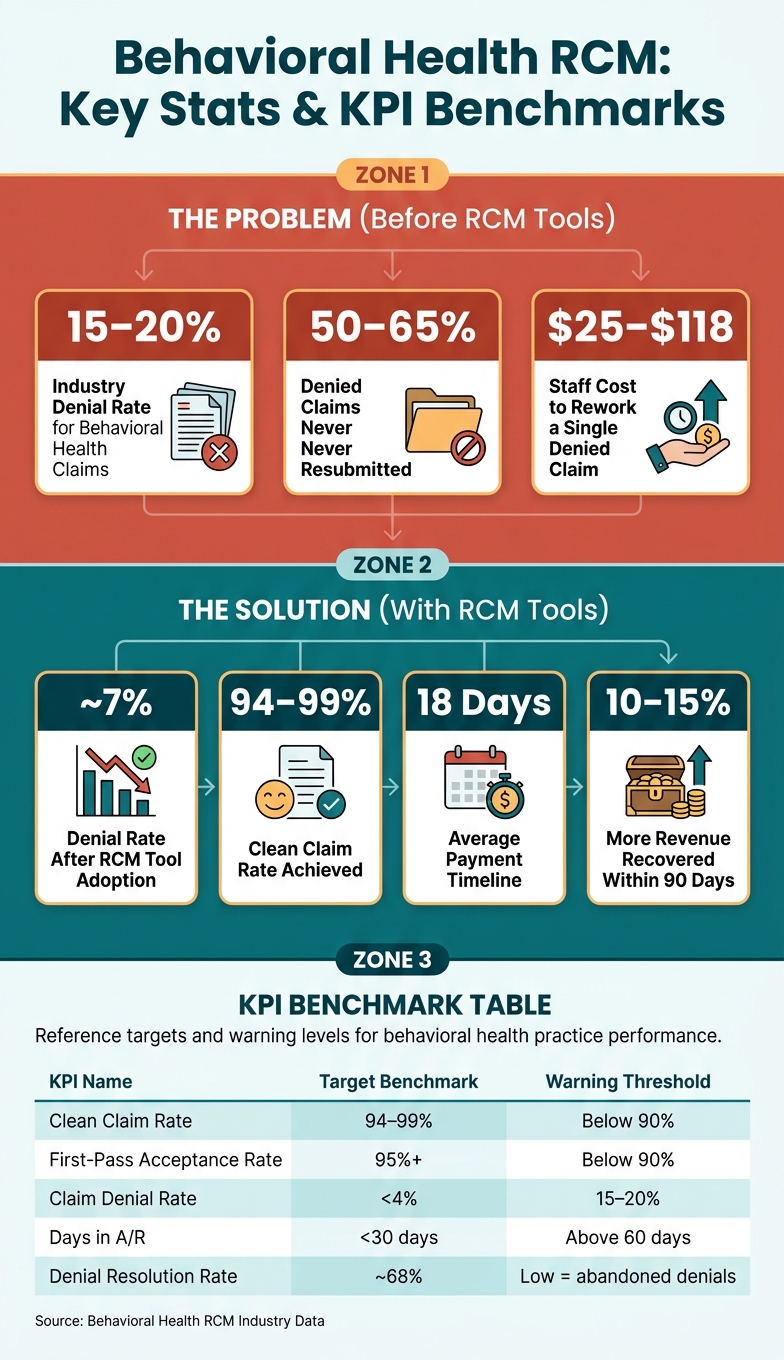
Behavioral health billing is complex, with denial rates for claims reaching 15–20% – far higher than standard medical billing.
Errors often stem from time-based coding, frequent authorization renewals, payer carve-outs, and credential-specific rules. The good news? Specialized revenue cycle management (RCM) tools can dramatically reduce these issues.
Key Takeaways:
Denial Prevention: Automated claim scrubbing and real-time eligibility checks help reduce denial rates to as low as 7%.
Efficiency Boost: Features like authorization tracking dashboards and EHR integrations minimize manual errors.
Financial Impact: Practices using RCM tools report clean claim rates of 94–99% and faster payment timelines.
Behavioral health RCM tools are designed to simplify workflows, ensure compliance, and recover lost revenue. Platforms like BHRev integrate eligibility verification, claim validation, and predictive analytics to prevent errors before they happen, saving time and money for providers.
Generic billing platforms often fall short when it comes to the specific needs of behavioral health billing. Tools designed specifically for this field offer features tailored to its unique challenges, like handling per-diem rates, concurrent reviews, and carve-out rules.
Eligibility errors are one of the most common and avoidable reasons for claim denials. The issue? Standard electronic verification (eVOB) systems often miss key details that are critical for behavioral health. For example, while a 270/271 transaction can confirm active coverage, it might fail to show that mental health benefits are managed by a separate entity like Optum, Carelon, or Magellan [10].
Behavioral health–focused tools solve this with a hybrid verification approach. They combine quick electronic checks with targeted phone verifications to uncover carve-out rules, session caps, and level-of-care specifics. Some platforms even offer insurance discovery features, which can locate active coverage using only partial patient information. This reduces denials related to “no coverage on file” [10].
Once eligibility is verified, the next step is ensuring claims meet the specific coding and compliance requirements of each payer.
Standard claim scrubbing tools are helpful, but behavioral health RCM tools take it a step further. They perform advanced validations tailored to behavioral health, catching issues like missing modifiers, incorrect place-of-service codes, and payer-specific compliance problems before submission [4].
With the variety of rules across Medicaid MCOs, Medicare Advantage plans, and commercial payers, these tools rely on constantly updated edit libraries to ensure claims are aligned with the latest standards [10]. They also integrate with EHR systems to pull charge data directly from clinical notes, minimizing manual entry errors and reducing the risk of denials [9][12]. Features like credentialing roster integration ensure that claims aren’t rejected due to expired provider certifications or enrollment gaps [1].
For even more precision, advanced analytics come into play.
While automated scrubbing catches known errors, AI-powered tools go further by spotting emerging patterns that could lead to denials. These systems analyze clinical charts against standards like ASAM 4th Edition, Milliman MCG, and InterQual BH to identify documentation gaps before claims are submitted [11]. Some platforms can even auto-generate structured appeal letters and review scripts, making the appeals process faster and more efficient.
Predictive dashboards provide valuable insights, highlighting denial trends across payers, claim types, and providers. This helps teams address recurring issues, like frequent modifier errors, before they escalate [14].
Facilities using AI-driven billing tools have seen notable results, with some recovering an average of 10–15% more revenue within just 90 days of implementation [13]. This is particularly significant given that denial rates in behavioral health are already double those of primary care [9].
BHRev is specifically designed to handle the complexities of behavioral health billing.
It addresses the unique coding requirements, payer rules, and documentation standards that behavioral health providers deal with daily.
BHRev’s claim scrubbing system uses advanced validation tools to ensure claims meet payer-specific rules and behavioral health coding standards before submission. For example, it verifies that session durations match the correct CPT codes – such as 90837 for sessions over 52 minutes or 90834 for sessions lasting 38–52 minutes. The platform also applies the necessary modifiers automatically, including modifier 59, XE, or provider-specific modifiers.
Using machine learning, BHRev assigns a pre-submission risk score to claims based on historical denial patterns. This helps billing teams prioritize claims that are more likely to face rejection. Practices using BHRev’s validation tools achieve a clean claim rate of 94% to 99%, a significant improvement compared to the industry’s typical denial rate of 15–20% [2][5]. Additionally, the platform ensures all claims meet payer coverage requirements, reducing the chance of denials.
BHRev performs real-time eligibility checks across Medicaid, Medicare, and commercial payers, while also tracking authorizations to ensure services align with approved coverage. By matching authorized units to scheduled services, BHRev suspends claims until the documentation fully complies with authorization requirements, helping prevent revenue loss due to gaps in authorization.
By identifying eligibility and authorization issues during the scheduling process, BHRev helps avoid the costly rework that often follows claim denials. Fixing missed coverage gaps after a denial can cost between $25 and $118 in staff time [7].
In addition to its validation and eligibility tools, BHRev offers powerful denial management features. When claims are denied, the platform categorizes them by root cause and provides actionable feedback to the relevant team, helping to prevent repeated mistakes. This is particularly important, as 50% to 65% of denied behavioral health claims are never resubmitted, often due to the complexity or time-consuming nature of the appeals process [6].
BHRev’s predictive analytics enhance claim accuracy by identifying risky code combinations, modifiers, and documentation patterns that are likely to result in denials [7]. Over time, this proactive approach shifts the focus of billing teams from fixing errors to preventing them, leading to more efficient processes and increased revenue.
RCM tools aren’t just for back-office operations – they should play a role from the moment a patient walks in. For example, real-time eligibility verification should happen during intake, not after a claim is submitted. Catching potential issues upfront can prevent many denials before they even occur.
From there, it’s all about tailoring workflows to fit your specific services. For outpatient therapy, this means focusing on accurate CPT code selection, ensuring session durations match codes, and applying the right telehealth modifiers. For programs like Intensive Outpatient Programs (IOP) or Partial Hospitalization Programs (PHP), workflows need to include level-of-care authorization checks and choosing the correct claim type – whether institutional or professional. If you’re running a Substance Use Disorder (SUD) program, the process gets even trickier, with unique HCPCS versus CPT requirements and diagnosis restrictions to navigate [8]. Generic medical billing tools won’t automatically account for these complexities.
Another game-changer? Connecting clinical calendars directly to claim generation. This automation reduces manual errors by pulling claim data straight from completed sessions.
Once workflows are set, the focus shifts to ensuring your team knows how to use these tools effectively.
Even the best tools are only as good as the people using them. Your team needs to understand how to act on real-time alerts. For example, intake coordinators should be trained to run eligibility checks while scheduling, and billers should know how to interpret CARC and RARC codes. This allows them to apply specific fixes instead of making general corrections.
Assigning team members to focus on specific denial categories can also make a big difference. For instance, one person could handle eligibility-related denials, while another tackles documentation gaps. This setup creates a feedback loop, tying front-end error detection to back-end performance metrics. Take this example: In 2026, a billing manager for an IOP service in Nashville introduced 14-day expiration alerts for authorizations, which led to a 50% reduction in authorization-related denials within 90 days [6].
It’s also important to involve clinical staff. Progress notes that don’t clearly establish medical necessity – aligned with ASAM or MCG criteria – can lead to billing issues that even the best scrubbing tools can’t fix later [1][7].
Once your team is trained, tracking measurable KPIs will help you fine-tune and validate these practices.
To improve your revenue cycle processes, you need to track the right metrics. Here are some KPIs that give behavioral health organizations a clear view of their RCM performance:
KPI | Target | Warning |
|---|---|---|
Clean Claim Rate | Below 90% could signal workflow or coding problems | |
First-Pass Acceptance Rate | 95%+ [14] | Less than 90% needs immediate attention |
Claim Denial Rate | < 4% [4] | Rates of 15–20% suggest serious inefficiencies |
Days in A/R | < 30 days [14] | Over 45 days is concerning; above 60 days indicates systemic issues |
Denial Resolution Rate | ~68% [2] | Low rates may mean denials are being abandoned |
How you monitor these metrics is just as important as the metrics themselves. Relying on monthly reports could mean you’re looking at problems weeks after they occur [14]. Instead, live dashboards that highlight issues – like expiring authorizations or high-risk claims – allow your team to act quickly, preventing denials rather than reacting to them.
For organizations with multiple locations, comparing KPIs across sites can also be an eye-opener. A site with a consistently high denial rate might reveal a payer-specific issue or a workflow gap that could go unnoticed in broader reports.
Navigating the world of behavioral health billing can feel like solving a complex puzzle, with numerous points where claims can go wrong. From session-based coding to payer-specific authorization rules and intricate documentation requirements, many of these errors are avoidable with the right approach.
Organizations that have adopted AI-driven revenue cycle management (RCM) tools have seen impressive results. Denial rates have dropped from the industry norm of 15–20% to about 7%. Clean claim rates have climbed to approximately 94%, and average payment timelines have been slashed to just 18 days – dramatically improving financial performance [2].
These outcomes are made possible through targeted, real-time solutions. Key strategies include real-time eligibility checks at intake, automated claim scrubbing tailored to behavioral health codes, tracking denial patterns, and using live dashboards to address issues before they escalate. Platforms like BHRev are specifically designed for these challenges, integrating eligibility verification, claim scrubbing, denial management, and predictive analytics into a single, efficient system.
It’s worth noting that every denied claim left unresolved represents lost revenue, with the cost of reworking just one claim ranging from $25 to $118 in staff time [7]. By preventing these costly errors, RCM tools not only protect revenue but also confirm the importance of customized RCM solutions in minimizing financial losses for behavioral health providers.
To minimize denials, it’s essential to carry out detailed checks right from the start. Begin by verifying insurance eligibility and benefits before providing services and during any transitions in care. Double-check payer information, secure prior authorizations when needed, and set up alerts for authorization expiration dates. Additionally, review provider credentialing on a monthly basis to ensure no attestations have expired. Tools like BHRev’s AI-powered RCM solutions can automate these tasks, helping maintain accurate, payer-compliant patient data throughout the revenue cycle.
Behavioral health revenue cycle management (RCM) tools rely on rules-based claim scrubbing and AI to track encounters as they happen. These tools compare clinical documentation – such as therapy notes – with payer-specific guidelines to confirm that diagnosis and CPT codes align correctly. By flagging problems like missing modifiers or incomplete documentation before claims are submitted, providers can address errors swiftly. BHRev takes this a step further by combining automated claim scrubbing with predictive analytics, helping to minimize denials even more effectively.
When assessing how well a Revenue Cycle Management (RCM) tool works for your behavioral health practice, keep an eye on these critical metrics:
Clean claim rate: Aim for a rate between 95% and 98%. This indicates that most claims are submitted without errors, cutting down on rework and delays.
Days in accounts receivable (A/R): The fewer days claims spend in A/R, the quicker your practice receives payments – a sign of efficient processing.
Denial rate: A good RCM tool will help lower first-pass denials by identifying and addressing the root causes of claim rejections.
Net collection rate and authorization approvals: These metrics reflect how well your practice is capturing revenue and streamlining workflows, ensuring smoother operations and better financial outcomes.
One email a month, no fluff. Unsubscribe anytime.