
Home / How Predictive Analytics Reduces Behavioral Health Denials

Behavioral health claims face high denial rates – 15% to 25%, compared to 11.65% across all specialties.
These denials often stem from preventable issues like missing authorizations, eligibility errors, and coding mistakes, which delay revenue and increase administrative costs. Predictive analytics offers a solution by identifying high-risk claims before submission, reducing errors, and prioritizing appeals with the best recovery potential.
Key takeaways:
Denial rates in behavioral health are 85% higher than medical claims.
65% of denied claims are never appealed, costing providers significant revenue.
Predictive models analyze historical data, payer rules, and clinical notes to flag risks early.
AI-driven systems have reduced denial rates by 20–35% and improved appeal success rates by 15%.
Predictive analytics streamlines billing, decreases manual work, and helps providers recover lost revenue. This proactive approach transforms how behavioral health organizations manage claims.
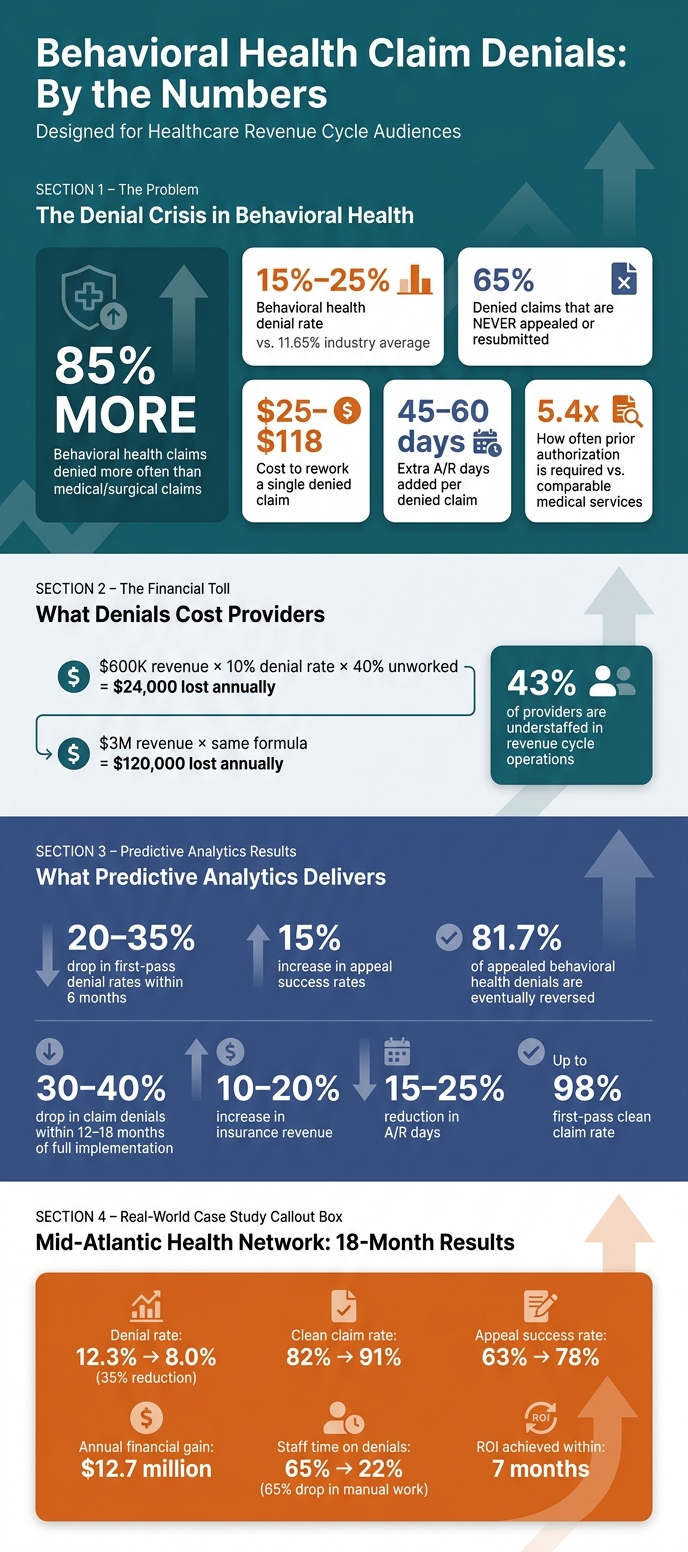
Behavioral health billing is far more intricate than general medical billing, and this complexity directly impacts denial rates. In fact, mental health claims are denied 85% more often than medical and surgical claims [9]. Why? The system itself is built with hurdles.
Take the MBHO carve-out model, for example. Many commercial insurers delegate behavioral health benefits to Managed Behavioral Health Organizations (MBHOs). Each MBHO has its own unique set of rules for enrollment, authorizations, and claims submission. Accidentally sending a claim to the wrong entity can mean it vanishes entirely from the adjudication process [10][11].
Another challenge is the reliance on descriptive clinical notes rather than objective test results. This subjectivity gives payers room to deny claims if the documentation doesn’t clearly connect the diagnosis, treatment plan, interventions, and outcomes – a concept often referred to as the “golden thread” [3][13]. If any part of this thread is missing, a medical necessity denial is almost inevitable.
These structural issues are at the heart of the recurring denial reasons discussed below.
Several recurring problems are behind most behavioral health denials. Here’s a breakdown of the most common denial codes and their root causes:
Denial Code | Meaning | Common Root Cause |
|---|---|---|
CO-197 | No authorization on file | Missing prior authorization or expired concurrent review [11] |
CO-50 | Not medically necessary | Documentation doesn’t meet ASAM or payer-specific criteria [11] |
CO-16 | Claim lacks information | Missing modifiers (e.g., 25, 95) or incorrect place of service [11][9] |
CO-B7 | Provider not certified | Credentialing issues or failure to enroll with the MBHO [11][9] |
CO-27 | Coverage terminated | Eligibility not re-verified at benefit-period boundaries [10][11] |
Prior authorization is a particularly heavy burden in behavioral health. It’s required 5.4 times more often than for comparable medical or surgical services [3][13]. On top of that, concurrent reviews – where providers must extend authorizations before they expire – often lead to denials, especially during transitions like moving a patient from residential treatment to a partial hospitalization program (PHP) [11].
Coding errors also play a big role. Time-based CPT codes, such as 90837, face extra scrutiny. Even small mistakes, like forgetting Modifier 25 when billing an evaluation and management (E/M) code alongside psychotherapy, can lead to denials. In such cases, the E/M service might be bundled and denied entirely [10][3].
The financial toll of denials adds up fast. For example, a billing operation generating $600,000 annually with a 10% denial rate loses $24,000 if 40% of those denials go unworked [10]. Scale that up to an organization billing $3 million a year, and the loss balloons to $120,000 [10].
Each denied claim also creates more work for staff. Reworking a single denied claim costs anywhere from $25 to $118 in staff time and overhead [1][4]. On top of that, denial rework can add an extra 45 to 60 days to Accounts Receivable (A/R) [1]. With 43% of providers understaffed in revenue cycle operations [1], many teams simply can’t keep up.
The outcome? 65% of denied claims are never appealed or resubmitted [1][5]. This isn’t about billing teams failing – it’s a system overwhelmed by volume. Addressing these challenges manually is inefficient, but predictive analytics offers a way to change the game. Understanding these issues is the first step toward using analytics to simplify denial management.
Standard reporting tools, like those tracking denial rates and A/R days, are helpful for understanding past performance. But here’s the catch: they only tell you what went wrong after the fact. By the time you’re reviewing last month’s denial trends, those claims have already been rejected, and it’s too late to prevent the issues.
Predictive analytics flips the script. Instead of analyzing what already happened, it focuses on what might happen. It evaluates claims before submission, identifying those most at risk of being denied. The table below highlights the key differences:
Feature | Standard Reporting | Predictive Analytics |
|---|---|---|
Timing | Retrospective (post-denial) | |
Data Source | Structured billing fields | Unstructured notes + historical patterns [4] |
Primary Goal | Tracking and reconciliation | Risk mitigation and prevention [7] |
Impact on Staff | Extensive manual rework | Focused review of high-risk exceptions [4] |
Visibility | Delayed (last month’s trends) | Real-time (today’s risk exposure) [7] |
This proactive approach allows billing teams to catch potential issues early, reducing the risk of denials before claims even leave the office.
Predictive models go beyond spotting simple coding mistakes. They dig into multiple layers of data to assess the likelihood of denial for each claim.
On the clinical side, these models use Natural Language Processing (NLP) to analyze unstructured data like therapy notes, psychiatric evaluations, and intake assessments. They extract critical details such as diagnoses, documented symptoms, session times, and levels of functional impairment [4][14]. Even if a claim is clinically sound, it might still fail if the documentation doesn’t align with a payer’s specific requirements – a situation known as being “payer-insufficient” [15].
The administrative side of the analysis is equally thorough. Models evaluate CPT and ICD-10 codes, modifiers, Place of Service codes, prior authorization status, authorized units remaining, and historical denial reasons (CARC/RARC) [9][15]. They also consider operational trends, like payer-provider combinations that often trigger documentation requests or whether certain submission days lead to higher denial rates [6].
The result? Each claim is assigned a denial risk score before submission [4]. High-risk claims are flagged with detailed explanations, allowing billing teams to focus on resolving potential issues. Meanwhile, low-risk claims proceed without manual intervention. This targeted approach eliminates the need to review every claim individually and avoids the chaos of reacting to denials weeks after submission.
Organizations that have adopted AI-driven revenue cycle management (RCM) have seen a 20–35% drop in first-pass denial rates within six months [7]. This improvement comes from addressing problems upfront rather than scrambling to fix them later.
Predictive analytics assigns a denial risk score to claims, flagging those at higher risk for rejection. These flagged claims are paused and sent to the appropriate team for review and correction before submission [4][6].
A real-world example comes from a Mid-Atlantic health network that implemented a predictive analytics platform to tackle its 12.3% denial rate. By using real-time alerts, coding safeguards for medical necessity, and a pre-submission review queue, the system achieved 87% accuracy in identifying issues. Over 18 months, the network reduced its denial rate to 8.0%, a 35% drop, and increased its clean claim rate from 82% to 91%. This translated into an annual financial gain of $12.7 million [16].
This proactive approach doesn’t just stop at flagging claims – it also addresses common billing errors before they happen.
Predictive analytics goes beyond identifying high-risk claims by actively correcting specific issues. Here’s how it tackles common denial categories:
Denial Category | Pre-AI Denial Share | How Predictive Analytics Helps |
|---|---|---|
Patient Info / Eligibility | 28% | Verifies coverage using real-time payer data |
Medical Necessity | 23% | Scans clinical notes with NLP to ensure required evidence |
Coding Errors | 19% | Validates CPT/ICD-10 codes and modifier logic |
Authorizations | 16% | Tracks authorized units against scheduled services |
Timely Filing | 14% | Sends early warnings before submission deadlines |
(Source: CaliberFocus Case Study [16])
One effective tactic is running a 72-hour eligibility check before appointments. This real-time verification catches coverage gaps or benefit changes, preventing issues before the patient arrives [3]. Similarly, an “auth-lock” protocol ensures that no encounter can be opened in the EHR without a valid authorization number, reducing authorization-related denials.
For coding, predictive tools enforce specific billing rules. For example, when billing under CPT code 90837, documentation must confirm a session length of at least 53 minutes. If the clinical note only supports 45 minutes, the system flags the claim to adjust it to CPT code 90834 before submission [2][3].
Integrating predictive analytics into revenue cycle management (RCM) workflows simplifies operations without requiring a complete system overhaul. These tools connect seamlessly to standard EHR systems like Epic, Cerner, or Netsmart via FHIR and HL7 integrations, adding an extra layer of risk intelligence [4][7].
The system employs a “human-in-the-loop” model, where AI handles the bulk of scanning claims, while staff focus only on flagged high-risk cases. Clean claims move through the system automatically, shifting billing teams’ efforts from reactive fixes to proactive prevention.
An example of this approach is BHRev’s platform, which includes automated eligibility checks, AI-driven claim scrubbing, and denial management tools tailored for behavioral health billing. By focusing on potential problem areas, these tools help prevent issues before they arise, streamlining the entire billing process.
Even with strong measures in place before submission, some claims inevitably face rejection, making a solid appeals process essential.
While avoiding denials is the primary goal, how quickly and effectively a billing team responds to rejections can significantly impact revenue recovery. Predictive analytics shifts appeals from a reactive task to a proactive, data-informed process.
Recovering lost revenue depends on timely and focused appeals.
However, not all denied claims are worth the same effort. Reworking a single denial can cost between $25 and $118 in administrative expenses [1][4]. Wasting resources on low-recovery claims can hurt overall revenue.
Predictive models help by assigning a recovery potential score to each denial.
These scores consider factors like claim value, historical success rates, and the complexity of the payer. This ensures that high-priority claims – those with the greatest chance of recovery – are addressed first [16].
Top-scoring claims are often routed to specialized billers or certified coders, who are provided with specific guidance on necessary corrections.
The system also uses CARC and RARC codes from Electronic Remittance Advice (ERA) files to analyze payer responses.
This helps pinpoint which denials are most likely to be overturned [14][9].
This is especially important since 81.7% of appealed behavioral health denials are eventually reversed, yet approximately 65% of all denied claims are never appealed [1][9].
For example, the Mid-Atlantic Regional Health Network – managing 2.8 million claims annually across four hospitals and 23 ambulatory centers – saw its appeal success rate jump from 63% to 78% over 18 months.
This 15-point increase added $1.6 million in recovered revenue thanks to better-targeted appeals [16].
Predictive analytics doesn’t just prioritize appeals – it also automates many of the tedious tasks involved.
The system can classify denial documents, identify root causes, and route claims to the right specialist, eliminating the need for manual ERA reviews [14][2].
Drafting appeal arguments, one of the most time-intensive steps, is also streamlined.
AI tools analyze past successful appeals to identify the evidence, corrective actions, or language that worked with specific payers [1][4].
These tools can even auto-fill appeal letters by pulling relevant clinical data directly from EHR records, cutting down the time spent on manual drafting [7].
The result is a hybrid approach, where AI handles tasks like classification, prioritization, and document preparation, while certified billers focus on finalizing strategies for complex cases [1].
At the Mid-Atlantic Regional Health Network, this approach reduced staff time spent on denials from 65% to 22%, representing a 65% drop in manual work [16].
Every resolved appeal feeds back into the predictive system, making it smarter over time. Whether a claim is paid, denied again, or written off, the outcome refines the model’s accuracy [1]. This feedback loop benefits the system in two major ways.
First, it builds payer-specific intelligence, learning the unique requirements and adjudication habits of each insurer. This allows the model to flag exactly what documentation is needed for future claims [15]. Second, it identifies patterns across clinicians, programs, and sites, helping organizations address systemic issues rather than treating each denial as an isolated case [2][4].
As the model processes more data, its risk assessments for denials become sharper, leading to higher appeal success rates.
Organizations using AI-driven prioritization report an average 15% increase in successful appeals [1][16].
Monitoring the monthly appeal overturn rate is one of the clearest ways to gauge whether the predictive model is continuously improving.
The success of predictive analytics hinges on high-quality data. To make this work, you need to integrate your Electronic Health Record (EHR), practice management system, and clearinghouse. These systems should share real-time data using connections like FHIR R4, HL7, or APIs.
Key data inputs include 2–5 years of historical claim data, EDI 837 (claims), EDI 835 (remittance) files, and CARC/RARC codes from ERA files [1][18]. Beyond billing data, the model also requires clinical documentation, such as therapy notes, psychiatric evaluations, intake assessments, and prior authorization records. This ensures medical necessity aligns with billed services [4][18]. For example, codes like 90837 (psychotherapy) and 90791 (psychiatric diagnostic evaluation) often face higher scrutiny from payers [4].
Payer-specific calibration is equally important. Each insurer has unique adjudication rules, documentation thresholds, and modifier requirements. Predictive models must track real-time updates to payer rules – such as modifiers 59, GT, or HN/HO/HP – to generate accurate risk scores [9][12].
Integration Layer | Data Sources / Technologies | Purpose |
|---|---|---|
Ingestion | FHIR R4 API, EDI 837, EHR Data | Extracts raw billing and encounter details [18] |
Remittance | EDI 835, CARC/RARC Codes | Matches claims with final payment/denial outcomes [18] |
Clinical | NLP, Unstructured Clinical Notes | |
Payer Rules | Payer Portals, Contract Logic | |
Workflow | Role-based Access Control, Work Queues | Routes high-risk claims to human specialists [18] |
To build effective machine learning models, aim for at least 10,000 labeled claims per major payer. Also, clean up any historical data inconsistencies before training the model to ensure accuracy from the start [6][18].
With solid data integration, you can move forward with a phased rollout of predictive analytics.
Jumping straight into a full-scale rollout can disrupt your operations. Instead, take a phased approach to validate the model and protect existing workflows.
Begin with a 90-day data audit. Analyze your most recent claims, categorizing denials by payer, reason code, and procedure type. This will identify the top 3–5 reasons for denials and establish a baseline for measuring improvements [1][19]. Use this phase to clean your data, resolve inconsistencies, and set governance rules before introducing the model.
Next, pilot the tool with a high-risk payer or service line for 3–6 months. This allows you to test its performance without overhauling your entire workflow [1][6]. Intensive Outpatient Programs are a common starting point due to their complex authorization requirements. During the pilot, add a human-in-the-loop review step: claims flagged with a 70% or higher denial probability should be routed to a certified biller for review before submission [1][18].
Once the pilot proves successful, scale the solution across your organization. Many organizations report a 30–40% drop in claim denials within 12 to 18 months when following this method [1][8]. To keep the model effective, retrain it monthly using the latest claim outcomes. A model trained on outdated data won’t account for recent payer policy changes.
For providers seeking a streamlined solution, BHRev offers a platform specifically tailored for behavioral health.
Unlike general-purpose tools, BHRev combines predictive analytics with automated eligibility checks, claim scrubbing, and denial management – all within one system.
What makes BHRev stand out is its focus on behavioral health needs. Its workflows address Medicaid, Medicare, and commercial insurance requirements, including the documentation standards, authorization cycles, and code-specific scrutiny that other tools may overlook.
Providers can choose full-scale RCM outsourcing or targeted support, such as prior authorization or denial management, without disrupting their current setup.
BHRev’s performance-based pricing aligns its success with measurable outcomes. This means their focus isn’t just on platform usage but on reducing denials and improving cash flow for providers.
Behavioral health billing is shifting from reactive problem-solving to proactive prevention.
With the national average initial claim denial rate at 11.65% [1] and behavioral health claims being denied 85% more frequently than standard medical and surgical claims [9], it’s clear that action is needed to address this disparity.
These numbers highlight the importance of rethinking billing workflows. Many major payers now rely on proprietary AI tools capable of flagging up to 16 times more high-risk claims than human reviewers [1]. This puts providers using manual workflows at a clear disadvantage.
Predictive analytics offers a way to close this gap by identifying potential issues with claims before they even reach the payer.
Implementing predictive tools can lead to some impressive results – insurance revenue increases of 10–20% [17], reductions in accounts receivable (A/R) days by 15–25% [7], and first-pass clean claim rates as high as 98% [2].
These tools free up staff to focus on more impactful tasks, such as handling complex appeals or offering financial counseling to patients. The combination of increased revenue and improved efficiency demonstrates the clear benefits of adopting a proactive approach to denial management.
Predictive analytics doesn’t just reduce denials; it enhances the entire revenue cycle management process. As technology continues to evolve, we can expect advancements like real-time financial dashboards, automated authorization management, and revenue forecasting based on payer-specific models.
The key takeaway? Every denial should be seen as an opportunity to refine processes [4]. Providers who embrace this mindset and leverage BHRev’s tailored solutions will be well-equipped for the future of behavioral health billing.
To get started with predictive denial risk scoring, it’s essential to have a unified data layer that connects your practice management system with your electronic health record (EHR) system. The critical data you’ll need includes:
Historical claim outcomes
Payer billing rules
Denial history
Diagnosis-procedure relationships
Authorization patterns
Patient demographic details
Clinician documentation
By examining years of claim data, predictive tools can uncover patterns in coding, modifiers, and documentation that frequently result in denials. This analysis helps pinpoint areas where improvements can reduce denial risks.
Predictive analytics works effortlessly with your EHR through connections like API, FHIR, or HL7. While running in the background, it evaluates clinical notes, payer rules, and denial data.
Before claims are submitted, the system flags high-risk ones for review, letting error-free claims move forward automatically. This approach helps catch issues like coding errors or missing authorizations, ensuring claims are submitted smoothly and on time.
BHRev provides tools designed to streamline cash flow and cut down on denials.
To handle denied claims effectively during appeals, it’s essential to focus on three key factors: the dollar amount, appeal deadlines, and the likelihood of recovery.
Advanced denial management systems simplify this process by tracking claims based on payer, reason codes, and service types. Taking it a step further, AI-powered tools enhance this approach by assigning risk scores, helping you identify which claims are most likely to be overturned.
This way, your team can prioritize high-value claims instead of treating all denials the same.
One email a month, no fluff. Unsubscribe anytime.