
Home / Behavioral Health RCM Compliance Tips

Behavioral health revenue cycle management (RCM) is complex, with higher claim denial rates and strict Medicaid/Medicare rules. Non-compliance can result in audits, lost revenue, and exclusion from insurance networks.
Key practices include:
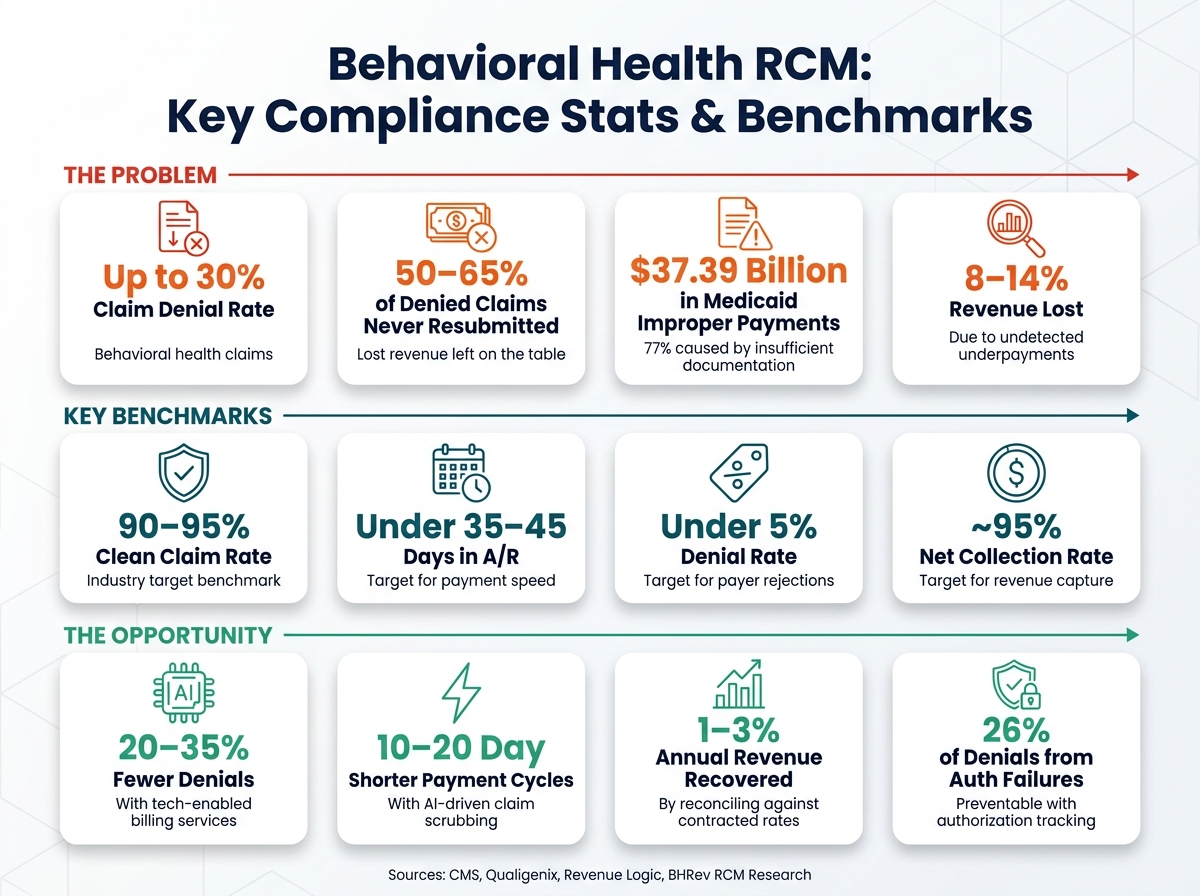
Reducing Denials: Behavioral health claims face denial rates up to 30%, with 50–65% of denied claims never resubmitted. Effective documentation and payer rule monitoring help reduce this.
Medicaid/Medicare Challenges: Providers must navigate dual eligibility rules, carve-out plans, and confidentiality laws like 42 CFR Part 2.
Payment Reconciliation: Match payments to contracted rates, flag underpayments, and ensure accurate posting to avoid compliance risks.
Automation & Analytics: Tools like automated eligibility verification, AI-driven claim scrubbing, and analytics dashboards improve accuracy and compliance.
Compliance isn’t just about avoiding penalties – it protects revenue and streamlines operations.
Achieving compliance in payment reconciliation requires staying informed about payer-specific rules and maintaining a well-structured internal revenue cycle. Below, we’ll dive into two often-overlooked essentials: understanding payer policies and optimizing your workflow to support reconciliation efforts.
Medicaid policies can differ drastically from state to state, with variations in fee schedules, filing deadlines, and other requirements. Meanwhile, Medicare operates under federal standards, but behavioral health carve-outs introduce additional layers of complexity. For instance, when behavioral health benefits are managed by MBHOs like Optum, Carelon, or Magellan, each comes with its own unique authorization processes and reimbursement guidelines. This creates a moving target for compliance teams to monitor [7][12].
Payers rarely announce changes to their rules. Instead, shifts in denial patterns often serve as the first clue. To catch these changes early, monitoring denial trends weekly – rather than monthly – is crucial. A centralized system for managing authorizations and telehealth billing codes ensures your team isn’t relying on outdated information [3][13].
Looking ahead, two upcoming federal regulations will have a direct impact on behavioral health claims:
CMS-0057-F Prior Authorization rule (effective January 2026)
CMS-0053-F HIPAA Claims Attachments standard (effective May 2026)
Both of these changes will influence how claims are documented and submitted. As Claim Max RCM emphasizes:
“Documentation excellence is the single biggest revenue protection any practice has in 2026.” – Claim Max RCM [5]
Staying on top of payer rules is just the first step. The next is aligning your internal processes to minimize errors and improve reconciliation outcomes.
Even with a solid understanding of payer rules, payment reconciliation often fails due to breakdowns within the internal revenue cycle.
Many issues can be traced back to intake errors. For example, skipping an eligibility check on the day of service, missing a prior authorization, or entering the wrong Place of Service code – such as “02” (telehealth, other than home) instead of “10” (telehealth, patient’s home) – can lead to lower reimbursements or outright denials [11].
A well-designed workflow integrates eligibility verification at every encounter, not just during intake. This is especially important for Medicaid patients, as eligibility can change monthly [11]. Additionally, a clear workflow creates accountability. When a denial arrives with a specific Remittance Advice Remark Code (RARC), your team can trace it back to the exact step where the error occurred. Fixing the issue at its source prevents recurring mistakes and reduces the need for appeals.
Keeping payment handling consistent, accurate, and defensible is essential to minimize compliance risks during Medicaid and Medicare reconciliation.
In behavioral health billing, inconsistent posting can lead to serious compliance issues. When team members interpret the same remittance code differently, it creates unreliable financial data and makes audits far more challenging.
A good solution is creating a posting playbook – a detailed guide that outlines how to handle each remittance type. For instance, a CO-45 (contractual obligation) should be verified against the fee schedule before being recorded as a write-off. Meanwhile, an OA-23 (other payer responsibility) should always be routed to secondary insurance, not written off. Practices that post payments within 24 hours typically see 8 to 12 fewer days in accounts receivable (A/R) compared to those with delays exceeding three days [15].
Additionally, establish clear limits for write-off approvals. For example, staff could handle write-offs up to $50, while amounts over $250 would require manager approval. This approach ensures that recoverable revenue doesn’t slip through the cracks [15].
Many providers check whether payments arrive but fail to confirm if the correct amount has been received.
To address this, load Medicaid and Medicare fee schedules into your practice management (PM) system. This allows you to automatically compare received payments to contracted rates at the claim line level. Set a 1% to 2% variance threshold to flag payments outside this range for manual review [15]. Identifying underpayments using this method can help recover 1% to 3% of annual payer revenue [15].
Pay special attention to the CO-253 code, which reflects Medicare’s mandatory 2% sequestration reduction. This adjustment should be recorded separately from contractual write-offs to maintain clean, audit-ready reporting [15].
Accurate reconciliation also depends on using eligibility and authorization data effectively. These aren’t just pre-visit tasks – they’re critical reference points for resolving payment discrepancies. Prior authorization failures alone account for 26% of all behavioral health claim denials, many of which could be avoided by integrating authorization data into the reconciliation process [4].
A centralized tracker that flags expiring authorizations 10 to 14 days before the final session gives your team time to renew approvals and prevent gaps [4][7]. Running real-time eligibility (RTE) checks 72 hours before each appointment is another best practice. This helps identify carve-out statuses or remaining session limits before claims are submitted [17].
Tools like BHRev‘s automated eligibility verification and denial management systems are tailored for behavioral health workflows. They help providers catch coverage gaps and authorization issues early, reducing the risk of denied claims. Leveraging these tools ensures compliance while streamlining operations.
Relying on manual workflows in behavioral health billing often leads to errors. Automated tools help minimize these risks by ensuring consistency throughout the process, even before a claim is submitted to the payer.
One key area to automate is eligibility verification. Tools like eVOB, integrated within automated platforms, quickly confirm enrollment and flag carve-outs, reducing the need for manual checks [7][18]. This is especially critical for Medicaid, which covers about 12% of adults with substance use disorders. Medicaid coverage can change frequently, and with the end of continuous enrollment protections in 2023, identifying procedural coverage losses early has become essential [18].
AI-driven claim scrubbing is another game-changer. It validates CPT codes, applies modifier logic (like the GT modifier for telehealth or HQ for group services), and identifies payer-specific Medicaid MCO edits before submission [18][19]. Platforms such as BHRev are tailored for these needs, offering AI-powered tools for claim scrubbing, automated eligibility checks, and denial management. These features help providers navigate the complexities of Medicaid, Medicare, and commercial payer rules within a single streamlined workflow.
The industry standard for clean claim rates ranges from 90% to 95% [2]. Providers leveraging automated pre-submission tools, such as scrubbing and authorization tracking, are better equipped to consistently hit this benchmark. Beyond submission, analytics play a critical role in identifying and addressing compliance issues on the backend. Together, automation and analytics help safeguard compliance and improve financial outcomes.
While automation simplifies claim submissions, analytics provide the necessary oversight to catch problems early and maintain compliance. Analytics dashboards allow billing teams to spot gaps before they lead to costly errors.
Some of the most important metrics to monitor include denial rate, denial recovery rate, net collection rate, and accounts receivable (AR) aging. Among these, denial recovery rate is often overlooked.
Breaking down AR aging reports by payer, denial code, and provider can uncover issues like credentialing problems, authorization mismatches, or routing errors [8]. Behavioral health practices typically have 8% to 15% of their monthly billed charges in AR beyond 60 days, highlighting ongoing challenges that need attention [8].
Here’s a quick look at key performance indicators (KPIs) that aid in Medicaid and Medicare compliance monitoring:
KPI | Target Benchmark | What It Reveals |
|---|---|---|
Clean Claim Rate | 90% – 95% | Accuracy of initial submissions [2] |
Days in A/R | Under 35 – 45 days | Payment speed and follow-up efficiency [2] |
Denial Rate | Under 5% | Frequency of payer rejections [2] |
Net Collection Rate | ~95% | Effectiveness in capturing earned revenue [2] |
Analytics can also identify subtle changes in payer rules, like unannounced code updates or policy shifts, weeks before they would be noticed through manual reviews [6]. With this proactive insight, billing teams can address issues early, protecting revenue and ensuring smoother operations.
A strong compliance framework weaves together every part of your revenue cycle. The best setups unite leaders from billing, clinical documentation, IT, privacy, and program management into one cohesive, cross-functional team [9]. When these groups work in isolation, issues often get passed around without resolution.
To avoid this, assign clear accountability. Every denial should have a specific owner and a resolution timeline of seven days, ensuring nothing gets overlooked [7]. Privacy requirements, like 42 CFR Part 2 and HIPAA, should be built directly into RCM workflows as operational safeguards, rather than being treated as a separate checklist [9].
With payer audits in behavioral health expected to rise by over 30% across both commercial and government programs by 2026 [4], organizations that view compliance as a strategic focus – not just a back-office task – will be better prepared for scrutiny. However, even the best framework depends on well-trained staff to carry out its processes.
Training gaps are a major culprit behind documentation issues, which account for 77% of Medicaid improper payments [5]. Effective training zeroes in on specifics, such as time-based CPT coding for psychotherapy sessions (90832, 90834, 90837), crafting medical necessity narratives, and meeting Medicaid and Medicare documentation standards [3]. These skills directly improve payment reconciliation by ensuring clinical records back up every claim.
One approach gaining popularity is the “Provider Champion” model. This involves designating clinicians as liaisons between RCM and clinical teams, translating billing requirements into actionable clinical practices [21]. Alongside this, enforcing a 24-to-48-hour note lock policy ensures progress notes are completed promptly, reducing the chance of missing important details and improving claim accuracy [4][6].
Regular audits then validate training effectiveness and highlight areas needing further attention.
Routine audits are essential for spotting workflow gaps and maintaining compliance. They help catch problems before payers do, which is critical for accurate Medicaid and Medicare reconciliation. A well-planned audit schedule might look like this:
Audit Type | Recommended Frequency | Focus Area |
|---|---|---|
Random Chart Review | Monthly | 5–10 charts per provider; medical necessity [11] |
Internal Mock Audit | Bi-Annually | 20–30 random claims; full compliance check [4] |
Chart-to-Auth Audit | Quarterly | Alignment between clinical notes and authorizations [6] |
Credentialing Audit | Every 90 Days | Provider enrollment and license status [4] |
OIG Screening | Monthly | Employee/vendor exclusion list verification [10] |
The quarterly chart-to-auth audit is especially important. Reviewing a sample of authorizations and verifying that clinical notes align with the level of care authorized is one of the best ways to identify audit risks early [6]. Often, discrepancies here point to larger workflow issues, not just isolated documentation errors.
Audit results should be more than just a scorecard. Use them as actionable data. For example, feed patterns of denials and documentation gaps back into intake scripts, clinical templates, and training programs. This way, each audit cycle builds on the last, making future outcomes even better [12].
When it comes to behavioral health revenue cycle management (RCM), compliance depends on a combination of well-coordinated processes. And the stakes couldn’t be higher: Medicaid improper payments hit $37.39 billion in 2026, with a staggering 77% of those errors linked to insufficient documentation – not fraud [5]. This highlights that many compliance issues are entirely avoidable.
The best-performing providers treat documentation, workflows, and technology as an interconnected system. For example, tech-enabled billing services report 20–35% fewer denials [4], while AI-driven pre-submission claim scrubbing can shorten payment cycles by 10 to 20 days [9]. These advancements show how attention to detail and proactive tech adoption can make a huge difference.
This specialized nature makes precise reconciliation practices essential for recovering revenue. Behavioral health practices can lose 8–14% of revenue due to undetected underpayments [1]. Reconciling payments against contracted rates helps recover these losses. Additionally, using tools like real-time eligibility verification and centralized authorization trackers – set to flag expiring approvals at least 10 days in advance – can address common denial issues [4][7].
For providers who want these capabilities without building them from scratch, BHRev offers AI-powered RCM tools tailored specifically for behavioral health. Their services include automated eligibility checks, claim scrubbing, denial management, and analytics designed to meet Medicaid and Medicare compliance standards. Adopting such specialized solutions ensures behavioral health providers maintain compliance while improving financial outcomes.
To spot changes in payer rules more efficiently, focus on shifts in denial patterns rather than examining individual claims. These changes typically emerge as clusters in denial data within the first week. Organize denials by payer, reason code, and date, and conduct a monthly review of these clusters. Tools like BHRev’s AI-driven RCM solutions and predictive analytics can assist behavioral health providers in identifying patterns early, streamlining workflows, and ensuring compliance with Medicaid and Medicare guidelines.
To identify underpayments without the hassle of manual checks, automated revenue cycle management tools are the way to go. BHRev provides an AI-powered platform that simplifies this process by centralizing payer rates, modifiers, and fee-for-service rules. It compares expected reimbursements with actual payments, flags any discrepancies, and generates actionable reports. By streamlining recovery efforts, it helps ensure compliance while boosting cash flow for Medicaid and Medicare claims.
Auditing for behavioral health reconciliation works best when done on a structured schedule. Here’s a breakdown:
Provider rosters: Review credentialing every 90 days to ensure accuracy and compliance.
Billing and documentation: Conduct monthly reviews to monitor denial trends and ensure coding accuracy.
Quarterly internal audits: Randomly select claims to evaluate against external standards, maintaining readiness for outside reviews.
Tools like BHRev’s AI-powered RCM solutions can simplify these tasks, helping to cut down on denials and boost cash flow efficiency.
One email a month, no fluff. Unsubscribe anytime.