
Home / How to Automate Eligibility Verification for Mental Health Claims
Mental health providers spend up to 18 minutes per patient manually verifying insurance eligibility, often navigating multiple payer portals. This outdated process leads to 20% of claims containing errors, contributing to 30–40% of denials. Fixing these denials costs between $25 and $118 per claim. Automating this process can cut verification time to 8–15 seconds, reduce errors, and improve claim approval rates by an average of 28%.
Key Takeaways:
Manual checks are slow and prone to errors, costing time and money.
Automation reduces denial rates, saves 22 staff hours per week, and helps recover lost revenue.
Tools like BHRev simplify eligibility checks, manage prior authorizations, and integrate with EHR systems.
Switching to automated systems ensures faster, error-free eligibility verification, saving time and increasing revenue for mental health providers.
Automation offers practical solutions to the challenges of eligibility verification. By streamlining insurance checks, reducing errors, and speeding up workflows, automation enhances efficiency and protects revenue. Here’s how it transforms the process.
Manual verification often requires staff to manually input details like member IDs, group numbers, copay amounts, and deductible information from payer portals into internal systems. This process is prone to mistakes, and 56% of providers report that incorrect insurance information is a leading cause of claim denials [1].
Automation eliminates this issue by directly importing data from payer systems. For example, a primary care practice with six physicians and three nurse practitioners adopted automated eligibility verification in late 2025 using US Tech Automations and Athenahealth. Within just 90 days, they cut eligibility-related claim denials by 31%, reducing their denial rate from 14.3% to 9.8% [3]. Automated systems also track behavioral health-specific details, such as session limits and visit maximums, helping prevent claims from being denied for exceeding coverage limits [5]. This directly addresses revenue loss caused by preventable errors in mental health claims.
Manual insurance checks can take up to 18 minutes per patient, largely due to the need to navigate multiple payer portals and interfaces. In contrast, automated systems can complete the same task in just 8 to 15 seconds [3]. This time savings adds up quickly – practices that automate verification reclaim an average of 22 staff hours per week [3].
Automation also enables real-time checks, ensuring that coverage changes are identified promptly. Systems can trigger verifications at key points, such as scheduling, 72 hours before an appointment, and again at check-in. Verifying insurance 48+ hours before a visit has been shown to reduce denial rates on initial claims by 34% [3]. In 2026, Smilist, a dental organization, implemented Ventus AI agents to handle high-volume revenue cycle management tasks. These agents performed over 3,000 claim status and eligibility checks daily without requiring additional staff [2]. This speed not only saves time but also aligns with payer expectations, increasing the likelihood of claim approvals.
Insurance payers have already embraced automation – 94% of payers now use AI to process claims and flag denials [1]. Relying on manual verification puts practices at a disadvantage, as payers evaluate claims with speed and precision. Automated systems level the playing field by meeting payer standards for accuracy and efficiency.
The financial benefits are clear. Practices that automate eligibility verification see an average reduction in claim denials of 28% [3]. Since reworking a denied claim costs between $25 and $35 in administrative labor [3], preventing denials saves both time and money. For instance, the primary care practice mentioned earlier identified $147,000 in annual revenue previously lost to denials. After implementation costs, they achieved a net annual ROI of $96,400 [3]. For mental health providers, who often deal with complex behavioral health benefits, higher approval rates mean steadier revenue and less administrative hassle.
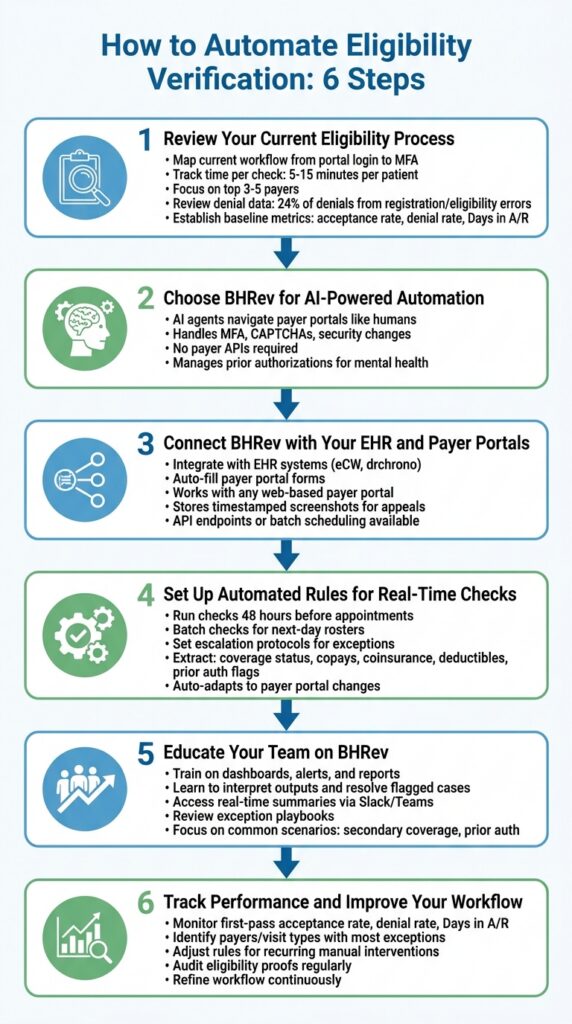
Switching from manual to automated eligibility verification takes careful planning. These six steps will guide you in setting up a system that minimizes errors, speeds up processes, and improves claim approvals.
Start by mapping out how your team currently handles eligibility checks. Document every step, from logging into payer portals and managing multifactor authentication (MFA) to dealing with secondary coverage. Pinpoint where inefficiencies or errors occur.
Track how long each check takes – manual verifications typically take 5 to 15 minutes per patient [2]. Focus on your top 3–5 payers and examine key data fields like coverage status and deductibles. Also, evaluate how your team stores eligibility proofs, such as screenshots or timestamps, to ensure they’re accessible for appeals.
Look into your denial data to find out how many rejections stem from registration or eligibility mistakes. 24% of denied claims result from errors during this phase [7]. Establish baseline metrics for your first-pass acceptance rate, denial rate, and Days in Accounts Receivable (A/R) before automation. These benchmarks will help you measure progress [8].
With this analysis complete, you’ll be ready to choose a solution to streamline these steps.
The single best leverage point in a denials operation is specialization. Cross-functional billers are slower at denials and less accurate. Three suggestions:
Once you’ve selected BHRev, integrate it with your EHR system to eliminate manual errors. This involves two key connections: pulling patient data from your EHR and accessing payer portals for eligibility details. BHRev’s AI agents pull data directly from systems like eCW or drchrono, auto-filling payer portal forms to avoid transcription mistakes [2].
The system works with any payer portal that has a web interface, even older ones without modern APIs [2]. Before integrating, define the exact data fields you need, such as “deductible remaining” versus “deductible met”, to ensure consistency. Document workflows for secondary coverage and out-of-network cases to set clear AI escalation rules [2].
BHRev also stores timestamped screenshots of eligibility proofs for appeals. You can trigger the system via API endpoints or schedule batch checks for your entire patient roster, with results sent to tools like Slack, Microsoft Teams, or email for quick action on flagged cases [2].
Configure BHRev to run eligibility checks 48 hours before appointments and batch checks for next-day rosters. Early verification helps cut down on denial rates for initial claims [4].
Set escalation protocols for situations requiring human intervention, like coordination of benefits issues or out-of-network cases [2]. Develop standardized playbooks for staff to handle flagged exceptions efficiently [2].
Tailor the system to extract the most relevant data, such as coverage status, copays, coinsurance, deductibles, and prior authorization flags [2]. BHRev’s agents adapt automatically to changes in payer portal interfaces, reducing the need for ongoing manual updates [1].
Even with automation, your team must know how to use BHRev’s dashboards, alerts, and reports. Train them to interpret outputs and resolve flagged cases quickly. Incomplete checks can add over 10 minutes per instance [6], so proper training is essential.
Show staff how to access real-time summaries of success rates and exceptions through integrated tools like Slack. Teach them how to retrieve stored eligibility proofs for appeals [2], and review the exception playbooks created in Step 4 to ensure everyone follows consistent procedures.
Focus on common scenarios your practice encounters, like secondary coverage or prior authorization requirements, to make the learning process smoother and improve efficiency.
Use BHRev’s analytics to measure progress against the baseline metrics from Step 1. Monitor your first-pass acceptance rate, denial rate, and Days in A/R to assess the impact of automation. Identify which payers or visit types still generate the most exceptions and adjust your rules as needed. If certain manual interventions keep recurring, consider adding new rules to address those cases [2].
Regularly audit eligibility proofs to ensure they meet payer requirements for appeals. As payer portals update, confirm that BHRev’s agents continue capturing the necessary documentation [2]. These ongoing adjustments will help you refine your workflow and get the most out of your automation system.
When automation simplifies your workflow, selecting the right pricing plan becomes essential to boost both efficiency and revenue.
BHRev offers two pricing options: Full RCM Services and Targeted Support Services. With Full RCM Services, you pay a performance-based percentage fee, meaning BHRev earns a portion of the revenue they successfully collect for your practice. This ensures costs are tied directly to results – you only pay when claims are approved and payments are received. On the other hand, Targeted Support Services operates on a pay-per-service model. This lets you choose specific add-ons, such as prior authorization or aged accounts receivable (AR) recovery, without committing to a full-service package.
Full RCM Services is ideal for practices looking to outsource the entire billing process. It covers everything from eligibility verification and claim scrubbing to denial tracking, payer contract reviews, and analytics. If manual eligibility checks are eating up too much staff time or errors in eligibility verification are frequently derailing claims, this comprehensive solution can help streamline operations and reduce errors.
Targeted Support Services works best if your billing team handles most tasks effectively but needs help with specific challenges. For example, if prior authorizations or recovering old unpaid claims are slowing down your revenue cycle, you can add just those services. This modular approach ensures you only pay for what you need, avoiding unnecessary expenses while addressing key problem areas.
Plan Name | Price | Description | Features | Limitations |
|---|---|---|---|---|
Full RCM Services | A percentage fee based on recovered revenue | Comprehensive revenue cycle management | Eligibility verification, claim scrubbing, denial tracking, payer contract review, analytics | N/A |
Targeted Support Services | Pay only for the services you need | Flexible add-ons for existing billing teams | Verification of benefits, prior authorization, denial management, aged AR recovery | N/A |
To decide which plan fits your needs, assess your current workflow and denial trends. For instance, if non-clinical staff spend a lot of time on eligibility checks, Targeted Support could save approximately 8 minutes per check [9]. Practices that value predictable, performance-based costs might prefer Full RCM Services, while those needing flexibility to scale specific services up or down may lean toward Targeted Support.
AI-driven automation transforms eligibility checks, reducing the process from 5–15 minutes to just 1–2 minutes. It also addresses a key issue: the 30% of denials caused by incorrect or inactive insurance details [2][4][6][10].
BHRev’s automation takes these improvements further by tackling specific challenges faced by mental health providers. It identifies behavioral health carve-outs and verifies coverage for essential CPT codes, such as 90837 for 60-minute therapy sessions [11]. By running batch checks 24–72 hours before appointments, the system flags inactive plans and missing authorizations well in advance, ensuring smoother patient visits [11][4].
On the financial side, health systems that have adopted AI for eligibility verification have seen a 30% drop in claim denial rates within just 90 days [2]. With 94% of payers already using AI to screen and deny claims, providers must adopt similar technology to stay competitive [1]. Beyond financial benefits, automation significantly eases the workload for staff – 82% of clinicians report that AI tools greatly reduce the effort required for administrative tasks [4].
Automated eligibility checks for mental health visits need to gather essential information to streamline the process. This includes details about insurance coverage, plan status, and specific mental health benefits, such as therapy or telehealth options. It should also confirm CPT code coverage, any applicable visit limits, and patient costs like copays or deductibles. Additionally, it’s crucial to verify authorization or referral requirements, in-network provider status, and coordination of benefits. Collecting this information helps reduce claim denials and ensures smoother billing workflows.
Eligibility should be verified again while scheduling, preferably 48–72 hours before the patient’s appointment. Automating this step during that window can cut down day-of-service denials by 40–60% and minimizes the risk of unexpected bills. Taking this proactive step streamlines operations and boosts the chances of claims being approved.
To link BHRev with your EHR and payer portals, take advantage of its automation features for real-time eligibility verification and smooth integration. First, confirm that your EHR supports integration. Then, configure BHRev to automatically pull payer data and enable real-time eligibility checks. For step-by-step instructions, consult BHRev’s technical support team or review their integration documentation.
We staff full denials teams for behavioral-health practices and recover an average of 32% of aged A/R prior agencies wrote off. 30-minute consultation, no pitch.
One email a month, no fluff. Unsubscribe anytime.