
Home / In-House vs Outsourced RCM: Which Is Right for Your Practice?

Claim scrubbing is the process of reviewing medical claims for errors before submission to insurance payers.
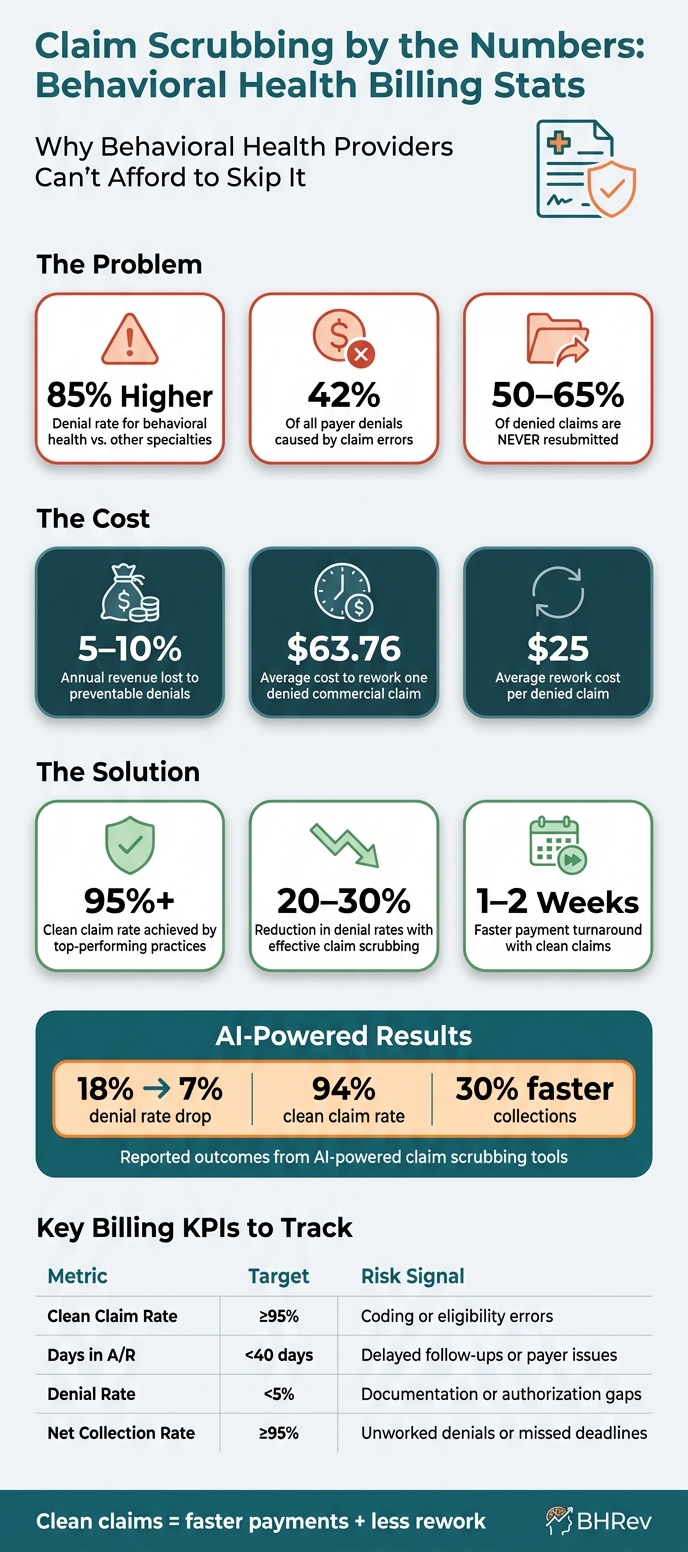
It ensures claims are accurate, complete, and compliant with payer rules, reducing denials and speeding up reimbursements. For behavioral health providers, where denial rates are 85% higher than other specialties, this step is critical to maintaining revenue.
What it catches: Errors in codes, patient details, modifiers, and payer-specific requirements.
Why it matters: Prevents revenue loss (5–10% annually) and reduces costly rework ($25 per claim).
How it works: Automated tools and manual reviews identify and fix issues before submission.
Impact: High-performing systems achieve 95%+ clean claim rates, cutting denial rates by 20–30% and improving cash flow.
Claim scrubbing is a must-have for behavioral health practices navigating complex billing rules and tight payer scrutiny.
It minimizes revenue leakage while ensuring faster, smoother reimbursements.
Claim scrubbing happens after coding but before submission.
It serves as a final quality check, ensuring that every detail of a claim meets a set of rules before it’s sent to the payer. The aim is simple: catch errors early and prevent denials.
Scrubbing tools automatically scan claims for errors. The first step often involves reviewing demographic data – things like mismatched spellings of a patient’s name, incorrect birth dates, or subscriber ID discrepancies. These small mistakes are responsible for nearly 20% of rejected claims [3].
Next comes a closer look at coding accuracy. For behavioral health, this means ensuring that CPT codes match ICD-10 diagnoses, verifying that time-based codes like 90834 or 90837 align with documented session durations, and checking that modifiers – like GT for telehealth or HN/HO/HP for provider-level distinctions – are used correctly [3][6]. The system also flags administrative issues, such as missing NPI numbers, expired prior authorizations, or mismatched place-of-service (POS) codes (e.g., using office-based POS code 11 for services provided in an IOP setting) [8].
More advanced scrubbing tools go a step further by incorporating payer-specific requirements. Insurers like Optum, Magellan, and Beacon have unique formatting rules and coverage criteria. Even a claim that seems correct might fail if it doesn’t align with a specific payer’s guidelines [6][9].
Once errors are detected, the focus shifts to resolving them efficiently.
After identifying issues, the next step is correcting them quickly. Claims are typically returned to the billing team with detailed error descriptions. Some problems, like missing fields or formatting issues, can resolve automatically. However, more complex errors need manual review [1].
Common corrections include updating subscriber IDs, ensuring names match insurance records, and verifying coordination of benefits (COB) when a patient has multiple payers [6]. If a claim is flagged for medical necessity, the billing team collaborates with clinical staff to confirm that the documentation – such as session notes, interventions, or ASAM criteria for SUD cases – supports the billed level of care [6][8]. This highlights the importance of thorough documentation: claims that pass the scrub on the first try avoid the need for time-consuming back-and-forth corrections.
Claim errors make up a staggering 42% of all payer denials [3]. These errors often fall into a few predictable categories, and understanding what claim scrubbing catches – and why it matters – can help pinpoint revenue leaks. Left unchecked, these mistakes undermine the clean claims standard discussed earlier.
Coding mistakes are among the most common issues that derail claims, even when everything else is carefully prepared. These errors can significantly impact revenue and typically include:
Outdated CPT/ICD-10 codes
Diagnosis codes that don’t logically support the procedure being billed
Missing or incorrect modifiers
For instance, forgetting Modifier 25 (used when billing for a separate evaluation and management service on the same day as a procedure) or Modifier 59 (used to indicate distinct procedures) is one of the leading causes of denials [3].
Payers are also cracking down on “unspecified” ICD-10 codes, requiring providers to use the most precise diagnosis codes available [11]. Scrubbing tools catch these issues before claims are submitted, saving providers from denials that would otherwise require costly rework – averaging over $25 per claim [11].
Errors in demographic and insurance details often start at registration, long before billing even begins. Simple mistakes – like misspelled names, incorrect birthdates, or invalid subscriber IDs – can snowball into multiple denials. This is especially problematic in behavioral health, where recurring sessions mean a single intake error can affect dozens of claims for the same patient [3][8][12].
Another frequent issue is benefits coordination sequencing, where the primary and secondary payers are listed in the wrong order, leading to denial code CO-22. Scrubbing tools help by performing real-time eligibility checks (270/271 transactions), ensuring that active coverage and payer hierarchy are correct before submission [10].
Beyond these basic errors, payer-specific rules add another layer of complexity.
Every payer has its own unique set of rules. What one insurer allows, another might reject outright. Claim scrubbing tools are designed to account for these variations, catching common issues like:
Missing prior authorization numbers
Frequency limits being exceeded
Place of Service (POS) code mismatches (e.g., billing POS 11 for an office visit when it should be POS 02 or 10 for telehealth) [10][11]
Behavioral health providers face additional challenges with MBHO carve-outs. Mental health benefits are often managed by separate entities like Optum, Magellan, or Beacon, rather than the primary medical insurer. Submitting claims to the wrong payer results in immediate rejections [10][8]. Scrubbing tools tailored for behavioral health can identify the correct MBHO and ensure claims meet payer-specific medical necessity criteria – whether that’s ASAM standards for Medicaid or MCG/InterQual guidelines for commercial plans [10].
This denial gap is largely avoidable. Most of these errors are systematic, not random, meaning a well-configured scrubbing process can catch and correct them before they ever reach a payer.
For behavioral health providers, claim denials aren’t just an inconvenience – they’re a direct hit to revenue. A practice generating $2 million annually can lose a significant chunk of that income to avoidable denials. Claim scrubbing acts as a safeguard, catching errors before claims even reach the payer.
Claim scrubbing dramatically improves first-pass resolution rates (FPRR), ensuring that most claims are approved on the first try. Top-performing practices achieve nearly flawless clean claim rates [4]. Here’s why that matters: reworking a denied commercial claim costs an average of $63.76, while Medicare Advantage denials cost $47.77 on average [4]. Even more concerning, 50% to 65% of denied claims are never resubmitted [8]. That’s revenue lost forever – something effective claim scrubbing can prevent.
Fewer denials don’t just protect revenue – they also speed up payments. When claims are formatted and coded correctly, payers process them faster, often issuing payments within one to two weeks [7][8]. On the flip side, manual errors can delay payments by weeks, throwing off cash flow.
Lowering Days in A/R (Accounts Receivable) makes cash flow more predictable, which is critical for maintaining the financial health of behavioral health practices.
Claim scrubbing isn’t just about revenue; it’s also about staying in compliance. Behavioral health billing in 2026 faces a maze of new challenges. Recent updates to CPT and HCPCS codes for telehealth, group therapy, and psychiatric crisis services have led to a surge in technical denials as providers and payers adjust [5]. Meanwhile, stricter enforcement of 42 CFR Part 2, which protects Substance Use Disorder (SUD) records, adds another layer of complexity. Over-redacting clinical documentation to protect privacy can result in denials due to “lack of medical necessity”, while under-redacting risks compliance violations [5].
By flagging mismatches before submission, claim scrubbing ensures billing codes, authorizations, and payer rules are aligned. This reduces the chances of post-payment audits and costly clawbacks.
BHRev addresses the critical need for reducing claim errors with its AI-powered tools, which are designed to tackle the root causes of payer denials. With claim errors responsible for up to 42% of all payer denials [3] and behavioral health claims denied 85% more often than medical and surgical claims [8], having robust technology in place is no longer optional. BHRev’s platform integrates these tools into the billing process to help providers navigate these challenges effectively.
BHRev’s AI engine takes claim scrubbing to the next level. It doesn’t just check for surface-level mistakes; it analyzes clinical documentation and cross-references it with key CMS databases like HCPCS, RVU, and NCCI bundling edits [15]. This ensures the system understands the clinical context of a code, not just its presence.
The platform identifies critical issues such as missing modifiers, mismatches between diagnoses and procedures, expired authorization numbers, and incomplete time documentation for psychotherapy codes like 90834 vs. 90837 [10]. For crisis services billed under CPT 90839, it verifies that all required crisis documentation is complete before submission. Providers using BHRev’s tools have reported a significant drop in denial rates – from 18% to 7% – along with a 94% clean claim rate and an average of 18 days to pay [14].
BHRev’s scrubbing tools are seamlessly embedded into the billing workflow. When clinicians complete attendance rosters or clinical notes within the Behave EHR, billing is triggered automatically [14]. For IOP and PHP programs, the system pulls participation data directly from group notes, eliminating the need for manual data entry and ensuring accurate charges [10]. This integration not only reduces manual errors but also streamlines the entire process.
Additionally, the platform tracks pre-authorizations and incorporates VOB data to confirm accurate copays, deductibles, and policy details [14].
BHRev provides billing teams with live dashboards that offer a complete view of the claim lifecycle – from submission to payment. These tools ensure no claim misses critical filing deadlines [16]. The analytics engine categorizes denials by payer, clinician, denial code, or service type, helping teams identify recurring issues such as documentation gaps or payer-specific coding rules [10].
The platform operates on an exception-based workflow, allowing clean claims to process automatically while flagging only outliers for human review [16]. This approach reduces staff workload while maintaining efficiency. Key performance indicators (KPIs) such as Clean Claim Rate, Days in A/R, Denial Rate, and Net Collection Rate are tracked against industry benchmarks:
KPI | Target Benchmark | What It Signals When Below Target |
|---|---|---|
Clean Claim Rate | ≥ 95% | Coding errors, eligibility failures, or missing authorizations [10] |
Days in A/R | < 40 days | Delayed follow-ups, payer issues, or timely filing problems [10] |
Denial Rate | < 5% | Documentation gaps, missing prior authorizations, or coding mistakes [10] |
Net Collection Rate | ≥ 95% | Unworked denials or missed filing deadlines [10] |
Practices using BHRev’s AI-powered tools have reported 30% faster collections and a 98% claim accuracy rate [16], showcasing the effectiveness of integrating claim scrubbing into every stage of the revenue cycle.
Even the best tools are only as effective as the processes supporting them. Here’s how to refine your claim scrubbing approach and improve billing accuracy across your practice.
Relying solely on manual claim reviews just doesn’t cut it for the complexities of behavioral health billing. Automated claim scrubbing tools can identify errors that might escape human review – like invalid NPI numbers, mismatched diagnosis codes, incorrect place-of-service codes, or missing authorization numbers [6]. The biggest win? Speed. These tools catch issues before submission, saving your team the time and hassle of fixing denied claims later.
A proactive approach to “claims hygiene” involves automatically validating insurance, provider, and diagnosis details before submission [2]. For example, BHRev’s AI-powered platform integrates scrubbing checks throughout the billing workflow, treating them as a continuous process rather than a last-minute task. By combining automation with your team’s expertise, you can significantly reduce errors and denials.
While technology can handle a lot, your billing team still needs to grasp why claims get denied in the first place. A common blind spot is at the front end of the revenue cycle – areas like real-time eligibility verification during intake and tracking authorizations. Interestingly, many denials stem from scheduling errors, not billing [9][8].
Equip your staff to interpret ERA files and understand Claim Adjustment Reason Codes (CARC) and Remittance Advice Remark Codes (RARC). Knowing the difference between a CO-197 (missing authorization) and a CO-50 (non-covered service) denial – and how to address each – can transform a reactive team into a proactive one. Establish a feedback loop that routes denial information back to the responsible clinician or team to prevent repeat issues [9].
In addition to training, ensure your team has access to the latest payer guidelines for further accuracy.
Behavioral health payer requirements are in constant flux. From modifier specifications to filing deadlines, these rules vary widely. For instance, one insurer might require modifier 95 for telehealth claims, while another uses GT. Filing windows can range from 90 to 180 days, with some secondary payers imposing even shorter deadlines [6][7]. To complicate matters, many behavioral health benefits are managed by separate entities like Optum or Magellan, which often have their own authorization and submission rules [6][7].
To stay ahead, maintain a centralized, living document that tracks payer-specific requirements – such as modifiers, filing deadlines, and authorization rules – for all major insurers your practice works with [6]. Pair this with automated alerts that notify your team 14 days before an authorization expires [8]. This simple step can help avoid one of the most common and preventable denial triggers in behavioral health billing. Keeping payer rules current, combined with automation and staff training, ensures your claims process runs smoothly.
Tracking the right metrics is essential to understanding how claim scrubbing affects your revenue. Without clear benchmarks, it’s impossible to identify hidden revenue losses, even when improvements are made.
To evaluate the effectiveness of claim scrubbing and its financial impact, focus on specific metrics. The First-Pass Resolution Rate (FPRR) is a key indicator. It measures the percentage of claims paid on the first submission without requiring corrections or follow-ups. Top-performing behavioral health practices maintain a Clean Claim Rate between 97% and 99% [17]. If your rate is significantly lower, it could mean errors are slipping through before submission.
Other important metrics to monitor include the denial rate, Days in Accounts Receivable (AR), and Cost to Collect. Here’s a quick breakdown of these metrics, their benchmarks, and what they mean for your revenue:
Metric | Target Benchmark | Implication |
|---|---|---|
First-Pass Resolution Rate | 95%+ | Indicates claims paid without manual intervention [1] |
Denial Rate | Below 5% | Higher rates (10–15%) signal major revenue leakage [17] |
Days in AR | 30–40 days | Shorter cycles improve cash flow [17] |
Cost to Collect | 3%–7% of net revenue | Manual processes can push costs above 10% [17] |
Net Collection Rate | 95%–99% | Ensures you’re collecting what you’re contractually owed [17] |
Monitoring these metrics not only helps gauge performance but also uncovers areas where ROI can improve. For instance, with an 81.7% appeal success rate in behavioral health [8], many denials could be avoided entirely through better claim scrubbing. Regularly tracking these numbers lets providers directly tie operational improvements to revenue growth.
Over time, these metrics reveal the true return on investment from claim scrubbing efforts. Behavioral health organizations lose 5% to 10% of annual revenue to preventable denials and underpayments [5]. For a practice earning $2 million annually, that translates to $100,000 to $200,000 in lost revenue each year [5]. Compounding the issue, 50% to 65% of denied claims are never resubmitted [8], meaning a large chunk of potential revenue is permanently lost.
Denied claims also come with additional costs. Each denied claim can cost about $25 in rework [13]. For a practice with a 10% denial rate on 10,000 claims, that adds up to $25,000 annually in rework costs [13]. And this doesn’t even account for the revenue that’s never recovered. Effective claim scrubbing helps catch errors before submission, significantly reducing these avoidable expenses.
Organizations leveraging AI-powered tools for their revenue cycle have reported 20% to 30% reductions in denial rates, along with net revenue increases of 3% to 5% [18].
To calculate your ROI, start by establishing a baseline for your current denial rate, Clean Claim Rate, and Days in AR. Then, track how these metrics improve after implementing or optimizing your claim scrubbing process. The changes in these figures will provide a clear picture of your return on investment.
Claim scrubbing plays a crucial role in protecting the financial health of behavioral health providers. With denial rates for behavioral health claims reaching up to 85% higher than those for medical and surgical claims, and errors contributing to 42% of all payer denials [3][8], even minor mistakes can lead to significant revenue losses. Behavioral health organizations often lose 5% to 10% of their annual revenue to preventable denials and underpayments. Worse yet, 50% to 65% of denied claims are never resubmitted [5][8], quietly compounding financial strain.
The billing challenges these providers face are unique. From managing time-based psychotherapy codes and telehealth modifiers to navigating prior authorization requirements and MHPAEA enforcement, the complexity of behavioral health billing demands tailored solutions. Generic systems simply aren’t equipped to handle these intricacies. BHRev’s AI-driven tools address this gap by adapting to payer requirements in real time, ensuring accurate documentation and coding from the start.
The bottom line is clear: clean claims mean faster payments and less administrative rework. Achieving a 95%+ clean claim rate [4] through effective claim scrubbing is essential for maintaining steady cash flow and financial stability.
A rejected claim is sent back by the payer because of errors or missing details that need correction. On the other hand, a denied claim has been processed but not paid, often due to issues like non-coverage or policy exclusions. While rejected claims can typically be corrected and resubmitted, denied claims may require an appeal or additional steps to address the issue.
To align with payer-specific claim edits in your practice, it’s essential to understand each payer’s unique guidelines. These typically include requirements for codes, modifiers, and documentation standards. Using automated claim scrubbing tools can be a game-changer, as they help catch potential issues before submission, cutting down on denials. For example, common denial reasons – like missing authorizations or incorrect modifiers – can highlight areas where adjustments are needed. By tailoring edits to match specific payer policies, you can improve compliance and boost claim approval rates.
To demonstrate the return on investment (ROI) of claim scrubbing, it’s essential to keep an eye on key performance indicators (KPIs). Start with the claim denial rate, which reflects the percentage of claims denied due to avoidable errors. Another crucial metric is the clean claim rate, representing the share of claims submitted without errors.
Additionally, monitor days in accounts receivable (A/R) to gauge how quickly claims are processed and payments are received. Lastly, check the net collection rate, which shows how much of the potential revenue is successfully collected. Together, these metrics provide a clear picture of improved accuracy and better reimbursement efficiency.
One email a month, no fluff. Unsubscribe anytime.