
Home / Predictive Analytics in Patient Payment Collection
Predictive analytics is transforming how healthcare providers manage patient payments.
By using historical and current data, providers can forecast payment behaviors, prioritize accounts, and improve collections. This approach is especially impactful in behavioral health, where complex billing and financial challenges are common.
Key takeaways:
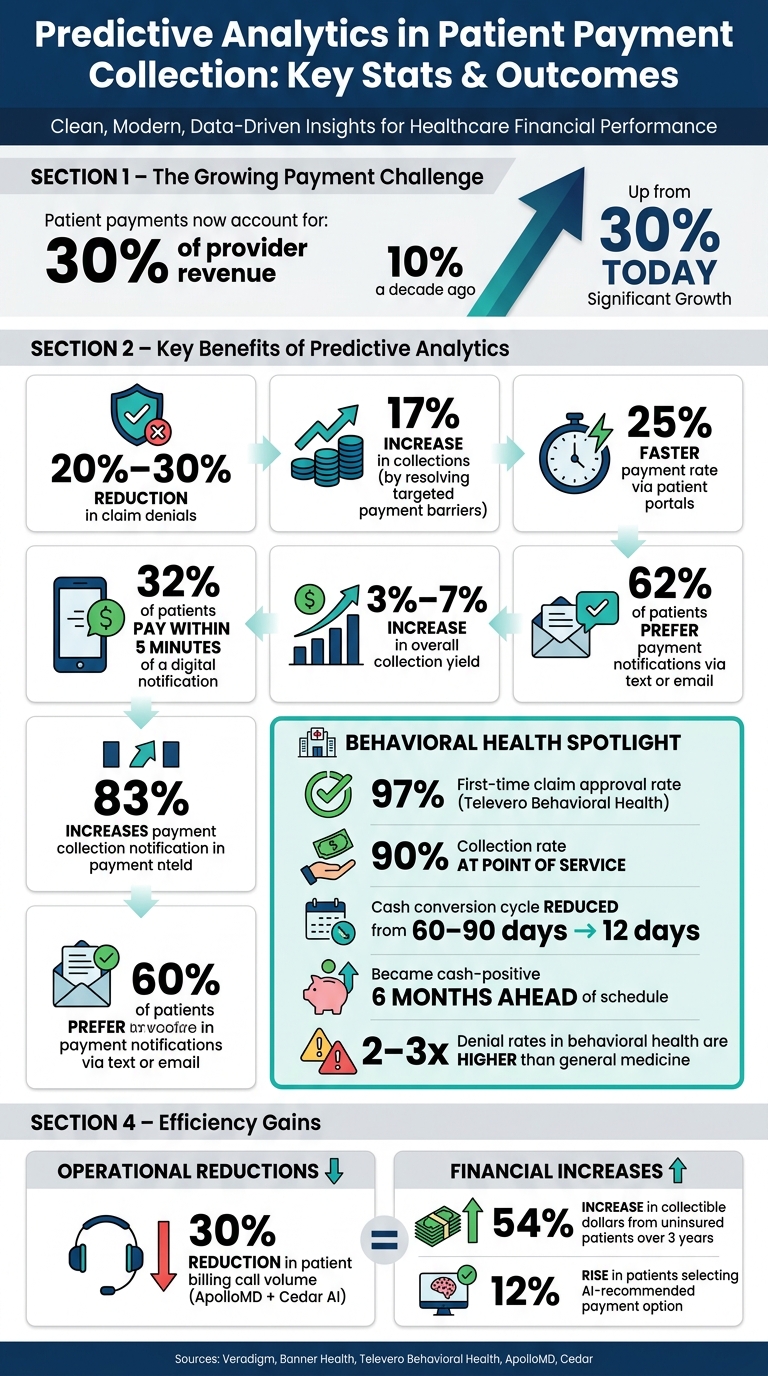
Patient payments now account for 30% of provider revenue, up from 10% a decade ago.
Predictive tools help identify patients likely to face payment challenges, enabling early engagement.
Techniques like propensity-to-pay scoring and real-time data integration streamline billing efforts.
Behavioral health providers benefit from tailored solutions that address unique billing complexities.
Results include fewer claim denials (20%-30% reduction) and faster payment cycles.
Predictive analytics not only improves cash flow but also enhances the patient experience by offering personalized payment options and reducing financial surprises.
Predictive Analytics in Patient Payment Collection: Key Stats & Outcomes
Predictive analytics in patient payments leans on some key methods. One such method is propensity-to-pay scoring, which assigns patients a risk score – low, medium, or high – based on their historical payment patterns. This helps billing teams prioritize their efforts more effectively [5][3]. Another approach, behavioral modeling, examines how patients respond to various types of outreach – like emails, text messages, or paper statements – allowing teams to choose the best communication method for each patient [5].
Risk tiering, an extension of propensity scoring, groups patients based on their predicted payment behavior. Meanwhile, real-time data integration adjusts these scores dynamically when claim statuses change, such as when a denial occurs or a deductible resets [1][5].
These methods are powered by robust and diverse data inputs, which are explored in the next section.
The effectiveness of predictive models hinges on the quality and variety of the data they use. In healthcare finance, this data comes from several key categories:
Data Input Category | What It Includes |
|---|---|
Demographics | Information like age, income, employment status, education, and marital status [4][5] |
Payment History | Details about past payments, including timing, frequency, amounts paid, and responses to reminders [4][5] |
Clinical/Utilization | Data on visit types, CPT-coded services, and transitions in the level of care [1][3] |
Insurance/Financial | Factors such as deductible status, coinsurance, real-time eligibility, and existing medical debt [3][4] |
Behavioral Preferences | Patient preferences for communication methods, like SMS or email [3][5] |
For behavioral health, clinical utilization data becomes especially crucial. The type of service provided – whether it’s outpatient therapy or a more intensive residential program – affects what a patient owes and the complexity of their billing [1][3].
By leveraging these data categories, billing teams can move beyond merely describing past trends to predicting future payment behaviors.
Most billing teams are accustomed to using descriptive analytics, which focuses on historical data like days in accounts receivable (A/R), past denial rates, and gross collection totals. While this is helpful for understanding past performance, it doesn’t provide insights into what’s likely to happen next [12].
Descriptive analytics highlights past trends, but predictive analytics takes it a step further by identifying which accounts may need immediate attention. For example, in 2025, Banner Health implemented a predictive model to determine when bad debt write-offs are warranted. This model considered payment probabilities and specific denial codes, automating a process that previously required significant administrative effort [5]. This shift allows billing teams to engage proactively rather than reactively.
Predictive analytics enhances every step of the billing process, from the moment a patient schedules an appointment to the follow-up months after their visit. Here’s a closer look at how it works in practice.
Before a patient even steps into the office, predictive models analyze factors like historical payment patterns, insurance details, and demographics (e.g., age and employment status). This data helps identify patients who might face payment challenges. With this insight, staff can proactively engage with these patients – offering cost estimates, setting up payment plans, or checking eligibility for financial assistance.
When paired with real-time eligibility checks, these models significantly improve the accuracy of cost estimates. This reduces unexpected financial burdens for patients and helps healthcare providers avoid issues like claim denials. In fact, providers using these tools report 20% to 30% fewer claim denials by addressing eligibility problems before the visit even happens [9]. Early engagement not only improves financial outcomes but also builds trust with patients.
During check-in, predictive analytics helps staff offer personalized payment options. By calculating a “sweet spot” – a manageable deposit or payment plan tailored to the patient’s financial situation – providers can maximize collections while ensuring affordability [2].
In behavioral health settings, this step often involves real-time benefit verification to confirm details like copays, deductibles, and out-of-pocket maximums. For example, billing codes such as H0035 (intensive outpatient programs) or H2014 (skills training) come with specific requirements, making accurate, up-to-date information essential [11]. Automating these processes has led to a 25% faster payment rate through patient portals [4]. By addressing payment details upfront, providers set the stage for smoother collections after the visit.
After the visit, predictive analytics keeps the billing process efficient by guiding follow-up efforts. Instead of working through accounts in a simple chronological order, billing teams can focus on those with the highest propensity-to-pay scores. This means prioritizing high-value accounts where the likelihood of payment is greatest [6][8].
The system also determines the most effective communication method for each patient. For instance, someone who responds well to SMS reminders will receive a text, while others may prefer mailed statements. This personalized approach works – 32% of patients pay within five minutes of receiving a digital notification [4]. In behavioral health, where recurring visits are common, this level of precision helps prevent small billing errors from snowballing into larger issues [10]. Tools like BHRev‘s billing automation and online payment portal are designed to support this kind of targeted outreach on a large scale.
Research highlights how predictive analytics can deliver measurable improvements in both financial outcomes and operational workflows across the payment lifecycle.
Healthcare providers using predictive analytics have reported significant gains. For instance, claim denial rates dropped by 20% to 30%, helping organizations recover lost revenue [9]. One healthcare partner saw a 17% increase in collections simply by using predictive insights to pinpoint and resolve specific payment barriers for a targeted group of patients [13].
In the behavioral health sector, the impact is even more pronounced. Televero Behavioral Health, under the leadership of CEO Ray Wolf, integrated predictive analytics into its revenue cycle processes. The results? A 97% first-time claim approval rate and a 90% collection rate at the point of service – far exceeding industry norms. Additionally, the practice reduced its cash conversion cycle from the standard 60–90 days to just 12 days, becoming cash-positive six months ahead of schedule [14].
Predictive analytics has transformed how billing teams operate. By assigning propensity-to-pay scores to accounts, billing teams can prioritize their efforts based on risk.
High-risk accounts receive direct staff attention, while low-risk accounts are handled through automated workflows. This proactive approach reduces inefficiencies in revenue cycle management.
For example, Banner Health developed a predictive model that flags accounts for bad debt write-offs using payment probability scores and denial codes [5]. Similarly, ApolloMD, using Cedar‘s AI voice agent Kora in early 2026, achieved a 30% reduction in patient billing call volume and saw a 54% increase in collectible dollars from uninsured patients over three years [7].
Workflow Area | Traditional Approach | With Predictive Analytics |
|---|---|---|
Staff Focus | Chasing aged balances reactively | Prioritizing high-risk accounts early |
Patient Outreach | Generic, manual reminders | Automated, personalized by channel and timing |
Inquiry Handling | High call volume for staff | AI-driven resolution of routine questions |
Write-Off Decisions | Manual review of aging accounts | Automated flagging based on payment probability |
These operational improvements also enhance the patient financial experience, creating a smoother process for both patients and providers.
Patients increasingly prefer digital communication, with 62% favoring payment notifications via text or email [4].
Practices leveraging predictive analytics report a 3% to 7% increase in overall collection yield, not by increasing the number of reminders but by ensuring reminders are timely and relevant [4].
By December 2023, organizations using Veradigm Intelligent Payments’ scoring feature saw a 12% rise in patients selecting the AI-recommended primary payment option [4]. This targeted outreach makes it easier for patients to engage and pay.
BHRev exemplifies this approach with its patient billing automation and online payment portal.
These tools are designed for behavioral health workflows, ensuring consistent, data-driven communication, which is especially critical for practices with recurring visits and complex billing codes.
Using predictive analytics for patient payment collection comes with real risks if not handled carefully. One of the most urgent concerns is bias tied to socioeconomic status. For example, traditional credit scores exclude about 41% of U.S. adults – over 100 million people – who have healthcare debt [4].
Relying solely on credit data to build payment models can unfairly underestimate a patient’s ability or willingness to pay, leading to inequitable treatment. To address this, ethical models focus on behavioral and demographic data instead. By analyzing historical payment patterns and life circumstances, these models aim to provide a more accurate and fair assessment of a patient’s financial situation.
Transparency is also critical. Patients should receive clear, detailed cost estimates at the CPT level before receiving care – not vague averages.
It’s important to recognize that no algorithm can account for every individual hardship. This is why human oversight remains essential.
For high-risk accounts, staff involvement is crucial; a personal conversation is often more effective than an automated message. Predictive analytics should assist staff by flagging cases that need attention, not replace their clinical or financial judgment [10].
These ethical principles directly shape how predictive tools should be designed, implemented, and governed.
When introducing predictive analytics, starting small is often the best approach. Begin with a pilot program targeting a specific patient group.
Track how predicted outcomes compare to actual payment behaviors, and refine the model before expanding. This step-by-step process helps catch and fix data quality issues early. For example, auditing 12–24 months of historical claims data before launching the model can reveal inconsistencies in denial coding or remittance matching.
Another key strategy is segmenting patients into risk tiers – high, medium, and low. This allows you to allocate resources more effectively. High-risk patients might require direct contact and financial counseling, while lower-risk accounts can be managed through automated workflows. Pairing these efforts with real-time eligibility verification helps eliminate surprise bills, a major cause of non-payment.
Together, these steps ensure predictive tools work seamlessly within broader billing processes for behavioral health.
Strong governance is especially important when applying predictive analytics to behavioral health payment collections. For instance, 42 CFR Part 2 enforces stricter privacy rules for substance use disorder (SUD) records compared to standard HIPAA.
Any predictive tool that interacts with these records must include tight access controls and audit trails [10]. Additionally, the Mental Health Parity and Addiction Equity Act (MHPAEA) mandates that mental health and SUD benefits be treated no more restrictively than medical or surgical benefits, which directly influences how financial engagement strategies are designed [15].
Stigma surrounding behavioral health adds another layer of complexity. Financial discussions about unpaid balances can be particularly sensitive.
Using plain-language terms instead of technical CPT codes can make these conversations less intimidating and easier for patients to understand [10]. Training front-desk and billing staff to use respectful, data-driven talking points – not assumptions – can also improve the patient experience.
As with other applications of predictive analytics, strong governance ensures these tools deliver both financial and patient-centered benefits.
Platforms like BHRev are designed with these behavioral health-specific requirements in mind, incorporating compliance measures for 42 CFR Part 2 and HIPAA.
These tools are built to enhance – not replace – the human element of patient financial engagement.
Predictive analytics gives behavioral health providers the tools to make informed decisions, helping them stay ahead of potential problems rather than simply reacting to them. This shift toward proactive financial management can significantly improve outcomes.
For example, healthcare organizations using predictive tools have seen denial rates drop by 20–30%. One mid-sized healthcare system even reported a 25% reduction in denials within just six months by identifying high-risk claims early on [9].
This is especially impactful in behavioral health, where denial rates are 2–3 times higher than those in general medical fields [15]. These improvements mean less strain on staff and a more consistent revenue cycle.
But the benefits go beyond finances. Predictive analytics can also improve the patient experience.
With accurate cost estimates and customized payment plans, patients are more likely to follow through with payments and avoid surprises from unexpected bills.
Behavioral health providers can take advantage of BHRev’s predictive analytics, automated eligibility checks, and denial management tools to tackle the specific challenges of their billing processes. This forward-thinking approach not only keeps cash flow steady but also builds stronger patient trust throughout their financial journey.
Predictive payment models rely on historical financial and behavioral data to estimate how likely patients are to make payments. Important data points include past payment behavior, insurance information, demographic patterns, age, employment status, and communication preferences. By analyzing this information, these models can generate precise forecasts and improve the efficiency of payment collection efforts.
Propensity-to-pay scores simplify processes by allowing staff to concentrate on high-risk accounts that may require personalized outreach and financial counseling. Meanwhile, tasks related to low-risk patients can be automated, boosting efficiency and leading to better collection results.
Providers can reduce bias in predictive analytics by focusing on a few key practices. First, they should rely on ethically sourced, de-identified data to protect patient privacy and maintain integrity. Regularly reviewing and fine-tuning algorithms is also crucial to promote fairness and avoid unintended disparities. Finally, strict compliance with HIPAA and anti-discrimination laws ensures patient rights are upheld and prevents profiling, fostering more equitable care.
One email a month, no fluff. Unsubscribe anytime.