Home / Top Behavioral Health Coding Training Programs
BLOG
Top Behavioral Health Coding Training Programs
Compare top 2026 behavioral health coding courses by role, payer mix, cost, and audit-readiness to reduce denials and improve RCM.
SHARE
Why behavioral health is different
Behavioral health coding got harder in 2026, that’s why a reliable behavioral health coding training program is a must.
How to choose the right one?
Match the course to role, payer mix, and billing risk first – not price.
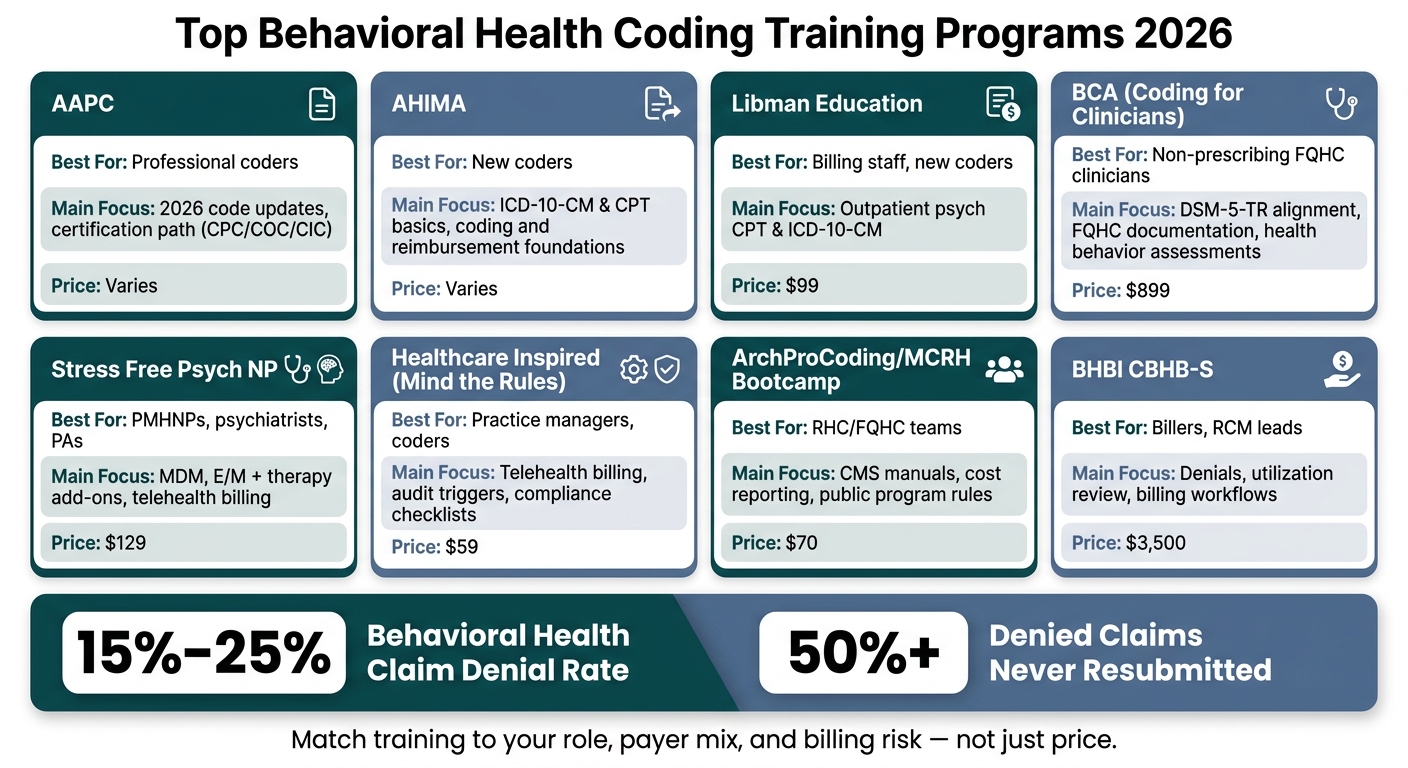
Here’s a summary of the top hehavioral health coding training programs (and what they do best):
AAPC fits coders who need 2026 code updates and a path tied to certification.
AHIMA works best for people who need basic ICD-10-CM and CPT training before moving into psych-specific topics.
Libman Education is a low-cost pick for new coders and billing staff who need focused outpatient psych training.
BCA is aimed at non-prescribing clinicians in FQHCs, with attention on documentation, DSM-5-TR, and health behavior assessments.
Stress Free Psych NP is built for prescribers who bill E/M, therapy add-ons, telehealth, and MDM.
Healthcare Inspired leans toward telehealth billing, audit issues, and checklists.
ArchProCoding/MCRH Bootcamp is a fit for RHC/FQHC teams that bill Medicare and Medicaid.
BHBI CBHB-S is more about billing operations, denials, and revenue cycle work than coding alone.
A few topics matter across all of them: 90791/90792, 90832–90837, 90839/90840, Interactive Complexity, ICD-10-CM diagnosis selection, Z codes, time-based coding, telehealth rules, and for prescribers, MDM.
That means training should do more than explain code sets. It should help your team document visits the right way, bill by payer rules, and cut denials before revenue slips away.
Best Behavioral Health Coding Training Programs 2026: Side-by-Side Comparison
Quick comparison
Program
Best For
Main Focus
Price
AAPC
Professional coders
2026 updates, certification path
Varies
AHIMA
New coders
Coding and reimbursement basics
Varies
Libman Education
Billing staff, new coders
Outpatient psych CPT and ICD-10-CM
$99.00
BCA
Non-prescribing FQHC clinicians
Documentation, DSM-5-TR, HBA codes
$899.00
Stress Free Psych NP
PMHNPs, psychiatrists, PAs
MDM, E/M + therapy add-ons, telehealth
$129.00
Healthcare Inspired
Managers, coders
Telehealth billing, audit checks
$59.00
ArchProCoding/MCRH
RHC/FQHC teams
CMS manuals, cost reporting, public program rules
$70.00
BHBI CBHB-S
Billers, RCM leads
Denials, utilization review, billing workflows
$3,500.00
Main Takeaway: pick the training that matches the claim problems your team has right now.
Top Behavioral Health Coding Training Programs in 2026
AAPC’s behavioral health training covers 2026 updates, E/M guideline changes, plus psychiatry and substance use coding. Its self-study certification prep courses for CPC, COC, and CIC are built to be finished in about 4 months[1][7].
There’s also a practical upside for new coders: if someone completes an AAPC classroom course with 80 hours or more, that can waive one year of the work experience needed for certification [1]. For hiring and onboarding, that’s a big deal. It gives teams a clear path for training new coders while keeping credentials consistent.
AHIMA Medical Coding and Reimbursement Online for behavioral health foundations
AHIMA’s training covers ICD-10-CM and CPT basics for outpatient behavioral health claims. That includes psychiatric diagnostic evaluations, psychotherapy for individuals, families, groups, and crisis situations, substance use disorders, and Z codes tied to social determinants of health [2].
This is a good starting point for new coders before they move into specialty behavioral health training. It builds the base first, then lets teams layer on psychiatry-specific rules.
For teams that need faster, role-specific training, the next options go deeper into outpatient psychiatry and prescribing workflows.
Psychiatry and behavioral health workshops
These shorter programs focus on the behavioral health coding tasks teams deal with most often.
Program
Clinical Focus
Format
Ideal Audience
Price
Libman Education
CPT & ICD-10-CM fundamentals, outpatient psych and substance use [2]
These workshop-style options are often the best fit when a team doesn’t need a full certification track. Instead, they zoom in on day-to-day work like telehealth billing, therapy add-on use, FQHC documentation, and payer rule differences. They tend to work best alongside documentation training aimed at audit readiness and cleaner claims.
Documentation and Compliance Training That Improves Coding Accuracy
Once a team knows the code set, the next job is making sure the chart supports it. That’s where a lot of problems start. Coding falls apart when documentation is thin or incomplete, and that can lead to denied claims or extra audit risk.
Behavioral health documentation courses for clinicians and coding teams
One of the most common causes of behavioral health claim errors is the disconnect between what clinicians write and what coders need to bill cleanly. BCA trains non-prescribing clinicians in FQHC settings to document treatment plans, explain why the service was provided, and support the diagnosis used for billing [3].
Some teams don’t need beginner training. They need help tightening charts before an audit finds the holes. In that case, a couple of programs take a closer look at documentation review.
Stephanie Allard Consulting’s Behavioral Health Office-Based Coding webinar costs $149.00 and helps office-based teams spot and fix documentation gaps before claims are denied [8].
Documentation Wizard’s “Misery or Mastery” live webinar costs $347.00 and focuses on the “Golden Thread” – tying intake, diagnosis, treatment plans, and progress notes together in one audit-ready record [9].
State Medicaid and public program training materials
If your team bills public programs, there’s another layer to learn: payer-specific documentation rules. General coding knowledge helps, but it won’t cover every Medicaid or Medicare detail.
ArchProCoding’s 2026 Billing & Coding Bootcamp, offered through the Michigan Center for Rural Health (MCRH), costs $70.00 to register and runs as a two-day interactive program for RHC and FQHC teams [6].
It covers CMS Benefits and Claims manuals, cost reporting, and documentation rules tied directly to reimbursement in public programs [6]. For teams billing Medicare and Medicaid, this training helps connect documentation to CMS reimbursement rules and cost reporting.
How to Choose the Right Program for Your Organization
Match training depth to team roles and payer mix
Once you know which programs stand out, the next step is to narrow the list by role and payer mix. Put simply, the best course for a prescriber may be the wrong one for a biller, and a program built around commercial plans may fall flat in a Medicaid-heavy clinic.
For prescribing clinicians like psychiatrists and PMHNPs, a focused option such as the Stress Free Psych NP Coding Companion ($129.00) covers core topics like MDM, E/M and psychotherapy add-on codes, plus Medicare vs. commercial prolonged service rules [4].
For non-prescribing clinicians in FQHCs, look for role-based training that covers Psychiatric Diagnostic Evaluations, Health Behavior Assessments, and Medicaid-centered documentation [3].
For revenue cycle leads and new billers, BHBI’s CBHB-S is aimed at day-to-day billing work. It covers benefits verification, utilization review, and denial resolution across commercial and government payers [10].
Role fit matters. But payer mix can matter just as much. A Medicaid-heavy FQHC should lean toward training built around CMS and FQHC billing rules. If most of your contracts are commercial, put more weight on carve-outs, authorization rules, and fee schedules [3][6][11].
Compare cost, time commitment, and return on investment
Sometimes even a short course pays for itself fast if it helps stop repeat denials [12].
There’s also one 2026 change that deserves fast attention. If your team bills Collaborative Care Management, move training on this to the top of the list. Your staff needs to know about the shift from CPT 99492–99494 to HCPCS G0568–G0570 [11].
After role fit, compare the day-to-day tradeoffs: budget, time, and scope. The table below makes that easier.
Experienced coders updating to 2026 code sets; CEUs available [2]
Stress Free Psych NP Guide
$129.00
Immediate download
Psychiatric prescribers optimizing E/M and therapy stacking [4]
BCA Coding for Clinicians
$899.00
~2 hours 15 mins
Non-prescribing clinicians in FQHC environments [3]
BHBI CBHB-S Certification
$3,500.00
Weeks
New billers and RCM leaders building billing-operations skills [10]
A $59.00 webinar and a $3,500.00 certification are solving very different problems. That’s the key point here: don’t judge a program by price alone. Judge it by who needs the training, how fast they need it, and what billing errors it can help prevent.
Conclusion: Build Training Into a Stronger Behavioral Health RCM Strategy
The best 2026 programs have one thing in common: they tie today’s coding rules to day-to-day documentation and actual claim results. For 2026, that means keeping up with collaborative care code changes, along with payer-specific telehealth and psychotherapy add-on rules [4][11].
Training alone isn’t enough. It has to show up in the way teams document visits and move claims through the billing process. Denials in behavioral health still sit between 15% and 25%, and more than half are never resubmitted. When that happens, the revenue is simply gone [13][14]. That’s the gap where stronger RCM support can make a big difference.
That is where BHRev comes in. BHRev’s claim scrubbing, eligibility verification, and denial workflows help turn cleaner documentation into cleaner claims [13][14].
Key takeaways for behavioral health leaders
Choose training built for behavioral health. Match it to each role, and line it up with your payer mix. Then back that training with eligibility checks, claim scrubbing, and denial follow-up, so better documentation leads to better cash flow.
FAQs
Which program best fits my role?
Choose the path that fits the work you do and what you want to get better at:
Clinicians/prescribers: specialized guides or courses
Coders/billers: CPC, COC, or CIC prep through AAPC
Behavioral health billing staff: specialist certification or 1-on-1 training through the Behavioral Health Billing Institute
For day-to-day support, a behavioral health coding and payment guide can help. Webinars can also keep your team up to date on policy changes, telehealth compliance, and audit readiness.
How do I choose based on payer mix?
Prioritize training that lines up with the insurers you bill most often. In behavioral health, billing rules can change from one payer to the next.
If you depend on Medicaid, look for training that covers HCPCS Level II. If most of your claims go to Medicare or commercial insurers, put more weight on CPT and ICD-10-CM basics. It also helps to pick programs with hands-on practice, like mock claims or lab work, so you can train for the billing tasks your team handles every day.
What topics should every team learn in 2026?
Behavioral health teams in 2026 need to pay close attention to documentation and coding changes if they want to stay compliant and avoid missed revenue.
The big areas to watch are updated ICD-10-CM categories for major depressive disorders, anxiety disorders, and substance use disorders. Teams also need to get time-based psychotherapy coding right by recording exact start and end times. On top of that, 42 CFR Part 2 privacy rules, telehealth billing modifiers, and changing CMS guidance all need close attention.