
Home / 5 Common Denial Management Mistakes and How to Fix Them

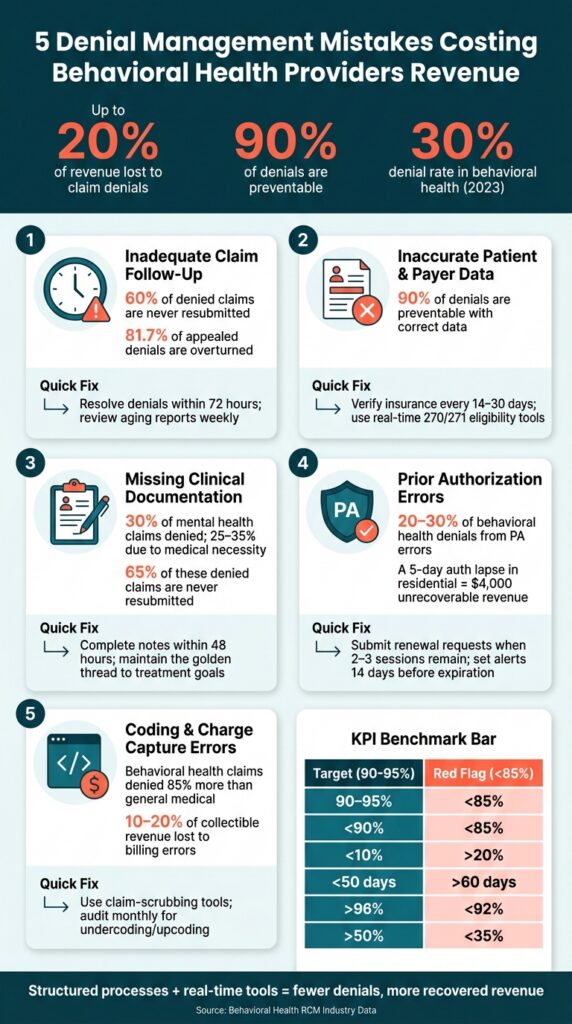
Claim denials are costing behavioral health providers up to 20% of revenue, but 90% of these denials can be avoided.
Here’s the problem: behavioral health billing is uniquely complex, with high denial rates (30% in 2023) driven by issues like missed follow-ups, inaccurate data, weak documentation, prior authorization errors, and coding mistakes.
Each mistake creates financial and operational strain, but there are clear ways to address them.
Missed claim follow-ups lead to lost revenue; 60% of denied claims are never resubmitted.
Data errors (e.g., wrong payer info) account for 90% of preventable denials.
Documentation gaps (e.g., vague notes, missing links to treatment plans) drive medical necessity denials.
Authorization errors (expired approvals, session overages) cause 20-30% of denials.
Coding mistakes (e.g., incorrect CPT codes, missing modifiers) result in costly rejections.
Claims: Resolve denials within 72 hours and review aging reports weekly.
Data: Verify insurance details every 14–30 days for ongoing treatments.
Documentation: Ensure notes explicitly link to treatment goals and are completed within 48 hours.
Authorizations: Track expiration dates and session counts with automated tools.
Coding: Use claim-scrubbing tools to catch errors before submission.
Efficient denial management starts with structured processes, real-time tools, and consistent team collaboration.
Addressing these five mistakes can recover lost revenue and reduce future denials.
In behavioral health, a single missed follow-up on a denied claim can lead to thousands of dollars in lost revenue. Given the high frequency of recurring services – like weekly therapy sessions, medication management, or intensive outpatient programs – even one slip can create a significant financial gap.
Add to this the complexity of Medicaid redeterminations and mental health “carve-outs” (where a patient’s mental health benefits are managed by a separate payer, such as Magellan, rather than their primary insurer like BCBS), and the opportunity to address denials can disappear faster than many billing teams anticipate.
The real issue isn’t just that claims get denied – it’s that they remain unresolved. Around 60% of denied behavioral health claims are never resubmitted [7]. That’s revenue left on the table.
Here’s an example: a 20% denial rate on $1 million in annual billing puts $200,000 at risk [8]. Fixing these claims isn’t cheap either. The average cost to rework a single denied behavioral health claim is $62.40 [8]. For a $115 outpatient therapy session, the rework cost eats up more than half the claim’s value.
Delays only make matters worse. Filing limits for payers typically range from 90 to 180 days [4][1]. Once that window closes, a potentially recoverable denial turns into a permanent write-off.
Burnout among billing staff further complicates things. When overwhelmed by aging claims, follow-up becomes inconsistent and reactive. This leads to missed appeals, even though 81.7% of appealed behavioral health denials are overturned when properly challenged [7][8]. Most of that lost revenue could have been recovered with a structured approach.
The solution starts with discipline and structure. Submit claims within 24–48 hours of service delivery and address rejections immediately [4][8]. Implement a strict rule: no denial should sit unresolved for more than 72 hours.
Adopt a systematic approach by reviewing aging reports weekly. If your days in AR exceed 45–60, it’s a sign your follow-up process is faltering [1][8]. Group denials by CARC codes (like CO-29 for timely filing, CO-50 for medical necessity, or CO-197 for authorization issues) to quickly identify patterns. Each month, focus on your top 3–5 recurring denial codes and trace them back to process failures – whether it’s documentation errors, missed authorizations, or routing mistakes due to carve-outs.
Tools like BHRev’s denial tracking and real-time dashboards can streamline this process. Instead of sifting through spreadsheets, your team can instantly see which claims need attention, how long they’ve been pending, and what steps are required. Automated claim status checks also reduce the time spent on payer calls, allowing staff to concentrate on resolving denials rather than hunting for them.
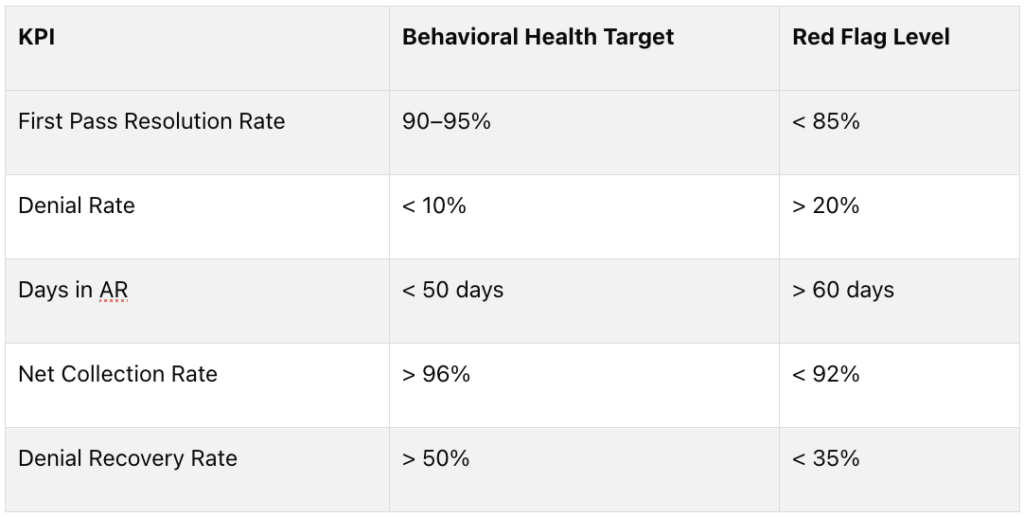
Use this table as a quick reference. If your metrics fall into the red flag range, it’s a clear indication that follow-up issues are contributing to revenue loss – something that needs immediate attention.
Front-end data errors are a leading cause of preventable denials in behavioral health billing. In fact, up to 90% of denied behavioral health claims could have been avoided [3]. Small mistakes – like a swapped digit in a Medicaid ID, outdated insurance details, or missing carve-out arrangements – can result in claim rejections before they even reach a payer for review.
This issue becomes even more expensive when you consider how often behavioral health patients experience job changes or Medicaid churn. These shifts in coverage can happen suddenly, often mid-treatment, leading to CO 27 (expired coverage) or CO 31 (coverage gap) denials – problems that could often be prevented with a quick re-verification.
Errors in data entry are just the beginning. Billing the correct Managed Behavioral Health Organization (MBHO) requires dedicated checks. Many patients have mental health benefits managed separately from their primary medical coverage. Sending claims to the wrong payer – even when the patient is fully insured – results in immediate denials.
Coordination of Benefits (COB) errors are also a frequent issue. For patients with dual coverage, like Medicare and Medicaid, submitting a claim to the secondary payer before the primary can trigger a PR 275 denial. Adding to the complexity, some payers use COB verification as a way to delay payment, requiring confirmation that the patient has no other active insurance [9].
Here’s a quick look at some common denial codes tied to data-related errors:
Denial Code | Meaning | Common Cause in Behavioral Health |
|---|---|---|
CO 16 | Missing or Incomplete Information | Errors like missing NPI, incorrect POS codes, or subscriber data issues [1][4] |
CO 27 | Coverage Expired | Due to Medicaid redetermination or terminated employer plans [1] |
CO 31 | Coverage Gap | |
PR 275 | Payer Hierarchy Error | Incorrect primary/secondary payer order for dual-eligible patients [1] |
PR 204 | Service Not Covered | Exclusions for specific care levels or carve-outs [1] |
Another common mistake is verifying only general mental health benefits rather than checking for specific levels of care. For instance, a plan might cover outpatient therapy but exclude residential or Intensive Outpatient Program (IOP) services. Billing for an unverified level of care is almost guaranteed to result in a denial [1].
The good news? These errors are preventable with the right processes. Real-time 270/271 eligibility tools can verify active coverage in under 10 minutes [3][1]. Regular eligibility checks – every 14 to 30 days for patients in residential or IOP programs – can catch coverage changes before they lead to denials [1].
Train front-office staff to ask targeted questions during intake, such as whether the patient has experienced recent job changes or received any insurance updates. This can help uncover issues like Medicaid churn or plan switches early [1]. Additionally, require staff to verify patient details against both a physical insurance card and photo ID at every visit [4].
On the back end, automated claim scrubbing tools, like those offered by BHRev, can catch errors such as missing NPIs, invalid Place of Service codes, or mismatched subscriber IDs before claims reach the clearinghouse. While clearinghouse rejections don’t count toward timely filing deadlines, they still waste valuable time and delay payments [9]. Fixing these errors upfront is far more efficient than addressing them after submission.
Below: the code, why it shows up, and the first move our team makes. Read more on our methodology →
The single biggest denial driver in BH. Usually a treatment-plan change (PHP → IOP, or IOP → outpatient) that wasn’t re-authorized. First move: pull the auth log, identify the date the plan changed, request retro-auth from the payer with the clinical note attached.
Almost always preventable but recoverable in narrow windows. Payers vary from 90 to 365 days. First move: check if you have proof of original submission (clearinghouse acknowledgment). If yes, file an appeal with the trace. We’ve recovered 6-figure aged buckets this way.
In behavioral health, documentation is the backbone that justifies care, especially since there are no lab tests or imaging to rely on. Alarmingly, 30% of mental health claims are denied, with 25–35% of those tied to medical necessity issues [5][10]. Even more concerning? About 65% of these denied claims are never resubmitted, leading to permanent revenue loss [10]. Strong documentation not only supports clinical decisions but also plays a critical role in recovering lost revenue.
A key principle in behavioral health documentation is maintaining the “golden thread.” This means ensuring a clear and continuous link between the patient’s diagnosis, treatment plan goals, interventions during sessions, and the patient’s documented responses. When progress notes fail to connect explicitly to an active treatment plan goal, payers may reject claims as not medically necessary. Consistency and clarity in documentation are just as important as timely follow-up on claims when it comes to reducing denials and recovering revenue.
Using vague phrases like “patient is doing well” or “supportive counseling provided” doesn’t meet payer standards. Instead, incorporate objective metrics like PHQ-9 scores, GAD-7 results, or ASAM dimension assessments.
For CPT codes 90832, 90834, and 90837 – which are billed based on session duration – omitting start and stop times can trigger audits or lead to downcoding. Another common issue is confusing psychotherapy notes (private clinician reflections) with progress notes, which are the legal records used for billing. This mix-up can result in missing critical billing details.
To improve documentation, consider these actionable steps:
Standardize templates in your EHR: Include prompts for session start and stop times, DSM-5-TR diagnosis links, intervention details, and patient responses. This ensures all required fields are completed [10][5].
Complete notes promptly: Aim to finalize documentation within 24–48 hours to improve accuracy and defend claims [10].
Regular chart reviews: Weekly spot-checks using a standardized checklist can catch missing signatures or weak medical necessity details before claims are submitted [11].
Leverage compliance tools: Platforms like BHRev can flag documentation gaps, allowing them to be addressed before they lead to denials.
Documentation Gap | Denial Risk | Fix |
|---|---|---|
Vague language (e.g., “doing well”) | May result in medical necessity denials | Use objective data (e.g., PHQ-9, GAD-7 scores) |
Missing start/stop times | Increased risk of audit and potential downcoding | Require mandatory time-in/time-out fields in the EHR |
Broken golden thread | Services not clearly linked to the treatment plan | Explicitly reference a treatment plan goal in every note |
Cloned/copy-paste notes | Raises red flags that can trigger denials | Use templates that enforce unique, session-specific input |
Missing diagnosis link | Risk of denial due to unverified diagnosis | Directly tie DSM-5-TR codes to current clinical findings |
Authorization issues can wreak havoc on revenue cycles, especially in behavioral health. Prior authorization (PA) errors are among the priciest and most avoidable reasons for claim denials. Shockingly, they account for 20% to 30% of all behavioral health denials [5]. These errors don’t just hurt the bottom line – they can disrupt patient care.
The problem often reveals itself too late. Services are rendered, claims are submitted, and weeks later, a denial lands, leaving the service unbillable. The table below highlights common PA mistakes and how to address them, underscoring the importance of proactive oversight.
Certain errors occur repeatedly, with expired authorizations topping the list. When a session is delivered after an authorization has lapsed, recovery is nearly impossible. Another frequent issue is depleted session counts – payers don’t notify providers when authorized units are nearly exhausted. This means delivering a 13th session on a 12-session authorization leads to instant denial.
Modality mismatches have also become a growing issue. In 2026, telehealth-related claim denials surged 84% in 2025 [13], often due to providers using in-person authorizations for telehealth sessions – or vice versa – without confirming payer requirements. For intensive care levels like IOP or residential treatment, level-of-care gaps can be devastating. For example, a 5-day authorization lapse in a residential program billing $800/day results in $4,000 of unrecoverable revenue [14].
Failure Mode | Impact | Fix |
|---|---|---|
Expired authorization | Retroactive denial (often unrecoverable) | Set alerts 14 days before expiration |
Depleted session units | Denial of sessions exceeding authorized count | Use auto-decrementing counters in your EHR |
Modality mismatch | Telehealth vs. in-person rejection | Validate delivery method at scheduling |
Level-of-care gap | High-dollar loss in IOP/PHP/residential | Build step-up/step-down authorization protocols |
Secondary insurance | Invisible until primary pays or denies | Track dual-coverage clients in parallel |
To reduce these errors, it’s crucial to adopt a proactive, centralized system for tracking authorizations. A master authorization matrix can help by logging each patient’s authorization details, including CPT codes, sessions used, remaining sessions, and expiration dates. Renewal requests should be submitted when 2 to 3 sessions remain, rather than waiting until the authorization expires [5]. For higher-acuity settings, concurrent review requests should start 7 to 10 business days before the current approval ends [14].
Scheduling workflows should also include authorization initiation. This small adjustment can cut the typical 14-day authorization wait by 3 to 7 days [13]. However, as practices grow, manual tracking systems become unreliable.
This highlights the need for automation as a practice scales. Tools like BHRev’s prior authorization support can automate session tracking, flag expiring approvals in real time, and integrate authorization checks into scheduling to prevent errors before they happen. When denials do occur, requesting a peer-to-peer review within 10 to 14 days can overturn decisions 40% to 60% of the time [5], making it a crucial part of any appeals process.
Accurate coding is just as important as proper follow-up and documentation when it comes to recovering revenue. Unfortunately, coding errors are a common issue in behavioral health billing, leading to significant revenue losses. According to Cipher Billing, behavioral health claims are denied 85% more often than general medical claims, with facilities losing anywhere from 10% to 20% of collectible revenue due to avoidable billing errors [1]. The good news? Unlike some issues, coding mistakes can often be caught before claims are submitted.
Behavioral health coding is known for its complexity. For example, billing correctly for CPT 90837 requires precise documentation of session start and stop times. Submitting 90837 for a 45-minute session is an automatic red flag and will likely result in a denial [5].
Modifier mistakes are another common problem. Forgetting to include telehealth modifiers (like 95 or GT) or using the wrong Place of Service (POS) code – such as POS 11 instead of POS 02 or 10 – can lead to instant rejections. On top of that, state-specific modifiers, like HE in Florida or U1 in California, add even more layers of complexity that can trip up billing teams [1][15].
Underbilling is another issue that often flies under the radar. For instance, many practices fail to bill for add-on codes, even though they apply to a large number of sessions. Examples include Interactive Complexity (CPT 90785), which is relevant in 50% to 70% of qualifying sessions, and crisis add-ons (CPT 90840) or brief emotional assessments (CPT 96127). These codes represent legitimate services that often go unbilled [5].
Here’s a quick look at common coding mistakes and their impact:
Common Coding Error | Why It Causes Denials |
|---|---|
Time-based CPT mismatch (e.g., billing 90837 for a 45‑min session) | Documented time doesn’t support the billed code |
Missing telehealth modifiers (95, GT) or wrong POS code | Automatic technical rejection by the payer |
Unspecified ICD-10 F-codes (e.g., F11.20 instead of F11.21) | “Diagnosis uncovered” or medical necessity denial |
Omitting add‑on codes (90785, 90840) | Lost revenue for services already performed |
Corrected claims without frequency code 7 or 8 | “Already adjudicated” denial on resubmission |
Tackling these challenges starts with implementing thorough pre-submission checks. Using claim-scrubbing tools and standardized EHR templates can help ensure that coding aligns with clinical documentation. For instance, templates that require fields like start/stop times, Mental Status Exam findings, and ASAM criteria can reduce errors and improve claim acceptance rates [15][12][16]. Without this alignment, even correctly coded claims can still be denied.
Regular internal audits are another key strategy. Conducting monthly reviews can help catch patterns of undercoding or upcoding before they become bigger problems.
AI-powered tools, like those offered by BHRev, can make a big difference here. These tools automatically flag high-risk codes (like 90837), identify missing add-ons, and verify modifier accuracy based on payer-specific rules. By handling routine error-checking, these tools free up billing teams to focus on resolving denials and recovering lost revenue.
The five common mistakes outlined – poor claim follow-up, inaccurate patient and payer data, weak clinical documentation, prior authorization gaps, and coding errors – often point to broader issues that span across intake, clinical, and billing teams. As Michael Arevalo, Psy.D., PMP of Core Solutions, explains:
By addressing these areas through a unified framework, teams can collaborate more effectively and tackle the root causes of denials.
Consider this: resolving a single denial costs an average of $62.40 in administrative labor [8]. Without a structured system, these costs add up fast. Categorizing denials using Claim Adjustment Reason Codes (CARC) – such as CO 50 for medical necessity or CO 151 for expired authorization – can help divide responsibilities into clear categories like Authorization/Concurrent Review, Eligibility/Benefits, Coding/Documentation, and Timely Filing/Follow-Up. This ensures that each team handles its specific part of the process, instead of leaving billing to clean up issues that began elsewhere.
Tracking metrics is another essential piece. A first-pass clean claim rate below 92% or a denial rate above 10% can signal deeper problems [17]. Monthly feedback meetings where billing teams share denial trends with intake and clinical staff can help identify and fix recurring issues. For example, updating intake scripts or templates based on these insights can prevent avoidable mistakes from snowballing into significant revenue losses.
Our platform offers tools like AI-powered claim scrubbing, automated eligibility verification, and real-time analytics to optimize denial management. Practices using these solutions have achieved clean claim rates exceeding 95%, reduced A/R days to under 45, and kept hard denial rates below 3% [17][18]. Whether you need comprehensive RCM outsourcing or targeted help with specific challenges like aged A/R recovery or prior authorization, BHRev provides the support to meet your goals effectively.
Tracking the right denial KPIs is crucial for maintaining efficient revenue cycle operations. Start with the first-pass clean claim rate, which should ideally fall between 92–95%. If it drops below 90%, it could indicate issues like coding errors or incomplete claims.
Next, keep an eye on your initial denial rate – this should remain between 5–10%. If it creeps above 10–15%, it’s a red flag that there may be process gaps or systemic problems.
You’ll also want to monitor the hard denial rate, aiming to keep it under 2–3%. This metric reflects claims that cannot be recovered, so keeping it low is critical. Lastly, check your appeal overturn rate; it should exceed 50%. A strong overturn rate indicates that your denial management strategies are effective and that appeals are being successfully resolved.
By consistently tracking these metrics, you can identify problem areas and improve your overall claims process.
If a claim is denied due to medical necessity, start by carefully reviewing the denial reasons. Collect all relevant documentation that supports the need for the services provided. This might include detailed clinical notes, treatment plans, and a clear explanation of why the services were essential. When appealing the decision, make sure the documentation aligns with the payer’s specific requirements.
Before resubmitting, check for and resolve any issues, such as missing or incomplete records. Taking these steps can increase the likelihood of the claim being accepted.
To cut down on prior authorization denials, it’s essential to have a well-defined protocol for documenting all necessary information in the medical record. Consistency is key here. Make sure your staff is thoroughly trained on authorization policies and knows how to apply them during scheduling.
By taking these steps, you can reduce errors, avoid delays, and simplify the authorization process. This not only makes scheduling sessions smoother but also lowers the chances of denials.
We staff full denials teams for behavioral-health practices and recover an average of 32% of aged A/R prior agencies wrote off. 30-minute consultation, no pitch.
One email a month, no fluff. Unsubscribe anytime.