
Home / How to Improve Cash Flow in Behavioral Health Practices

Running a behavioral health practice can feel like navigating a maze – especially when cash flow issues arise.
The demand for mental health services is higher than ever, but complex billing systems, high denial rates, and no-shows often create financial roadblocks.
Here’s what you can do to improve cash flow:
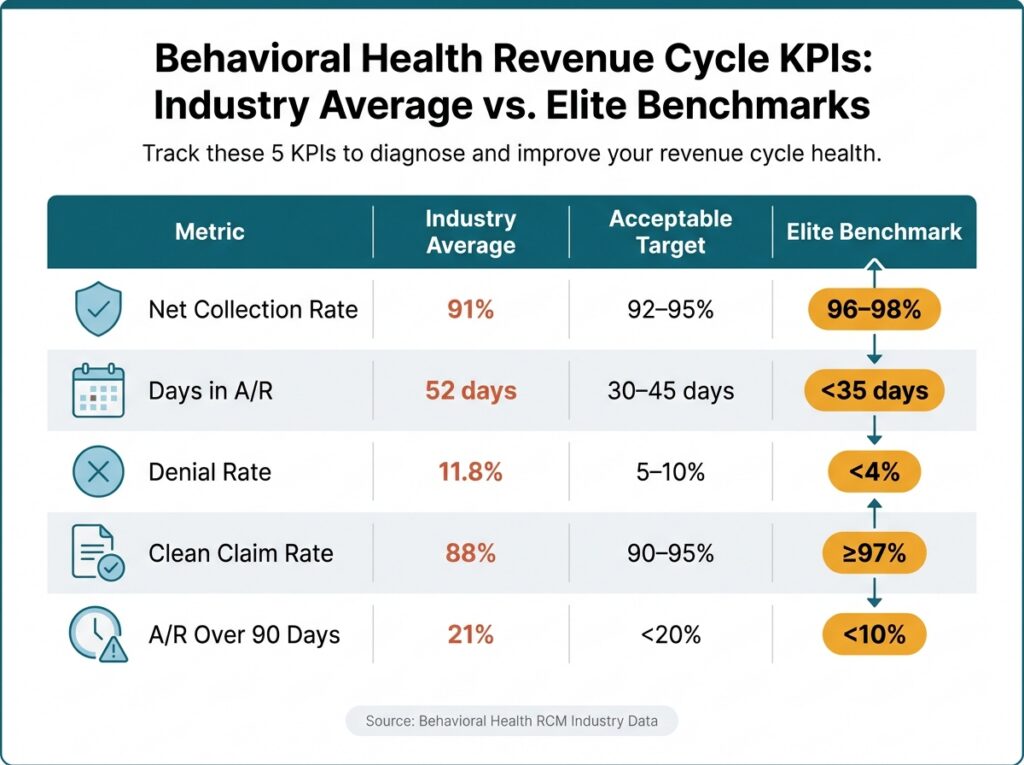
Track Key Metrics: Focus on critical revenue cycle indicators like Days in A/R (aim for under 35 days), Net Collection Rate (target 95%+), Clean Claim Rate (keep above 95%), and Denial Rate (below 5%).
Fix Front-End Processes: Verify patient eligibility and prior authorizations early. Use tools like two-way SMS reminders to reduce costly no-shows.
Streamline Billing: Use behavioral health-specific EHR templates and ensure time-based CPT codes are accurate. Automate claim submissions to avoid delays.
Manage Denials Effectively: Categorize and resolve denials systematically. Use analytics to identify patterns and prevent recurring issues.
Leverage Technology: Implement tools for predictive analytics, automated billing, and compliance tracking to reduce errors and speed up collections.
Tracking your practice’s cash flow requires looking beyond just total revenue or your bank balance.
So which reports actually matter when tracking the financial health of a behavioral health practice?
Total revenue? Visit counts? Bank balances?
These reports are popular… but they are lagging indicators.
Rely on them alone, and you may be surprised by cash flow dips.”
To get ahead of potential cash flow issues, focus on metrics that highlight pre-payment activities. These early indicators provide a clearer picture of your revenue cycle’s health.
Five essential metrics can help you evaluate the health of your revenue cycle:
Days in A/R: This measures the time between providing a service and receiving payment. The industry average for behavioral health is 52 days, but practices that perform well aim for under 35 days. If your number exceeds 50, it could signal delays in billing or follow-up processes.[10]
Net Collection Rate (NCR): This reflects the percentage of collectible revenue you actually receive after adjustments. A strong NCR is 95% or higher, and anything below 90% signals trouble.[5][6]
Clean Claim Rate: This is the percentage of claims paid on the first submission. Aim for 95%–99% to ensure quicker revenue collection.[8]
Denial Rate: This shows how often claims are rejected outright by payers. While the behavioral health average is 11.8%, general medicine sees rates of 5%–8%. High denial rates can cost your practice 15%–30% of collectible revenue annually.[10]
A/R Over 90 Days: Claims unpaid for over 90 days are at high risk of becoming uncollectible. Try to keep this under 20% of your total A/R, and ideally below 10%.[6][10]
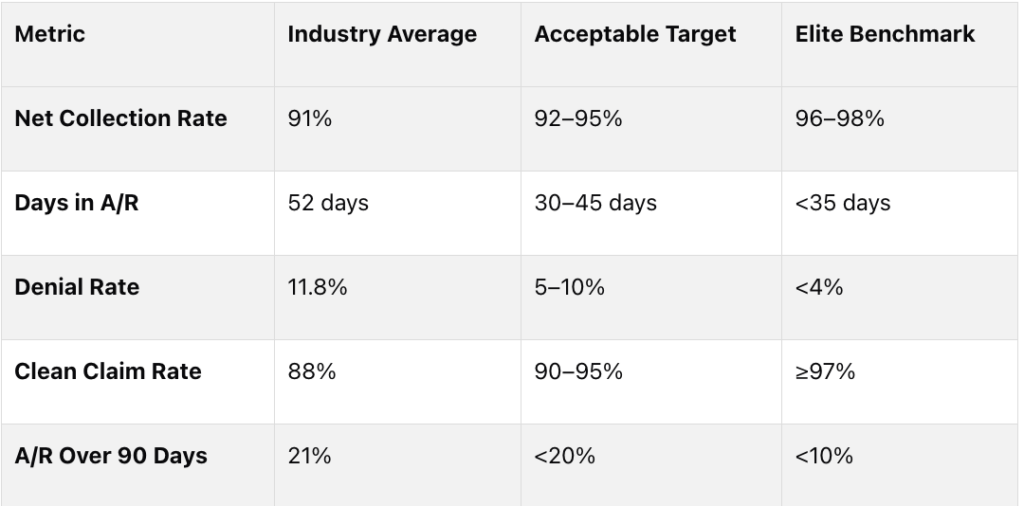
Tracking these metrics is just the start. Analytics tools can help you uncover trends and pinpoint problem areas. For example, billing teams should review clean claim and denial rates weekly, while practice managers monitor NCR and days in A/R monthly to catch issues early.[5][6]
Revenue cycle management (RCM) dashboards simplify this process. Tools like BHRev provide real-time insights into payer mix, aging claims, and denial patterns.
By tagging denials with reason codes, payers, and service lines, these platforms help answer critical questions, such as: Which payer is rejecting the most claims? Which provider has the lowest first-pass rate? Where are claims getting stuck in the 60–90 day range?
One specific issue to watch for is behavioral health carve-outs. When a patient’s mental health benefits are managed separately by entities like Optum or Magellan, sending claims to the wrong payer can lead to systematic denials.[9][10] Dashboards that segment denials by payer type can quickly highlight this issue, saving your practice from weeks of lost revenue.
Accurately tracking these metrics and using analytics tools to identify patterns are critical steps in managing billing, reducing denials, and improving your practice’s cash flow.
Cash flow challenges in behavioral health practices often start at the front desk, not the billing department. Over 70% of claim denials stem from errors made before a patient even receives care[7]. Tackling these issues early can help reduce revenue loss significantly. This approach works hand in hand with monitoring key revenue metrics to keep finances on track.
Eligibility checks aren’t a one-and-done task – they need to be ongoing.
Behavioral health benefits are often managed by a separate carve-out payer, different from a patient’s primary insurance. Verifying benefits with the wrong payer can result in claim denials, even if everything else is correct.
One effective strategy is the “48-Hour Rule”: complete a full benefit verification for every patient at least two days before their appointment[7]. This gives your team time to address coverage gaps, confirm visit limits, and check telehealth-specific requirements, such as whether the session must include both audio and video. This is especially important as about 40% of behavioral health visits in 2026 are expected to be conducted via telehealth[1].
To manage prior authorizations effectively, use a centralized log to track approved CPT codes, session units, and authorization dates. This ensures reauthorization requests are submitted before the current approval expires – ideally when 2 to 3 sessions remain[3]. Since prior auth denials account for 20%–30% of behavioral health claim denials[1], documenting every interaction with payers (including the representative’s name, call date, and reference number) is critical[13].
Accurate eligibility checks not only reduce denials but also help patients stick to their scheduled appointments.
No-shows are a major drain on cash flow. In outpatient therapy, no-show rates typically range from 20% to 30%, higher than the 18% average in primary care[15]. With each missed appointment costing an average of $200[14], even small improvements can make a big financial difference.
To address this, implement two-way SMS confirmations and structured reminders 72 hours, 24 hours, and on the day of the appointment. Two-way messaging allows patients to confirm or reschedule instantly, increasing their commitment to attend.
For instance, between January and April 2026, Atlas Medical Center used Curogram’s two-way messaging tools to reduce its no-show rate from 14.26% to 4.91% within 90 days, processing over 1,100 automated confirmations per month[15].
Telehealth options can also help patients who struggle to leave home due to severe anxiety or depression. However, telehealth isn’t a perfect solution – one study found that telehealth patients in rural behavioral health clinics had a 17% no-show rate compared to 13% for in-person visits[16].
Once front-end processes are running smoothly, clear financial discussions are the next step to maintaining a healthy cash flow. Skipping financial conversations during intake often leads to payment issues later. When patients are surprised by a bill weeks after their session, collecting payment becomes much harder, and unpaid balances increase.
Before the first session, review the patient’s estimated out-of-pocket costs, copays, and any limits their insurance plan imposes. For example, if their insurance only covers six sessions, but their treatment plan requires 20, bring up this gap during intake. Discuss options like sliding-scale fees or payment plans upfront to avoid future issues.
Collecting copays and outstanding balances at check-in further reduces additional billing costs. Patient portals with online payment options can make the process even easier, especially for patients who prefer paying through their mobile devices.
Efficient billing and claims management are crucial for maintaining steady cash flow in behavioral health practices. Mistakes in documentation, coding errors, and delays in claim submissions can lead to revenue losses – but they’re often avoidable. After addressing front-end processes, refining billing workflows ensures you capture all the revenue your practice earns.
Generic EHR templates designed for primary care often miss the mark when it comes to behavioral health needs. In fact, over 60% of behavioral health providers still use generic or outdated systems that fail to reflect the complexity of their work [18].
Switching to behavioral health-specific EHR templates – aligned with formats like SOAP, DAP, or BIRP – can make a huge difference. These templates map clinical notes directly to payer requirements, saving clinicians up to 90 minutes per day. That’s enough time to add 30+ billable sessions each month [20].
Behavioral health templates also enforce “hard stops” – fields that must be completed, like session start and end times, CPT code rationale, and risk assessments. Each progress note should tie back to a specific goal in the patient’s Individualized Treatment Plan (ITP), showing medical necessity. Payers are quick to flag vague phrases like “patient made progress” or copy-pasted notes as audit risks [13][17].
A practical approach? Set documentation standards by diagnosis clusters, such as mood disorders, anxiety disorders, or substance use disorders. This ensures notes are detailed and relevant without overloading clinicians.
Behavioral health coding comes with its own challenges, and even small errors can have big financial consequences. One of the most common issues is time-based coding errors. For example, psychotherapy codes (90832, 90834, 90837) are based on actual face-to-face minutes – not the scheduled appointment length. If a note reads like a 30-minute session but is billed as a 60-minute session, it’s likely to be denied or trigger a recoupment request [17].
Another overlooked opportunity is the Interactive Complexity (CPT 90785) code. This add-on applies when communication is significantly complicated, such as when a third party is involved, there’s a safety crisis, or a language barrier exists. Despite research showing it applies to 50%–70% of qualifying sessions, many practices rarely bill for it [1].
When billing medication management alongside therapy, it’s essential to pair the correct E/M code with the appropriate psychotherapy add-on (90833, 90836, or 90838). Documentation must clearly separate the medical evaluation from the therapy to avoid denials for “inclusive” or “duplicate” services [23][1]. Tools like BHRev’s AI-powered claim scrubbing can catch potential issues – like NCCI bundling conflicts, missing modifiers, or mismatched diagnoses – before claims are sent to payers.
Once coding accuracy is under control, the next step is ensuring timely and error-free claim submissions.
Timeliness is critical for claim submissions. The industry standard for “Time to Bill” is fewer than three business days after the date of service, and top-performing practices aim for a clean claim rate of 95% or higher [24]. Submitting claims daily is the most reliable way to meet these benchmarks.
Automated charge capture can help reduce manual errors, especially for telehealth visits. For example, telehealth claims need the right Place of Service (POS) codes – POS 10 for home-based services or POS 02 for other locations – and the correct modifier (95 for video sessions or 93 for audio-only visits) [19][21][22][24].
To further minimize errors, create one-page payer quick sheets. These should outline key details like authorization thresholds, documentation requirements, and modifier rules. Quick sheets keep your billing team aligned and reduce the chance of small oversights that can lead to revenue losses.
Even with the best coding practices, denials are inevitable. In 2023, mental health claims faced a denial rate of 30%, nearly twice the 19% rate seen across other medical specialties [25]. The good news? Up to 90% of these denials can be avoided [25].
The key difference between practices that bounce back quickly and those that struggle often lies in having a structured process rather than addressing denials on a case-by-case basis. A solid denial management process ties directly to maintaining and improving your practice’s cash flow.
To resolve denials effectively, you first need to identify why they happen. Start by grouping them into four main categories: eligibility/coverage, authorization, medical necessity/clinical documentation, and coding/technical errors. Analyzing denials by payer can also highlight recurring issues that may need upstream fixes.
Review the Claim Adjustment Reason Codes (CARC) and Remittance Advice Remark Codes (RARC) listed on the Explanation of Benefits (EOB). These codes reveal patterns, helping you trace the most common causes of denials and the payers responsible for them.
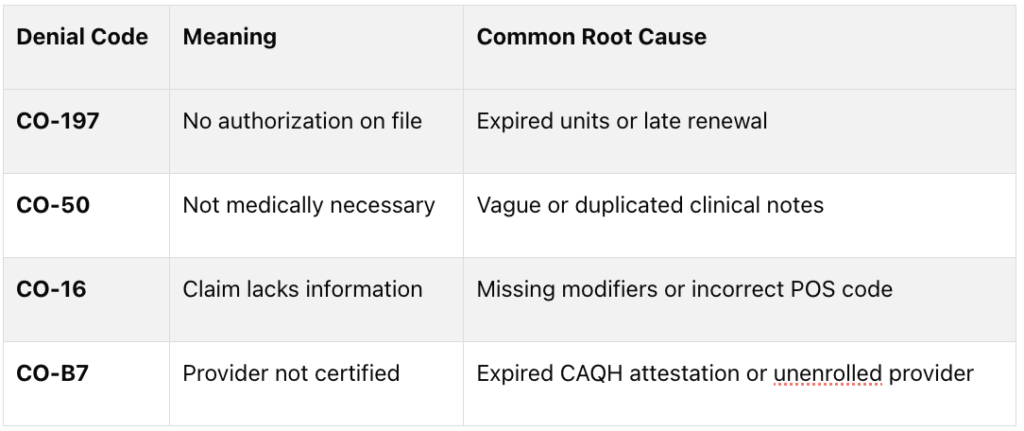
Once you’ve categorized the denials, implement a consistent process to address them promptly and systematically.
Leaving denials unresolved means lost revenue. Assign each denial to a specific team member within seven days of receipt [9]. Prioritize denials based on dollar value and filing deadlines, as Medicaid and many county plans often require claims to be submitted within 90 to 120 days [7].
For medical necessity denials, initiate a peer-to-peer review within 10 to 14 days. This is a direct conversation between your clinician and the payer’s medical reviewer.
Peer-to-peer reviews can overturn denials 40% to 60% of the time. Additionally, if the payer’s criteria for behavioral health services seem stricter than those for similar medical services, you may be able to cite a violation of the Mental Health Parity and Addiction Equity Act (MHPAEA) [1].
Denial management shouldn’t be confined to the billing department. Conduct weekly cross-functional reviews involving billing, intake, and clinical leads to discuss the top five reasons for denials.
If a denial stems from a front-desk error or a documentation issue, provide immediate feedback to the responsible team. Treat denials as a source of valuable data instead of just administrative tasks. This approach helps reduce recurring errors [3].
A strong denial resolution process also sets the stage for identifying and recovering underpayments. Silent underpayments – when payers reimburse less than the contracted rate – are a common issue. In fact, 82% of psychologists report receiving incorrect reimbursement rates [26]. Regularly comparing payments against payer contracts is critical, and tools like BHRev’s underpayment recovery system can flag discrepancies before they impact your revenue.
On the prevention side, claim scrubbing tools can catch issues like coding errors, missing modifiers, or incorrect Place of Service codes before submission. Additionally, using an authorization matrix – a centralized tracker for each patient’s authorized CPT codes, approved units, and expiration dates – can help avoid the 20% to 30% of denials caused by expired or missing authorizations [1]. Set alerts to request reauthorizations when two or three sessions remain, rather than waiting until the authorization has expired.
A well-structured denial management process lays the groundwork, but technology is what keeps cash flow steady over time. The right tools don’t just solve problems – they help identify and address them early.
Predictive analytics leverages your historical billing data – such as reimbursement trends, payer performance, and seasonal fluctuations – to spot cash flow gaps before they disrupt collections. Instead of scrambling to react to a slow month, you can plan ahead.
Real-time dashboards provide a live snapshot of billing operations. For example, if unpaid claims are stacking up with a specific payer or your 90+ day accounts receivable (A/R) bucket starts edging past 20–25% of total receivables, you’ll catch it immediately instead of stumbling upon it during a quarterly review [12]. Organizations that embrace revenue cycle analytics often see their collection rates improve by 10–15% within the first year [2].
Rules engines take this even further by flagging at-risk revenue in real time. For instance, they can alert your team when a patient’s authorized sessions are running low or when a prior authorization is set to expire in two weeks [3][9].
This kind of proactive insight separates practices with consistent cash flow from those constantly chasing payments. These tools also pave the way for automated billing and more scalable operations.
Manual billing follow-ups eat up time and resources. Automated tools, like online payment portals and scheduled billing reminders, lighten the administrative workload while speeding up collections.
Timely claim submission is a cornerstone of revenue cycle efficiency, and technology ensures those standards are consistently met. Integrated billing software can accelerate collections by up to 70% [27], while adding an integrated billing module can boost net revenue and cash collections by as much as 12% [27].
By automating billing, practices can eliminate delays that previously extended A/R days. For example, when session data flows seamlessly from your EHR into the billing system, you avoid manual re-entry errors, unbilled charge delays, and coding mismatches that quietly drain revenue [9][8].
Claim scrubbing tools further enhance this process by catching errors before submission, helping practices maintain clean claim rates above 95% – a benchmark consistently hit by top-performing behavioral health organizations [2].
Many practices don’t have the internal resources to handle every aspect of revenue cycle management (RCM). Targeted RCM support steps in to fill those gaps, offering specialized services for areas like credentialing, prior authorizations, aged A/R recovery, or denial management.
BHRev’s targeted support model is a great example of this approach. Practices pay only for the specific services they need, making it easier for smaller teams to access expert RCM support without increasing staff. For those seeking a more comprehensive solution, BHRev also offers full-scale RCM services.
These cover the entire revenue cycle – from eligibility checks and claim scrubbing to underpayment recovery and revenue forecasting – on a performance-based fee structure.
The combination of the right technology and targeted expertise creates a powerful system. Tools provide the automation and visibility needed, while specialized support ensures the processes behind them are efficient and effective. Together, they help build a financially sustainable foundation for your behavioral health practice.
Telehealth billing has become increasingly complex.
By 2026, specific POS (Place of Service) codes will be required: POS 02 for telehealth services provided outside the home and POS 10 for home-based telehealth services [1]. With about 40% of behavioral health visits now happening via telehealth [1], ensuring these codes are applied correctly is critical for protecting your revenue stream.
To keep up with these changes, successful practices rely on a few key strategies:
Regularly reviewing the CMS Medicare Benefit Policy Manual (Chapter 6) to stay informed about updates.
Holding cross-functional meetings with billing teams, clinicians, and intake staff to ensure everyone understands the latest payer requirements [3].
Maintaining a payer-specific matrix that details telehealth codes, necessary modifiers (like 95 or GT), and documentation expectations. This tool keeps your team on the same page and helps avoid costly mistakes [4].
Accurate time tracking for psychotherapy codes is another essential compliance step.
As payer rules evolve, relying on manual compliance processes becomes risky – especially when turnover rates in healthcare can climb as high as 30% annually [28].
Integrating compliance tools directly into your workflows reduces the chances of errors tied to individual memory or staff changes.
For example, the BHRev platform embeds payer-specific rules into its system. Its claim scrubbing engine identifies issues like NCCI bundling conflicts, missing modifiers, and mismatched diagnosis-procedure codes before claims are submitted [1][24].
Features like automated eligibility verification and credentialing trackers ensure coverage is active, carve-outs are correctly identified, and providers are properly credentialed. These tools can cut eligibility denials by up to 30% [2][29][9].
Additionally, EHR templates designed around DSM-5 diagnoses and symptom severity – aligned with CMS standards – help protect against medical necessity audits [3][4]. Running quarterly internal audits of clinical notes against billed CPT codes, using payer standards as the benchmark, can identify documentation gaps early, avoiding surprises down the line [3][7].
Building better cash flow in behavioral health means fine-tuning every step of your revenue process.
The most successful practices treat revenue cycle management as an ongoing effort rather than a one-time task.
Start with strong front-end processes, accurate documentation, and a clear approach to handling denials. A solid denial management system doesn’t just fix mistakes – it provides insights to prevent them in the future.
Tools like automated eligibility checks, claim scrubbing, and predictive analytics can take the heavy lifting off your team while reducing errors. Staying on top of compliance, especially with telehealth billing and Medicaid/Medicare rules, adds another layer of protection for your revenue. Together, these strategies create a revenue cycle that’s ready to handle challenges and support long-term growth.
Focus on your biggest revenue leaks first, whether that’s high denial rates, slow accounts receivable (A/R), or missed authorizations.
Fix the issue, measure the results, and move forward step by step. Over time, these changes build momentum, leading to stronger financial stability. Keep an eye on key metrics to gauge your progress: Days in A/R under 35–40 days, a clean claim rate above 95%, and an overall denial rate below 5% [2][7].
These aren’t just benchmarks – they’re the foundation of a practice that’s financially secure and ready for what’s ahead. By following these strategies, you’ll set your practice up for lasting success.
The claim denial rate is the most important KPI to tackle first because it has a direct impact on cash flow. A high denial rate slows down reimbursements and creates financial instability. To address this, focus on pinpointing the most frequent denial reasons, refining your processes, and ensuring strict adherence to Medicaid and Medicare guidelines. These steps can lead to quicker payments and a more stable financial outlook.
The most effective way to avoid behavioral health claim denials is by having solid authorization and eligibility verification procedures in place before delivering services. Make sure to verify prior authorizations, CPT units, diagnoses, and plan details during the intake process. It’s also essential to set up payer-specific guidelines and confirm insurance coverage before scheduling appointments. Regular eligibility checks can help identify coverage problems early, minimizing denials and keeping your cash flow steady.
To ensure compliance, it’s essential to stay informed about updates to Medicare and Medicaid policies. For instance, Medicare allows coverage for telehealth services, including behavioral health, as long as both audio and video technology are utilized. For audio-only services, modifier 93 should be used for billing.
Following the end of the Public Health Emergency (PHE), new rules may require in-person visits for certain established patients. Always confirm authorizations, maintain precise documentation of services provided, and regularly check updates from CMS and state Medicaid programs to keep your billing practices aligned with current regulations.
One email a month, no fluff. Unsubscribe anytime.