Most revenue loss starts before a claim is sent.
Missed eligibility checks, expired prior auths, weak documentation, underpaid claims, and slow follow-up turn billable care into delayed cash or lost money.
Key takeaways
- Denials often come from missing auths, coding mismatches, and missing modifiers
- Front-end mistakes at intake lead to denials 20 to 30 days after the visit
- Underpayments can chip away at revenue when payer payments aren’t checked against contract rates
- A/R over 60 days can strain cash flow and day-to-day bills
- Clean claim rates below 75% usually mean more manual fixes
- Initial denial rates above 15% and avoidable write-offs above 3% point to a billing process in trouble
- The fix is usually simple in concept: verify coverage early, scrub claims before submission, track denials by cause, and watch KPI trends every month
Bottom line: keeping more of what you earn takes tighter intake, cleaner claims, better denial follow-up, and closer tracking of payer behavior.
Where Revenue Leaks Occur in Behavioral Health Billing
Behavioral health revenue usually leaks in three spots: denials and underpayments, front-end mistakes, and the rework that follows. And those losses don’t begin at the end of the process. They start much earlier, inside the claim cycle itself.
Claim Denials, Underpayments, and Delayed Reimbursements
Denied and underpaid claims create the fastest path to lost revenue. In behavioral health, common denial triggers include expired or missing authorizations, diagnosis-to-procedure code mismatches, and missing modifiers.
Underpayments are harder to spot. If a practice isn’t checking whether payer payments match the contracted rate, short payments can slip through without anyone noticing. Over time, those gaps add up to major uncollected revenue. Late payments create another problem: they tighten cash flow and push balances into aging.
A big part of the problem is timing. Many of these denials begin before the claim ever goes out.
Front-End Errors: Eligibility, Authorization, and Documentation
Most billing issues don’t start when the claim is filed. They start at intake. Inaccurate registration, missed eligibility checks, or skipped authorizations can lead to a denial 20 to 30 days after the date of service [1]. By that point, the claim is tougher and more costly to fix.
Documentation gaps are especially expensive for time-based claims. Behavioral health claims often need exact session-length details plus medical necessity documentation. If those details are missing or don’t line up, payers may reject the claim outright or flag it for audit and recoupment [1][2].
The table below shows where front-end weak points hit hardest:
RCM Component | Common Vulnerability | Financial Impact |
|---|
Eligibility Verification | Missing visit caps or expired coverage | Late denials and write-offs |
Prior Authorization | Treatment started without payer approval | No reimbursement |
Clinical Documentation | Gaps in time-based claim details | Denials and recoupment risk |
Patient Registration | Inaccurate demographic or insurance data | Claim rejection and delayed payment |
Administrative Rework and Avoidable Write-Offs
Every denial creates more work. Staff have to find the error, fix it, resubmit the claim, and often appeal before timely filing runs out. That means multiple touches per claim, less time for other billing work, and a higher cost to collect payment [1].
Missed filing deadlines can turn a denial into a permanent write-off. That’s where the damage stacks up: lost reimbursement, staff time spent trying to recover it, and the work that got pushed aside while the team dealt with the issue.
These leak points are measurable – and the next section shows which KPIs expose them.
How to Measure the Financial Damage of Poor RCM
Start by finding where revenue leaks out. Then put a dollar amount on each leak.
The KPIs That Reveal Revenue Cycle Problems
Six metrics tend to tell the story fast:
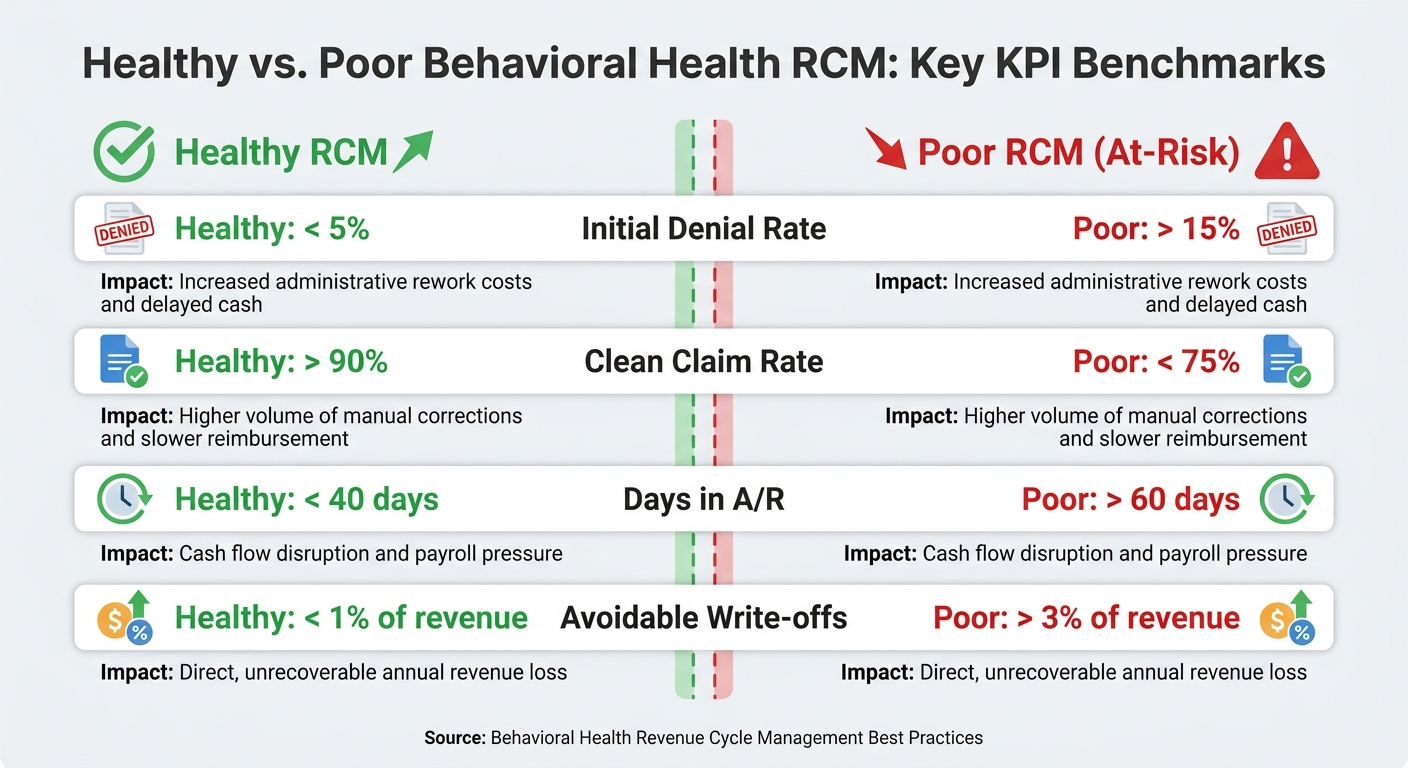
Days in A/R shows how long it takes to collect payment after a service is rendered. Under 40 days is generally healthy. Once it climbs above 60 days, cash flow starts to strain [1].
Clean claim rate tracks the share of claims accepted on the first submission. Above 90% helps keep reimbursement moving. Below 75% usually means more manual fixes [1].
Initial denial rate shows the share of claims denied by payers. Below 5% keeps rework under control. Above 15% makes backlogs and delayed cash much harder to avoid [1].
Net collection rate compares insurance reimbursements and patient payments against submitted claims, showing how much expected revenue is actually collected [1].
Underpayment rate points to cases where payers reimburse less than the contracted rate. That makes it easier to spot reimbursement issues and payer contract problems [1][4].
Avoidable write-offs reflect revenue lost to unresolved denials, authorization gaps, or missed follow-up. Under 1% is manageable. Above 3% starts to cut into revenue in a serious way [1][3].
When these numbers drift the wrong way, the damage doesn’t stay on a spreadsheet. It hits cash, staff time, and write-offs.
What Poor RCM Performance Costs in Dollars
Poor RCM shows up in dollars almost immediately. Higher denial volume means more staff labor, more resubmissions, and slower payment cycles [1].
Even a 1% to 3% avoidable write-off rate can wipe out meaningful annual revenue [1][3]. And when Days in A/R stretches past 60, the cash flow hit can put pressure on payroll and leave less money available for care delivery.
The table below shows the gap between healthy and poor performance.
Comparison Table: Healthy vs. Poor Behavioral Health RCM
KPI | Healthy RCM | Poor RCM (At-Risk) | Financial Impact |
|---|
Initial Denial Rate | < 5% | > 15% | Increased administrative rework costs and delayed cash |
Clean Claim Rate | > 90% | < 75% | Higher volume of manual corrections and slower reimbursement |
Days in A/R | < 40 days | > 60 days | Cash flow disruption and payroll pressure |
Avoidable Write-offs | < 1% of revenue | > 3% of revenue | Direct, unrecoverable annual revenue loss |
When these metrics get worse, the next move is to trace the root cause and fix the workflow.
Workflows and Tools That Cut Revenue Loss
When KPIs start slipping, the fix usually isn’t just “work harder.” It’s fixing the workflow that caused the loss in the first place.
Building a Denial Tracking and Root-Cause Workflow
Resubmitting a denied claim without fixing the reason behind it is like putting a bucket under a leak instead of patching the roof. The claim may come back, but the same problem keeps draining money.
A structured denial workflow breaks that cycle.
When a claim is denied, flag it right away and sort it by reason code. That step helps your team see if the issue started at the front end, like eligibility, in the clinical record, like missing documentation, or at the back end, like coding errors [1]. Then prioritize claims based on dollar amount and filing deadline. Fix the error fast, and resubmit before the window closes.
The bigger win comes next: send denial trends back to the front desk and clinical team. Denial data shouldn’t sit in a report no one reads. It should shape eligibility checks, claim edits, and staff training so the same mistakes don’t keep showing up.
Eligibility Verification, Claim Scrubbing, and Predictive Analytics
The fastest way to cut leakage is to catch issues before a claim ever goes out [1].
Eligibility verification checks active coverage, copays, deductibles, carve-out rules, and prior authorization needs before the patient’s appointment. That single workflow step can stop front-end denials and reduce surprise patient balances [1].
Claim scrubbing adds a second checkpoint. It reviews each claim against payer-specific rules and flags coding mistakes or documentation gaps before submission. The result: better first-pass acceptance rates and less admin time spent fixing claims by hand [1][2].
Then there’s predictive analytics. With dashboards that track A/R aging, denial trends, payer performance, and expected cash flow, leadership can spot trouble early instead of waiting for it to snowball [1][5].
How BHRev Addresses Behavioral Health RCM Gaps
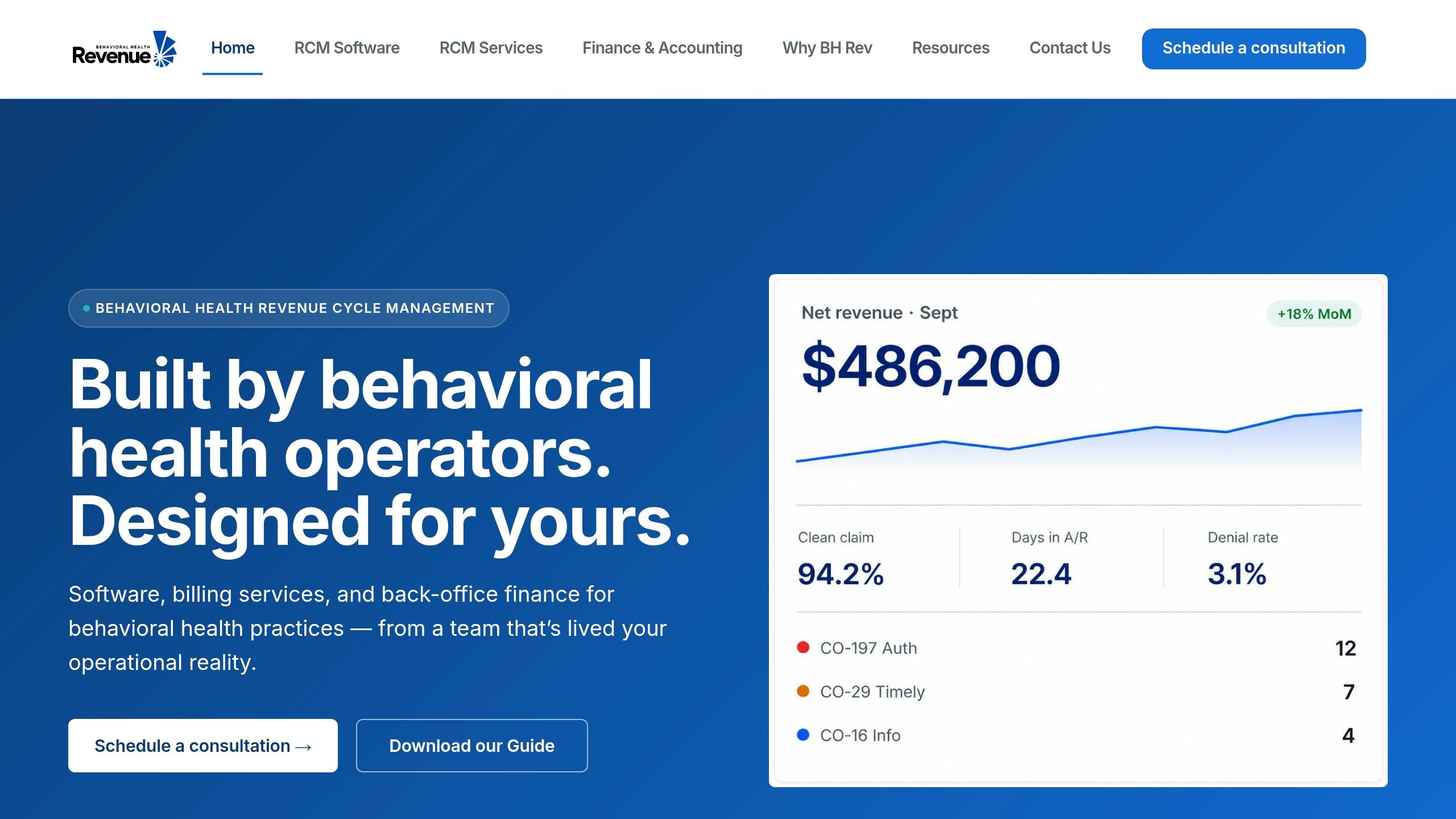
BHRev combines automation with human review to cut manual work, catch errors sooner, and keep claims moving. It handles routine RCM tasks so staff can spend their time on exceptions and compliance work.
Instead of spreading these controls across different systems and spreadsheets, BHRev brings them into one workflow.
BHRev Capability | Operational Impact | Financial Impact |
|---|
Claim Scrubbing | Catches errors before submission | Increases first-pass acceptance; lowers rework costs |
Eligibility Verification | Confirms coverage and patient responsibility before appointments | Prevents front-end denials; reduces uncollectible balances |
Denial Tracking, Appeals & Aged A/R Recovery | Identifies, corrects, and pursues rejected and outstanding claims | Accelerates cash flow; reduces avoidable write-offs |
Revenue Forecasting & Analytics | Provides visibility into A/R aging and payer performance | Supports better financial decisions and cash flow planning |
Underpayment Recovery | Identifies claims paid below contracted rates | Captures revenue lost to payer errors |
Credentialing Maintenance | Keeps enrollments current | Prevents coverage interruptions |
Conclusion: Better RCM Protects Revenue and Cash Flow
Poor behavioral health RCM usually doesn’t lead to one big hit. It leads to the same kind of loss over and over: denials, underpayments, slow reimbursement, and missed follow-up.
That’s where the damage adds up.
These losses start to shrink when providers stop reacting after the fact and put stronger controls at the front end. Eligibility checks, claim scrubbing, denial tracking, and KPI monitoring help cut preventable revenue loss. That kind of discipline protects cash flow and lowers write-offs.
Automation helps by cutting manual work and moving claims to resolution faster. A healthy revenue cycle depends on disciplined workflows and the right tools. Providers that treat RCM as a core part of operations collect more of the revenue they’ve earned and build the financial stability they need to keep delivering care.
FAQs
What is the biggest cause of revenue loss?
The biggest cause of revenue loss in behavioral health is claim denials. They throw off cash flow, slow down reimbursements, and create extra admin work.
Behavioral health providers deal with a higher risk of denials because payer rules are often complicated, documentation standards are strict, and insurance policies change often. When workflows aren’t standardized, those problems can pile up fast and lead to more denials and more lost revenue.
Which KPI should I monitor first?
Start with denial trends. In behavioral health, denials often come from complex payer rules and documentation gaps, so tracking them can show you exactly where revenue is slipping away.
It also helps to watch accounts receivable aging and your clean claim rate. Those two KPIs give you a better sense of cash flow and day-to-day financial health. When you review these metrics on a regular basis, it becomes much easier to spot bottlenecks and improve reimbursement performance.
How can I reduce denials faster?
Cut denials by stopping mistakes before a claim goes out the door. Check insurance eligibility, secure any needed prior authorizations before the visit, and use claims scrubbing to spot documentation gaps and coding errors early.
When denials still happen, use denial tracking and analysis to pinpoint the cause, fix issues faster, simplify appeals, and resubmit claims with less back-and-forth. Automation helps take repetitive manual tasks off your team’s plate, too.