Home / Why Behavioral Health RCM Breaks Down: 7 Revenue Leaks to Fix First
BLOG
Why Behavioral Health RCM Breaks Down: 7 Revenue Leaks to Fix First
Fix seven common behavioral health RCM failures—from eligibility and documentation to denials and underpayments—to stop lost revenue.
SHARE
Behavioral health RCM breaks down in predictable ways, and the revenue leaks that cause it usually start before the claim ever goes out.
Seven leaks tend to do the most damage.
These are worth tackling in order, because each leak can block the next step in payment.
A missed prior auth can turn a $1,000+ episode into a write-off. A denial left untouched past the appeal window can drop to $0 recovered. And even when money arrives, line-item short pays can chip away at margin month after month.
The 7 Behavioral Health Revenue Leaks:
Leak
What it hurts most
First thing I’d check
Eligibility & auth
Whether the claim can pay at all
Real-time verification at intake
Documentation
Whether the service is supported
Same-day signed notes
Coding & charge flow
Whether all billable work reaches billing
Daily encounter reconciliation
Claim submission
Whether the claim leaves clean
Pre-submission edits
Denial follow-up
Whether denied dollars can still be saved
48-hour touch rule
Underpayments
Whether posted cash is correct
Line-item variance review
Patient collections
Whether the patient portion gets paid
Upfront estimates and fast statements
The fastest path to improved cash flow within 30 days: start with intake checks, then tighten note completion, then clean up denial work and payment review.
In this article, we’ll walk you through each leak — the damage it causes, the early warning sign, and the first fix to put in place.
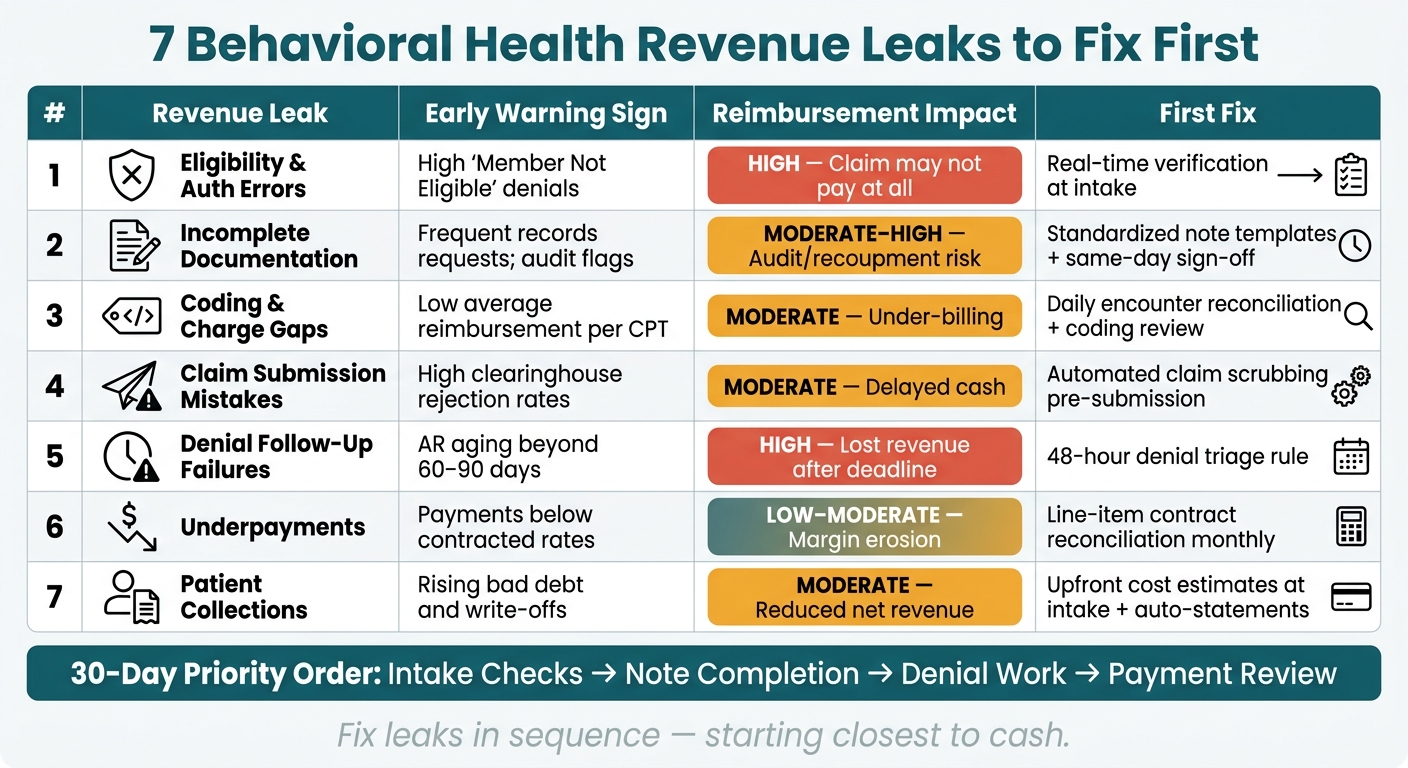
7 Behavioral Health Revenue Leaks: Warning Signs, Impact & First Fixes
The First 4 Leaks Happen Before a Claim Is Ever Submitted
The first four leaks start upstream, before a claim ever leaves billing.
1. Eligibility and Authorization Errors
Active coverage does not mean the patient has behavioral health benefits. Before the first visit, verify carve-outs, copays, deductibles, and prior authorization.
Carve-outs can send behavioral health claims through a separate authorization path. Bill the wrong entity, and the claim can deny on the spot. On top of that, many behavioral health services need prior authorization before treatment starts. Miss that step, and an entire episode of care may become non-reimbursable.
2. Incomplete Clinical Documentation
A clean code can still deny if the note doesn’t support the service. In behavioral health, the documentation has to show medical necessity and match the treatment plan.
The usual problems are pretty straightforward:
Missing time
Vague medical necessity
Outdated treatment-plan links
Unsigned notes
Use EHR prompts for signatures, time fields, and treatment-plan links before billing. That simple check can stop a lot of avoidable denials.
Even then, solid documentation won’t help if the code or charge never makes it to billing.
3. Coding and Charge Capture Gaps
Sometimes the note is fine, but money still slips through the cracks. That happens when the codes don’t match the documentation or when the service never reaches the billing queue.
Time-based psychotherapy codes often fail when billed time doesn’t line up with documented time. Modifier mistakes, incorrect place of service codes, and incomplete diagnosis coding can also trigger pre-submission failures. Then there are charge capture gaps: services were rendered, but they never reach billing, often because the EHR and billing system don’t sync.
If the claim doesn’t reflect the visit the right way, reimbursement never begins. Use claim edits, EHR-to-billing integration, and daily encounter reconciliation to catch missing charges before submission.
Once these front-end leaks are closed, the next failures show up in claim submission and denial rework.
Leaks 4 and 5 Happen During Claim Submission and Denial Rework
Clean documentation and accurate coding help. But they don’t guarantee payment.
Claims can still fall apart at submission. And if a denial isn’t handled fast, that money can slip away for good.
4. Claim Submission Mistakes
After front-end checks clear, the next weak spot is claim submission.
Common errors include subscriber ID mismatches, the wrong billing NPI, missing authorization numbers, wrong payer routing, and missing attachments for Medicaid and Medicare claims [2].
Duplicate claims cause avoidable rejections when staff resend a claim before a status update comes in. Then there’s late filing, which is the worst outcome. Once the timely filing window closes, that revenue is gone [2].
This is where claim scrubbing helps. Automated scrubbing checks claims against payer-specific rules and flags problems like NPI mismatches, demographic gaps, and missing authorization numbers before the claim leaves your system. Pair that with a standard registration workflow, where staff confirm demographics and insurance details at intake, and you cut down the bad data that leads to submission mistakes [2].
5. Denial Follow-Up Failures
A denial comes with a clock.
Most payers give you a short window to appeal or fix the claim and resubmit. Miss that window, and the revenue gets written off.
The most common behavioral health denial triggers are authorization not on file, eligibility not active on date of service, unsupported medical necessity, and coding mismatches [2]. The problem isn’t that these issues are hard to grasp. It’s volume. Denials stack up fast when no one owns them, no one tracks root cause, and no one sorts them by dollar amount or appeal deadline.
Tracking denial rate by reason and AR aging buckets shows where follow-up is falling apart. Then you can sort work in the right order: first by dollar value, then by how close the filing deadline is. That approach recovers the most cash in the least time [2].
After denial work, the next leaks show up when expected payments come in short, or don’t come in at all. From there, the remaining leaks come from short payments and weak patient collection workflows.
Leaks 6 and 7 Reduce Cash After Payment Should Have Arrived
Getting paid and getting paid correctly are two different things.
These last two leaks show up after the ERA or EOB is posted, which is exactly why teams often miss them. On paper, the money came in. In practice, some of that cash may still be leaking out.
6. Underpayments and Missed Contract Variances
A lot of billing teams post a payment and move on. That’s where trouble starts.
Posted cash is not the same as correct cash. Underpayments can slip through when the amount posted doesn’t match the contracted rate, especially if no one is reconciling ERAs and EOBs against submitted claims [2]. In behavioral health, this can get expensive fast because contract updates and payer rules make short pays easy to overlook [2].
The fix is pretty simple in concept, even if it takes discipline: compare expected reimbursement to actual reimbursement at the line-item level, not just the total claim amount. Monthly reviews of collection rate and contract variance reports can help teams spot patterns before those short pays pile up [2].
Automated remittance auditing can flag repeat variances and payments that don’t line up with contracted rates faster than a manual check [3]. Instead of asking staff to dig through a pile of remittances that all look fine at first glance, it gives them a short list of claims that need attention. And once payer cash is in line, the next risk is the patient portion.
7. Patient Collections Breakdowns
After the payer pays, the leftover balance shifts to the patient.
That’s where another common leak shows up. Collections often fall apart when copays, deductibles, and covered services aren’t confirmed before the visit [2]. If the estimate at intake is off, the patient may get a surprise bill later. Then the process gets even harder when statements arrive late or the balance isn’t explained clearly [2].
Wrong estimates at registration often create those surprise balances. Real-time eligibility verification helps teams give patients a more accurate estimate before the visit [2]. Clear upfront cost estimates, automated patient statements, and online payment options can also help patients pay sooner [2].
This is also where steady AR follow-up matters. Reviewing patient aging reports each month and reaching out soon after a balance appears can keep small balances from turning into uncollectible ones [2].
Priority Actions to Stop the Biggest Leaks First
A 30-Day Triage Plan for Faster Reimbursement
Once you can see the seven leaks, don’t try to fix everything at once. Go after the problems that slow down cash the most.
Start with real-time eligibility verification at intake and authorization checkpoints built into your intake workflow. This matters even more for IOP and PHP, where one missing prior auth can turn a high-dollar claim into a total loss.
In Weeks 1–2, standardize note templates and require same-day note completion and charge capture. That alone can cut a lot of preventable billing drag.
In Weeks 3–4, tighten claim scrubbing, enforce a 48-hour denial touch rule, and run a contract variance review. The goal is simple: catch errors early, work denials fast, and spot payment gaps before they pile up.
Automated eligibility checks, claim scrubbing, denial tracking, and underpayment recovery tools can cut manual work and speed up reimbursement. That means staff spend less time on routine tasks and more time on the exceptions that need human judgment.
Revenue Leak Summary Table
Use this table to rank fixes by cash impact, not by where they happen in the workflow.
Revenue Leak
Early Warning Sign
Reimbursement Impact
First Fix
Best Workflow/Tool
1. Eligibility & Auth Errors
High “Member Not Eligible” denials
High – claim may not pay
Real-time verification at intake
Automated eligibility tools
2. Incomplete Documentation
Frequent records requests; audit flags
Moderate to High – audit/recoupment risk
Standardized note templates
Integrated EHR/RCM platform
3. Coding & Charge Gaps
Low average reimbursement per CPT
Moderate – under-billing
Professional coding review
AI-driven coding and scrubbing
4. Claim Submission Mistakes
High clearinghouse rejection rates
Moderate – delayed cash
Automated claim scrubbing
Pre-submission validation
5. Denial Follow-Up Failures
AR aging beyond 60–90 days
High – lost revenue
48-hour denial triage rule
Denial management dashboard
6. Underpayments
Payments below contracted rates
Low to Moderate – margin erosion
Line-item contract reconciliation
Revenue analytics and reporting
7. Patient Collections
Rising bad debt and write-offs
Moderate – reduced net revenue
Upfront cost estimates at intake
Patient portal and auto-statements
Conclusion: Fix the Leak Closest to Cash First
Behavioral health RCM usually doesn’t break because of one huge mistake. It breaks because of small, repeatable errors across intake, documentation, billing, and collections – errors that no one clearly owns and no one tracks in a steady way.
“Your revenue cycle is like a production line. Each step has to be perfectly executed so the next one can be. One little hiccup and the production line (your revenue) comes to a screeching halt.” – Aria RCM [1]
After the first 30 days, keep the same order: intake, documentation, submission, denial recovery, then payment accuracy.
Fix leaks in sequence, starting with the ones closest to cash. Begin with eligibility and authorization, then work your way through the rest of the revenue cycle.
FAQs
Which revenue leak should we fix first?
Start with insurance eligibility verification. Verifying benefits before appointments is the foundation of the revenue cycle.
It helps prevent claim denials, cut admin rework, and reduce unexpected patient balances, which supports cash flow. If coverage isn’t checked upfront, payment delays and collection issues get much harder to fix later.
How can we spot underpayments faster?
Use steady payment posting and routine revenue tracking to compare the money you’ve received with the amount you expected.
Check revenue dashboards, monthly financial reports, and accounts receivable on a regular basis. During reconciliation, put unpaid or underpaid claims at the top of the list so your team can follow up with insurers fast, keep records accurate, and recover lost revenue.
What metrics best show RCM problems early?
Monitor denial trends, claims aging, and accounts receivable aging to catch revenue cycle problems before they hit cash flow.
It also helps to track collection rates, payment turnaround times, revenue summaries, and provider productivity reports. These numbers can flag bottlenecks like high denial rates or coding mistakes before they turn into a bigger mess.