
Home / 10 Signs Your Behavioral Health Organization Needs RCM Consulting
If denials are climbing, A/R is getting older, and staff can’t explain where cash is stuck, your revenue cycle likely has a system problem.
In behavioral health, small billing misses can turn into delayed payments, write-offs, patient balance issues, and audit risk.
Here are 10 warning signsthat point to outside RCM help:
Higher denial rates
Slower reimbursements
More days in A/R
Eligibility or authorization misses
Credentialing or enrollment delays
Coding, modifier, or note errors
Weak patient collections
Poor reporting
Billing backlogs
Compliance and payer-rule gaps
A few numbers usually tell the story first.
If 60- and 90-day A/R keep growing, if your net collection rate slips, or if missing authorizations are showing up too often, those aren’t random problems. They usually point to weak intake checks, broken follow-up, or claims going out with errors.
What does an RCM consultant fix first?
In most cases, you should start with:
Eligibility checks before the visit
Prior authorization tracking
Denial root-cause review
Coding and documentation review
A/R follow-up rules
Reporting dashboards for denials, A/R, and collections
Sign | What it often points to | What happens next if it stays unfixed |
|---|---|---|
Rising denials | Intake, coding, or claim issues | More rework and slower cash in |
Slow payments | Weak follow-up or front-end misses | Older A/R and cash pressure |
Authorization gaps | Intake workflow failure | Denials, take-backs, patient disputes |
Enrollment delays | Provider setup problem | Missed billing windows and write-offs |
Coding/note errors | Claim and chart mismatch | Denials, audits, recoupments |
Weak patient collections | Poor benefit checks and billing follow-up | More self-pay aging |
Poor reporting | Low visibility into trends | Slow decisions and hidden losses |
Billing backlogs | Too much manual work | Claims sit and A/R climbs |
Compliance gaps | Rule and documentation issues | Audit exposure and repayment demands |
Missed payer updates | Outdated workflows | Avoidable denials across payers |
Bottom line: if you’re seeing more than one of these at the same time, don’t treat it as a one-off billing issue. Treat it as a revenue cycle problem that needs a close review.
A packed schedule can make the revenue cycle look healthier than it is. I
n behavioral health, patient volume can go up while cash coming in starts to slip. That happens a lot when recurring authorizations, session-based billing, and frequent payer rule changes create weak spots that don’t show up right away.
Most revenue cycle issues build quietly in the background. An authorization gap can sit there for weeks without anyone spotting it. Services keep moving, but if a prior authorization expired or was never confirmed, those claims may deny later [1][4]. By the time someone catches it, the organization may already have weeks of services tied up in denials or rework.
The same thing happens with A/R. If teams aren’t watching it closely, balances start to pile up. Leaders may not see the problem at first. What they notice instead is pressure on payroll, slower collections, or more write-offs [1][4]. And some problems stay buried even deeper in the billing process, like underpayments, coding mistakes, or payer rules that changed but never made it into day-to-day workflows [1][4].
In most cases, those hidden breakdowns show up first in three places:
Denials
Slow payments
Authorization issues
Rising denials are a sign that something in the revenue cycle is slipping – often at intake, verification, coding, or claim submission. In behavioral health, that can snowball fast because coding rules, documentation standards, and prior authorization demands create several places where a claim can get knocked out [1]. And most of the time, the first warning doesn’t show up in the bank account. It shows up in the work queue.
On the ground, this usually looks like claims piling up in the queue, billing teams falling behind, appeal backlogs growing, and A/R becoming harder to track. The problem often starts earlier than people think, at registration or insurance verification. Common triggers include missed authorizations for recurring therapy visits, skipped session-limit checks, and notes that don’t clearly support medical necessity [1][4]. Once those issues stack up, payment gets delayed and staff end up doing the same work twice.
This kind of pattern usually points to a workflow issue, not one random bad claim. Denials slow cash flow, add admin work, and push days in A/R higher [1]. If the denials come from weak documentation or coding errors, the risk gets bigger. You can also end up dealing with audits and payer recoupments [1][5].
An RCM consultant looks for the root cause – eligibility, authorization, coding, or documentation – and then tightens the process with better verification, claim scrubbing, and denial tracking. When denial rates start climbing, slower reimbursement is often right behind them.
Once denials start piling up, the next problem usually hits the cash flow: payments slow down.
And in many cases, that slowdown points to a gap in the workflow. Claims that sit without follow-up, missed authorization steps, and manual billing all push up accounts receivable [4]. In behavioral health, that gets worse fast. Policy updates, coding rules, and heavier documentation demands can turn small front-end mistakes into payment delays. A minor error at the start of the process can keep a claim unpaid far longer than it should.
You’ll often see this first in the aging report. If your team can’t clearly explain what’s sitting in 60- or 90-day A/R, that’s usually not a one-off issue. It’s a system problem. At a bare minimum, A/R aging reports should be reviewed every month [1].
An RCM consultant looks at A/R aging, tracks denials back to the source, checks eligibility work before the visit, and puts follow-up workflows into a standard process [1]. If A/R keeps climbing, authorization and eligibility control are usually the next areas to check.
If reimbursements are slowing down, check eligibility and authorization at intake next. That’s often where the trouble starts.
In behavioral health, small intake mistakes can snowball later into denied claims or patient balance disputes. A missed coverage check, wrong patient details at registration, uncovered services, or an expired authorization can all create denials and follow-up backlogs [1][4].
Missing required prior authorization can also lead to audits or recoupments, not just slower payment [1][3].
An RCM consultant can shift eligibility verification to a real-time pre-visit check. That means confirming coverage, copays, deductibles, and covered services while there’s still time to fix errors. They can also standardize how authorizations are submitted and tracked, including expiration dates, so gaps show up before claims are sent out [1][2].
When denials are tied to new clinicians, the problem is usually enrollment, not coding. If denials are piling up around new providers or clinicians who were recently re-credentialed, start there. Check for denial reasons like “provider not enrolled” or “non-participating provider” on clinicians who should already be active [1][8]. If A/R is unusually high for new clinicians while established providers are still getting paid, that’s a strong sign the enrollment process is off track [4][3].
This kind of delay can snowball fast. Claims may sit long enough to miss timely filing limits, which turns services you could have billed into write-offs [1][3]. One delayed enrollment step can hold up payment across the full provider workflow.
A lot of teams still track this in spreadsheets, and that’s where things slip. Re-credentialing deadlines get missed, and payment stops follow [4].
An RCM consultant digs into the issue and figures out whether it’s a one-off problem or something hitting the whole system. From there, they standardize credentialing tracking with a central workflow for verifying provider data and keeping tabs on deadlines [1][4]. If enrollment looks clean, the next place to look is coding and documentation.
If enrollment looks clean, the next place to check is the claim itself. Behavioral health billing depends on strict coding rules and solid documentation. A lot of CPT codes are time-based, so if the session length isn’t documented fully, denials or recoupments can follow [3]. And when denials keep showing up around the same code set or the same note style, that’s usually a workflow issue, not a random miss.
Don’t just look at one rejected claim at a time. Look for patterns. Common problems include:
Missing modifiers
Mismatched ICD-10 codes
Notes that don’t support medical necessity
Those gaps can trigger audits and recoupments [1][5]. The biggest red flag is repeat failure tied to the same modifier, diagnosis, or note pattern. That’s a sign the process is breaking in the same place over and over, not that someone made one small mistake.
An RCM consultant will often start with a denial audit. That means checking rejected claims against the actual clinical notes to find the root cause behind repeat errors [5]. From there, the fix usually comes from two pieces working together: automated claim scrubbing to catch missing modifiers or code mismatches before submission, and standardized documentation workflows that prompt clinicians to record session duration, diagnosis linkage, and medical necessity language [1][5].
Even when claims are paid, cash flow can still take a hit if patient balances sit too long.
A lot of revenue slips away on the patient side. It usually starts when patient responsibility isn’t clear during the visit and follow-up after the visit is weak. If staff don’t verify benefits before the appointment, patients often walk out with no clear sense of what they owe. Then the first statement shows up, and that surprise balance often leads to slow payment [1].
Without real-time eligibility and benefit checks, staff are collecting based on incomplete information. Patients then get bills they didn’t expect. On top of that, manual billing slows down statements, follow-up, and payment posting [1][4].
An RCM consultant can tighten pre-visit eligibility checks, make patient statements more consistent, and put a clear cadence in place for collecting and aging self-pay balances. When balances keep piling up and staff can’t tell what’s driving it, weak reporting is often part of the issue.
Once patient balances start to stack up, weak reporting often makes the root problem hard to spot.
A lot of organizations have plenty of data. They just don’t have a clear way to see it. When teams rely on spreadsheets pulled from separate systems, action slows down, and leaders may not notice the trend until the damage is already done.
Without steady tracking, missed denial patterns, stalled claims, and unclear payer performance can quietly drain cash flow. That’s why it helps to track A/R aging, denial trends, payer performance, clinician productivity, and audit flags in one dashboard.
An RCM consultant usually fixes this by replacing static reports with real-time dashboards that pull EHR and billing data into a single view. Automation can cut manual work and send cleaner data into reporting. The aim is simple: fewer reports, but better ones. Teams should review denial codes, A/R aging, and authorization status on a steady cadence [1][4].
When reporting is weak, the next bottleneck usually shows up in the billing queue.
When workflows are broken up across too many steps, the billing queue starts to pile up. Claims sit untouched, payment posting slows down, and follow-up falls through the cracks. In behavioral health, this tends to snowball fast because prior authorizations, session limits, and documentation edits keep sending claims back for rework.
At the root, this is usually a process issue. Manual work tied to payer rules, documentation, and rework can clog the queue in no time. Something as simple as a wrong insurance ID or a missed authorization can stop a claim before it even goes out.
When claims sit without action, days in A/R go up and it gets tougher to recover missed reimbursement [4]. Once the backlog is out in the open, the next move is to pinpoint the step that’s slowing the whole revenue cycle.
An RCM consultant starts by finding that choke point. From there, they automate high-volume tasks like eligibility checks, claim scrubbing, and payment posting, so staff can spend their time on exceptions instead of doing the same manual work over and over. That keeps claim submission, payment posting, and denial follow-up moving without staff having to touch every step by hand.
Billing errors don’t always show up as denials first. Sometimes they turn into audits and recoupment demands before anyone spots the pattern. That can slow payments, lead to take-backs, and eat up a lot of staff time.
Behavioral health billing carries more compliance risk because documentation, coding, and HIPAA rules are strict [1]. If a CPT code isn’t supported, or a note doesn’t show medical necessity, payers may take a closer look and audit risk goes up [1][6]. And if the same mistakes keep happening, that scrutiny usually gets harder to avoid.
The problem can snowball when Medicaid or Medicare rules change and the update gets missed. In that case, incorrect billing can keep going for months before someone catches it [1][7].
An RCM consultant helps close these gaps by running a mix of scheduled, risk-based, and retrospective audits. The goal is simple: find high-risk patterns before an external payer does [5]. On the documentation side, they standardize clinical workflows so each note is complete and audit-ready before a claim is sent. Automated claim scrubbing can also catch coding and documentation issues before submission [6]. Once that piece is in place, the next test is staying current with new payer rules.
Payer rules don’t sit still. Medicaid and Medicare update policies on a regular basis, commercial insurers change authorization requirements, and new billing edits can show up with no warning. When those updates get missed, claims get denied, authorizations fall through the cracks, and reimbursement takes longer. In most cases, the first sign is a batch of avoidable denials.
The bigger issue is misreading the problem. What looks like a few random mistakes is often a workflow that no longer matches current payer rules. That matters because one-off fixes won’t solve a process gap. If there’s no clear system for tracking updates, staff usually don’t catch changes until denials start piling up.
This is where RCM consulting can help. It can bring in automated rule monitoring, claim scrubbing, and exception handling so claims stay aligned with current payer requirements.
When rule changes slip through, the warning signs usually appear in denial, A/R, and authorization metrics.
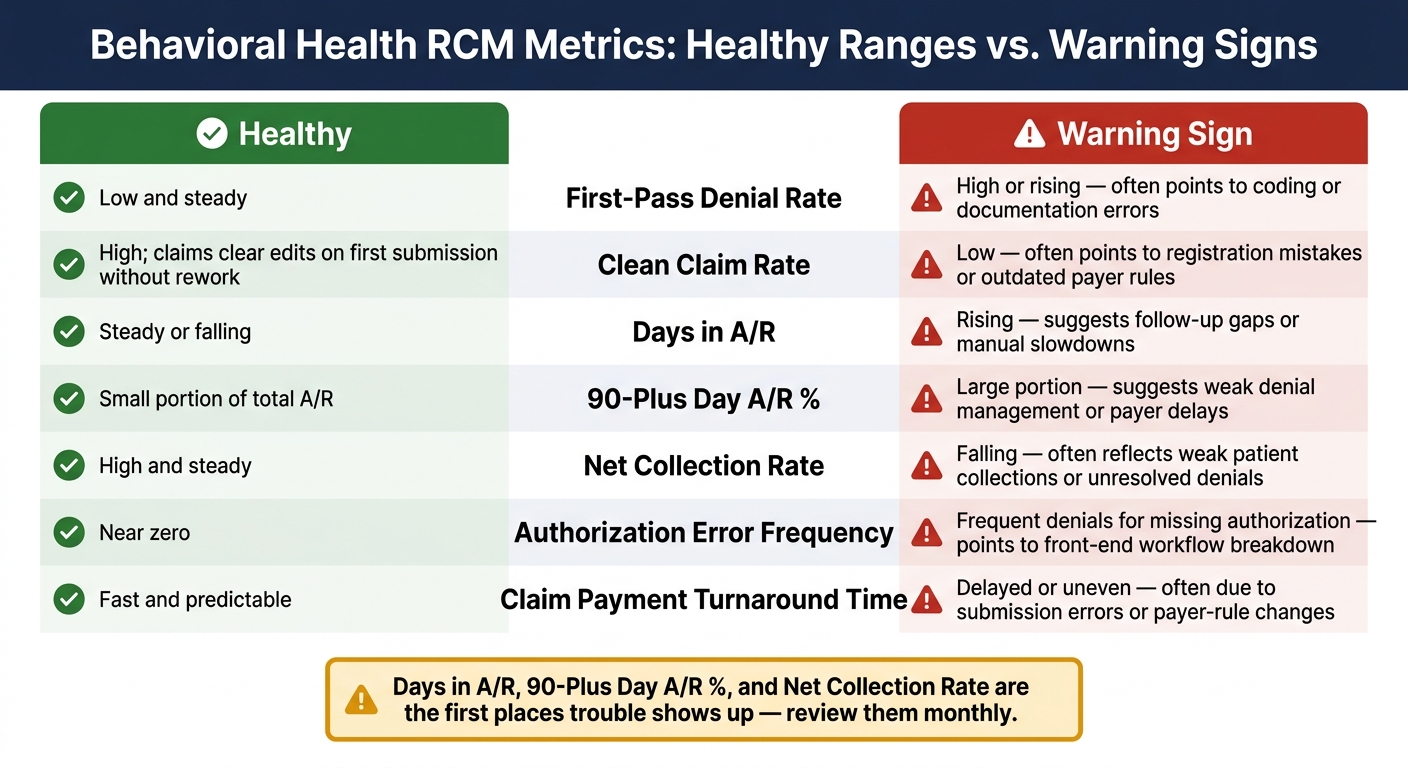
Behavioral Health RCM Metrics: Healthy Ranges vs. Warning Signs
These metrics help you figure out whether the issues above are one-off problems or signs of a bigger revenue cycle mess. Each one ties back to a common weak spot: eligibility, claims, collections, reporting, or follow-up.
Use the table below as a quick gut check against the 10 warning signs above.
Metric | Healthy | Warning Sign |
|---|---|---|
First-Pass Denial Rate | Low and steady | High or rising; often points to coding or documentation errors |
Clean Claim Rate | High; claims clear edits on the first submission without rework | Low; often points to registration mistakes or old payer rules |
Days in A/R | Steady or falling | Rising; suggests follow-up gaps or manual slowdowns |
90-Plus Day A/R % | Small part of total A/R | Large part; suggests weak denial management or payer delays |
Net Collection Rate | High and steady | Falling; often reflects weak patient collections or unresolved denials |
Authorization Error Frequency | Near zero | Frequent denials for missing authorization; points to a front-end workflow breakdown |
Claim Payment Turnaround Time | Fast and predictable | Delayed or uneven, often due to submission errors or payer-rule changes |
Days in A/R, 90-plus day A/R, and net collection rate are usually the first places trouble shows up. Review them monthly so you can spot slippage early.
If these numbers are moving in the wrong direction, the next step is simple: find the workflow that’s breaking first and fix that before the damage spreads.
Once the warning signs are clear, the consultant usually starts at the point where money slips out first: the front end.
Most RCM consultants begin with eligibility verification and prior authorization. That’s because front-end mistakes can throw off every claim that comes after. One miss at the start can choke off cash flow across the rest of the revenue cycle.
From there, the review moves further down the line. The consultant checks claims, coding, and documentation against payer rules to spot repeat breakdowns. Then they dig into denial root causes so the fix targets the workflow itself, not just the pile of denied claims. A/R recovery often happens at the same time, starting with unpaid claims and aging patient balances.
In day-to-day work, consultants usually handle a different lane than in-house billing teams:
RCM Area | Internal Team Focus | Consultant Focus |
|---|---|---|
Claims | Submission and corrections | |
Coding | Basic code entry | Audits for accuracy, compliance, and regulatory updates [5][1] |
A/R Management | Payment posting | A/R recovery [1] |
Front End | Registration and verification | Eligibility verification and prior authorization controls [1] |
Compliance | Documentation | Audit-ready documentation [5] |
Internal teams keep daily billing moving. Consultants, on the other hand, are often brought in to find system-level failures, manual bottlenecks, and payer-rule changes that keep driving denials.
They also put dashboards in place that show denial trends, aging A/R, and collection issues fast. That gives leaders a clear view of what’s happening and whether denials, A/R, and collections are starting to move the right way.
One denied claim or one slow-pay month is manageable. But when several warning signs show up at the same time – authorization gaps, manual billing slowdowns, claims sitting with no follow-up, and no clear read on denial or A/R trends – you’re not dealing with a one-off mistake. You’re dealing with a system problem [4].
Use these 10 signs as a diagnostic checklist. If the same issues keep coming back across denials, A/R, authorization, compliance, and reporting, the revenue cycle likely needs more than an internal fix. When those patterns go unresolved, cash flow gets tighter and audit and recoupment exposure grows [2][5]. That’s where RCM consulting makes sense. That’s the point to bring it in.
Hire an RCM consultant when day-to-day billing and admin issues start putting cash flow or compliance at risk.
Common signs include rising claim denials, slow reimbursements, credentialing delays, inaccurate coding, weak reporting, unmanaged authorizations, or trouble keeping up with Medicaid and Medicare rules. A consultant can review your processes, cut errors, and help improve collections.
Start with denial trends and accounts receivable aging. These two metrics give you a fast read on claim issues and weak follow-up.
It also helps to watch collection rates, payment turnaround times, provider productivity, and monthly claim aging summaries. Together, they make bottlenecks easier to spot before they hit cash flow.
There’s no set timeline. Fixing revenue cycle management problems depends on the workflow, documentation, compliance, and day-to-day process gaps affecting the organization.
RCM spans multiple steps, so improvement usually takes time. Expert oversight and automation can help standardize workflows, fix issues, and support long-term financial stability and faster reimbursements instead of offering an instant fix.
One email a month, no fluff. Unsubscribe anytime.