Home / How Behavioral Health RCM Services Reduce Denials
BLOG
How Behavioral Health RCM Services Reduce Denials
Reduce behavioral health claim denials by verifying eligibility, tracking authorizations, scrubbing claims, and fixing repeat errors.
SHARE
Denied claims slow payment and create more work.
In behavioral health, most denials come from a handful of repeat issues: wrong payer, missed prior authorization, coding errors, weak chart support, and missed filing deadlines.
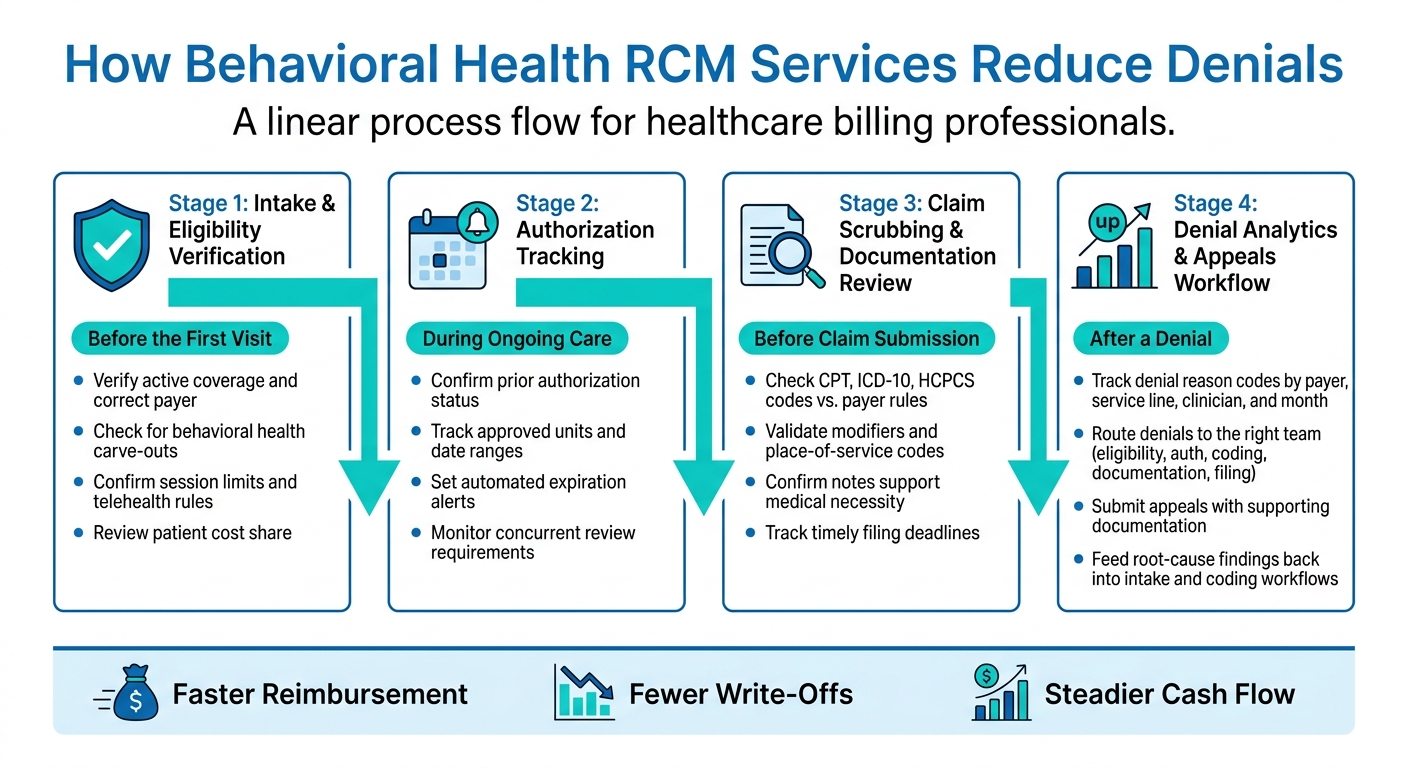
To cut denials, start with five controls:
Check eligibility and carve-outs before the first visit
Track authorizations, units, and end dates
Scrub claims for payer-specific coding rules
Make sure notes support the billed service
Use denial reports and appeals workflows to fix repeat issues
Catching errors at intake and before claim submission means more claims get paid on the first pass. The result: faster reimbursement, fewer write-offs, and steadier cash flow.
Here’s the core idea:
Denial risk
What reduces it
Wrong payer or inactive coverage
Eligibility and benefit checks
Missing or expired authorization
Auth tracking and alerts
Coding and modifier errors
Claim scrubbing
Notes don’t support the service
Documentation review
Late claims or missed corrections
Filing deadline tracking
Repeat denials
Denial analytics and routed appeals
Behavioral health RCM services reduce denials by catching common billing errors before claims go out—and having a clear process for the ones that still come back denied.
Why behavioral health claims get denied
Behavioral health denials usually trace back to missed checks around eligibility, authorization, coding, or filing deadlines.
In many cases, the problem starts before a claim is ever submitted. If eligibility, authorization, or payer rules get missed early, the denial often follows later.
Eligibility, benefits, and carve-out errors
A claim can get denied before treatment even starts if it goes to the wrong payer.
This is common with behavioral health carve-outs, where mental health benefits are handled by a separate behavioral health payer instead of the patient’s main medical plan. Send the claim to the medical payer, and you’ve got an instant eligibility mismatch.
Other common triggers show up just as often:
Inactive coverage
Exhausted session limits
Unconfirmed telehealth rules
If telehealth coverage isn’t checked up front, that alone can lead to a denial.
Authorization, coding, and documentation failures
Prior authorization is one of the most common sources of denials in behavioral health.
If services are provided without an active authorization, or after an authorization expires during care, payers often deny the claim outright. This gets risky fast when teams aren’t closely tracking expiration dates and session counts.
Coding mistakes make things worse. The usual issues include incorrect CPT, ICD-10, or HCPCS codes, missing modifiers, and the wrong place-of-service codes. Any one of those can give a payer a reason to reject the claim. And if the note doesn’t support medical necessity, the claim may be denied.
Timely filing and payer-rule mismatches
Late submissions are some of the hardest denials to fix. Once the filing window closes, the denial is often final. Missed correction windows can also turn rejections into denials.
Then there’s the payer-rule problem. Medicaid, Medicare, and commercial plans each follow their own billing requirements for behavioral health claims. What passes under one contract may trigger a denial under another. When teams rely on manual tracking, the odds of a payer-rule mismatch go up.
These are the denial points front-end RCM controls are built to catch before submission.
The next section shows how front-end RCM controls prevent these failures before claims go out.
Front-end RCM controls that prevent denials before claim submission
Behavioral Health RCM: How to Reduce Claim Denials Step by Step
A lot of behavioral health denials can be stopped before they ever happen.
The best time to catch them is at intake, before a claim goes to the payer. That’s where front-end RCM controls come in. They check coverage, confirm authorizations, and flag payer rules early, so the billing team isn’t stuck fixing avoidable problems later.
Eligibility verification and behavioral-health-specific benefit checks
Behavioral health eligibility checks need to do more than confirm that coverage is active. Staff should verify the correct payer, look for carve-outs, check session limits, confirm coverage for IOP and PHP, verify telehealth coverage for billed CPT codes, and review the patient’s cost share before the first visit.[1]
Benefits should also be checked again when insurance changes, the level of care changes, or dates of service move.
Prior authorization tracking and expiration alerts
Authorization tracking should cover status, approved units, date ranges, and concurrent review rules for therapy, IOP, PHP.[1]
This is where automated expiration alerts matter. If an authorization is close to its end date, or if a payer requires a concurrent review, the billing team needs enough lead time to act before the approval expires.[1]
Table: Common front-end denial causes and the control that prevents them
Front-End Denial Cause
RCM Control That Prevents It
Inactive coverage
Real-time eligibility verification before the first visit
Wrong payer billed
Payer responsibility and coordination of benefits checks
Carve-out oversight
Behavioral-health-specific benefit verification for secondary payers
Missing authorization
Prior authorization status confirmation during intake
Expired authorization
Automated expiration alerts and approved date range tracking
Session-limit overages
Authorized unit tracking and benefit limit monitoring
Uncovered telehealth services
Telehealth-specific eligibility check for behavioral health CPT codes
Level-of-care mismatch
Coverage verification for IOP, PHP, and other specific care levels
When these controls are part of the intake workflow, cleaner data enters the billing system from day one, and first-pass acceptance rates improve.[1]
After intake data is cleaned up, claim scrubbing and documentation support can catch the denial risks that are still left before submission.
Claim scrubbing, documentation support, and payer compliance
Claim submission can still go sideways when coding, notes, or filing rules are off. That’s where claim scrubbing, documentation review, and payer compliance checks do the hard work.
Claim scrubbing and coding accuracy for behavioral health claims
Claim scrubbing tools review each claim against payer-specific rules before submission. For behavioral health claims, that means catching diagnosis-code and procedure-code mismatches, missing or incorrect modifiers, unit mismatches, wrong place-of-service codes, and provider NPI mismatches that could otherwise trigger an automatic denial[1][5].
The tricky part is that billing rules differ a lot across Medicaid, Medicare, and commercial plans. They also change based on service type and setting. Scrubbing tools built around payer-specific claim rules catch those issues before the claim reaches the payer.
If a claim clears scrubbing, documentation review becomes the next checkpoint before submission.
Documentation quality and medical necessity support
Accurate coding, by itself, won’t save a claim if the clinical note doesn’t back up the billed service. When payers review behavioral health claims, they look for progress notes and treatment plans that clearly support medical necessity, not just a diagnosis code[1].
RCM services flag missing clinical details before submission so clinicians can update the note before it turns into a denial.
Timely filing controls and proof of submission
Timely filing denials are avoidable, but only if someone is watching the clock. Payer filing windows vary, and many plans apply those deadlines to corrected claims and appeals too, not just original submissions[1].
RCM workflows that track payer-specific deadlines and generate submission logs help protect providers when a claim needs correction or appeal. It also helps to keep clearinghouse reports and submission logs as proof if a payer disputes receipt. Without that paperwork, even a valid appeal can be denied on procedural grounds alone.
Even with clean claims and tight filing controls, some denials still slip through; denial analytics and appeals workflows handle those next.
Denial analytics, appeals, and the cash flow impact
Denial analytics and structured appeals workflows
Fixing one denial is reactive. Tracking repeat causes helps stop the next one.
Even with front-end checks and claim scrubbing in place, some denials still slip through. When that happens, analytics and appeals help recover revenue and cut repeat denials.
Good RCM analytics track denial reason codes by payer, service line, clinician, and month. That view helps teams spot whether a jump in denials comes from a payer rule change, a documentation gap in a program such as an IOP, or a staff workflow problem where claims get stuck in work queues [1][4]. A monthly review is a practical rhythm for catching issues before they pile up [1].
Analytics should send each denial to the right fix, not one catch-all queue. Once a denial is flagged, a structured appeals workflow routes it to the right team based on category – eligibility, authorization, coding, documentation, or timely filing – instead of dumping everything into one pile [1].
Denial Category
Resolution Action
Eligibility/Benefits
Re-verify coverage and resubmit with corrected patient info
Prior Authorization
Submit retroactive authorization request or clinical appeal
Coding Errors
Correct CPT/ICD-10 codes and resubmit
Medical Necessity
Submit clinical documentation and treatment plans
Timely Filing
Provide proof of initial submission or appeal for exception
The big win with denial analytics is the root-cause feedback loop. It shows what needs to change in templates, staff training, and daily workflows. That feedback should move back into intake, coding, and documentation so the same issues don’t keep showing up [1][4].
How fewer denials improve reimbursement speed and cash flow
Every denied claim adds more time between service delivery and payment. In some cases, it turns into a write-off.
When these controls work together, more claims get paid on the first submission [1][2]. Fewer denials mean less rework, faster payment, and steadier cash flow [1][3]. Automated payment posting and denial follow-up also cut manual delays.
That drop in rework gives billing staff more time for complex exceptions instead of chasing the same avoidable errors again and again.
Conclusion: The RCM services that reduce denials most
No single control stops every denial. But when you combine front-end prevention with a structured recovery process on the back end, the revenue cycle works a lot better. That means fewer rejections, faster reimbursement, and stronger financial stability for behavioral health organizations [1][2].
FAQs
Which denial issues should I fix first?
Start with insurance eligibility verification and prior authorization management. These front-end steps help stop claims from getting rejected before they’re even submitted.
Once those workflows are stable, shift your focus to accurate clinical documentation, claim scrubbing for coding errors, and regular denial trend review so you can spot repeat problems and fix them early.
How often should authorizations and benefits be rechecked?
Insurance eligibility needs to be checked before every appointment. That helps confirm the patient still has active coverage, shows current copays and deductibles, and flags any new authorization rules.
Prior authorizations must be in place before behavioral health services are delivered. Keeping up with this work cuts down on claim denials, helps avoid treatment delays, and keeps your team in line with payer rules.
What metrics should I track to lower denials over time?
Track key financial metrics with steady monthly reporting. Pay close attention to denial trends, collection rates, claims aging, payment turnaround times, and accounts receivable aging.
Pair those reports with a review of provider productivity. That makes it easier to spot root causes and see where coding accuracy, documentation quality, and follow-up may need work.