
Home / Medicaid vs Medicare: Billing Differences for Behavioral Health
Medicaid and Medicare billing for behavioral health services differ in several key areas, including reimbursement rates, coverage policies, and compliance requirements. Here’s a quick breakdown:
Medicare is a federal program for individuals aged 65+ or with certain disabilities. It follows consistent national policies and offers standardized reimbursement rates.
Medicaid is a state-federal program for low-income individuals and families. Policies and reimbursement rates vary significantly by state.
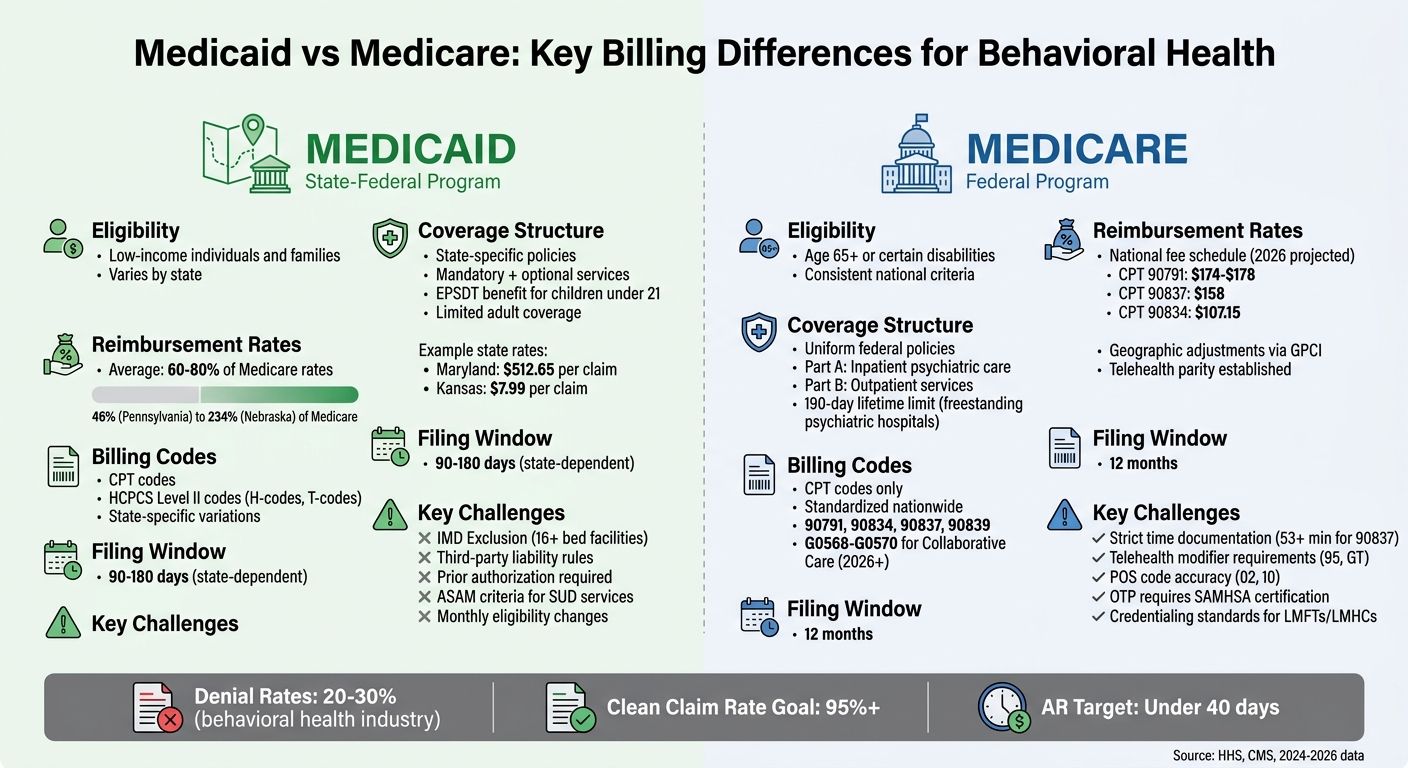
Reimbursement Rates: Medicaid often pays 60–80% of Medicare rates, though some states exceed Medicare rates. Medicare uses a national fee schedule, while Medicaid rates depend on state budgets.
Coverage: Medicare applies uniform rules, while Medicaid’s benefits differ by state. Medicaid’s EPSDT benefit ensures comprehensive care for children but offers limited coverage for adults.
Billing Codes: Medicare relies on CPT codes, while Medicaid uses both CPT and state-specific HCPCS Level II codes, adding complexity.
Compliance: Medicare has federal guidelines, while Medicaid compliance varies by state, with added challenges like the IMD exclusion and third-party liability rules.
For behavioral health providers, understanding these differences is crucial to avoid claim denials and optimize revenue.
Medicaid doesn’t treat behavioral health as a single, unified benefit. Instead, it falls under a mix of mandatory and optional service categories.
Mandatory services include essentials like physician visits and hospital care. Optional services, such as rehabilitative care, case management, and peer support, differ widely from state to state [4].
For children under 21, Medicaid offers comprehensive coverage through the Early and Periodic Screening, Diagnostic, and Treatment (EPSDT) benefit. This federal requirement ensures states provide any service needed to “correct or ameliorate” mental health or substance use conditions [4].
For adults, the story is different. States have the flexibility to define optional benefits and can apply utilization controls like prior authorization or session limits [4].
A 2023 survey of 45 states revealed that while all states cover individual therapy, only about 75% provide mobile crisis services, and just six states cover more than 90% of surveyed services [4]. Additionally, over 80% of states now include peer support services, a response to workforce shortages [4].
One unique challenge Medicaid faces is the Institution for Mental Diseases (IMD) exclusion, which restricts federal funding for adult residential care in facilities with more than 16 beds that primarily serve psychiatric or substance use needs. This limitation applies to adults aged 21–64 and requires states to find workarounds, such as Section 1115 waivers. These waivers allow short-term residential substance use disorder (SUD) treatment, typically capped at 30 days [1][9].
Medicare, in contrast, takes a uniform federal approach to behavioral health coverage under its Part A (Hospital Insurance) and Part B (Medical Insurance) programs [6][7]. This standardization ensures the same policies apply nationwide, unlike Medicaid’s state-specific variations.
Part A covers inpatient psychiatric care, whether in general hospitals or freestanding psychiatric facilities. However, there’s a 190-day lifetime limit on inpatient care specifically in freestanding psychiatric hospitals. This restriction doesn’t apply to psychiatric units within general hospitals [7].
Part B, on the other hand, offers broad outpatient coverage. It includes individual and group therapy, psychiatric evaluations, diagnostic tests, medication management, and partial hospitalization programs [5][7]. Starting January 1, 2024, Medicare will also cover Intensive Outpatient Programs (IOP) as a standalone benefit. Additionally, Marriage and Family Therapists (MFTs) and Mental Health Counselors (MHCs) will be allowed to enroll as independent providers [7].
Medicare also provides substance use disorder treatment, including Opioid Treatment Program (OTP) services with methadone, alcohol misuse screenings, and tobacco cessation counseling [6][7]. Annual depression screenings are available at no cost to patients if their provider accepts assignment [5].
The differences between Medicaid and Medicare coverage policies are striking and have direct implications for billing, compliance, and reimbursement.
The most notable distinction lies in state-driven variability versus federal standardization. Medicaid benefits can vary widely depending on the state, meaning a service covered in one state might not be available in another [4]. Medicare, however, applies consistent rules across the country.
For children, Medicaid’s EPSDT mandate ensures comprehensive behavioral health coverage by requiring states to cover any medically necessary service. Adults under Medicaid, however, face limitations defined by their state’s policies [4][9]. Medicare, by contrast, maintains consistent coverage regardless of the beneficiary’s age.
Another major difference is the IMD exclusion. Medicaid restricts federal funding for residential treatment in larger facilities for adults aged 21–64, unless states obtain waivers [1][9]. Medicare does not have this restriction but imposes the 190-day lifetime limit for inpatient care in freestanding psychiatric hospitals [7].
Lastly, provider eligibility varies. Medicare Part B covers services from a wide range of professionals, including psychiatrists, psychologists, clinical social workers, nurse practitioners, physician assistants, MFTs, and MHCs [5][7]. Medicaid’s provider eligibility, however, depends on state policies, with some states allowing a broader pool of practitioners than others [4].
This section dives into how Medicaid and Medicare approach reimbursement rates, particularly for behavioral health services. While both programs aim to support care access, their methods for determining payment levels differ significantly.
Medicaid reimbursement rates for behavioral health services are incredibly inconsistent across states. This is because each state sets its rates based on its own budget and priorities, rather than following a national standard [13]. The result? A massive range in payments. For example, in 2024, Kansas Medicaid paid $7.99 per behavioral health claim, while Maryland Medicaid paid $512.65 – a staggering 64-fold disparity for similar services [11].
Some states even exceed Medicare rates. Nebraska pays 2.34 times the Medicare rate for certain behavioral health services, and Alaska pays between 1.8 and 2.0 times Medicare rates [12]. On the flip side, Pennsylvania Medicaid only reimburses 46% of Medicare rates [12]. Providers have no room to negotiate these rates – they must either accept the state’s payment terms or opt out of Medicaid entirely [13].
On average, Medicaid reimburses about 70% to 81% of Medicare rates for behavioral health services [10][12]. For instance, a 60-minute therapy session under Medicaid typically pays between $60.00 and $90.00, depending on the state [13]. These payments often fall short of covering the actual costs of delivering care, including clinician time and administrative overhead. Unlike Medicaid, Medicare follows a standardized approach to setting rates.
Medicare takes a more uniform approach by using a federal Physician Fee Schedule. Rates are determined by Relative Value Units (RVUs) and adjusted with Geographic Practice Cost Indices (GPCIs) to account for regional cost differences [2][10]. For example, high-cost areas like New York City and San Francisco see rate adjustments of 7% to 15%, while rural areas experience reductions of 5% to 10% [10].
In 2026, Medicare’s national rates are projected to include $158.00 for CPT 90837 (60-minute psychotherapy), $107.15 for CPT 90834 (45-minute psychotherapy), and $174.00 to $178.00 for CPT 90791 (diagnostic evaluations) [10]. After significant cuts in 2025, Medicare rates are expected to rise modestly by 2% to 4% in 2026 [10]. Additionally, Medicare has permanently established telehealth parity, ensuring remote sessions are reimbursed at the same rate as in-person visits [10].
One key difference: Medicare reimburses Licensed Marriage and Family Therapists (LMFTs) and Licensed Mental Health Counselors (LMHCs) at 75% of the rate paid to psychologists for equivalent services [10].
Service / CPT Code | Medicare (2026 Est. Avg) | Medicaid (Typical Avg) |
|---|---|---|
90791 (Diagnostic Eval) | $174.00 – $178.00 | $120.00 – $140.00 |
90837 (60-min Therapy) | $158.00 | $108.00 – $123.00 |
90834 (45-min Therapy) | $107.15 | $73.00 – $83.00 |
90832 (30-min Therapy) | $81.00 | $55.00 – $65.00 |
State | Medicaid Avg Payment per Claim |
|---|---|
Maryland | $512.65 |
New Jersey | $418.81 |
New York | $280.93 |
California | $219.33 |
Texas | $147.33 |
Florida | $83.76 |
Kansas | $7.99 |
Source: HHS Medicaid claims records, 2024 [11]
Billing for Medicaid and Medicare involves distinct practices and code sets, which can complicate the process for providers who work with both programs. Medicare uses a standardized set of CPT codes nationwide, while Medicaid employs a mix of CPT and HCPCS Level II codes that vary by state. This state-by-state variation in Medicaid coding adds another layer of complexity for providers managing claims for both systems.
Medicaid frequently relies on HCPCS Level II codes to document services not included in the CPT manual, particularly for community-based and rehabilitative care. Examples include:
H2011: Used for crisis intervention, typically billed in 15-minute increments.
H0015: Covers substance use disorder (SUD) intensive outpatient programs, billed per day or per hour.
T2034: Reserved for alcohol and drug waiver services.
Modifiers like HO, HN, or HP are often required to adjust reimbursement rates, and the meaning of these codes can vary significantly by state. For instance, H2011 might represent 15 minutes of service in one state but count as a full encounter in another.
Medicare exclusively uses CPT codes for outpatient behavioral health services. Some of the most frequently billed codes include:
90791: Psychiatric diagnostic evaluations.
90834: Psychotherapy sessions lasting 45 minutes.
90837: Psychotherapy sessions lasting 60 minutes.
For crisis psychotherapy, Medicare uses 90839 for the first 60 minutes, while Medicaid typically opts for H2011. Additionally, starting January 1, 2024, Medicare expanded its coverage to include Licensed Professional Counselors (LPCs) and Licensed Marriage and Family Therapists (LMFTs), who bill at 75% of the physician fee schedule. Medicare has also updated its Collaborative Care Model codes, requiring G0568–G0570 instead of the older 99492–99494 codes starting in 2026 to prevent claim denials.
A key Medicare requirement is that 90837 must document at least 53 minutes of face-to-face time. Falling short of this threshold (e.g., documenting 52 minutes) constitutes upcoding, which can trigger audits.
Code | Description | Medicare Acceptance | Medicaid Acceptance | Billing Unit |
|---|---|---|---|---|
90837 | Psychotherapy, 60 min | Yes | Yes | Per encounter (53+ min) |
90791 | Psychiatric Diagnostic Eval | Yes | Yes | Per encounter |
90839 | Crisis Psychotherapy | Yes | Limited (prefers H2011) | First 60 minutes |
H0015 | SUD Intensive Outpatient | No (uses facility codes) | Yes | Per diem or per hour |
H2011 | Crisis Intervention | No | Yes | Per 15 minutes |
T2034 | Alcohol/Drug Waiver Service | No | Yes (state-specific) | Per encounter |
H0004 | BH Counseling/Therapy | No | Yes | Per 15 minutes |
Errors in billing codes – such as using H-codes for Medicare or outdated CPT codes – can have a significant financial impact. These mistakes may cost practices anywhere from $18,000 to $45,000 annually, underscoring the importance of precise and accurate coding [15].
Medicare operates under federal guidelines enforced by MACs, while Medicaid rules vary by state. This means providers must juggle state-specific regulations, managed care contracts, and differing medical necessity standards to stay compliant and keep their revenue cycle on track [3][1].
Navigating Medicaid compliance can feel like a balancing act. Enrollment involves two steps: registering with the state agency and then with each Managed Care Organization or Managed Behavioral Health Organization separately [1]. Providers also need to revalidate their enrollment every five years, as required by federal law [1].
One major hurdle is the IMD Exclusion, which disallows Medicaid payments for adults aged 21–64 receiving care in facilities with more than 16 beds – unless a Section 1115 waiver is in place [1]. Violations lead to automatic claim denials, even if the service itself was appropriate.
Medicaid’s “payer of last resort” rule adds another layer of complexity. Providers must bill all other insurance options, such as Medicare for dually eligible patients, before billing Medicaid [18]. Claims can be denied with a CO-22 code if Third-Party Liability isn’t properly documented [3][1]. Since Medicaid eligibility can shift month to month based on income, verifying benefits for every admission – not just new patients – is critical [3][1].
Substance use disorder services are under particular scrutiny. Many state Medicaid programs require providers to follow American Society of Addiction Medicine (ASAM) criteria when determining medical necessity [1]. Including specific findings from the six ASAM dimensions in authorization requests can help align with reviewer expectations and reduce denial risks [3].
Medicare compliance, on the other hand, focuses on federal credentialing and detailed documentation, especially for telehealth. Licensed Clinical Social Workers (LCSWs), Licensed Mental Health Counselors (LMHCs), and Licensed Marriage and Family Therapists (LMFTs) must meet strict credentialing standards to bill independently. Starting in 2024, LMFTs and LMHCs became eligible to bill Medicare, though at 75% of the physician fee schedule [10].
Opioid Treatment Programs (OTPs) face particularly stringent Medicare requirements. Providers must have SAMHSA certification and include an Opioid Use Disorder (OUD) diagnosis on every claim. Missing this diagnostic detail leads to immediate denials [[8]](https://www.federalregister.gov/documents/2024/12/09/2024-25382/medicare-and-medicaid-programs-cy-2025-payment-policies-under-the-physician-fee-schedule-and-other p.97760-97761).
Medicare’s telehealth policies now extend through 2026, but compliance requires precise coding. Providers must use the correct Place of Service (POS) codes – 02 for telehealth outside the home and 10 for in-home telehealth – and apply modifiers like 95 or GT [18][10]. For audio-only mental health visits, the appropriate modifier must also be included on claims [18][10]. Timeliness is another challenge: Medicare claims must be submitted within 12 months, while Medicaid and commercial payers often have shorter deadlines of 90–180 days [3].
These compliance demands often translate into predictable claim denial patterns. Medicaid claims are frequently denied due to Third-Party Liability issues (CO-22), especially when other insurance isn’t billed first [3][1]. Authorization-related denials are also common in programs like IOP, PHP, and residential treatment, where missed concurrent reviews can block reimbursement for already-delivered services [17].
For Medicare, denials often arise from M86 codes (not medically necessary) or CO-4 codes (errors in telehealth modifiers or POS codes) [3][1]. Across both programs, documentation gaps are a persistent issue. Claims may be denied due to missing DSM-5 diagnostic details, incomplete treatment plans, or session notes that fail to demonstrate ongoing clinical necessity [17].
Behavioral health providers face unique challenges because their diagnoses are often subjective. Unlike physical medicine, there are no objective tests, making it easier for payers to question the validity of diagnoses or the necessity of treatment [17]. Setting automated alerts 5–7 days before prior authorizations expire can help avoid N130 denials [3]. Additionally, keeping CAQH ProView profiles updated quarterly can prevent credentialing-related claim rejections [3].
Denial Type | Medicaid Pattern | Medicare Pattern |
|---|---|---|
Third-Party Liability | Coordination of Benefits errors for dual-eligible patients | |
Authorization | N130 for expired or missing prior authorization [3] | Less common; focused on specific programs like OTP [[8]](https://www.federalregister.gov/documents/2024/12/09/2024-25382/medicare-and-medicaid-programs-cy-2025-payment-policies-under-the-physician-fee-schedule-and-other p.97760-97761) |
Medical Necessity | ASAM criteria violations for SUD services [1] | M86 for insufficient documentation or inappropriate level of care [3][1] |
Coding Errors | Incorrect modifiers (e.g., HO) [18] | |
Provider Issues | Credential mismatches or unlicensed rendering providers [18] |
Let’s break down how Medicaid and Medicare handle billing differently using a 60-minute individual psychotherapy session (CPT 90837) as an example. For Medicare, providers submit claims using the CMS-1500 form, and no prior authorization is needed. Claims can be filed up to 12 months after the service date, and reimbursements follow a federal fee schedule. Medicaid, however, often requires prior authorization after a certain number of visits, has a shorter filing window (usually 90 to 180 days depending on the state), and reimburses at a lower rate – typically 60% to 80% of Medicare’s rate.
Crisis intervention services highlight additional contrasts. Medicare reviews these claims retrospectively, focusing on documented evidence of medical necessity without requiring upfront approval. Some Medicaid programs, on the other hand, offer higher rates for crisis services but demand immediate follow-up documentation. For patients covered by both Medicare and Medicaid, Medicare acts as the primary payer, with Medicaid covering the remaining balance. Submitting claims in the wrong order can lead to coordination of benefits denials. These examples show how critical precise documentation and timing are in minimizing claim denials.
Regularly verifying patient eligibility is essential, especially for Medicaid, as coverage can change monthly. This simple step can prevent retroactive claim denials.
For time-based CPT codes like 90832, 90834, and 90837, document the exact start and end times of psychotherapy sessions. Even a minor discrepancy – like billing a 44-minute session as a 45-minute session – can result in a denial. Medicare telehealth claims require extra attention to coding guidelines to avoid errors.
Top-performing practices maintain over 90% clean claims and keep accounts receivable under 45 days. Using AI-driven claim scrubbing tools can help identify potential issues before submission, such as bundling conflicts, missing modifiers, or mismatched diagnosis and procedure codes. For substance use disorder (SUD) services, referencing ASAM Dimensions 1–6 in authorization requests strengthens claims and reduces the likelihood of denials.
BHRev offers tools to simplify these billing challenges. Its automated eligibility verification system catches coverage lapses before services are provided, while its AI-powered claim scrubbing ensures compliance with payer rules and flags potential errors.
For dual-eligible patients, BHRev’s platform automatically sequences Medicare as the primary payer and Medicaid as secondary, reducing coordination of benefits errors. The denial management dashboard tracks patterns like authorization expirations, allowing providers to address issues early and prevent revenue loss. Real-time analytics also help identify areas of revenue leakage, such as missing ASAM documentation in Medicaid SUD claims, ensuring providers can optimize their billing processes effectively.
The billing processes for behavioral health services under Medicaid and Medicare differ significantly, creating challenges for providers.
Medicare offers a consistent national framework with standardized fee schedules and a 12-month filing window. In contrast, Medicaid operates on a state-by-state basis, with reimbursement rates varying widely – from 46% to 234% of Medicare rates – and stricter filing deadlines, often between 90 and 180 days [12]. These variations can have a direct impact on your revenue cycle. Missing a Medicaid-specific requirement, like an authorization or filing deadline, can lead to uncollectible claims.
The complexities don’t stop at rates and deadlines. For instance, Medicare typically doesn’t require prior authorization for standard psychotherapy sessions. Medicaid, on the other hand, often mandates ASAM-based documentation, precise sequencing for dual-eligible claims, and adherence to time-based coding rules rather than relying solely on ASAM findings [3].
Thriving practices achieve clean claim rates above 95% and maintain accounts receivable under 40 days [3]. To hit these benchmarks, tools like automated eligibility checks, real-time claim scrubbing, and proactive denial management are essential. Platforms like BHRev simplify this process by routing claims to the right payer, flagging missing authorizations before submission, and using real-time analytics to identify potential revenue leaks. These tools can significantly enhance revenue cycle management and safeguard your financial performance.
With denial rates in behavioral health ranging from 20% to 30% – far higher than the 10% average in general medical billing [19] – understanding the differences between Medicaid and Medicare billing is crucial. Mastering these systems helps providers protect their revenue and maintain a steady cash flow.
When a patient is covered by both Medicare and Medicaid, Medicare should always be billed first for services it covers, as Medicaid serves as the payer of last resort. If Medicare denies the claim or the provider cannot bill Medicare, the next step is to submit the claim to Medicaid. To ensure compliance with federal regulations and maximize reimbursement, make sure all providers are properly enrolled in Medicare and follow Medicaid’s specific guidelines.
To minimize the chances of Medicaid and Medicare behavioral health claim denials, it’s crucial to maintain detailed and accurate documentation. This includes:
Progress notes that clearly outline patient care and progress.
Comprehensive treatment plans tailored to individual needs.
Thorough risk assessments to evaluate and address potential concerns.
Specific informed-consent forms that meet regulatory requirements.
Keeping these records well-organized and up-to-date is key to staying compliant and improving the likelihood of claim approval.
When billing for behavioral health services, CPT codes are used for specific treatments like psychotherapy, medication management, or other procedure-based services.
On the other hand, HCPCS “H-codes” typically cover supplies, equipment, or services not addressed by CPT codes. These often include behavioral health-related items or services that require extra coding or modifiers.
One email a month, no fluff. Unsubscribe anytime.