
Home / Understanding Payer Dispute Resolution Processes

When insurance claims are denied, underpaid, or contested, providers can use payer dispute resolution processes to challenge these decisions.
This article breaks down key aspects of payer disputes, focusing on behavioral health challenges, common issues, timelines, and strategies to improve outcomes.
What is a Payer Dispute? A formal request to reconsider a claim decision, differing from appeals as it involves broader disagreements (e.g., billing, policies).
Behavioral Health Issues: High denial rates due to strict medical necessity criteria, missing modifiers, and varying state timelines.
Dispute Lifecycle: Identify issues, submit disputes within deadlines (usually 365 days), and escalate if necessary.
Common Disputes: Payment underpayments, medical necessity denials, authorization lapses, and eligibility errors.
Resolution Tools: Platforms like BHRev streamline dispute management, improving success rates and reducing administrative burdens.
Verify contracts for clear fee schedules and filing limits.
Submit disputes online for faster acknowledgment.
Use detailed documentation to support claims.
Monitor KPIs like denial rates and appeal success rates to refine processes.
Understanding these processes and leveraging technology can help providers recover lost revenue and navigate payer complexities more effectively.
Navigating the dispute lifecycle in behavioral health involves tackling a variety of payer disputes, each requiring a specific approach. Understanding these common issues and their triggers can help providers address them more efficiently.
Payment amount disputes arise when payers reimburse less than anticipated. This often involves issues like bundling errors, incorrect modifiers, or mismatched fee schedules. Staying on top of coding guidelines and ensuring detailed documentation can make a big difference in resolving these disputes.
For instance, payers often use National Correct Coding Initiative (NCCI) edits to bundle services they consider redundant. If you bill for an evaluation and management (E/M) visit alongside a psychotherapy add-on or schedule multiple group sessions in one day, you might encounter a CO 59 denial, where only one service is approved [3]. Using specific X modifiers (like XE, XS, XP, or XU) instead of the generic modifier 59 can clarify that the services are distinct.
Another common issue is vague documentation. For example, a clinician who notes, “session lasted about an hour”, risks having the payer down-code the claim from 90837 ($135) to 90834 ($100), resulting in a $35 loss per claim.
Fee schedule discrepancies can also complicate things. Payers may apply the wrong rates, such as failing to differentiate between master’s-level and doctoral-level clinicians. Reconciling Electronic Remittance Advices (ERAs) with your contract is key to spotting underpayments early.
Coverage and medical necessity disputes are particularly tricky in behavioral health because they often rely on subjective clinical judgment. Unlike other medical fields that use objective tests, behavioral health relies on narrative-based documentation. Payers may flag these notes as insufficient or apply their own criteria, which can go beyond standard guidelines like ASAM or InterQual. Denial rates for treatments such as Intensive Outpatient, Partial Hospitalization, and residential care are notably higher than the 8%–12% seen in general medicine [5].
The 2024 final rule for the Mental Health Parity and Addiction Equity Act (MHPAEA) has added scrutiny to non-quantitative treatment limitations (NQTLs), such as stricter prior authorization requirements for behavioral health [4]. Providers now have better tools to challenge these practices by requesting a payer’s comparative analysis under MHPAEA. Additionally, treatments labeled as “experimental” (like equine or art therapy) or cases where PHQ-9 or GAD-7 scores show minimal improvement can also lead to denials [3].
Authorization and eligibility disputes often catch providers off guard, especially when they surface after services have already been provided. Retroactive eligibility terminations, for instance, can disrupt long-term residential care if Medicaid coverage lapses mid-treatment. A practical solution is to reverify benefits at the start of each month for residential patients [3].
Authorization disputes commonly occur when reauthorizations are missed or delayed. For example, UnitedHealthcare requires reauthorization every seven days for Intensive Outpatient (IOP) services – a tight window that can easily be overlooked [3]. A CO 15 denial indicates that an authorization has expired, and missing certifications for specialized programs, like Opioid Treatment Programs (OTPs), can lead to similar issues.
Another frequent problem is carve-out misrouting, which results in “Patient Not Eligible” (CO 31) or “Service Not Covered” (PR 204) denials. This happens when behavioral health benefits are managed by a separate Managed Behavioral Health Organization (MBHO), such as Optum or Magellan, but the claim is sent to the primary medical carrier instead. Always check the back of the insurance card to confirm which organization handles behavioral health benefits before submitting a claim [3][5].
|
Denial Code |
Category |
Common Trigger |
|---|---|---|
|
CO 50 |
Medical Necessity |
Failure to show why a lower level of care was tried first [3] |
|
CO 59 |
Payment Amount |
Bundling of intake assessment with same-day therapy [3] |
|
CO 15 |
Authorization |
Lapsed authorization in a residential or IOP program [3] |
|
CO 31 |
Eligibility |
Coverage terminated mid-treatment or carve-out misrouting [3] |
|
PR 204 |
Coverage |
Plan exclusion for services like Wilderness Therapy or MAT [3] |
|
PR 32 |
Documentation |
Missing telehealth modifier or insufficient session documentation [3] |
Every effective payer dispute resolution process starts with solid contracts and detailed documentation. Yet, over 60% of providers fail to consistently reference their contracts during appeals – a costly oversight [6].
Your payer contract is more than just paperwork; it’s your key to ensuring proper reimbursement.
A well-negotiated contract can prevent many disputes before they even arise. One of the most critical elements is a fee schedule that clearly outlines each CPT code alongside its negotiated rate. Without this, payers have the freedom to set their own rates, leading to underpayments that typically account for 3–5% of total contracted revenue [6].
Be cautious of unilateral amendment clauses, which allow payers to change reimbursement rates with minimal notice (often 10–30 days) and no provider approval. Push to either remove or limit these clauses during negotiations. Other essential terms to include are:
Prompt payment clauses
Timely filing limits (at least 90 days)
Audit provisions (restricting recoupments to 12–24 months)
These terms help safeguard your cash flow and reduce financial uncertainty.
Of course, even the best contract is only as good as the documentation that backs it up during disputes.
Winning a dispute isn’t just about clinical evidence – it’s about having the right documents ready. These can be grouped into three main categories:
|
Category |
Examples |
Role |
|---|---|---|
|
Administrative |
Remittance notification/EOP, original claim, NPI/TIN, Member ID |
Identifies the transaction and denial reason |
|
Legal/Regulatory |
Waiver of Liability, Appointment of Representative, state-specific forms |
Authorizes action or protects the member |
|
Clinical |
Medical records, clinical notes, new evidence |
Proves medical necessity and validates services rendered |
|
Justification |
Appeal explanation, reasons for missing prior authorization |
Provides context for procedural errors or deviations |
Don’t focus solely on clinical records. For example, disputes involving Medicare Advantage plans often require a Waiver of Liability form. Without it, the dispute may be dismissed outright, no matter how strong your clinical argument is [7]. Whenever possible, submit disputes through digital portals like Availity Essentials. These platforms provide instant confirmation and automatically link documents to the claim [7][8].
Credentialing lapses are a frequent and avoidable issue. Missing a CAQH re-attestation cycle, which is required every 12–24 months, can trigger automatic denials unrelated to the quality of care [5]. Setting calendar reminders for each payer’s credentialing deadlines can help prevent these denials.
On the documentation side, vague clinical language is a common problem. Phrases like “patient is making progress” can lead to denials on medical necessity grounds. Instead, follow the “golden thread” standard, which ties the intake assessment, DSM-5 diagnosis, treatment plan goals, and measurable outcomes into a clear narrative [5]. For time-based CPT codes like 90832, 90834, and 90837, always include exact start and stop times, as missing this detail can result in automatic down-coding by payer AI systems [9].
To streamline processes, maintain a one-page summary for each payer that outlines key details like fee schedules, filing limits, and appeal windows. For instance, a Midwest multispecialty clinic recovered over $250,000 in underpayments over 18 months simply by having billing staff compare payment variances against their contracted rates [6]. The key isn’t complexity – it’s consistency.
Having solid contracts and thorough documentation is essential, but knowing the exact steps and deadlines for resolving disputes is just as important. Each type of payer dispute follows specific rules, and missing even a single deadline could mean losing your right to appeal.
When dealing with commercial payers, disputes typically follow a structured, multi-step process. After a denial, payers are required to notify you within specific timeframes: 15 days for prior authorization requests, 30 days for services already provided, and 72 hours for urgent care cases [10][11]. Once notified, you have up to 180 days (6 months) to submit an internal appeal [10]. As mentioned earlier, accurate documentation is crucial for a successful appeal.
Once your appeal is submitted, the payer must resolve it within 30 days for pre-service cases and 60 days for post-service cases [10][11]. If the internal appeal is denied, you can escalate to an external review, which must be requested within 60 days of the final denial and resolved within another 60 days [11]. For urgent cases where delays could harm the patient, internal appeals must be decided within 72 hours, and external reviews within 4 business days [10][11]. In these urgent scenarios, providers are allowed to file both the internal appeal and external review at the same time [10].
It’s important to note that “grandfathered” plans – employer-sponsored plans established before March 23, 2010 – may not follow the standard ACA appeal rules. Always verify the plan’s status to ensure you’re working within the correct guidelines [11].
Medicare disputes involve a five-step appeals process: redetermination by the Medicare Administrative Contractor (MAC), reconsideration by a Qualified Independent Contractor (QIC), a hearing with an Administrative Law Judge (ALJ), review by the Medicare Appeals Council, and finally, federal district court. Each step has its own strict filing deadlines, and missing one means you can’t proceed further.
Medicaid, on the other hand, is more complex due to variations in state-specific rules and whether the patient is enrolled in fee-for-service Medicaid or a Medicaid managed care organization (MCO). MCO disputes generally follow timelines similar to those of commercial payers but are governed by state contracts and federal Medicaid regulations. For providers working across multiple states, it’s useful to maintain a reference sheet detailing Medicaid appeal timelines for each state. Some states allow as little as 30 days to file a grievance with an MCO, so knowing these details is critical.
In addition to these traditional processes, the No Surprises Act introduces its own unique framework for resolving disputes.
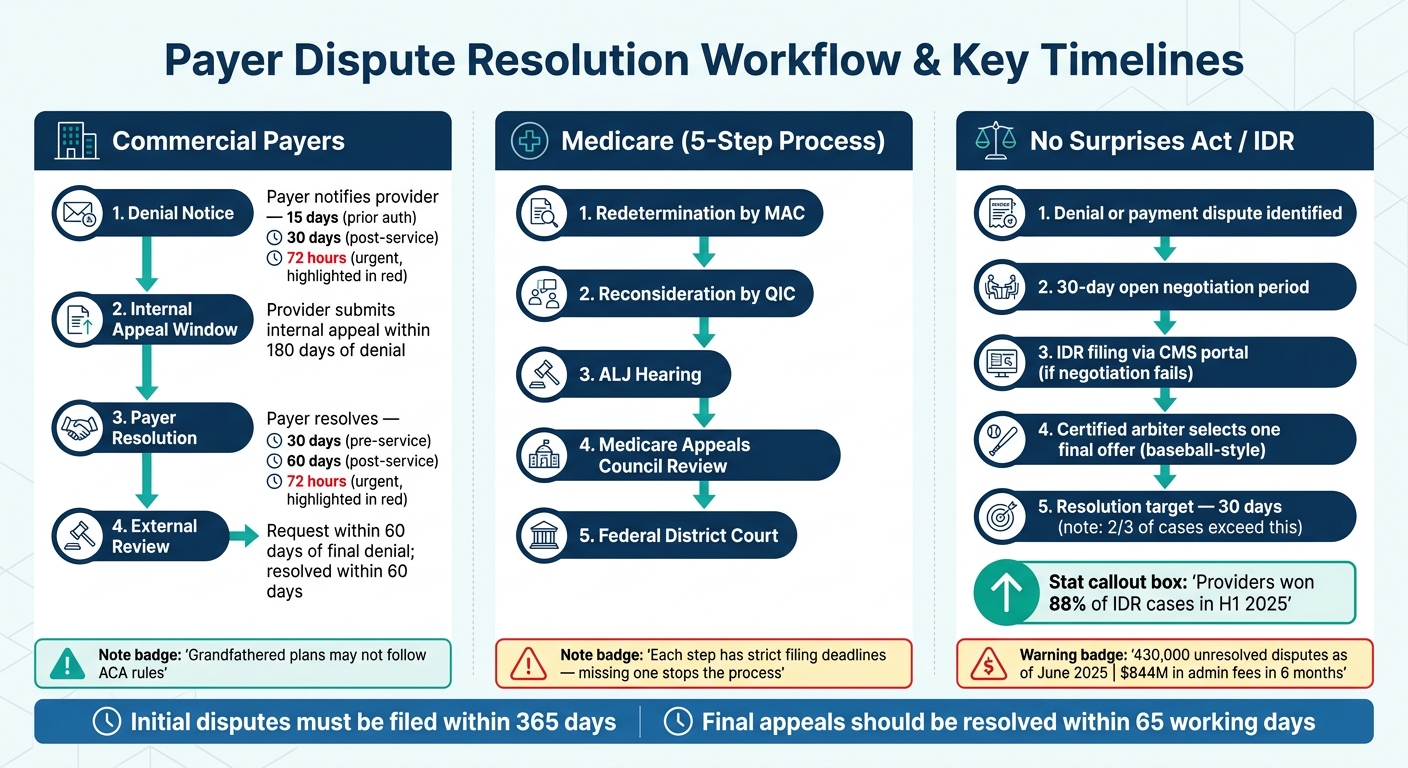
The No Surprises Act (NSA) established a federal Independent Dispute Resolution (IDR) process for resolving payment disputes between out-of-network providers and health plans. This process is most often used in balance billing cases and does not apply to patients covered by Medicare, Medicaid, VA health care, or TRICARE [14].
Before filing for IDR, both parties must go through a 30-day open negotiation period [13][15]. If negotiations fail, either party can initiate the IDR process through the CMS portal. In this process, a certified arbiter uses a “baseball-style” approach – each side submits a final payment offer, and the arbiter chooses one [13]. While the law specifies a 30-day timeline for resolution, two-thirds of IDR decisions exceed this deadline due to a growing backlog [12]. As of late June 2025, there were 430,000 unresolved disputes in the federal system [12].
In the first half of 2025, providers won 88% of IDR cases, marking the highest success rate so far [12]. However, the process isn’t without risks. Around 40% of cases were contested as ineligible by payers during that same period, and administrative fees totaled a staggering $844 million in just six months [12]. To avoid wasting time and money, make sure your claim meets federal eligibility requirements before filing. Additionally, some states, such as Maryland, Virginia, and Texas, operate their own IDR systems, which may yield different outcomes compared to the federal process [14][16].
To effectively handle payer disputes, it’s crucial to separate routine claim inquiries from formal disputes. Establish distinct workflows for each, supported by a tracking system that incorporates two critical deadlines: initial disputes must be filed within 365 days, and final appeals should be resolved within 65 working days. Every submission should clearly outline the rationale for the dispute and specify the desired outcome.
Switching to online submission systems can dramatically improve efficiency, reducing acknowledgment times from 15 days to just 2. Grouping similar claims using Internal Control Numbers (ICNs) can streamline the process further. Additionally, create a dedicated sub-workflow for overpayment refund requests, which typically require a response within 30 working days. This ensures all deadlines are met and no claims fall through the cracks [1].
Once these workflows are in place, integrating technology can take your dispute resolution process to the next level.
AI-powered tools, like BHRev, can revolutionize how disputes are managed. These platforms automate critical tasks, such as identifying underpayments, generating appeal letters with clinical justifications, and tracking deadlines. For example, BHRev’s system flags parity law violations where reimbursement rates for mental health or substance use disorder (SUD) services are lower than those for comparable medical treatments. It also auto-generates appeal letters pre-filled with ASAM criteria and offers built-in deadline tracking and alerts to prevent authorization lapses.
The results speak for themselves: practices using tools like these report first-pass claim rates of 97–98.5%, appeal success rates of 87–93%, and reduced days in accounts receivable (A/R) to 16–24 days. Denial rates also drop significantly, ranging between 3–6% [17][18].
Managing disputes effectively doesn’t end with resolution. Ongoing performance tracking is essential to identify weak spots and refine workflows. Key performance indicators (KPIs) to monitor include:
|
Metric |
What It Tells You |
|---|---|
|
Denial Rate by Reason |
Highlights areas where coding, documentation, or authorization issues are recurring. |
|
Appeal Success Rate |
Measures the effectiveness of your dispute resolution team, helping to prioritize which claims to focus on. |
|
Days in A/R (Disputed) |
Shows which payers are slower to respond, offering leverage for contract negotiations. |
|
Net Recovery Value |
Evaluates whether the revenue recovered justifies the administrative costs of pursuing disputes. |
Identifying patterns in recurring denials – such as frequent rejections from a specific payer for a certain service – can guide improvements in documentation, staff training, or even contract terms. For instance, refining documentation templates and preparation processes has been shown to cut appeal turnaround times from 90 days to as few as 21 [19]. By continuously analyzing and adjusting your approach, you can ensure a more efficient and effective dispute resolution process.
Payer disputes are a common challenge in U.S. behavioral health practices, directly affecting both financial outcomes and relationships with payers.
The core principles to manage these disputes effectively are straightforward: ensure contracts have clear terms, maintain detailed documentation, and meet all deadlines. For instance, missing the 365-day window for an initial dispute or the 65-working-day deadline for a final appeal can mean losing access to additional revenue or legal options permanently [1]. Regularly reviewing contracts and keeping thorough records can help avoid disputes altogether. When disputes do arise, understanding the appropriate course of action – whether it’s filing a commercial appeal, Medicare reconsideration, or an IDR claim – can make the resolution process more efficient and safeguard your legal rights [2].
Incorporating technology into this process can make a big difference. AI-driven tools like BHRev simplify tasks such as spotting underpayments, preparing appeal submissions, and monitoring deadlines. These tools help shift the process from being reactive to proactive, saving time and reducing errors.
If you disagree with a payment or coverage decision – like the amount paid or questions about eligibility – you can file a dispute. This process allows for an informal review or correction of the decision. On the other hand, if your coverage or benefits have been formally denied, you’ll need to file an appeal. Appeals are used to request a formal review of the insurer’s decision. In short, disputes are for seeking clarification, while appeals are for challenging denials.
To challenge a medical necessity denial effectively, you’ll generally require the following:
A letter of medical necessity from your doctor explaining why the treatment or service is essential.
Comprehensive clinical documentation that outlines your condition and treatment history.
Test results and imaging reports to provide objective evidence supporting your case.
Records of prior treatments to show that alternative options have been explored.
Make sure all submitted documents clearly demonstrate why the treatment or service is medically necessary.
If a dispute isn’t resolved within the 30-business-day negotiation period outlined by the No Surprises Act, you can escalate it to an external review or initiate the Independent Dispute Resolution (IDR) process. To proceed with IDR, make sure to file within 4 business days after the negotiation period ends.
For denied claims, you can request an external review once internal appeals have been exhausted. In urgent situations, you can bypass the usual process and request an expedited review. Standard external reviews typically take up to 45 days, while urgent reviews are decided within 4 business days.
One email a month, no fluff. Unsubscribe anytime.