
Home / Denial Reasons for Medicare Behavioral Health Claims

Medicare behavioral health claims are denied far more often than general medical claims, with denial rates ranging from 15% to 20%. This can result in significant revenue losses for providers, especially since over half of denied claims are never resubmitted. Key reasons for denials include:
Eligibility Issues: Errors like outdated coverage, incorrect payer billing, or Medicare Advantage mismatches.
Coding Errors: Missing modifiers, time-based code mistakes, or telehealth-specific coding problems.
Documentation Gaps: Incomplete or vague clinical notes and failure to show medical necessity.
Prior Authorization Problems: Missing approvals, frequency limit violations, or coverage rule errors.
Provider Credentialing Mistakes: Inactive PECOS enrollment, incorrect NPI or taxonomy codes.
Preventing these issues is more cost-effective than appealing denied claims, which can cost $62.40 per claim. Using automated tools for eligibility checks, claim scrubbing, and real-time denial tracking can help providers reduce denial rates and improve revenue recovery.
Eligibility denials make up nearly 30% of preventable claim rejections, costing practices $25–$30 per error [13]. These denials often stem from simple administrative mistakes.
Here are some common triggers:
Lapsed or terminated coverage (denial code CO-27): This happens when a patient’s insurance plan ends before the service date. A “ghost period” between the termination of one plan and the start of another can exacerbate the issue.
Coordination of Benefits (COB) errors (CO-22 or CO-109): These occur when Medicare is billed as the primary payer, even though an employer-sponsored plan should have been billed first.
Medicare Advantage enrollment mismatches: Billing Traditional Medicare for patients enrolled in Medicare Advantage HMOs or behavioral health carve-outs managed by MBHOs (like Optum or Carelon) results in automatic denials [12][5].
Recent market shifts have made these issues worse. For example, the 2026 Medicare Advantage market restructuring forced 2.6 million beneficiaries – around 13% of all individual Medicare Advantage enrollees – into new plans after major insurers left certain markets [1]. Many patients didn’t realize their coverage had changed, leading to a surge in denials when providers failed to re-verify information.
To combat this, consistent eligibility verification before every encounter is essential. Using real-time 270/271 eligibility checks, which provide responses in under 2 seconds, can lower denial rates from 12–18% to under 2% [13]. When reviewing a 271 response, always check the EB01 status code first: a “1” indicates active coverage, while a “6” means terminated. Avoid billing based solely on deductible details if coverage is inactive. Additionally, confirm that the patient’s Medicare Beneficiary Identifier (MBI) is up to date and that the service date aligns with their Part B effective period [12].
It’s also crucial to verify whether behavioral health benefits are managed by a separate MBHO. Document the payer’s specific ID to avoid missing coverage details, as generic eligibility tools often overlook these carve-outs. Tools like BHRev are specifically designed for behavioral health and can flag carve-out details and COB statuses that standard tools might miss, helping practices identify gaps before they lead to denials.
Behavioral health claims face denial rates between 15% and 25%, which is about three times higher than general medicine claims [8][18]. A large portion of these denials stems from avoidable coding mistakes.
One frequent issue is forgetting Modifier 25 when billing an Evaluation and Management (E/M) code alongside a psychotherapy add-on. For instance, if you’re billing 99213 with 90833 on the same date, you must attach Modifier 25 to the E/M code. This modifier indicates that the E/M service is distinct from the psychotherapy add-on. Without it, payers often bundle the services together and automatically deny the E/M code.
Telehealth coding introduces its own set of challenges. For Medicare audio-only sessions, you should use Modifier FQ rather than Modifier 93. Additionally, when providing home-based telehealth services, bill with POS 10 instead of POS 11. Using the wrong modifier for telehealth modalities is a top reason for denials in 2026 [8][20], and mismatched POS codes are increasingly flagged during payer audits [19]. The financial stakes are notable – billing POS 10 instead of POS 02 for a single 90837 session under 2026 Medicare rates can result in a $42 difference [8].
Time-based CPT codes also require precise documentation. For example, CPT 90837 demands at least 53 minutes of session time. Documenting just 52 minutes can lead to denials for upcoding [8]. To avoid this, always record exact start and stop times in clinical notes. Some payers, like Optum, now use AI to automatically flag and down-code claims for 90837 if documentation is incomplete or lacks timestamps [9].
Here’s a quick breakdown of common coding errors and how to address them:
Common Error | What Goes Wrong | The Fix |
|---|---|---|
Missing Modifier 25 | E/M bundled with psychotherapy add-on | Attach Modifier 25 to the E/M code (99213–99215) |
Wrong telehealth modifier | Modifier 93 used for Medicare audio-only | Use Modifier FQ for Medicare audio-only sessions |
POS 11 for home telehealth | Claim flagged during payer audit | Use POS 10 for home-based telehealth |
90837 billed under 53 min | Down-coded or denied | Document exact start/stop times; bill 90834 for 38–52 minutes |
Obsolete HCPCS code | G2012 rejected | Use 98016 (replaced G2012 as of 2025) |
Wrong modifier sequence | Automated rejection triggered | List pricing modifiers (-25, -59) first, then informational ones (-95, -FQ) |
Specialized claim scrubbing tools can help catch these errors before the claim is submitted. Behavioral health-specific scrubbers are particularly effective – they validate time-to-code alignment, ensure POS consistency, and enforce proper modifier sequencing. These tools enable practices to achieve clean claim rates of 96%–99%, compared to the 82% average for generalist billing setups [9]. For example, BHRev offers AI-powered claim scrubbing tailored to behavioral health needs, flagging issues like CPT-to-time mismatches and missing modifiers before submission.
The next section will explore how insufficient documentation further increases the risk of claim denials.
Documentation gaps are a major issue, contributing to $254.5 million in improper Medicare psychiatry payments at a rate of 16.1% [17]. On top of that, medical necessity denials account for 25% to 35% of all behavioral health claim denials [7].
One common issue is vague documentation. For example, notes like “patient is doing well” fail to provide details about symptoms, severity, frequency, or responses to treatments such as CBT or DBT [21]. Another red flag is duplicated notes, where identical language is repeated across multiple sessions. In 2026, AI-driven payer audits have become adept at catching these, often leading to medical necessity denials [1][9].
A critical concept to grasp here is the “golden thread.” This refers to the clear, logical connection between a patient’s diagnosis, treatment goals, specific interventions, and documented outcomes [6][21]. If this thread is broken – such as when a “check-in” note lacks evidence of clinical intervention – payers are quick to deny claims. For instance, replacing vague goals like “improve quality of life” with measurable ones such as “reduce frequency of depressive episodes interfering with work from 3 days to 1 day per week” strengthens the case for medical necessity [6].
Time-based codes present another layer of complexity. The table below breaks down the key thresholds and common deficiencies for these codes:
CPT Code | Billable Time Threshold | Key Deficiency |
|---|---|---|
90832 | 16–37 minutes | Missing timestamps [21] |
90834 | 38–52 minutes | Session time below 38 minutes [7] |
90837 | 53+ minutes | Billed for standard 45–50-minute sessions [7] |
90833/90836/90838 | Separate E/M and therapy notes | Overlapping time or lack of distinct therapy notes [7] |
To avoid denials, ensure the ICD-10 code, treatment goals, and CPT code align with the clinical documentation before submission [6]. Tools like the PHQ-9 or GAD-7 can also provide objective evidence of functional impairment, which payers often value more than narrative descriptions [9].
While 81.7% of behavioral health denials are eventually overturned on appeal [2], resolving these issues is costly. The average appeal costs $62.40 per claim to process in 2026 [9]. Preventing documentation errors upfront is far more efficient than dealing with appeals later. Next, we’ll dive into the challenges posed by prior authorization and coverage rules.
Prior authorization is one of the leading causes of denials in behavioral health billing. Behavioral health services face prior authorization requirements at about five times the rate of physical medicine services [10]. To make matters worse, approximately 25% of initial prior authorization requests in this field are denied, often due to missing or incomplete information [22].
Here’s a key point to keep in mind: Original Medicare (Fee-for-Service) rarely requires prior authorization for most behavioral health services. In contrast, Medicare Advantage plans almost always do [16]. For example, eight out of nine Medicare Advantage organizations require prior authorization for inpatient behavioral health care, while six out of nine require it for partial hospitalization [23]. Treating both Fee-for-Service and Medicare Advantage the same when it comes to authorization processes often leads to denials.
Understanding frequent denial codes can help address authorization challenges. Here’s a quick breakdown:
Denial Code | Meaning | Common Root Cause |
|---|---|---|
CO-197 | Authorization absent | Service performed without prior approval or authorization never requested [1] |
CO-16 | Claim lacks required information | |
CO-50 | Medical necessity | Patient no longer meets criteria for the approved level of care [3][2] |
CO-222 | Exceeds frequency limit | Service exceeds annual therapy caps or diagnostic test limits [1] |
Beyond missing authorizations, level-of-care mismatches frequently cause problems. For instance, if an authorization is approved for an Intensive Outpatient Program (IOP) but the claim is submitted for Partial Hospitalization (PHP), the payer will deny it [3]. Similarly, if an authorization is issued under one provider’s NPI but the claim is submitted under another rendering provider, it will be rejected [3].
Another common pitfall involves MBHO carve-outs. If a patient’s behavioral health benefits are managed by a separate organization, like Optum or Magellan, and the claim is mistakenly sent to the primary Medicare carrier, it will result in a denial [3][22].
To prevent authorization-related denials, consider these steps:
Set up alerts for authorization expiration – at 21 days and 7 days before the current authorization expires [3].
Perform a hybrid verification at intake. This includes an electronic eligibility check followed by a phone call to confirm whether behavioral health benefits are managed by a separate payer [5].
Looking ahead, retroactive authorizations are becoming harder to secure. By 2026, AI systems will increasingly deny claims for services performed without pre-service approval numbers [1]. Staying proactive with tracking and verification is no longer optional – it’s essential.
Next, we’ll dive into how provider credentialing and enrollment issues further impact claim approvals.
Once prior authorization challenges are addressed, another hurdle in Medicare behavioral health billing emerges: provider credentialing issues. These errors are responsible for about one-third of billing denials [28], often due to administrative oversights in provider records.
A frequent culprit is a missing or inactive enrollment in PECOS (Provider Enrollment, Chain, and Ownership System). Medicare will automatically reject any claim submitted without an active PECOS record [14]. Similarly, CAQH ProView requires providers to re-attest their profiles every 120 days [5]. If this step is missed, enrollment can be quietly suspended, leading to “provider not enrolled” denials. Alongside enrollment status, accurate provider identifiers are equally critical.
Errors in NPI type or specialty taxonomy also result in immediate claim rejections [25][24]. Automated systems compare the NPI and taxonomy codes on submitted claims against PECOS and CAQH records. Using a Type 1 (individual) NPI when a Type 2 (group) NPI is required – or submitting a mismatched taxonomy code – triggers an instant denial. Additionally, as of January 1, 2026, Medicare began deactivating enrollments for providers who haven’t been identified on claims for 13 consecutive months [14].
Inconsistent data across systems is another common issue. Updates made in NPPES don’t automatically sync with PECOS, creating discrepancies. Under 2026 rules, failing to manually align these updates within 30 days can result in compliance violations [27]. Even minor formatting differences – like “Suite 200” versus “Ste. 200” – can lead to automated rejections [28].
Here’s a quick breakdown of how these systems interact:
System | Primary Function | Sync Behavior |
|---|---|---|
NPPES | Issues and maintains NPI records | Does NOT automatically push updates to PECOS [27] |
PECOS | Manages Medicare enrollment and billing privileges | Pulls from NPPES but requires manual reconciliation [27] |
CAQH | Centralized database for commercial insurers | Requires re-attestation every 120 days to remain active [26] |
To reduce these denials, proactive credentialing management is key. Conduct monthly audits to compare records across NPPES, PECOS, and CAQH.
Set up calendar alerts to complete CAQH re-attestation at least 90 days before the deadline [28][26]. These regular checks not only maintain credentialing compliance but also strengthen overall claim accuracy, helping to prevent avoidable denials as we move forward in tackling billing challenges.
Missing filing deadlines can lead to irreversible revenue loss.
Traditional Medicare requires claims to be submitted within 12 months from the date of service [14][29]. However, many Medicare Advantage plans set much stricter deadlines – plans like Molina Healthcare and Kaiser Permanente, for instance, enforce a 90-day filing limit [30].
One critical point to remember is that a claim is only considered “filed” if it successfully reaches Medicare’s payment floor. If a claim is rejected as unprocessable due to incorrect data, it doesn’t enter the system at all. Denial code CO-29 (timely filing) leaves no room for appeals, making prevention the best course of action [29][11].
To minimize the risk of filing errors, consider setting an internal filing cutoff 45 days before any legal deadline. Pair this with automated alerts at 30, 45, and 60 days to flag unresolved claims [30][3][11].
Tools like BHRev can help streamline this process. Their AI-driven claim scrubbing and denial tracking features catch submission errors before claims are sent to payers. This approach can help behavioral health practices maintain a clean claim rate above 95% and keep days in accounts receivable under 50 [9].
Addressing these filing and submission challenges is essential for reducing Medicare behavioral health claim denials.
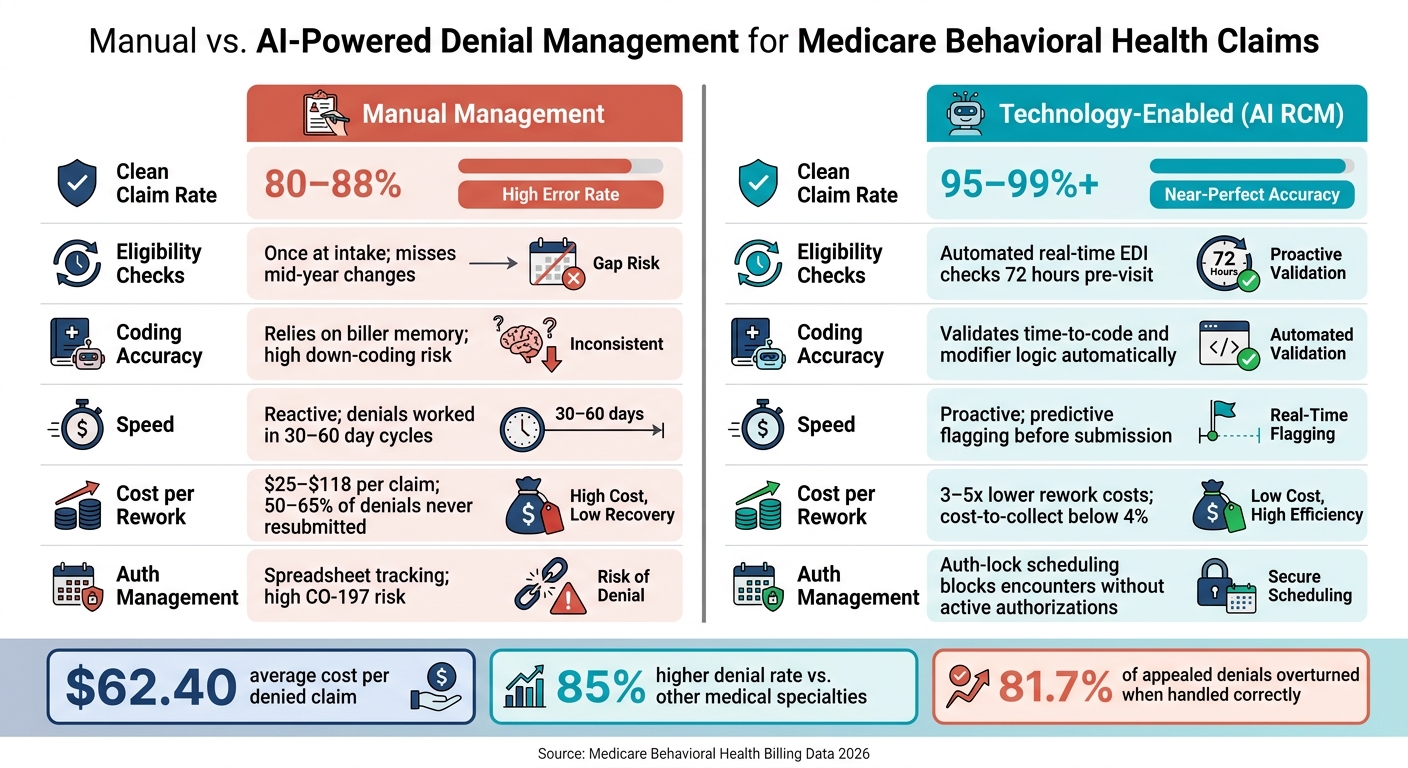
The challenges outlined earlier highlight the need for technology-driven solutions to address denial prevention effectively.
For instance, Medicare behavioral health claims are often preventable, yet payers like Optum utilize AI to flag denials in under 60 seconds [31].
On the other hand, many behavioral health practices still rely on manual processes like eligibility checks, spreadsheet-based authorization tracking, and reactive workflows for denial management. This outdated approach directly impacts revenue.
Currently, initial denial rates average between 12% and 14% [31], but behavioral health claims experience denial rates 50% to 85% higher than comparable medical claims [9].
With an average rework cost of $62.40 per denied claim [9], it’s clear that preventing denials is far more cost-efficient than addressing them after the fact.
Technology-enabled revenue cycle management (RCM) tackles these problems at their root. Automated, real-time eligibility checks can prevent coverage errors and carve-out issues discussed earlier.
AI-powered claim scrubbers ensure compliance with requirements, such as documenting 53+ minutes for CPT 90837 or attaching Modifier 25 to E/M services [9][31].
Additionally, “auth-lock” scheduling blocks appointments without valid authorizations, eliminating a major source of CO-197 denials [9][5]. Platforms like BHRev integrate these capabilities into a single, specialized RCM solution for behavioral health. Let’s take a closer look at how automation stacks up against manual processes in managing denials.
Factor | Manual Management | Technology-Enabled (e.g., BHRev AI RCM) |
|---|---|---|
Clean Claim Rate | 80–88% [31] | |
Eligibility Checks | Once at intake; misses mid-year changes [3] | |
Coding Accuracy | Relies on biller memory; high down-coding risk [9] | AI scrubbing validates time-to-code and modifier logic [9][31] |
Speed | Proactive; predictive flagging before submission [31] | |
Cost Impact | $25–$118 per rework; 50–65% of denials never resubmitted [9][31] | Automated prevention reduces rework costs by 3–5 times, keeping the cost-to-collect below 4% [31] |
Auth Management | Spreadsheet tracking; high CO-197 risk [3] | Auth-lock scheduling blocks encounters without active authorizations [9][5] |
Automation delivers measurable benefits, with high-performing practices achieving a first-pass clean claim rate of 95% or higher, compared to the 80–88% typical of manual systems [31][32].
Over time, this efficiency translates into significant financial and operational advantages, especially for practices managing hundreds of claims each month.
Medicare behavioral health claim denials often follow predictable patterns – whether it’s eligibility issues, coding mistakes, or gaps in documentation. The good news is that most of these problems can be addressed.
To put the financial impact into perspective, a practice billing $600,000 annually with a 10% denial rate could lose $24,000 every year if 40% of those denials remain unresolved [3].
Industry-wide, behavioral health claims face denial rates that are 85% higher than other medical specialties [2]. However, about 81.7% of appealed denials are successfully overturned when handled correctly [2].
The difference between recoverable denials and those left unresolved often comes down to having efficient workflows in place.
Preventing denials is far more cost-effective – 5 to 10 times cheaper – than appealing them later [4]. Tools like real-time eligibility checks, AI-driven claim scrubbing, authorization tracking, and well-organized clinical documentation not only streamline operations but also safeguard revenue. Platforms such as BHRev integrate automated verification, denial management, and predictive analytics into a single solution tailored for behavioral health providers, turning these tools into tangible financial improvements.
The ultimate aim is clear: maintain a clean claim rate above 95%, keep days in accounts receivable (AR) under 35, and reduce denial rates to below 5% [7]. Achieving this requires understanding why claims fail and implementing workflows designed to prevent those failures from occurring in the first place.
Before submitting a claim to Medicare, make sure the 271 response confirms the patient has active coverage. Look for an EB01 value of 1 (indicating active status); if you see a value of 6, it means the coverage is inactive. Confirm whether the patient is enrolled in Medicare Part A or Part B, and check if they have Medicare Advantage or any secondary insurance. Review details like deductibles, copays, and coinsurance to ensure accuracy.
Also, double-check that the 271 response aligns with your original 270 inquiry. Pay attention to any AAA segments, as these could signal errors or issues with the patient’s eligibility.
Modifier 25 is used to show that a significant, separately identifiable evaluation and management (E/M) service was provided on the same day as another procedure. When completing the CMS-1500 form, make sure to place Modifier 25 in Box 24D before any informational modifiers like 95 or HO. This helps prevent technical denials and ensures smoother claim processing.
BHRev provides revenue cycle management solutions designed to assist healthcare providers in managing modifier requirements and enhancing claim accuracy.
To meet Medicare’s standards for proving medical necessity in psychotherapy, documentation must clearly demonstrate that the service is reasonable, necessary, and aimed at improving the patient’s condition.
Here’s what needs to be included:
Individualized Treatment Plan: This should outline the patient’s diagnosis, specific goals, and the type of services being provided.
Clinical Notes: These should summarize the patient’s symptoms, diagnosis, and any progress made during treatment.
Mental Status Exam: A detailed evaluation of the patient’s mental state.
Session Details: Include either the start and stop times or the total duration of each session.
Provider Information: The provider’s signature and credentials must be present.
Accurate and thorough documentation is essential to ensure compliance with Medicare’s requirements.
One email a month, no fluff. Unsubscribe anytime.