
Home / Ultimate Guide to Workflow Automation in Behavioral Health RCM
Behavioral health billing is complex and prone to errors. From time-based CPT codes to payer carve-outs, small mistakes can lead to high denial rates and revenue losses. Automation offers a solution by streamlining eligibility checks, documentation, coding, and denial management.
Key takeaways:
Automation reduces errors by flagging issues before claims are submitted.
Practices using automation report a 95% first-pass acceptance rate and cut Days in A/R from 46 to 26.
Tools like BHRev provide AI-driven claim scrubbing, eligibility verification, and denial tracking.
Automation simplifies the revenue cycle at every step – covering eligibility checks, authorizations, documentation, coding, and denial management. It addresses the unique challenges of behavioral health practices with tailored solutions.
Did you know that about 50% of claim denials are tied to eligibility errors? Manual insurance verification isn’t just time-consuming – it takes 8 to 12 minutes per patient and has a 15–20% error rate. In contrast, automated systems using X12 270/271 queries can process each patient’s eligibility in just 5 to 15 seconds. This switch to automation can reduce eligibility-related denials by 40–60% within 60 days [6].
To minimize errors, it’s critical to run eligibility checks at three specific stages:
During intake
At scheduling
With a 24–48 hour batch refresh before the appointment
This is especially important for Medicaid patients, whose coverage can change between scheduling and the actual visit [6][7].
Automation also tackles prior authorization gaps by monitoring approved sessions and renewal deadlines. Alerts notify staff when only 2–3 authorized sessions remain, ensuring timely renewals and reducing “no authorization” denials [2][4]. Additionally, it’s essential to confirm carve-out details in advance, as behavioral health benefits are often managed by specialized providers like Optum, Carelon, or Magellan [4][5].
These front-end strategies set the stage for smoother mid-cycle processes.
Once front-end checks are complete, mid-cycle automation ensures claims are submitted accurately. For example, time-based CPT codes (such as 90832, 90834, 90837) must match the exact face-to-face minutes recorded. Missing start or stop times can lead to denials. Automated templates guide clinicians to capture all necessary details, reducing errors. These templates also help identify sessions eligible for the Interactive Complexity add-on code (90785), which is often overlooked in 50–70% of qualifying sessions when billing is done manually [2].
Before claims are submitted, automated claim scrubbing checks them against payer-specific rules. This includes verifying:
Telehealth modifiers (95 vs. GT)
Place of Service codes (02 vs. 10 for telehealth)
Diagnosis pointer accuracy
With these checks in place, practices can achieve a 95% first-pass acceptance rate and a 99% claim accuracy rate [2]. Tools like BHRev’s AI-powered claim scrubbing apply these rules automatically, catching errors that manual reviews might miss.
Even with strong front-end and mid-cycle automation, some claims may still be denied. This is where back-end automation steps in, focusing on resolving denials quickly and protecting revenue. Automated denial management systems categorize denials by root cause – whether related to eligibility, authorization, coding, documentation, or timely filing – and route them to the right team with all the supporting materials. For instance, medical necessity denials account for 25–35% of behavioral health claim denials, and automation helps develop effective appeal strategies [2]. Automated workflows recover 68% of denials within an average of 14 days [8].
When denials happen, efficient systems prioritize aged accounts and trigger follow-ups before appeal deadlines. Automated Electronic Remittance Advice (ERA) processing posts payments immediately and flags secondary billing opportunities, ensuring no revenue slips through the cracks [1][8].
A well-managed system keeps the A/R aging distribution on track, as shown below:
A/R Aging Bucket | Target Distribution |
|---|---|
0–30 days | 45% |
31–60 days | 28% |
61–90 days | 17% |
90+ days | 10% |
Start by analyzing your revenue cycle to uncover areas where inefficiencies and revenue leaks occur. Break your revenue cycle management (RCM) into three parts – front-end, mid-cycle, and back-end processes – and conduct a workflow audit. This will help you pinpoint where breakdowns are most frequent.
Look for “time sinks” – those repetitive, low-value tasks that eat up staff hours. Examples include manually verifying payer eligibility, chasing clinicians for missing documentation, or resubmitting claims without addressing the root cause of errors. These are perfect opportunities for automation.
During your audit, focus on these four key performance indicators (KPIs):
KPI | What It Reveals |
|---|---|
Clean Claim Rate | How well front-end and mid-cycle data is captured |
Denial Rate by Reason | Whether issues stem from coding, documentation, or other breakdowns |
Days in A/R | The efficiency of collections and follow-up processes |
Lag Time (DOS to Submission) | Delays in claim submission that could lead to denials |
The quality of your data plays a huge role here:
For example, if your intake fields aren’t standardized or eligibility checks only happen during scheduling, automation will simply replicate those flaws. Identifying these gaps is essential before you move forward with automation.
Take a phased approach – crawl, walk, then run. Begin by automating simple, high-volume tasks, but only after fixing broken processes. Eligibility verification is often a good starting point. Once simpler automations are stable, you can move on to more advanced workflows, like predictive denial management. Use the inefficiencies identified in your audit to prioritize which tasks to automate first.
Every automation initiative should have a specific goal and measurable metrics to track its success. A well-thought-out roadmap will guide you as you integrate automation into your workflow.
Your automation tools must work seamlessly with your EHR and practice management systems to ensure critical information updates smoothly without disrupting your existing processes. Compliance is a must – your systems need to align with HIPAA and, when applicable, 42 CFR Part 2 standards. [1] When evaluating vendors, prioritize those with experience in behavioral health compliance. For instance, BHRev’s RCM platform is built with compliance-focused workflows tailored for behavioral health providers, addressing Medicaid, Medicare, and commercial insurance requirements.
Before launching any automation, conduct a readiness check. Ask yourself:
Are your intake fields standardized?
Is your team trained on the updated workflow?
Does your vendor understand behavioral health-specific coding, like H-codes and ASAM criteria?
Taking the time to address these foundational elements will help you avoid common pitfalls during implementation. [9][10]
The single best leverage point in a denials operation is specialization. Cross-functional billers are slower at denials and less accurate. Three suggestions:
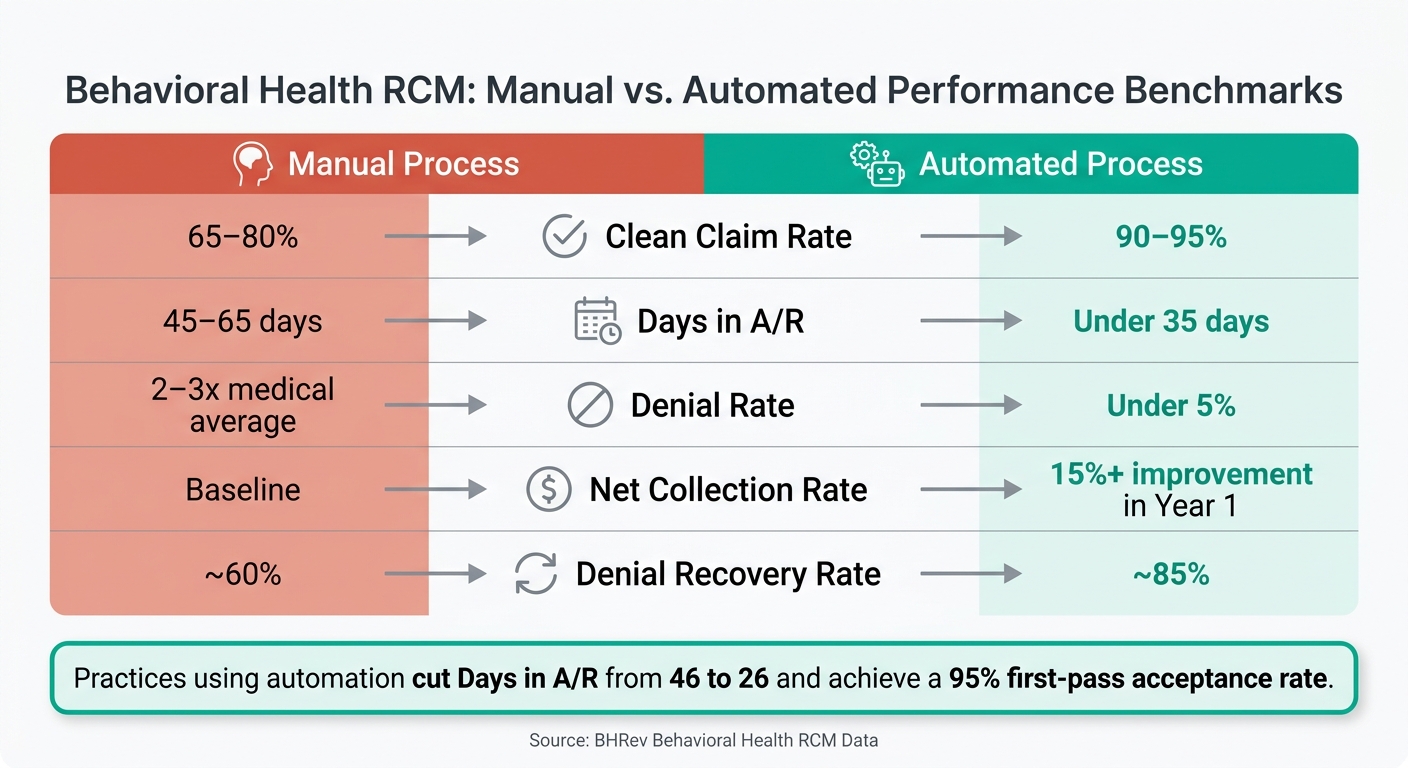
Once your automation system is live, it’s crucial to monitor its performance. Regularly tracking metrics like clean claim rate (CCR), days in accounts receivable (A/R), denial rate by reason, net collection rate, and denial recovery rate will give you a clear picture of your revenue cycle’s overall health.
KPI | Target | Why It Matters |
|---|---|---|
Clean Claim Rate | 90–95% [2] | Manual processes often fall between 65–80%; automation helps bridge this gap. |
Days in A/R | Manual workflows typically take 45–65 days to process. | |
Denial Rate | Under 5% [2] | Behavioral health denials can be 2–3 times higher than the medical average without automation. |
Net Collection Rate | 15%+ improvement in year one [11] | Shows the percentage of expected revenue actually collected. |
Denial Recovery Rate | ~85% [11] | Manual appeals recover about 60% of denied claims on average. |
One key area to focus on is tracking denial rate by reason rather than just the total number of denials. For instance, if 20–30% of denials are due to missing or expired prior authorizations [2], it signals a workflow issue that automation can address. These insights allow you to fine-tune your system for better results.
These metrics are just the beginning – automation thrives on regular updates and feedback.
For example, analyzing denial reason codes can help you identify patterns. If a specific payer repeatedly downcodes a CPT code, you can quickly adjust your claim scrubber rules, update documentation templates, or tweak intake processes. The faster you act, the fewer denials you’ll face.
Adopting predictive prioritization can also make a big difference. Instead of relying on traditional 30/60/90-day aging buckets, focus on claims that are most likely to be collected with minimal effort [3]. Additionally, conducting weekly reviews of your authorization tracking matrix – keeping tabs on remaining units, expiration dates, and coverage changes – can prevent many denials before they happen [2].
The financial benefits of automation can be impressive. Consider a practice collecting $5,000,000 annually with a 7% denial rate. By automating denial recovery, they could achieve a 3:1 return on investment within the first year [11]. Automated systems can recover revenue in as little as 72 hours, while manual processes often leave 20–30% of denied claims unresolved until deadlines pass [11].
On the operational side, automation can cut routine denial follow-up work by 30–50% [11]. This doesn’t mean eliminating staff – it frees up your team to handle more claims, focus on complex cases, and address exceptions requiring human expertise. The result? Recovered revenue, reclaimed staff hours, and resources that can be used to expand care access, reduce patient wait times, or strengthen your practice’s financial stability.
BHRev’s RCM platform is designed with these goals in mind, offering real-time dashboards, predictive analytics, and automated denial tracking. With this kind of integration, providers can monitor their revenue cycles in real time and make quick adjustments to optimize cash flow.
Workflow automation has the potential to reshape your revenue cycle from the ground up.
But let’s be clear: it’s not a magic fix. Instead, it’s a tool to build a more efficient and resilient system. Behavioral health providers who see the best results don’t try to automate everything overnight. They focus on repairing and standardizing their core processes first, then expand automation step by step. As Becky Carlson, Head of RCM at Joyful Health, wisely puts it: “If your RCM processes are broken and you introduce AI, you’re just going to get chaos faster.” [3]
A smart starting point is targeting the most time-consuming friction points, like manual eligibility calls, expired authorization alerts, and claim scrubbing errors. By addressing these areas, you can achieve tangible benchmarks like a clean claim rate of 95% or higher, keeping days in A/R under 40, and reducing denial rates to below 5% [9]. These aren’t just lofty goals – they’re attainable outcomes for organizations with a well-planned and automated revenue cycle.
The benefits go beyond just financial metrics. With automation handling repetitive tasks like routine follow-ups, your billing team can redirect their efforts to more complex work, such as appeals and payer escalations. This shift allows your team to focus on tasks that truly require human expertise.
What’s even better? Advanced technology is no longer exclusive to large systems. Smaller behavioral health practices now have access to AI-driven tools tailored specifically for their needs. Platforms like BHRev offer solutions such as automated eligibility verification, payer-specific claim scrubbing, denial tracking, and predictive analytics – all designed with the unique challenges of behavioral health billing in mind, including compliance with Medicaid, Medicare, and commercial insurance.
The key takeaway? Automation isn’t about replacing people; it’s about making them more effective. Think of it as a force multiplier – a way to empower your team to achieve better results, faster, and with fewer resources.
Start with automating eligibility verification to confirm insurance coverage, benefits, and authorization status right at the beginning. This step helps avoid claim denials and delays while making the billing process more efficient. By using real-time eligibility checks and automated benefits verification, you can cut down on manual mistakes and save time. This creates a solid base for automating other processes, such as claims processing, denial management, and payment posting.
To stay compliant, choose a platform with verified security credentials, such as a HIPAA Business Associate Agreement (BAA) and SOC 2 Type II certification. Use Part 2-compliant consent forms, include redisclosure notices with records, and maintain a log of all releases. Additionally, train your staff on proper procedures and regularly audit consent forms, automated notices, and secure data transfer processes to ensure everything aligns with regulations.
Before diving into AI automation for behavioral health revenue cycle management (RCM), it’s crucial to standardize key data within your EHR and billing systems. This ensures smoother, more accurate processing. Here’s what to focus on:
Session Details: Make sure start and stop times are recorded consistently.
Clinical Information: Standardize clinical diagnoses and symptoms.
Coding Accuracy: Use consistent CPT codes, telehealth modifiers, and adhere to payer-specific rules.
Provider Credentials: Ensure provider information is up-to-date and formatted uniformly.
Authorization and Limits: Normalize details like authorization statuses and session limits across systems.
Coding Practices: Maintain consistency in how coding is applied.
By cleaning and standardizing your data, you reduce errors, cut down on manual tasks, and set the stage for AI automation to work more effectively.
One email a month, no fluff. Unsubscribe anytime.