Home / How to Choose a Behavioral Health RCM Services Partner
BLOG
How to Choose a Behavioral Health RCM Services Partner
Use your denial rates, A/R days, and clean-claim data to evaluate behavioral health RCM vendors on payer expertise, tech, and support.
SHARE
The short answer: choose a partner that can reduce denials, manage authorizations, integrate with the organization’s EHR, and demonstrate measurable results.
When evaluating a behavioral health RCM partner, four areas deserve particular attention:
Service fit: Experience with the organization’s specific care settings, including outpatient therapy, psychiatry, IOP, PHP, residential treatment, telehealth, and SUD services.
Payer know-how: Medicaid, Medicare, commercial plans, and state-level rule changes.
Workflow and technology: Eligibility verification, claim scrubbing, denial management, reporting dashboards, authorization tracking, and EHR integration
Cost and support: Clear pricing, defined service responsibilities, responsive account support, and reasonable contract and termination terms
A poor RCM fit often becomes visible in core revenue cycle metrics, including higher denial rates, increased days in A/R, authorization delays, and lost or delayed revenue. The right partner should contribute to improvements in clean-claim rate, net collection rate, and payer turnaround times.
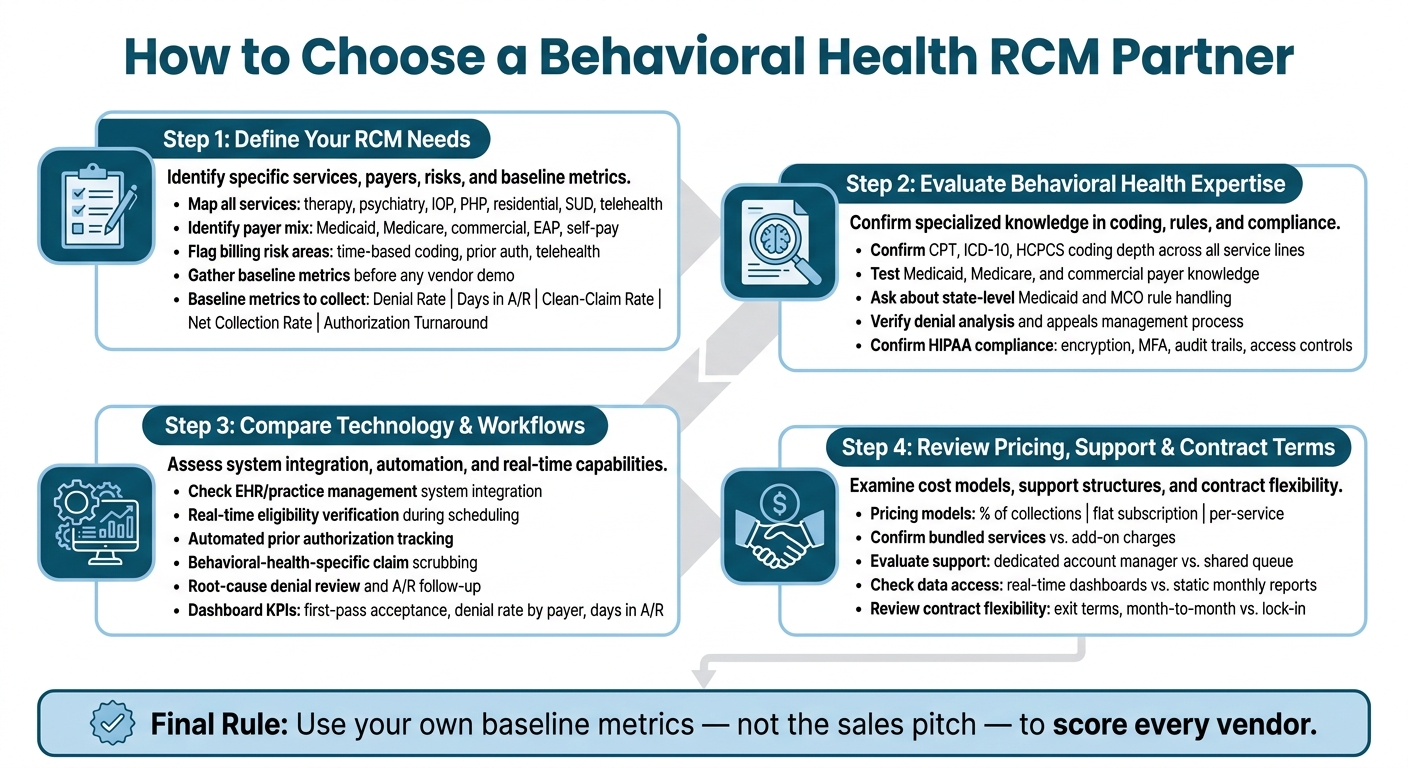
A practical vendor evaluation should include five steps:
Establish baseline performance before vendor demos Document current denial rate, days in A/R, clean-claim rate, net collection rate, and authorization turnaround time. These metrics provide an objective basis for evaluating vendor claims and measuring future performance.
Assess behavioral health billing expertise Confirm that the vendor has experience with the coding, documentation, and billing requirements associated with relevant services, such as therapy, psychiatry, SUD treatment, IOP, PHP, residential care, and telehealth.
Evaluate payer and compliance knowledge Review the vendor’s approach to Medicaid requirements, medical-necessity reviews, appeals, HIPAA compliance, audit trails, and PHI security.
Review day-to-day workflow compatibility Examine EHR integration, real-time eligibility verification, authorization tracking, denial root-cause analysis, and A/R follow-up. The technology should reduce administrative work rather than create additional manual processes.
Compare pricing and support consistently Evaluate percentage-of-collections, flat subscription, and service-based pricing models alongside the services included in each fee. Account support, reporting access, implementation requirements, additional charges, and contract exit terms should also be considered.
One useful rule is to avoid selecting an RCM partner based on the sales presentation alone. Current billing challenges and established performance metrics provide a more reliable framework for comparing vendors and validating their claims.
A straightforward final test is: Can this partner help the organization submit cleaner claims, reduce authorization-related denials, and collect more revenue without increasing the administrative burden on staff?
If the vendor cannot provide a clear, evidence-based answer, other options should be considered.
What to compare
What I’d check
Services fit
Therapy, med management, IOP, PHP, residential, telehealth, crisis care
Payer skill
Medicaid, Medicare, commercial, MCO rules, state billing rules
% of collections, monthly fee, or per-service pricing
Support
Dedicated contact, response time, dispute handling, contract terms
TO SUMMARIZE: know your numbers, test specialty billing depth, and compare support and workflow – not just price.
How to Choose a Behavioral Health RCM Partner: 4-Step Selection Process
How to Choose the Right RCM Services Partner
Step 1: Define your behavioral health RCM needs before comparing partners
Before you talk to vendors, get a clear view of your own operation. If you skip this step, you end up comparing vendors based on guesswork instead of what your organization actually needs.
Map your services, payer mix, and billing risks
Start by mapping every service you bill: psychotherapy, group therapy, medication management, IOP, PHP, residential treatment, crisis care, and specialty programs like substance use or eating disorder treatment. Each one comes with its own coding rules, documentation standards, and authorization requirements.
Then map your payer mix. What share of revenue comes from Medicaid managed care, Medicare, commercial plans, EAPs, and self-pay? That matters a lot. A Medicaid-heavy mix brings a very different set of authorization and coding issues than a commercial-heavy mix.
You should also flag the places where billing tends to go off the rails. In behavioral health, that often includes time-based coding, telehealth billing, prior authorization, and medical-necessity documentation [1][2].
Decide which RCM functions to keep in-house or outsource
Full RCM outsourcing isn’t the right move for every provider. Sometimes the better path is narrower and more focused.
Look closely at where your team gets stuck.
That may include:
Eligibility verification
Prior authorization
Coding
Claims submission
Denial follow-up
A/R
Credentialing gaps
This kind of gap check helps you see whether you need a full-service partner or help with just a few pressure points.
Gather your baseline metrics before talking to vendors
The most useful thing you can bring into a vendor call is your own data. Before any sales demo, collect your current denial rate, days in A/R, net collection rate, clean-claim rate, and authorization turnaround[1].
These numbers show where your revenue cycle is falling short. Just as important, they give you a way to measure whether a vendor is actually doing a good job after you sign.
Track these five metrics before any vendor demo.
Metric
What It Tells You
Denial rate
How often claims are rejected and why
Days in A/R
How quickly services convert to collected cash
Clean-claim rate
First-submission accuracy
Net collection rate
Share of owed revenue actually collected
Authorization turnaround
How well prior approval timelines are managed
Use these benchmarks to score each vendor on fit, performance, and accountability. They become your scorecard for the next step.
Step 2: Evaluate behavioral health expertise, compliance, and payer knowledge
Once you know what your organization needs, the next step is figuring out which vendors have real behavioral health depth and which ones are just general RCM firms with little specialty experience. That gap shows up fast in denials and payment timing. Use the metrics from Step 1 to test whether a vendor can fix the billing areas where you’re most exposed.
Review coding depth and documentation support
Start by checking whether the vendor can handle behavioral health CPT, ICD-10, and HCPCS coding across therapy, psychiatry, SUD, IOP, and PHP. Ask if their staff gets regular training on coding updates [1][5].
You should also ask whether they use automated claim scrubbing built for behavioral health payer edits. That kind of front-end check can catch mistakes before a claim leaves your system, which can improve your first-pass acceptance rate [1][6].
Coding knowledge matters. But it only goes so far if the vendor doesn’t understand how each payer applies those codes.
Denials, authorization delays, and payment holds often come back to one thing: weak payer knowledge. Medicaid behavioral health billing can vary a lot by state, and managed care organization rules add yet another layer. A vendor that handles Medicaid well in one state may struggle with the rules in yours [1].
Ask a few direct questions:
“What is your workflow for obtaining and tracking prior authorizations, and how do you review clinical documentation to ensure it meets each payer’s medical necessity criteria?”[1]
“How does your team stay current with insurance policy updates and the specific rules of managed care organizations?”[1]
“What is your process for denial analysis and appeals management, and how do you identify the root causes of denials?”[1]
Their answers will tell you a lot. Are you hearing a clear process, or are they winging it?
Once you understand the payer side, make sure those workflows sit on top of secure PHI handling.
Treat compliance as part of revenue protection. A billing partner handles protected health information at scale, so their security setup has a direct effect on reimbursement and contract risk.
At a minimum, confirm that they have HIPAA-compliant workflows, data encryption, secure cloud storage, multi-factor authentication, user access controls, regular staff training on HIPAA updates, and detailed audit trails [1]. It also helps to ask for a walkthrough of their audit process, including how they handle documentation requests and how fast they respond.
Step 3: Compare technology, reporting, and denial management workflows
At this stage, you’re checking a simple but BIG thing: can the vendor’s system handle day-to-day billing work without forcing your team into extra manual steps? This is where you find out whether their tools cut busywork and flag issues early, or just shift the mess somewhere else.
Assess EHR integration, eligibility checks, and authorization tracking
Start with the connection to your current EHR or practice management system. Ask how the vendor plugs into what you already use. Direct integrations can move data in real time [2][4]. That matters because bidirectional data transfer helps staff avoid entering the same information twice.
Eligibility checks are another spot where small details can turn into expensive problems. The system should verify active coverage, copays, deductibles, and authorization rules in real time during scheduling or check-in [1]. Finding a coverage problem before the visit is much cheaper than dealing with a denial later.
Prior authorization tracking should work the same way: early, automatic, and connected to the rest of the workflow. Ask whether the vendor’s system checks payer rules on its own, confirms the clinical documentation is there, and pulls together submission packets [1][7]. Ideally, eligibility verification, authorization tracking, and denial prevention work as one flow, not three disconnected manual jobs.
Evaluate claim scrubbing, denial prevention, and A/R follow-up
Use behavioral-health-specific claim edits that stay current with payer rules [1][6]. That front-end review stops avoidable errors before the claim ever reaches the payer.
If a claim is denied, the next step matters just as much. You want a process built around root-cause review, not just sending the claim back out and hoping it sticks [1][2]. On the accounts receivable (A/R) side, ask how the vendor tracks aging balances and how older claims get flagged for follow-up.
Once you understand the denial workflow, look at the reporting. The key question is whether it shows issues fast enough to stop the same mistakes from happening again.
Compare dashboards, analytics, and AI-enabled tools
Ask for daily visibility into claims, denials, A/R aging, and payer performance [1][3]. Automation should handle repeat tasks like eligibility checks, claim scrubbing, and payment posting, while staff step in for exceptions [2].
When you compare vendors, focus on a few areas:
Real-time reporting
Automated eligibility
Behavioral-health-specific coding
Denial prevention
Prioritized worklists
Then look at the numbers that show whether the process is working:
After workflow fit, compare pricing, support, and contract terms.
Step 4: Review pricing, service model, and support quality before deciding
After workflow fit, the choice usually comes down to cost, support, and contract risk. That’s the point where you want to slow down and look closely at pricing, service, and terms.
Understand pricing models and what the fee covers
Behavioral health RCM partners often charge in one of three ways: percentage-of-collections, subscription, or service-specific pricing.
Percentage-of-collections ties the vendor’s fee to the money they bring in, so their pay moves with your revenue. Subscription and service-specific pricing are common too, especially if you plan to keep part of billing in-house.
But here’s the thing: the pricing model matters less than what you’re getting for the fee.
Before you sign anything, confirm exactly what’s included. A single fee should cover insurance verification, prior authorization support, medical coding, claims management, payment posting, denial resolution, old A/R follow-up, and financial reporting [1]. You should also ask whether credentialing maintenance, old A/R recovery, and underpayment recovery are part of the package or billed on top.
That step sounds basic, but it saves a lot of pain later. A lower fee can look good at first, then get expensive once add-on charges start stacking up.
Use a scorecard to compare performance, support, and contract terms
Once pricing is clear, compare each vendor against the same standards. After you narrow the list, gut feel isn’t enough. A simple scorecard makes the process more objective.
Use the criteria that matter most to your organization, assign weights if needed, and score every vendor the same way. Pull in the same denial rate, days in A/R, and clean-claim rate from Step 1 so your finalists are judged on a level playing field.
Criteria
What to Look For
Pricing model
Percentage-of-collections, subscription, or service-specific
Included services
Confirm what’s bundled vs. billed separately
Clean-claim rate
Ask for documented benchmarks
Denial rate
Request payer-level breakdown, not just overall averages
Support model
Dedicated account manager vs. shared support queue
Data access
Real-time dashboards instead of static monthly reports
Contract flexibility
Month-to-month vs. long-term lock-in; exit terms
Support quality tends to show up fast when something goes wrong. Ask direct questions: Who will be your point of contact? How fast do they handle billing disputes? Look for dedicated account management and transparent real-time reporting.
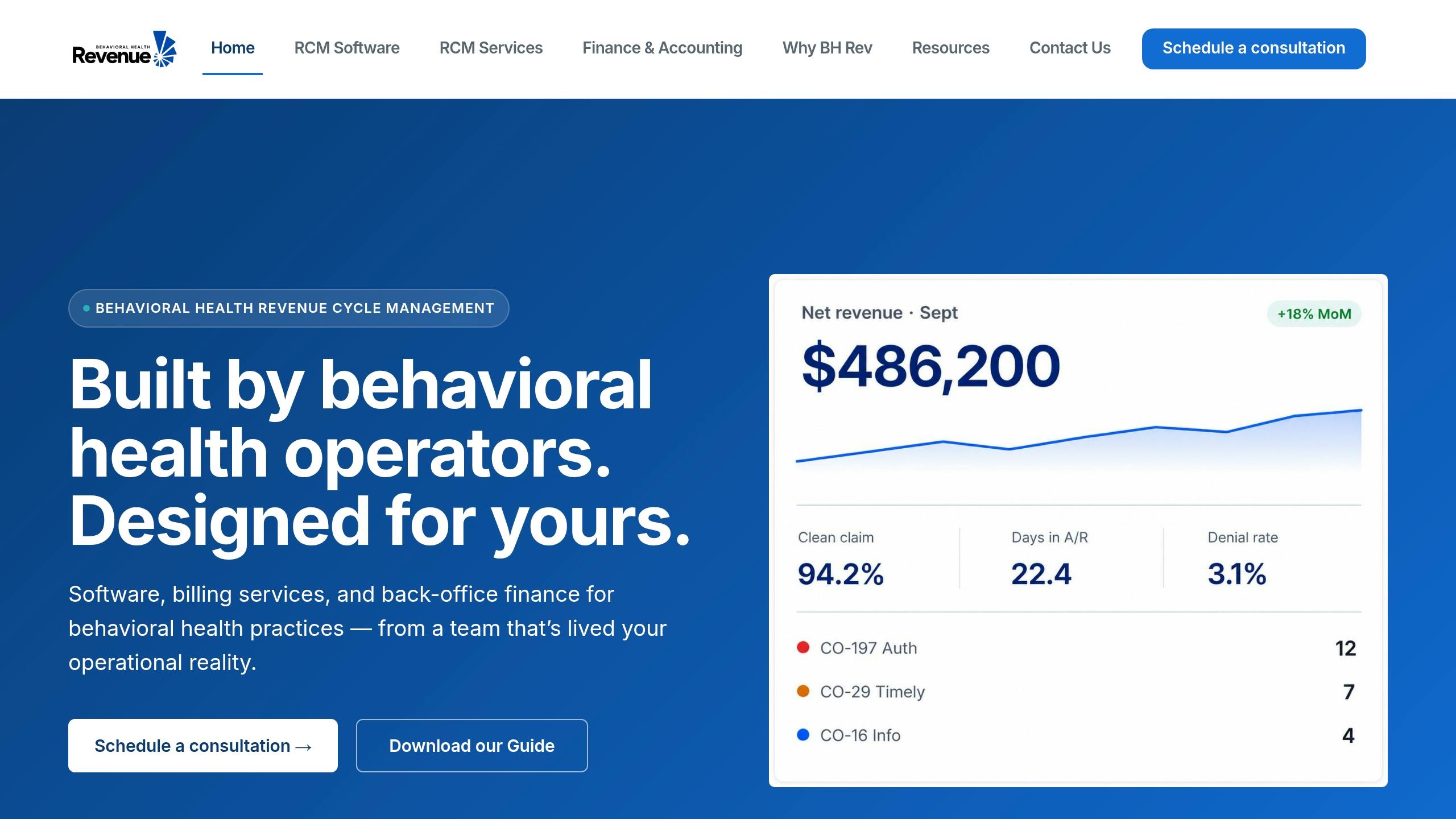
If you are evaluating BHRev, use this same scorecard. The goal is simple: see whether its model fits the way your team already works.
BHRev lines up with these selection points through behavioral health-focused RCM, real-time reporting, automation for routine tasks, and human oversight for exceptions.
Conclusion: Choose the partner that fits your behavioral health workflow and growth plan
After you compare vendors, use your scorecard to make the final call. Follow a simple order: define your needs, check subject-matter fit, compare the tech, then look at pricing and support.
The goal is pretty clear. You want fewer denials, stronger collections, compliant billing you can stand behind in an audit, and a partner that can grow with your payer mix and caseload.
Before you sign anything, confirm the basics: automation, real-time reporting, and dedicated support. Then stack each finalist against your baseline metrics and let the numbers lead. That keeps the choice tied to performance, not sales promises.
FAQs
How do I know if I need full RCM outsourcing?
Consider full revenue cycle management outsourcing if your organization is dealing with high claim denials, tricky payer reimbursement rules, or admin work that keeps your team away from patient care.
It can also make sense if you need specialized expertise in behavioral health documentation and changing compliance standards. Done well, it can improve cash flow, cut errors, and support scalable, compliant growth.
What metrics should I track before choosing a partner?
Before you choose a revenue cycle management partner, look at the numbers that show how your practice is doing financially and where money may be getting stuck.
Key metrics to review include:
revenue summaries
overall collection rates
accounts receivable aging
denial trends
payment turnaround times
provider productivity
These metrics can show where claims are breaking down, how fast revenue comes in, and whether billing performance matches clinical output.
Which contract terms should I review most carefully?
Focus on terms that cover the full revenue cycle, not just claim submission. That means looking past the moment a claim goes out the door and checking how the agreement handles the work before and after billing.
Review HIPAA compliance, data security, and each party’s responsibilities for denial management and appeals, including proactive follow-up. If those duties are vague, problems can slip through the cracks fast.
You’ll also want to check reporting transparency, pricing, and service expectations. Those terms should match the day-to-day reality of behavioral health billing, including coding complexity, prior authorization needs, and documentation standards.