Behavioral health claims get denied at higher rates than general medical claims, often because intake teams miss carve-outs, visit limits, or prior auth rules.
When choosing the best platform, look at six things first: active coverage, behavioral health carve-outs, copays and deductibles, visit limits, prior auth, and support for Medicaid, Medicare, and commercial plans.
Key points:
-
BHRev is the most behavioral-health-focused option in this group.
-
Waystar has broad payer access, but behavioral health detail may still need manual follow-up.
-
Experian Health stands out for intake cleanup and denial reduction tied to eligibility data.
-
Availity works well for payer access and prior auth workflows, but service-level behavioral health detail may vary.
-
Change Healthcare is a strong pick for high-volume teams that need fast checks and EHR connections.
-
Office Ally is a lower-cost choice for smaller practices, but carve-out setup can take more manual work.
Remember: a platform is only as good as the behavioral health detail it returns during intake. A basic “active” response is not enough if the patient’s mental health or SUD benefits sit with an MBHO.
Features that matters most :
-
Behavioral health carve-out visibility
-
Copays, deductibles, and out-of-pocket detail
-
Visit limits and level-of-care checks
-
Prior authorization flags
-
Batch checks and point-of-service speed
-
EHR/CRM integration
-
Fit for small practices vs. large systems
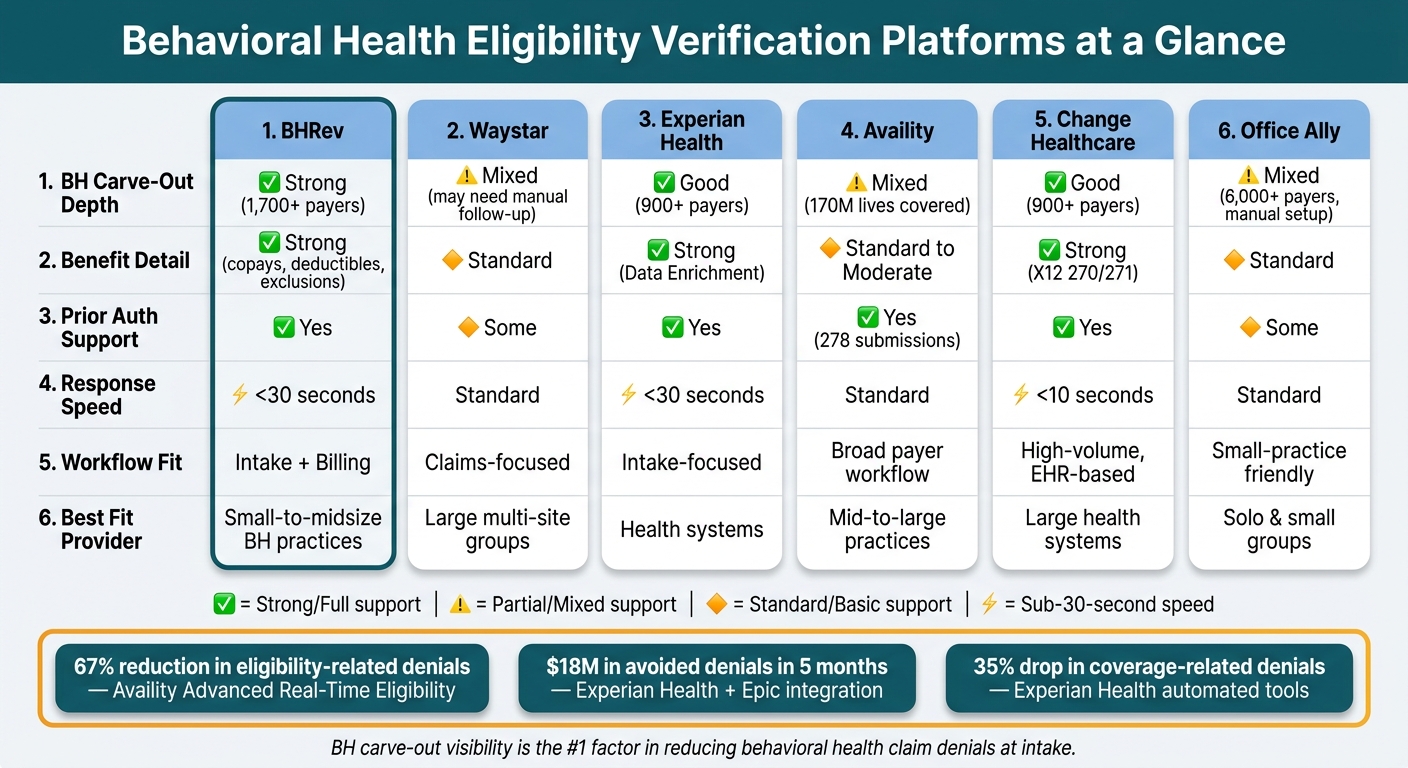
Quick Comparison
|
Platform
|
BH carve-out depth
|
Benefit detail
|
Prior auth
|
Workflow fit
|
Best fit
|
|
BHRev
|
Strong
|
Strong
|
Yes
|
Intake + billing
|
Behavioral health providers
|
|
Waystar
|
Mixed
|
Standard, may need follow-up
|
Some
|
More claims-focused
|
Large, multi-site groups
|
|
Experian Health
|
Good, depends on payer data
|
Strong
|
Yes
|
Intake-focused
|
Health systems
|
|
Availity
|
Mixed
|
Standard to moderate
|
Yes
|
Broad payer workflow
|
Mid-to-large practices
|
|
Change Healthcare
|
Good, depends on mapping
|
Strong
|
Yes
|
High-volume, EHR-based
|
Large systems
|
|
Office Ally
|
Mixed, more setup needed
|
Standard
|
Some
|
Small-practice friendly
|
Solo and small groups
|
The bottom line: if your team deals with many behavioral health carve-outs, put BHRev near the top.
If your main goal is front-end eligibility cleanup inside a large health system, Experian Health and Change Healthcare stand out. If price matters most, Office Ally is worth a look.
Below is a breakdown of how each platform stacks up and where each one fits best.
BHRev is an AI-powered revenue cycle management platform made for behavioral health providers.
Behavioral-Health Coverage Depth
BHRev connects to more than 1,700 commercial, government, and smaller payers to show behavioral health carve-outs, including mental health and SUD coverage across inpatient, outpatient, detox, and residential care [3][5]. That gives intake teams a clearer view of whether coverage exists in the first place. After that, they still need the next layer of detail: cost-sharing and authorization rules.
Authorization and Benefit Checks
BHRev also shows copays, deductibles, exclusions, and prior authorization requirements [3]. That matters because intake mistakes can turn into billing problems down the line. With this info up front, teams can spot issues before care starts.
Workflow Automation and Integrations
Speed matters, especially for busy intake teams handling a high volume of checks. BHRev returns results in under 30 seconds [3][5], which can save staff from getting stuck in back-and-forth calls or manual lookups.
It also integrates directly with Salesforce and other CRMs and EHRs to cut duplicate data entry between admissions and billing [3][6]. In plain terms, staff don’t have to keep typing the same details into different systems.
BHRev can also verify an entire census in one step. Teams can schedule daily, weekly, or monthly batch checks to catch lapsed policies before they lead to non-reimbursable care [5]. And for staff who aren’t tied to a desk, the mobile app gives them access to eligibility checks in the field [3][5].
Revenue-Cycle Impact
Eligibility errors often show up later as denials. Catching coverage problems before claim submission can help reduce denials linked to eligibility errors [7].
2. Waystar

Waystar gives providers access to a broad set of payer connections. But for behavioral health, that reach doesn’t always translate into the level of detail intake teams need. The big issue is simple: can staff see service-level benefits fast enough to make an intake decision?
Behavioral-Health Coverage Depth
Waystar connects with many commercial, Medicare, and Medicaid payers. That sounds good on paper. Still, broad payer access doesn’t always mean clear behavioral health benefit data.
For behavioral health providers, that gap matters. A system may show that a patient is active or inactive, yet still fail to spell out benefits tied to residential, PHP, or outpatient care. When that happens, teams may still be left guessing about mental health, SUD, or facility-level coverage.
Authorization and Benefit Checks
This is where benefit detail matters more than a basic eligibility response. Waystar returns standard benefit data such as deductibles and copays[8]. But if the response doesn’t include behavioral health specifics, staff often still need to do manual checks for IOP, PHP, or residential coverage[8][9].
That extra step can drag out intake. And in behavioral health, timing matters. When a patient is ready for care, staff can’t afford to bounce between systems and phone calls just to pin down basic coverage facts.
Workflow Automation and Integrations
When eligibility data comes back incomplete, teams often have to verify the missing pieces somewhere else. Waystar integrates with many EHR and practice management systems, and it connects with behavioral health EHRs like PIMSY, so staff can run eligibility checks right inside the patient chart[1].
That’s useful. But the workflow is still geared more toward claims work than front-end intake. In practice, it helps more with what happens after the visit than with the intake call itself, where behavioral health teams need fast, clear answers[8].
Revenue-Cycle Impact
Administrative errors, often tied to disconnected or manual verification workflows, account for about 49% of all claim denials[1]. For behavioral health providers, missed carve-out details can lead to coverage surprises that slow admissions or show up later as denied claims.
3. Experian Health
Experian puts less emphasis on basic payer lookup and more on getting faster, cleaner benefit data at intake. It connects to a network of more than 900 payers, including Medicare, Medicaid, and commercial plans. For behavioral health teams, that matters for one simple reason: intake staff need benefit checks that come back fast and include enough detail to act on.
Behavioral-Health Coverage Depth
Experian’s Data Enrichment feature pulls benefit data from payer sources and normalizes plan responses. That helps intake teams spot active coverage, cost-sharing, and plan differences with less back-and-forth. In behavioral health, this becomes most useful when a plan separates mental health or SUD benefits from medical coverage.
Authorization and Benefit Checks
Patient Access Curator validates demographics, eligibility, insurance discovery, and coordination of benefits in under 30 seconds, helping staff catch coverage errors before registration moves forward [11].
Workflow Automation and Integrations
Experian integrates directly with Epic and writes eligibility data back into the host system, so staff don’t have to bounce between separate platforms [10]. Providence Health reported $18 million in avoided denials within five months and identified $30 million in previously missed coverage each year after adopting the Epic integration [10].
Revenue-Cycle Impact
Experian clients report lower denial rates, with coverage-related denials typically dropping by 35% when using its automated tools [11]. That makes Experian a strong fit when front-end eligibility cleanup and payer coordination are the main pain points in behavioral health intake.
4. Availity
Availity connects more than 3 million credentialed providers to a nationwide payer network that covers about 170 million lives [12]. That kind of reach matters. For behavioral health teams, though, the bigger issue is simpler: can that scale help staff spot carve-outs and service-level benefits fast enough during intake?
Behavioral-Health Coverage Depth
Availity gives teams access to Medicaid, Medicare, and commercial plans. Its Coverage Locator and Advanced Real-Time Eligibility tools can show current benefits inside the provider workflow [13].
That said, Availity is still a general-purpose clearinghouse. In some cases, it may return only active or inactive coverage status. So intake staff may still need to do manual follow-up for carve-outs, visit limits, and level-of-care benefits like IOP or PHP [9][14]. That puts even more weight on the next step: checking authorization details.
Authorization and Benefit Checks
Availity automates prior authorization submissions and status checks with payers directly [13]. It also supports 278 submissions and can return:
Workflow Automation and Integrations
Availity offers a tiered setup. Essentials is free, Essentials Plus adds payer access, Essentials Pro brings eligibility checks into EHR workflows, and the API Marketplace adds REST/FHIR connectivity [4][13].
When eligibility checks happen inside the workflow, staff can catch problems before claims go out. That can cut denial risk upstream.
Revenue-Cycle Impact
Availity’s Advanced Real-Time Eligibility reduced eligibility-related denials by 67% at one major health system, and it uses AI-driven edits to flag claim errors before submission [4][13].
5. Change Healthcare
Change Healthcare stands out for two things: speed and deep payer reach. That combo makes it a strong fit for high-volume behavioral health intake.
Now part of Optum, it connects to more than 900 payers nationwide, including commercial, Medicare, and Medicaid plans [2].
Behavioral-Health Coverage Depth
The platform uses X12 270/271 transactions to return active coverage, deductibles, copays, and prior authorization requirements in under 10 seconds [2]. For busy intake teams, that kind of turnaround can make a big difference.
Service type codes can zero in on mental health and SUD benefits. Optum MBHO connectivity can also surface carve-outs. Even so, staff still need to verify those details before moving ahead [2][15].
Authorization and Benefit Checks
This level of benefit detail matters most when prior authorization decides whether care can begin. The 271 response dashboard includes a “Prior Auth Required” flag, which is especially helpful for behavioral health levels of care like residential treatment or PHP [2][15].
That early visibility can save a lot of pain on the back end. One multi-specialty group recovered $1.2 million in potentially denied claims within a single year by catching authorization gaps early [2].
Workflow Automation and Integrations
Change Healthcare integrates with Epic, Cerner, and athenahealth through OpenAPI. It also supports JSON, X12, and CSV batch options for high-volume verification [2].
That means teams can plug it into the systems they already use instead of bouncing between screens all day. One mid-sized clinic reduced manual data entry errors by 70% after connecting the tool directly to its EHR [2].
Revenue-Cycle Impact
These workflow controls matter when teams want fewer manual steps before a claim goes out. A hospital that put a 48-hour pre-visit verification rule in place with the platform cut claim denials by 35% [2].
For large health systems, the biggest edge is its deep Epic and Cerner integration [2].
6. Office Ally
Office Ally is a lower-cost eligibility option for small and mid-sized practices. It serves 80,000+ healthcare organizations and connects to 6,000+ payers [16][17]. The big draw is simple: lower-cost verification. The catch is that behavioral health carve-outs can take extra payer mapping.
Behavioral-Health Coverage Depth
Office Ally shows deductibles, copays, coinsurance, and out-of-pocket totals in one interface [18][19]. That gives staff the main coverage details in one place instead of hunting through separate screens.
Behavioral health is where things can get a bit messier. If a payer uses behavioral health-specific carve-outs, providers may need to map payers to the right eligibility record for those carve-outs [18][19]. In plain English, the data may be there, but the setup has to be right or staff could end up checking the wrong benefit path.
Authorization and Benefit Checks
Verify360 checks eligibility first and then starts insurance discovery when it can’t find active coverage, which helps cut self-pay mistakes [20]. It also identifies primary, secondary, and tertiary coverage to help reduce coordination-of-benefits denials [20].
That matters because speed alone doesn’t solve much. A fast tool that misses a behavioral health carve-out can still create billing trouble later. So while setup speed helps, what matters more is how well the system deals with payer structures that split medical and behavioral health benefits.
Workflow Automation and Integrations
Office Ally supports real-time eligibility checks at intake, plus automated batch checks that usually run 24 hours before a scheduled appointment [18][19]. For walk-ins or last-minute schedule changes, staff can use the “Verify Now” trigger in the appointment section [18].
Its eligibility tools are built into Practice Mate and EHR 24/7. Office Ally also supports EDI Clearinghouse integration through JSON APIs, SOAP/MIME, and SFTP [17][18]. So if a practice wants a setup that fits into day-to-day scheduling and front-desk work, Office Ally covers the basics without much fuss.
Revenue-Cycle Impact
Eligibility verification is a paid add-on in the Service Center, Practice Mate, and EHR 24/7 plans [18][20]. Verify360 also includes a no-cost assessment to estimate return before purchase [20].
For budget-conscious practices, that can make Office Ally a solid fit. Still, the lower price comes with a tradeoff: if behavioral health carve-outs are common in your payer mix, setup may take more hands-on work.
Pros and Cons
The right fit comes down to claim volume, payer mix, carve-outs, and how much setup work your team can handle. The table below sums up the main trade-offs across the six platforms.
|
Product
|
Pros
|
Cons
|
Best-Fit Provider Type
|
|
BHRev
|
Built for behavioral health workflows; BH-specific claim scrubbing; live A/R and denial dashboards; optional full-service RCM outsourcing
|
Service bundling may increase cost compared to standalone software
|
Small-to-midsize behavioral health practices, especially those wanting to offload RCM
|
|
Waystar
|
Broad payer reach; high-volume clearinghouse power; integrates with specialty EHRs like PIMSY and Kipu
|
General-purpose medical eligibility focus; BH carve-out configuration may require additional setup
|
Multi-location organizations and high-volume enterprise providers
|
|
Experian Health
|
Fast benefit normalization via Data Enrichment; strong Epic integration; documented denial reduction results
|
Payer network limited to 900+ connections; BH carve-out depth depends on payer response quality
|
Health systems and larger practices prioritizing front-end eligibility cleanup
|
|
Availity
|
Covers 170 million lives; tiered access including free Essentials tier; supports 278 prior auth submissions
|
General-purpose clearinghouse; may return only active/inactive status without BH service-level detail
|
Mid-to-large practices needing broad payer access and prior auth automation
|
|
Change Healthcare
|
Sub-10-second response via X12 270/271; deep Epic and Cerner integration; supports batch and real-time verification
|
BH carve-out visibility depends on service type code mapping and Optum MBHO connectivity
|
Large health systems and high-volume programs needing fast, EHR-integrated verification
|
|
Office Ally
|
Cost-effective; connects to 6,000+ payers; built into Practice Mate and EHR 24/7
|
BH carve-out setup requires more manual configuration; limited advanced BH-specific automation
|
Solo practitioners and small therapy groups
|
In day-to-day use, behavioral health teams should look at carve-out visibility before anything else.
After that, focus on workflow fit and the amount of implementation work involved. In plain English: the choice usually comes down to BH depth, automation, and how much manual setup your staff can absorb.
Conclusion
No single platform works for every behavioral health workflow. What matters most isn’t how many features a tool has. It’s whether the platform can surface behavioral health benefits fast enough to stop intake delays and cut down avoidable denials.
BHRev is a strong fit for behavioral health providers that need automated eligibility verification, along with claim scrubbing, denial management, and A/R recovery in one platform.
For behavioral health teams, the best choice is the one that verifies the right benefits at intake and sends clean data into billing. Match the platform to the problem. Then focus on BH depth, automation, and integration.
FAQs
Why isn’t active coverage alone enough for behavioral health intake?
A policy can be active and still leave out certain levels of care, such as residential, detox, PHP, or IOP. In some cases, behavioral health benefits are carved out and handled by a separate entity.
Active status also doesn’t confirm prior authorizations, deductibles, or copays. BHRev helps providers sort through these details with automated eligibility verification before treatment starts.
How can I tell if a patient’s behavioral health benefits are carved out?
Use a behavioral health revenue cycle management platform that identifies MBHO status during real-time eligibility verification.
A basic eligibility check may show only general coverage. That can lead to denials when claims are sent to the parent insurer instead of the correct MBHO.
More advanced verification tools can flag carve-outs, authorization requirements, and payer-specific limits in one view.
What should I check before choosing a real-time eligibility tool?
Check that it gives behavioral health-specific benefit details, not just active or inactive coverage status. It should clearly separate medical coverage from behavioral health coverage, including mental health carve-outs and SUD requirements.
It should also fit your workflow or patient chart, connect with a broad range of clearinghouses and government payers, comply with HIPAA and 42 CFR Part 2, and support both per-appointment and batch verification.