
Home / Trends in Behavioral Health Claim Rejections

Medical denial playbooks don’t translate cleanly. Behavioral health has three structural differences that change how denials behave:
Behavioral health claims fail far more often than general medical claims, and most losses start before the claim is even processed.
According to studies, the biggest trouble spots are eligibility, authorization, coding, and chart notes that don’t support the service billed.
What’s the biggest takeaway?
You can’t treat claim rejections and claim denials like the same issue.
Rejections happen first, often from bad data or coding errors. Denials come later, after review, and are tied more to prior auth, coverage rules, or weak chart support. That one difference shapes the whole billing workflow.
Key Points:
Behavioral health denial rates run about 20% to 30% in 2026, versus 8% to 12% in general medicine.
Medicare Advantage and some Marketplace plans show some of the highest denial rates.
High-acuity services like residential treatment, IOP, and psychological testing get hit the hardest.
Authorization and eligibility issues drive about 65% of denials.
Each appealed claim costs about $62.40 to rework, and many practices never work a large share of denied claims.
New 2026 rules tightened the billing picture with faster prior auth decision deadlines and more specific ICD-10-CM coding.
A few points stand out right away.
First, front-end mistakes cost the most because they slow cash flow and create staff rework.
Second, many denials are later overturned, which suggests a lot of claims were blocked in error or with weak payer logic.
Third, simple workflow checks – like real-time eligibility review, auth tracking, claim scrubbing, and exact start/stop times for therapy codes – can cut a large share of these losses.
Area | What the study shows | What I’d focus on |
|---|---|---|
Claim type | Rejections happen before adjudication; denials happen after | Split front-end fixes from appeal work |
Highest-risk payer mix | MA, some ACA plans, and out-of-network claims | Watch payer rules by plan, not just by carrier |
Main root causes | Eligibility, carve-outs, auth lapses, coding, telehealth errors | Tight intake and pre-bill checks |
Hardest-hit services | Residential, psych testing, IOP, outpatient therapy | Track denials by service line |
Revenue impact | 8% to 12% of net revenue may be lost to unworked denials | Work aging A/R before 60–90 days |
The study is less about payer bad behavior alone and more about where behavioral health billing systems break under payer pressure.
If you fix intake, coverage checks, auth timing, and note quality, you can stop many of the losses before they hit A/R.
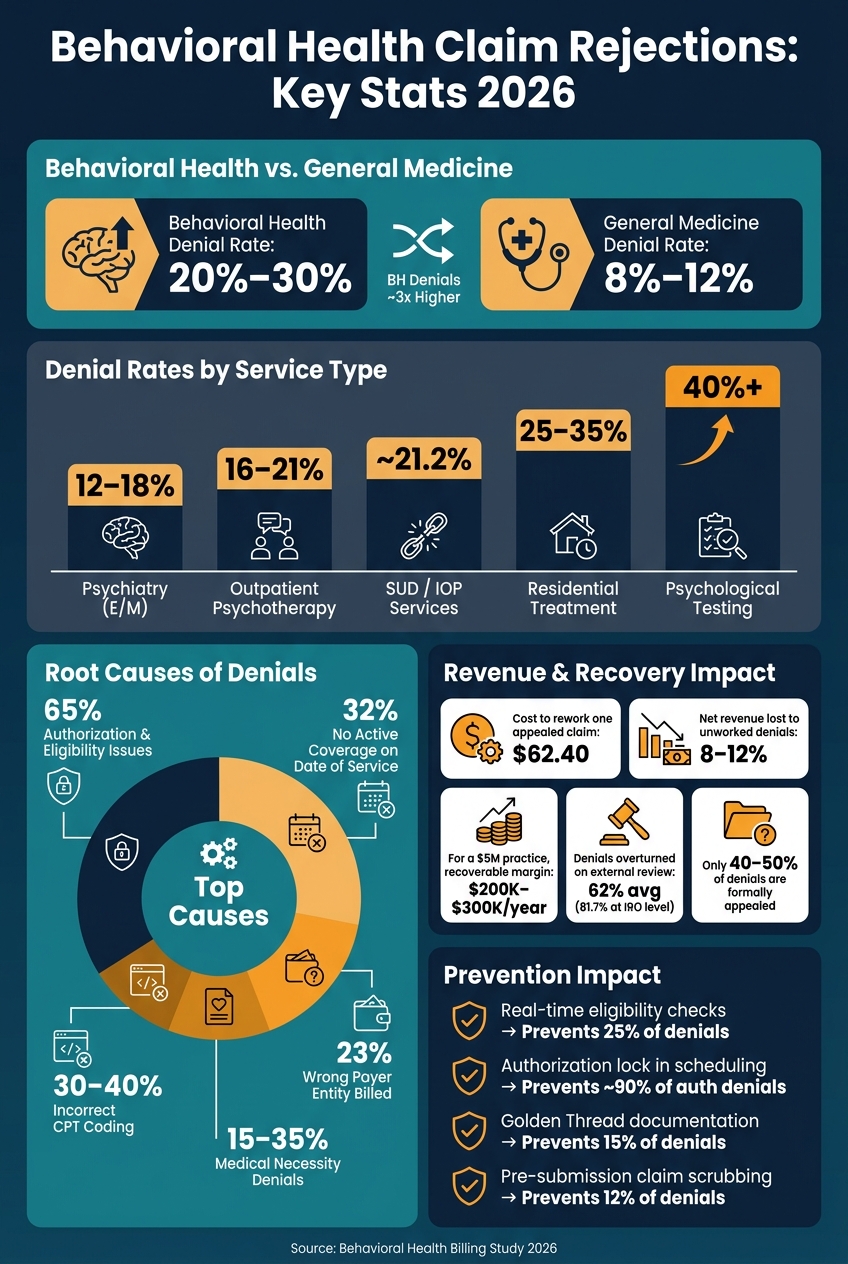
Top-line denial rates don’t tell the whole story. In behavioral health, the bigger problem sits in certain payer types and service lines, where claims fail far more often. The biggest losses tend to pile up around payer rules, high-acuity care, and front-end edits.
The rework cost adds up fast too. On average, one appealed behavioral health claim costs $62.40 to rework. And here’s the frustrating part: external review overturns most denials, reversing about 62% on average, with 81.7% reversed at the Independent Review Organization (IRO) level [6].
Denial rates shift based on payer type, care setting, and service category.
Medicare Advantage (MA) plans stand out as the highest-risk payer segment. MA denial rates topped 17% in 2026 – more than double the rate of traditional Medicare – as private insurers pushed prior authorization into categories that had been exempt and used tighter medical-necessity criteria [5]. ACA Marketplace payers such as Oscar Health (25%), Molina Healthcare (22%), and Cigna (21%) also post some of the highest reported in-network denial rates [2]. Out-of-network claims face the steepest odds at about 36% [2].
For providers, that means one payer may approve a service with no trouble, while another rejects that same claim.
Higher-acuity services also see the highest denial rates. The pattern shows up clearly in the service lines below:
Specialty / Service | Denial Rate (2026 Est.) | Primary Drivers |
|---|---|---|
Psychiatry (E/M) | 12–18% [6] | Prior authorization timing |
Outpatient Psychotherapy | 16–21% [6] | Medical necessity, session caps |
IOP Services | ~21.2% [2] | Level-of-care disputes, utilization review timing |
Residential Treatment | 25–35% [6] | Prior authorization complexity |
Psychological Testing | 40%+ [6] | Prior authorization not obtained |
Payers are also using AI to flag outlier coding patterns, duplicated notes, and missing medical-necessity language. That can lead straight to automated denials [6].
Rejection Driver | Billing / Cash-Flow Impact | Prevention Workflow |
|---|---|---|
CO-197 – Missing or expired authorization | High; often unrecoverable if retro-auth fails [6] | Flag when 75% of authorized sessions are used; implement auth-lock in scheduling [6] |
CO-50 – Medical necessity denial | Moderate; requires senior clinical staff time to appeal [6] | Document functional impairment using PHQ-9 and GAD-7 scores; apply the “Golden Thread” standard [6] |
CO-29 – Timely filing violation | Critical; usually unrecoverable after the filing window closes [6] | Verify behavioral health carve-outs at intake [6] |
CO-97 – Bundling or modifier error | Automated claim scrubbing for Modifier 25 on combined E/M and therapy sessions [6][3] | |
Eligibility gaps | High; accounts for 26% of all denials stemming from intake data errors [2] | Run real-time eligibility checks 72 hours before every appointment [6] |
Telehealth POS / modifier errors | Immediate technical rejection; requires manual rework [9][2] | Maintain a payer-specific telehealth coding matrix [9] |
Taken together, these denial patterns keep circling back to the same trouble spots: authorization and documentation.
The patterns above point back to two problems at the front end: coverage and authorization checks, plus weak documentation.
Most behavioral health claim issues start before the claim is ever sent. In fact, authorization and eligibility failures make up about 65% of all behavioral health denials [11].
One of the most common mistakes happens at intake. A practice may verify medical benefits, but skip checking whether behavioral health benefits are carved out to a separate Managed Behavioral Health Organization (MBHO). That gap can cause an instant rejection.
The numbers make the problem plain:
32% of denials are tied to no active coverage on the date of service [11]
23% are linked to billing the wrong payer entity [11]
Authorization issues tend to follow the same pattern. Many payers now use 7- to 14-day authorization windows for Residential, PHP, and IOP. So if renewals are late, denials can pile up fast. The CMS-0057-F rule, already in effect as of January 1, 2026, adds more pressure here. It requires decisions on standard prior authorization requests within 7 calendar days and urgent requests within 72 hours [7].
Once coverage is confirmed, the next trouble spot is documentation.
After a claim clears eligibility and authorization, documentation and coding usually become the next source of trouble. Medical necessity denials account for 15% to 35% of behavioral health claim rejections [4][10]. In many cases, the root issue is simple: the notes are too thin to support the treatment billed.
Behavioral health reimbursement leans heavily on the clinical story in the chart. That means the record needs to show symptom severity, functional impairment, and the reason for treatment. One Phoenix group practice cut 90837 denials from 19% to 4% in 60 days after updating its EHR templates to require three medical-necessity indicators [13].
Coding errors create another major risk. Incorrect CPT coding affects an estimated 30% to 40% of rejected behavioral health claims [12]. The main psychotherapy codes – 90832, 90834, and 90837 – are time-based. If the documented start and stop times do not line up with the code billed, the claim can be rejected. Payers are also using AI to flag providers who bill 90837 again and again without charting that backs it up [14].
Telehealth billing has its own traps. Modifier rules change by payer, and the wrong modifier or place of service can lead to repeat denials across many claims. For Medicare, missing the six-month and 12-month in-person visit windows leads to automatic denial with no appeal path [14].
These front-end mistakes are what fuel the rework and cash-flow strain discussed next.
Once claims fail front-end edits, the problem gets more expensive. What started as denial prevention turns into rework, aging A/R, and added audit exposure. Front-end mistakes create more manual work, slow down cash flow, and increase compliance pressure.
A rejected outpatient therapy claim can cost $62.40 to rework, and A/R that ages past 60 days puts pressure on cash flow. If claims sit unresolved for more than 90 days, they often end up as write-offs [6][1]. The hit doesn’t stop there. Unresolved denials can also trigger pre-payment review or focused audits [13].
For behavioral health practices, the loss can get steep fast. Many lose 8% to 12% of net revenue to denials that are never reworked because staff simply don’t have the time to get to them [8]. For a practice bringing in $5 million a year, recovering even half of that leakage adds back $200,000 to $300,000 in annual margin [8].
The biggest losses usually come from the same trouble spots: intake, authorization, coding, and follow-up.
Missed carve-outs and bad intake data lead to instant rejections. Expired authorizations create denials once services go past the approved session count [1][4]. And the back end is often where temporary problems turn into permanent losses. One two-provider psychology practice with $85,000 per month in billed charges and a 20% denial rate was losing about $10,200 per month – or $122,400 per year – because 60% of its denials were never worked or appealed [13]. On top of that, the average behavioral health practice formally appeals only 40% to 50% of denials, which means the rest often age into write-offs [6].
The table below shows the most common breakdown points and their impact:
Breakdown Point | Common Root Cause | Financial/Operational Impact |
|---|---|---|
Front-End | Missed carve-outs and inaccurate intake data | Immediate rejections before adjudication [2] |
Authorization | Expired or untracked authorizations | Claims denied once services exceed approved session count [4] |
Back-End | Denials left unworked | 40%–50% of denials never appealed; remainder ages into write-offs [6] |
High denial volume tends to feed on itself. Billing teams get pulled into fixing yesterday’s denials instead of checking today’s claims, so more front-end errors slip through and create even more rework. That’s why front-end prevention and automated follow-up become the next place to focus.
Most of these rejections can be avoided if you catch problems before the claim goes out.
Eligibility gaps drive 25% of all mental health denials [10]. A simple fix is to run real-time eligibility checks 72 hours before each visit. That gives your team time to spot coverage lapses and behavioral health carve-outs before they turn into denied claims.
Authorization problems need a hard stop in the workflow. Don’t let staff schedule visits without a valid authorization number in Box 23. And when an auth is close to running out, send renewal requests before the last 2–3 sessions expire [6][4].
Documentation is another big pressure point. Use the Golden Thread standard so each diagnosis connects to a specific treatment goal, the intervention used, and a measurable outcome. For example, document results like “PHQ-9 decreased from 18 to 10”. For time-based codes such as 90837, include exact start and stop times. If you don’t, you risk lower-level coding [6][13].
These controls line up with the three main failure points discussed above:
Prevention Strategy | Denial Cause Addressed | Impact |
|---|---|---|
Real-time eligibility check | Eligibility/Coverage Issues | Prevents 25% of denials [10] |
Authorization lock in scheduling | Missing/Expired Authorization | Prevents ~90% of auth denials [6] |
Golden Thread documentation | Medical Necessity Failures | Prevents 15% of denials [10] |
Pre-submission scrubbing | Coding/Modifier Errors | Prevents 12% of denials [10] |
Start/stop time tracking | Time-Based Coding Mismatches | Prevents automatic lower-level coding [15] |
Automation helps by flagging mistakes before submission. BHRev‘s behavioral health RCM platform automates eligibility verification, claim scrubbing, and denial management to cut preventable rejections.
A claim rejection happens when a claim has data or formatting errors, so it gets stopped before processing. The claim is sent back to the provider to fix and submit again.
A denial happens after the claim is processed and the payer formally refuses payment. Denials are usually more complex and often need an appeal.
Intensive outpatient programs (IOP), partial hospitalization programs (PHP), and telehealth visits get denied more often than most providers would like.
The usual causes are pretty familiar:
Eligibility or coverage problems
Missing or expired prior authorization
Medical necessity disputes
Coding mistakes, such as mismatched CPT and ICD-10 codes
It’s often not one big issue. More often, it’s a small paperwork miss, a coverage gap, or a mismatch between what was billed and what the payer expects to see.
Reduce claim denials by stopping problems before a claim goes out, not by fighting them after the fact. That’s the idea behind BHRev’s AI-powered revenue cycle management. It helps teams check eligibility, clean up claims, and stay on top of prior authorizations before small issues turn into lost revenue.
Here’s what that looks like in practice:
Verify eligibility before every appointment
Track authorizations, session limits, and renewal deadlines
Ensure documentation supports medical necessity
Review claims for coding accuracy and payer-specific edits
One email a month, no fluff. Unsubscribe anytime.