
Home / 7 Ways to Reduce Claim Denials in Behavioral Health

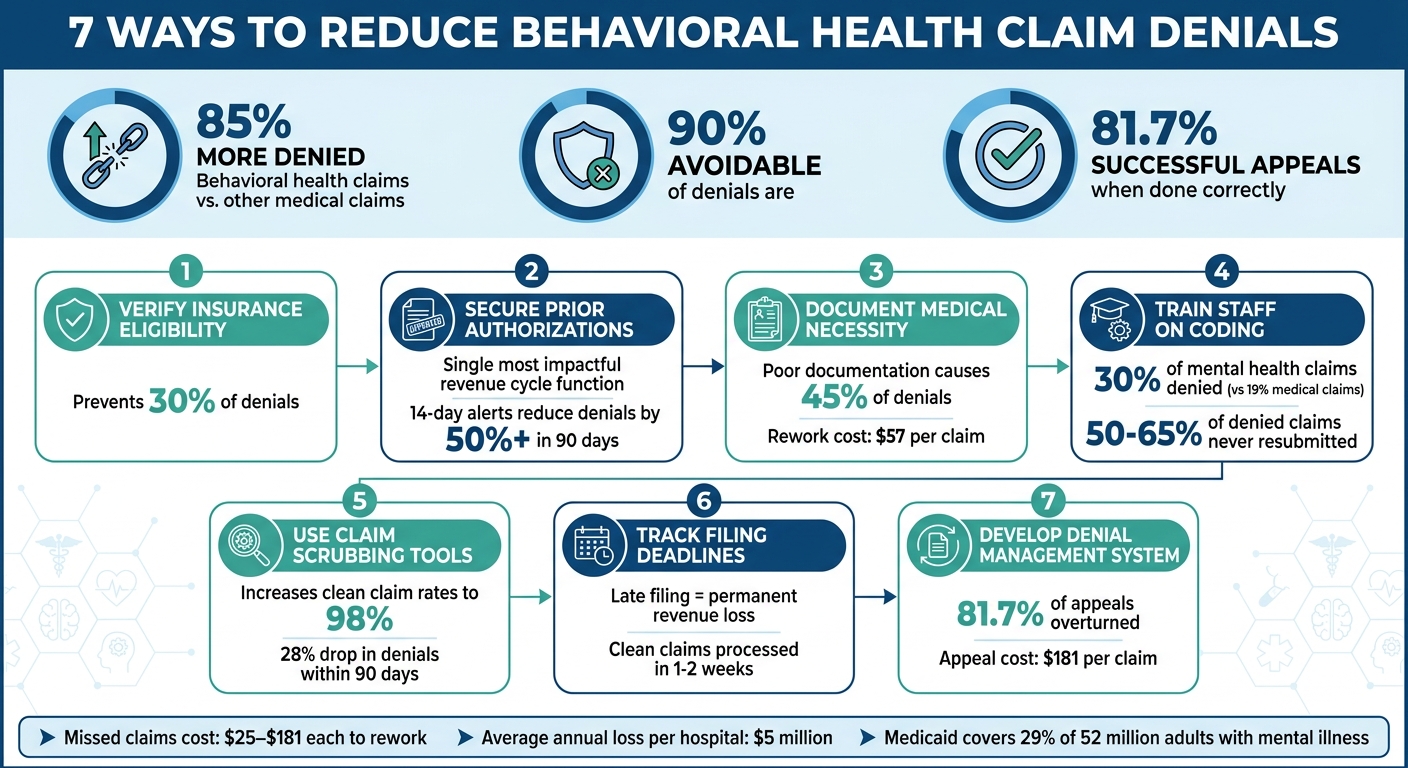
Behavioral health claims are denied 85% more often than other medical claims, leading to lost revenue and increased administrative work.
But the good news? Up to 90% of these denials can be avoided.
Here’s how claim denials can be avoided:
Verify Insurance Eligibility: Confirm benefits, session limits, and required authorizations before services. This step prevents 30% of denials.
Secure Prior Authorizations: Obtain approvals early, especially for high-cost treatments like residential care or IOPs.
Document Medical Necessity: Ensure clear, detailed notes link diagnoses to treatments. Poor documentation causes 45% of denials.
Train Staff on Coding: Proper coding reduces errors. Modifier mistakes and time-based code issues are common causes of denials.
Use Claim Scrubbing Tools: Automated tools catch errors before submission, increasing clean claim rates to 98%.
Track Filing Deadlines: Late submissions often mean permanent revenue loss. Stay ahead with automated reminders.
Develop a Denial Management System: Track, analyze, and appeal denials effectively. Over 81% of appeals succeed when done correctly.
These steps not only reduce denials but also improve cash flow and operational efficiency. Missed claims can cost practices $25–$181 each to rework, so prevention is key.
Checking insurance details before the first appointment is crucial. Behavioral health benefits are often handled by separate administrators like Optum, Magellan, or Beacon Health Options. Skipping this step can lead to claims being misrouted and denied automatically.
Real-time insurance verification during scheduling helps catch common issues, such as inactive policies, visit limits, or missing authorizations. These factors account for about 30% of mental health claim denials [1][4].
Contact provider services: Ensure the call is logged under your practice’s NPI and request detailed benefit information.
Ask key questions: Confirm if the policy is active, whether outpatient mental health services are covered, and the patient’s financial responsibilities (copays, deductibles, and coinsurance).
Check specific details: Verify annual session limits and whether prior authorization is needed for the CPT codes you plan to use.
Document everything: Record the date of the call, the representative’s name, and the reference number for future reference.
These steps also help ensure your practice meets payer-specific requirements.
Plan Type | Out-of-Network Coverage | Key Verification Requirement |
|---|---|---|
HMO | Generally None | Must use providers within the network |
PPO | Usually Available | Confirm higher out-of-pocket costs and deductibles |
EPO | None | Functions like a PPO but excludes out-of-network benefits |
Medicaid eligibility can change frequently, making it essential to verify coverage before every visit. For substance use disorder treatments, patient consent must be obtained under 42 CFR Part 2 before sharing treatment details. Additionally, government payers often require specific code sets and provider-level modifiers (like HN, HO, or HP) that differ from commercial plans. Double-check these to avoid automatic rejections.
Clean claims that have been verified process faster, typically within one to two weeks. This reduces days in accounts receivable and avoids costly appeals, which average $181 per claim [5]. Addressing eligibility issues upfront is critical, as 50% to 65% of denied claims are never resubmitted [2].
Prior authorization is a critical step where insurance approval is obtained before delivering services. In behavioral health, this typically applies to inpatient care, intensive outpatient programs (IOPs), residential treatments, and therapy sessions exceeding a specified number. Skipping this step can lead to automatic denials, which are notoriously challenging to overturn after services have already been provided.
Authorization issues are a leading cause of claim denials, especially for high-cost services like residential care or substance use disorder treatments. Securing prior authorizations ensures claims are processed smoothly, often resulting in payments within one to two weeks. In fact, up to 90% of behavioral health claim denials can be avoided by taking this proactive step [1]. This approach works hand-in-hand with eligibility verification to streamline the revenue cycle.
To minimize denials, behavioral health providers should integrate prior authorization checks into their workflows early – ideally during scheduling rather than waiting until the billing phase. Here are some practical steps:
Set up multi-stage alerts to monitor authorization expiration, such as reminders at 14, 5, 3, and 1 day(s) before the expiration date [8].
Use your EHR system to track remaining approved units or sessions to ensure you don’t exceed authorized limits.
Check whether mental health benefits are managed separately, as these often have distinct authorization rules.
For ongoing care, start concurrent reviews 7–10 business days before the current authorization expires. If a new approval isn’t received within three business days after the expiration, escalate the issue directly with the payer.
Starting January 1, 2026, payers will be required to respond to urgent prior authorization requests within 72 hours and standard requests within 7 calendar days, down from the previous 14-day limit [9]. Medicaid, in particular, often demands detailed tracking of units and expiration dates to meet state-specific requirements [2]. For substance use disorder treatments, ensure your clinical documentation aligns with ASAM criteria, as many state Medicaid programs use this standard for determining levels of care [10].
If you operate a residential facility with more than 16 beds, check whether your state has a Section 1115 SUD waiver in place to bypass the IMD (Institution for Mental Diseases) exclusion [10]. Keep in mind that Medicaid serves as the payer of last resort, meaning you must secure authorization from any primary insurer before billing Medicaid [10].
Introducing 14-day expiration alerts can slash authorization-related denials by over 50% within just 90 days [2]. Properly authorized claims avoid the costly and time-consuming appeals process. Since 50% to 65% of denied claims are never resubmitted [2], preventing these denials upfront is essential for protecting revenue and maintaining steady cash flow.
Once you’ve verified benefits and secured authorizations, the next step is ensuring accurate documentation. This is essential for avoiding denials in behavioral health claims. Payers need to see a clear connection between the diagnosis, treatment plan, specific interventions, and measurable outcomes [12]. If any part of this chain is missing, the claim is likely to be denied. Unlike medical claims that can rely on lab results or imaging, behavioral health claims depend entirely on clinical judgment. That makes your progress notes the primary focus during audits.
Each progress note should clearly outline symptoms, interventions, and the patient’s response – general or vague statements won’t cut it. For time-based psychotherapy codes (90832, 90834, 90837), you need to document exact start and stop times. Estimations could lead to down-coding, such as shifting from 90837 (60 minutes) to 90834 (45 minutes), which means a lower reimbursement rate [12]. Poor or incomplete documentation is responsible for about 45% of behavioral health claim denials [7], and reworking a denied claim costs an average of $57 [11].
Use EHR templates that prompt clinicians to include key details like diagnosis-to-intervention links, functional impairments, and patient responses.
Complete documentation within 24–48 hours of each session while details are still fresh. Avoid copying and pasting notes, as payers now use AI tools to detect repeated text, which can lead to instant “CO-50” (Not Medically Necessary) denials [12].
Incorporate standardized tools like PHQ-9 or GAD-7 to provide objective data instead of relying on subjective descriptions.
Tie every intervention to measurable goals in the treatment plan, and update those plans regularly to reflect ongoing necessity [6][12].
Medicaid and Medicare have detailed rules about what qualifies as medical necessity. Your documentation must demonstrate functional impairments, risk factors, and how your interventions address the specific needs of the patient [6][7].
For substance use disorder treatments, compliance with 42 CFR Part 2 federal privacy regulations is required by February 16, 2026 [11].
Treatment plans need to outline measurable goals, the types of interventions, service frequency, and expected outcomes. Progress notes must include the service date, start and end times, location, provider credentials, specific interventions, and the patient’s response [6]. With Medicaid covering 29% of the 52 million adults living with mental illness in the U.S. [4], adhering to these requirements is critical for maintaining your revenue stream.
Thorough documentation ensures your claims are processed quickly, often within one to two weeks, by keeping them in the automated adjudication process. Missing details can push claims into manual review, which slows the process and increases the risk of inconsistencies [2]. If claims are denied, 50% to 65% are never resubmitted [2][11], adding to lost revenue. While the cost to appeal a denial averages $181 [5], external reviews overturn 57% to 82% of appeals [12], showing that proper documentation upfront can prevent most denials. Fine-tuning your documentation practices is a key step in improving your revenue cycle efficiency.
After establishing solid documentation practices, the next step is ensuring your staff is well-trained in behavioral health coding. Even with detailed documentation, claims can still be denied if staff aren’t familiar with the specific coding rules for this field. Behavioral health billing operates under unique requirements compared to general medical practices, and coding errors contribute to the higher denial rates for these claims. Here’s the upside: about 90% of these denials can be avoided with proper training [1]. Clinicians need to document session details carefully, while billing teams must master modifiers, payer-specific rules, and time-based codes.
Training your staff on coding helps prevent rejections before they occur. When team members can accurately match service descriptions to the correct CPT, HCPCS, and ICD-10 codes, claims are more likely to pass smoothly through payer systems. Modifier errors, a common reason for behavioral health denials, are another area where training makes a big difference. For instance, using Modifier 95 for telehealth services or Modifier 25 for separate evaluation and management services can determine whether a claim gets paid or denied. Correctly applying POS codes is also critical; for example, billing an Intensive Outpatient Program (IOP) service with POS 11 (office) instead of the appropriate facility code will likely result in denial. In 2023, 30% of mental health claims were denied, compared to 19% for other medical claims [1][4]. Many of these denials stem from coding errors that could have been avoided with better training.
Tailor your training based on staff roles. Clinicians should focus on documentation specifics, such as recording exact start and stop times for psychotherapy sessions (codes 90832, 90834, 90837) rather than estimating. Billing teams need to understand license-level modifiers (HN, HO, HP) and payer-specific rules. Reviewing past claim denials can highlight common mistakes and provide real-world examples for training sessions. Use standardized checklists for major insurers to track billing guidelines, authorization requirements, and filing deadlines. Hold quarterly training sessions, especially after regulatory or policy changes. Since 50% to 65% of denied behavioral health claims are never resubmitted [2], investing in training upfront is far more efficient than managing appeals later. A solid coding foundation ensures smoother claims processing and sets the stage for further revenue cycle improvements.
Medicare now requires specific G-codes (G2067–G2074) for weekly bundled payments in Opioid Treatment Programs (OTPs), meaning staff cannot bill separately for individual counseling or drug tests within these bundles [13]. For Medicaid, staff must understand the “IMD exclusion”, which restricts federal Medicaid funds for facilities with more than 16 beds unless a Section 1115 waiver applies [13]. Many state Medicaid programs also require documentation aligned with American Society of Addiction Medicine (ASAM) criteria for determining substance use disorder levels of care [13]. When billing for both medical management (E/M) and psychotherapy, staff must document them as separate activities. The E/M code should be chosen based on the complexity of Medical Decision Making (MDM), not the total time spent [14]. Medicare has extended telehealth flexibilities for behavioral health through 2026, but this requires training on specific POS codes (02 vs. 10) and audio-only attestation requirements [13].
Properly trained staff can push claims into automated adjudication, where payments are typically processed within one to two weeks without manual review [2]. Coding mistakes, however, often lead to claims being flagged for manual review, slowing down the process and increasing the risk of denial. Appealing a denied claim costs an average of $181 [5], but 81.7% of appealed behavioral health denials are eventually overturned [2]. This demonstrates that most denials result from correctable coding issues rather than actual coverage problems. By reducing errors through training, you can avoid costly delays and streamline the revenue cycle, directly improving your organization’s financial performance.
After ensuring your staff is well-trained in coding, the next step is to identify and fix errors before claims leave your office. Claim scrubbing tools are designed to automatically scan claims for issues like missing modifiers, invalid CPT codes, and mismatched patient data. These tools also validate behavioral health-specific details, such as modifier 95 for telehealth services or session-duration codes like 90837 for 60-minute appointments, while flagging duplicate submissions [15][4].
Claim scrubbers enable same-day corrections, significantly reducing the chances of denials. For example, Tellica Imaging’s AI scrubbing platform led to a 28% drop in claim denials and a 22% reduction in operational costs within just 90 days [16]. Advanced scrubbers use “edit logic” to apply the 800–1,200 rules specific to Managed Care Organizations (MCOs), which are far stricter than the approximately 200 rules used in standard Fee-for-Service Medicaid [3]. These tools can increase clean claim rates to 98%, far above the national average of 85–90%. Considering the typical 30% denial rate and the average $5 million annual loss per hospital due to denials, the impact of scrubbing tools is clear [16][22][1][4][6].
To maximize efficiency, integrate scrubbing tools directly with your Electronic Health Record (EHR). This allows the system to pull data immediately after encounters are locked [15][16]. Opt for behavioral health-specific software instead of generic EHR templates, as these are tailored to handle group therapy, dual diagnoses, and bundled services [15]. Configure the system to account for payer-specific rules and “Chargemaster” logic, minimizing errors tied to unique insurer requirements [3][16].
Set up authorization alerts to prevent scheduling without valid prior authorization [17], and use real-time dashboards to address flagged issues before they become aged receivables [18].
By aligning data elements with clinical criteria checklists like InterQual or MCG, automated tools can validate claims more effectively. These steps ensure your claims are both compliant and efficient, streamlining operations while meeting regulatory standards.
Scrubbing tools must adapt to the specific coding and modifier requirements of federal, state, and plan-level guidelines. For Medicaid, this includes varying state codes for services like Intensive Outpatient Programs (e.g., H0035) or skills training (e.g., H2014) [20][21]. For Medicare, compliance involves validating documentation for medical necessity and clinical justification [21][7]. Automated scrubbing also helps practices adhere to updated coding standards and price transparency rules [19].
Keep in mind, correcting and resubmitting a single denied claim costs about $25, and preventable billing errors can result in annual losses averaging $150,000 per practice [20][7].
Automated scrubbing significantly speeds up the claim process by reducing “days in AR” (Accounts Receivable) and minimizing time spent on manual corrections or appeals [15][16]. Many MCOs now use auto-adjudication engines to process 80–88% of clean claims without human involvement [3], meaning scrubbed claims are typically resolved within one to two weeks. In 2025, 68% of providers reported that submitting clean claims had become more challenging, highlighting the critical role of scrubbing tools in maintaining cash flow [19]. By automating error checks, practices can cut down AR days and avoid costly appeals, improving overall revenue cycle efficiency.
After fine-tuning eligibility checks and automating claim scrubbing, keeping track of filing deadlines becomes essential to avoid losing revenue. Missing a payer’s deadline often means forfeiting payments permanently. Unlike coding errors that can be corrected and resubmitted, denials due to late filing rarely allow for recovery [22]. For mental health providers, this is particularly concerning since 30% of claims in this specialty face denial – compared to 19% for other medical fields – with late filing being a major cause [1]. Adding to the challenge, many denied claims never get resubmitted because staff often lack the time or tools to manage outstanding claims before deadlines pass [2]. This makes a solid system for tracking deadlines critical to protecting your revenue.
Staying on top of deadlines ensures claims are processed promptly, often leading to payment within one to two weeks [2]. Considering mental health claims are denied 85% more frequently than those for medical and surgical services [2], managing deadlines becomes even more crucial. With research showing that up to 90% of denied behavioral health claims could be avoided with better processes [1], tracking deadlines can have a huge impact on your practice’s financial health.
Here’s how you can streamline deadline management:
Leverage software alerts: Set up automated reminders in your EHR or billing system. For instance, configure alerts for 14 days before authorizations expire to prevent providing services outside approved timeframes [12]. Track remaining units and expiration dates, especially for Medicaid and managed care plans, which often have unique rules.
Train front-desk staff: Have them check insurance cards for behavioral health carve-out logos (e.g., Optum, Magellan, Evernorth, Beacon) to ensure claims are routed correctly [12]. Also, perform eligibility checks 72 hours before appointments to catch any coverage issues [12].
Submit electronically: Use clearinghouses like Claim MD or Waystar to avoid delays from paper submissions. These platforms provide immediate acceptance reports, helping you address rejections promptly. Review rejection reports every 24–48 hours, as rejected claims don’t count toward timely filing deadlines [23].
“Claims sitting in a rejected state do not count toward timely filing deadlines, often resulting in a total loss of revenue if not caught within 24–48 hours.” – Arj Fatima, Senior RCM Strategist, Billing MedTech [23]
Monitor accounts receivable: Regularly check for balances aging beyond 60 or 90 days. Monthly billing reviews should include denial trend analysis to identify payers with shorter filing windows that may need prioritized submissions [22].
These steps, blending automation and manual follow-ups, help ensure compliance with payer-specific requirements and reduce preventable denials.
Different payers have varying filing and appeal windows, so knowing these timelines is key. For example, Medicare allows 120 days for Level 1 redeterminations, while UnitedHealthcare/Optum only allows 65 days from the explanation of benefits (EOB) date [12]. Medicaid deadlines vary by state, typically ranging from 30 to 90 days. Some private insurers, like Anthem and Cigna, offer up to 180 days. Behavioral health carve-out payers, such as Magellan, have their own specific deadlines [12][23].
Payer / Program | Filing/Appeal Window | Typical Processing Time |
|---|---|---|
Medicare (Level 1) | 120 days from RA date | 60 days |
UnitedHealthcare / Optum | 65 days from EOB | 30 days |
Aetna / Cigna / Anthem | 180 days from EOB | 30 days |
Humana (Medicare Advantage) | 65 days from EOB | 30 days |
Medicaid | 30–90 days (varies by state) | 90–120 days |
If you receive a CO-29 denial (indicating the timely filing window has expired) because of a payer’s delay, use your clearinghouse 277 acceptance report as proof of the original submission to support your appeal [12].
Delays in filing turn potentially recoverable revenue into permanent losses as claims exceed their payment windows [22]. By 2026, the average administrative cost to rework a denied behavioral health claim will hit $62.40, while simpler resubmissions cost between $25 and $35 [12]. The percentage of providers with denial rates above 10% rose from 30% in 2022 to 41% by 2025, highlighting the pressing need for better deadline management [22]. Aim to keep accounts receivable under 50 days, as exceeding 60 days often signals breakdowns in front-end processes. Proactively tracking deadlines minimizes manual corrections and appeals, helping maintain steady cash flow.
Even with the best pre-submission practices, claim denials can still happen. That’s why having a clear and efficient denial management system is so important – it helps recover revenue and keeps billing operations running smoothly. The truth is, many denied claims never get challenged, even though 81.7% of appealed denials are eventually overturned [2]. By implementing a structured denial management workflow, you can protect your revenue while making your billing process more efficient.
A solid denial management process builds on strategies like timely submissions and accurate coding, offering an extra layer of protection for your revenue. By carefully analyzing CARC and RARC codes, you can pinpoint why claims are being rejected. Categorizing denials – whether they stem from authorization issues, coding errors, documentation gaps, eligibility problems, or credentialing mistakes – can uncover patterns. For instance, you might find that certain payers demand specific documentation or that some staff members need additional training. This insight allows you to address the root causes, such as intake verification errors or provider coding issues, before they lead to more denials.
The impact is clear: up to 90% of denied claims are considered avoidable when effective processes are in place [1]. By aligning denial categories with targeted solutions, you can reduce future rejections and steadily improve your clean claim rate.
Start with a denial log to track key details like the denial date, payer, claim amount, CARC/RARC codes, and the reason for denial. Consistency is critical – every denied claim should be logged and reviewed.
Conduct monthly billing reviews to analyze trends and identify patterns. For example, if one clinician frequently gets CO-50 denials (“not a covered service”), they might need training on verifying benefits before scheduling appointments. Similarly, if a specific Medicaid managed care plan generates a high volume of denials, check whether authorization numbers or specific documentation requirements are being overlooked.
Follow formal appeal procedures to recover lost revenue. For out-of-network claims, consider negotiating both before and after payment to address low reimbursements. Automating ERA posting through your EHR system can also help by reducing manual errors and speeding up denial identification [2]. To measure progress, monitor metrics like your Clean Claim Rate (aim for 95%+ [22]) and First-Pass Resolution Rate.
Claims tied to government programs like Medicare and Medicaid come with strict documentation rules and tight appeal deadlines. Medicare, for example, requires documentation that clearly demonstrates medical necessity, including patient symptoms, severity levels, functional impairments, and detailed mental status exam findings [7]. Notes must justify the need for “skilled therapy” by showing consistent functional improvement; vague or incomplete documentation can lead to denials during audits [1].
Medicaid rules vary by state and are frequently updated due to changing federal and state regulations [4][7]. Since Medicaid covers 29% of the 52 million adults living with a mental illness [4], getting these claims right is essential for the financial health of behavioral health practices. For substance use disorder (SUD) treatment, compliance with 42 CFR Part 2 is critical, including the use of specific consent forms to meet federal privacy standards [6].
The CMS guidelines on appeals and grievances provide a federal framework for the appeals process [24]. Deadlines for appeals range from 30 to 180 days depending on the program, and missing these deadlines can mean losing the right to appeal permanently [7][24]. Additionally, payers often use clinical criteria, such as those from the American Society of Addiction Medicine (ASAM) or InterQual, to assess medical necessity [24].
Common CARC Code | Meaning | Recommended Action |
|---|---|---|
CO-4 | Service not covered as billed | Review CPT codes or modifiers for mismatches [2] |
CO-50 | Not a covered service | Check benefit verification; service may not be in patient’s plan [2] |
CO-97 | Already adjudicated | Identify and remove duplicate submissions [2] |
PR-204 | Service not covered by plan | Confirm coverage details before resubmission [2] |
Ignoring denial patterns can slow down your revenue cycle, pushing accounts receivable balances past 60 or 90 days and increasing the likelihood of write-offs [22]. By 2026, the average cost of reworking a denied behavioral health claim is expected to hit $62.40, while simpler resubmissions could cost between $25 and $35 [12]. With 41% of providers now reporting denial rates above 10%, up from 30% in 2022, the financial strain of unmanaged denials is growing [22]. Systematic tracking and timely appeals can recover lost revenue and keep your revenue cycle on track.
A well-rounded revenue cycle strategy connects front-end verification, mid-cycle accuracy, and back-end recovery into one cohesive system. The seven strategies discussed earlier create a clear roadmap, ensuring claims are traceable at every stage [12].
This approach isn’t just about improving efficiency – it’s about cutting costs and safeguarding revenue. Consider this: resolving a single denied claim can cost anywhere from $25 to $62.40. With behavioral health denial rates hovering between 15% and 25% – a stark contrast to the 8% to 12% seen in general medicine – these denials can translate into major financial setbacks [12].
The billing landscape is becoming increasingly intricate. Payers are leveraging AI and machine learning to identify cloned text in progress notes and automatically down-code time-based services [12]. They’re also applying Non-Quantitative Treatment Limitations (NQTLs) using stricter medical necessity criteria. Add the complexities of telehealth, where even a small error like a missing modifier or incorrect Place of Service code can lead to immediate denial, and it’s clear why practices need to move from passively submitting claims to actively managing their revenue cycle [12][2].
Solutions like BHRev make it easier for behavioral health providers to incorporate these strategies into their workflows without increasing administrative burdens. Features such as “auth-lock” protocols can reduce authorization-related denials by up to 90%, while real-time eligibility checks done 72 hours before appointments help prevent issues before they arise [12]. Additionally, systems that create a continuous feedback loop for denial management can help practices achieve over 95% clean claims, maintain denial rates below 10%, and secure net collection rates above 96% [12][4][25]. This kind of efficiency not only protects revenue but also frees up providers to focus on what truly matters – patient care. By embracing these integrated strategies, behavioral health providers can streamline their billing processes and ensure financial stability while prioritizing their patients.
When tackling behavioral health claim denials, start by addressing authorization issues, coding errors, and documentation deficiencies. These are frequent culprits behind denied claims. Resolving them early can help reduce denial rates and streamline the revenue cycle.
Payers need clinical documentation that clearly demonstrates the medical necessity of services. This means including detailed progress notes, proof of measurable improvements in the patient’s condition, and specific reasons for the care provided. To minimize denials, ensure all records are thorough and meet the specific guidelines set by the payer.
To minimize losses from timely filing, it’s crucial to tackle claim issues as soon as possible. Start by ensuring every submission is both accurate and complete. Set up a system to track denied claims and resubmit them quickly – many claims never get resubmitted, which can lead to missed reimbursements. Regularly check claim details for common errors, such as using incorrect modifiers or submitting claims with expired authorizations. Using denial management tools and adhering to payer-specific requirements can also help you address rejections efficiently and avoid delays in filing.
One email a month, no fluff. Unsubscribe anytime.