
Home / Behavioral Health Credentialing Process Steps

Behavioral health credentialing is the process that ensures providers meet qualifications like licensing, certifications, and malpractice standards to bill insurance and Medicaid. Without it, providers can’t receive reimbursements for in-network services. The process involves three main levels: individual clinicians, facilities, and programs, with timelines ranging from 60 to 180 days depending on the payer.
Key Steps in Credentialing:
Preparation: Gather essential documents (licenses, NPI, Tax ID, insurance, etc.).
Applications: Update profiles on platforms like CAQH ProView, Medicare PECOS, and state Medicaid portals.
Payer Selection: Choose payers based on license type and network needs.
Verification: Payers verify credentials, review applications, and approve contracts.
Enrollment: Set up billing systems post-approval to begin claims processing.
Avoid Common Mistakes:
Keep profiles updated, especially CAQH (re-attest every 120 days).
Ensure taxonomy codes match services provided.
Track expiration dates for licenses and malpractice insurance.
Credentialing gaps can halt payments, so tools like BHRev can automate tracking and prevent claim denials. Staying proactive and organized is crucial for smooth operations.
Getting organized before starting the credentialing process can save you a lot of time and frustration. Start by confirming all the required credentials and gathering the necessary documents ahead of time.
Before applying, ensure you meet these basic requirements:
An active, unrestricted state license for the state where you practice.
A National Provider Identifier (NPI).
A Tax ID or Employer Identification Number (EIN).
Additionally, most commercial payers require professional liability insurance. For prescribers, the minimum coverage is usually $1 million/$3 million, while for other clinicians, it’s $1 million/$1 million. However, states like Florida and Texas may have different requirements.
Here’s a quick breakdown of NPIs:
Type 1 NPI: Identifies the individual clinician.
Type 2 NPI: Identifies a group practice or organization.
If you’re billing under a group, you’ll need both. Keep in mind, if you’re transitioning from a group to solo practice, you’ll need to go through full re-credentialing since payer contracts are tied to the group’s Tax ID.
Behavioral health facilities have additional steps. Along with standard credentials, they need a state facility license and accreditation from organizations like CARF or The Joint Commission. If the facility offers Medication-Assisted Treatment (MAT), SAMHSA certification is required before starting the credentialing process.
To streamline your applications, create a digital folder with all your essential credentialing documents. This will make it easier to access everything you need for every application.
|
Document Category |
What to Include |
|---|---|
|
Personal/Professional |
CV (covering the last 5–10 years), diplomas, transcripts, board certifications |
|
Identification |
Type 1 NPI, Type 2 NPI (if applicable), Tax ID/EIN, W-9 |
|
Legal/Regulatory |
State license, DEA registration (for prescribers), state facility license |
|
Insurance/Safety |
Malpractice insurance certificate, work history (explain gaps), reference letters |
|
Facility/Program |
CARF or Joint Commission accreditation, SAMHSA certification, program descriptions |
Be sure to explain any gaps longer than 30 days in your employment history, as payers may flag these. Also, check new clinicians against the OIG and SAM exclusion lists before adding them to your team. If a flagged individual is found, it can halt the entire enrollment process.
Once your documents are ready, double-check that your profiles are updated on all necessary credentialing portals.
These three platforms are essential for credentialing:
CAQH ProView
This is the primary starting point for most providers. Over 1.4 million providers use CAQH, and its data is used in about 75% of credentialing transactions. Keeping your CAQH profile complete and up-to-date can speed up the process by 30–45 days. Remember to re-attest your profile every 120 days; if it lapses, your profile becomes invisible to payers, leading to claim denials.
Medicare PECOS
This system handles federal Medicare enrollment. Individual provider enrollment usually takes 30–60 days, while facility enrollment can take over 90 days.
State Medicaid Portals
Each state has its own Medicaid portal. Typically, you must enroll in the state’s fee-for-service system before joining Medicaid Managed Care Organization panels. For example, UnitedHealthcare/Optum Behavioral Health enrollment is managed through Optum’s Provider Express portal.
Lastly, ensure your legal name matches across all platforms – CAQH, NPPES, and your state license. Even small differences, like “Robert J. Smith” versus “Bob Smith”, can cause verification issues. Also, confirm that your Healthcare Provider Taxonomy Code in NPPES accurately reflects your services. For example, clinical social workers should use 1041C0700X, while SUD rehabilitation facilities should use 324500000X. Mismatches here can cause claim rejections.
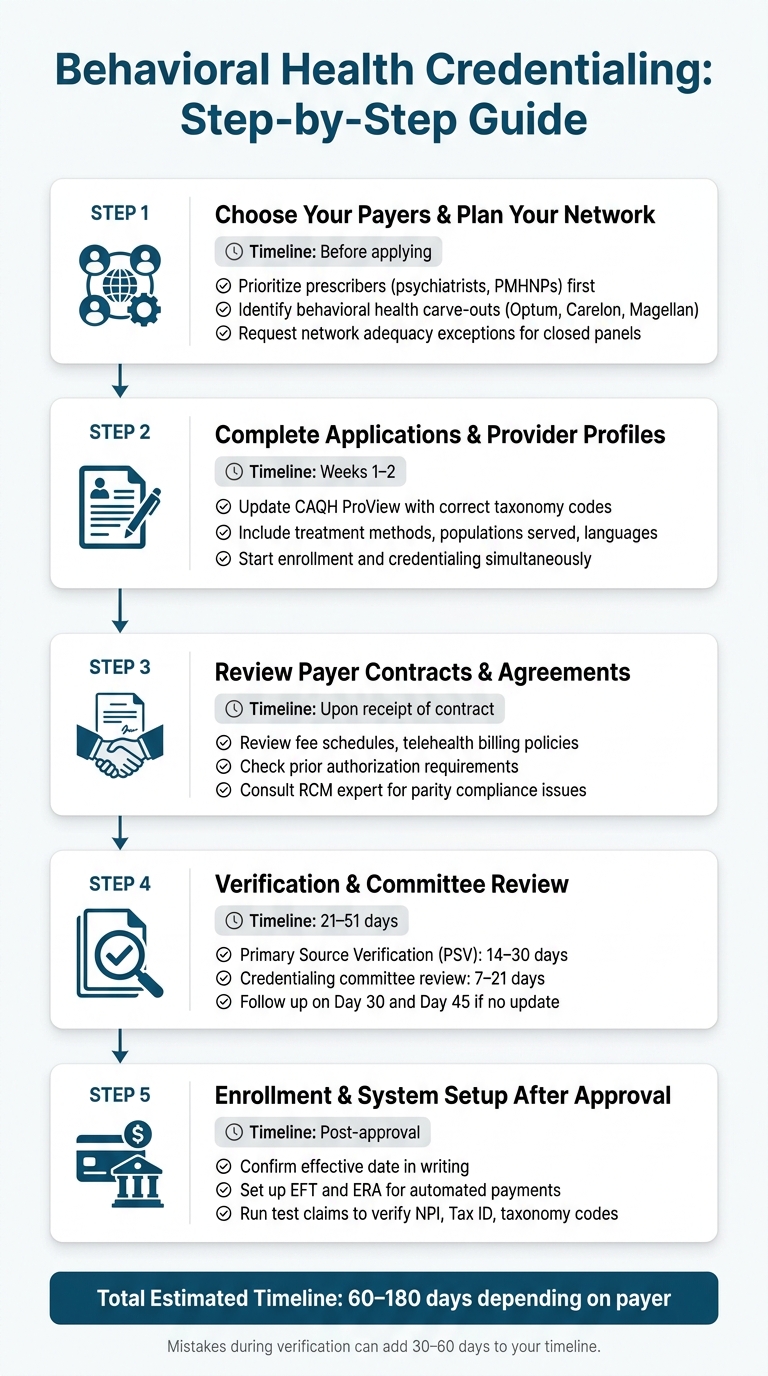
With your documents in order and online profiles updated, it’s time to dive into the actual credentialing process. Each step builds on the one before it, so keeping track of deadlines and details is more important than you might think.
Start by deciding which insurance payers you want to work with. This isn’t about casting the widest net – it’s about being deliberate. Credentialing requirements differ depending on your license type. For instance, some commercial payers credential Licensed Clinical Social Workers (LCSWs) but exclude Licensed Professional Counselors (LPCs) or Licensed Marriage and Family Therapists (LMFTs) in particular states [2].
Focus on credentialing prescribers first. Psychiatrists and Psychiatric Mental Health Nurse Practitioners (PMHNPs) generally have higher acceptance rates and faster processing times. Once they’re credentialed, it’s easier to add master’s-level clinicians to your group [2].
Be mindful of behavioral health carve-outs. Many commercial and Medicaid payers delegate behavioral health credentialing to Managed Behavioral Health Organizations (MBHOs) like Optum, Carelon (formerly Beacon), or Magellan. This means applications go through the MBHO rather than the main medical payer [1][2]. Here’s a quick look at some major payers and their processes:
|
Payer |
Estimated Timeline |
Management Entity |
|---|---|---|
|
UnitedHealthcare |
60–90 days |
Optum Behavioral Health |
|
90–120 days |
Carelon Behavioral Health |
|
|
60–90 days |
Internal |
|
|
60–90 days |
||
|
Medicare |
30–60 days |
PECOS (Individual) |
|
Medicaid MCOs |
60–120 days |
Varies by state/MBHO |
If a panel seems closed, don’t give up immediately. Panels often close based on provider-to-member ratios, even when patients face long wait times for appointments [2]. You can request a network adequacy exception by documenting patient delays and complaints in your area.
For telehealth providers, the process can be more complicated. Behavioral health is the most common telehealth specialty, with over 40% of visits delivered via telehealth as of 2026 [2]. Multi-state licensure and telehealth-specific attestations are often required before payers will even review your application.
Once you’ve chosen your payers, it’s time to move on to completing your applications and profiles.
After selecting your payers, the next step is completing applications. Accuracy is critical here – mistakes can delay your timeline by weeks or even months.
Make sure your CAQH ProView profile is fully updated and includes the correct taxonomy codes. Behavioral health applications often require additional details, such as treatment methods, populations served (e.g., children or adolescents), and languages spoken [1][2].
Keep in mind that enrollment and credentialing should happen simultaneously. Waiting to start enrollment until credentialing is finished will only delay your ability to bill.
Once your application is submitted, you’ll receive a contract if the payer decides to move forward. Review it carefully before signing. Pay attention to the fee schedule (reimbursement rates per CPT code), telehealth billing policies, prior authorization requirements, and documentation standards.
Behavioral health services are often carved out into separate agreements managed by MBHOs, with their own rules and reimbursement policies. If any part of the contract feels unclear – such as parity compliance or billing restrictions – consult a revenue cycle management (RCM) expert. Specialists like BHRev (bhrev.com) can flag problematic terms and ensure your billing setup aligns with payer requirements.
After submitting your application and signing the contract, payers begin primary source verification (PSV). This involves directly contacting licensing boards, medical schools, the National Practitioner Data Bank (NPDB), and exclusion lists like OIG/SAM [1][5]. Behavioral health facilities may also need to provide clinical program descriptions, staffing details, and quality assurance documentation [2].
PSV usually takes 14 to 30 days, followed by a credentialing committee review that lasts an additional 7 to 21 days [5]. The committee assesses whether you meet their standards and whether your specialty fills a gap in their network. Highlighting a niche specialty – like SUD treatment, eating disorder treatment, or Medication-Assisted Treatment (MAT) – can improve your chances of approval, especially for competitive or closed panels [2].
Mistakes discovered during verification can add 30 to 60 days to your timeline [5]. Follow up on day 30 and again on day 45. If there’s no update by day 45, ask to speak directly with the credentialing analyst to resolve any flagged issues.
Once approved, the real work begins. Confirm your effective date in writing and set up EFT (Electronic Funds Transfer) and ERA (Electronic Remittance Advice) to streamline your payments. These setups are essential for receiving timely, automated reimbursements.
Afterward, run test claims to ensure all your billing details – NPI, Tax ID, taxonomy codes, and billing address – are correctly configured in the payer’s system. Even minor mismatches can lead to claim denials, so double-check everything before you start billing.
Staying on top of credentialing is critical to avoid interruptions in your practice. Regularly updating profiles and meeting renewal deadlines ensures smooth operations and prevents revenue delays.
Insurance payers typically require recredentialing every 2 to 3 years, while the National Committee for Quality Assurance (NCQA) mandates it at least once every 36 months [4]. Medicaid providers must revalidate their enrollment every 5 years, though some states enforce shorter timelines [1].
Your CAQH ProView profile plays a central role in this process. Since commercial payers frequently pull data from it, keeping it current is non-negotiable [1]. Missing re-attestation deadlines can have serious repercussions.
It’s crucial to update your CAQH profile after any significant changes, such as a new practice location, license renewal, or a switch from group to solo practice. Transitioning to solo practice requires full re-credentialing because payer contracts are tied to the group’s Tax ID and NPI [3].
Beyond recredentialing, tracking expiration dates for licenses, malpractice policies, DEA registrations, and CAQH attestations is essential. Each operates on its own schedule, making it easy to overlook a critical deadline. A smart approach is to set your CAQH re-attestation reminder for day 90 instead of waiting for the 120-day deadline. This 30-day buffer gives you time to gather and update necessary documents [6].
For example, in January 2026, a family medicine physician in Philadelphia missed her CAQH re-attestation deadline. Her profile remained inactive for 27 days, during which routine data pulls caused claim holds, delaying reimbursements [6].
To prevent such issues, services like BHRev (bhrev.com) provide credentialing maintenance. Their automated alerts notify you of upcoming expirations for licenses, malpractice policies, and payer enrollments, ensuring you act before any gaps occur.
Credentialing gaps don’t just slow down payments – they can stop them altogether. For instance, a behavioral health practice seeing 10 patients daily at $180 per session could lose around $162,000 during a 90-day credentialing lapse [6]. As of 2026, stricter automated verification rules by payers flag expired CAQH profiles immediately, assigning “out-of-network” status without a grace period [7].
To protect your revenue, track credentialing-related denials separately in your RCM dashboard. Platforms like BHRev can flag these denials in real time and block claim submissions for clinicians with credentialing gaps, helping you avoid unnecessary losses. Leveraging RCM tools to monitor deadlines can safeguard your practice’s income and keep operations running smoothly.
Navigating the credentialing process can be tricky, but avoiding common mistakes is key to keeping your revenue cycle running smoothly.
Errors in credentialing can lead to delays and revenue loss. The good news? Most of these issues can be avoided with proper planning and the right tools.
Some of the most frequent application mistakes include missing malpractice certificates, expired state licenses, outdated work histories, and unregistered DEA numbers. For example, malpractice certificates must meet payers’ minimum coverage requirements, which are often $1M/$3M, to avoid application stalls.
Another common issue is NPI taxonomy mismatches. If, for instance, a specialized substance use disorder (SUD) facility uses a general counselor taxonomy code, claims can be automatically rejected.
It’s also crucial to check new hires against OIG and SAM exclusion lists before starting the credentialing process. Discovering an exclusion midway can derail the entire effort.
Behavioral health credentialing often involves additional steps compared to general medical credentialing. Many commercial and Medicaid plans delegate behavioral health services to Managed Behavioral Health Organizations (MBHOs) like Carelon, Magellan, or Optum. This means you’ll need to credential separately with these organizations, even if you’re already part of the primary medical network [1].
Another challenge is license type compatibility. Not all payers credential every license type in every state. This can lead to delays when a license type isn’t accepted by local payers, making careful payer selection critical, as discussed earlier.
For SUD facilities, having SAMHSA Opioid Treatment Program (OTP) certification is a must before payers will credential for Medication-Assisted Treatment (MAT) services. Similarly, Medicaid participation for residential and PHP programs often requires accreditation from organizations like CARF, the Joint Commission, or COA, whereas outpatient practices typically don’t face this requirement [1].
Manually tracking credentialing details for multiple clinicians, payers, and renewal cycles is a recipe for mistakes. That’s where Revenue Cycle Management (RCM) tools come in. Platforms designed for behavioral health streamline these processes. For example, BHRev (bhrev.com) offers automated alerts for expiring licenses, malpractice policies, and payer enrollments, catching potential issues before they turn into denials.
Modern RCM tools also include features like claim blocking, which prevents claims from being submitted by non-credentialed clinicians. This eliminates “pre-credentialing” denials. Additionally, BHRev’s dashboards make it easy to identify credentialing-linked denials, allowing billing teams to spot patterns and address problems quickly instead of discovering them weeks later during accounts receivable reviews.
Behavioral health credentialing is a detailed, step-by-step process that directly impacts your ability to bill insurance and receive payments. From collecting primary source documents and setting up your CAQH ProView profile to submitting applications, navigating committee reviews, and completing enrollment, every stage must be handled with precision to avoid setbacks.
Mistakes or delays in this process can be costly. For instance, a 90-day credentialing delay for a practice averaging 10 sessions per day at $180 per session could result in a revenue loss of around $162,000 [6].
Maintaining credentials is equally important. Regular re-attestation and monitoring are necessary to avoid claim interruptions. Even a brief lapse can lead to roster deactivation and halted claims across multiple payers. Staying on top of credentialing ensures your revenue cycle remains uninterrupted.
To tackle these challenges, automated revenue cycle management (RCM) tools are invaluable. BHRev (bhrev.com) simplifies credentialing management by integrating credentialing status with billing workflows. It prevents claims from being processed for non-credentialed clinicians, tracks expiration dates, and highlights enrollment gaps in real time. As Behave Health aptly states, “The business of being in-network starts and ends with clean credentialing” [1]. With BHRev, behavioral health practices can safeguard their revenue without needing to manually oversee every detail of the credentialing process.
To streamline the credentialing process, make sure your CAQH profile is complete and accurate at least 4–6 weeks before you start applying. Submit your applications to Medicare and faster commercial payers at the same time, and tackle commercial insurance and carve-out networks on the same day. Stay proactive by following up every 10–14 days. Leveraging professional credentialing services with systematic follow-ups can shave 30–50 days off the timeline.
Keeping your credentialing details accurate and current is essential to avoid claim denials. Here’s what you need to focus on:
Regularly review your CAQH profile: Ensure all information, such as education, licensure, and practice locations, is correct and up-to-date.
Verify your NPI records: Double-check that your National Provider Identifier (NPI) details – Type 1 for individuals and Type 2 for organizations – are accurate in the NPPES registry. These records should align with the services billed.
Update for taxonomy code changes: If your taxonomy codes change, make sure to update both the NPI registry and your CAQH profile to avoid mismatches that could lead to denials.
Taking these steps can help ensure smooth claims processing and reduce the likelihood of errors.
If a payer states that their panel is closed, consider submitting a Letter of Interest (LOI) to the network manager. Highlight what sets you apart – such as specialized expertise, fluency in additional languages, or offering extended hours – that could fill gaps in their network. To bolster your case, request network adequacy data and document any patient access challenges, like long wait times or geographical barriers. Stay proactive by keeping in touch with network managers and regularly resubmitting your interest for future opportunities.
One email a month, no fluff. Unsubscribe anytime.