AI excels at automating routine behavioral-health billing tasks, but skilled billers remain essential for complex denials and appeals.
SHARE
AI is usually better for routine billing work, while experienced billing staff are still essential for complex cases.
SUMMARY:
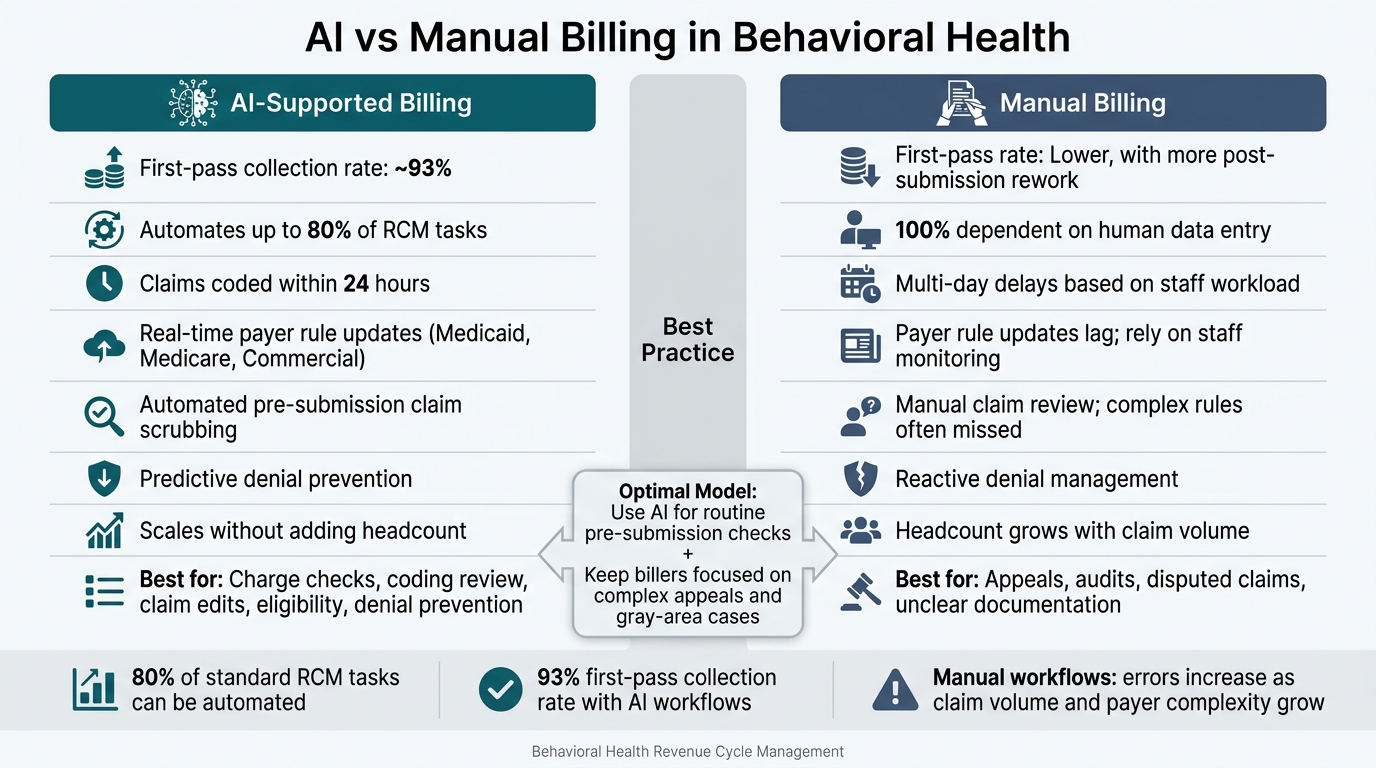
AI is most useful for charge checks, coding review, claim edits, eligibility verification, and denial prevention.
Manual billing is most useful for appeals, audits, disputed claims, and cases with unclear or incomplete documentation.
The biggest differences appear in accuracy, denial rates, staff workload, and the ability to keep up with changing payer rules.
The numbers matter: AI-supported tools can automate up to 80% of standard revenue cycle tasks, while some workflows report first-pass collection rates of around 93%.
Behavioral health billing is especially prone to delays because even small errors can hold up payment. Time-based codes, prior authorization requirements, telehealth modifiers, documentation requirements, and payer-specific policies all create opportunities for claims to be denied or delayed.
The most useful comparison between AI and manual billing, then, is where each approach prevents errors—and where human expertise is still needed to resolve them.
Quick Comparison
Area
AI-Supported Billing
Manual Billing
Charge accuracy
Checks claims before submission
Depends on manual entry and review
Coding review
Uses NLP and rule-based checks
Depends on staff knowledge and time
Claim edits
Screens for payer-specific errors
More likely to miss rule changes
Denials
Tries to stop issues before submission
Often fixed after denial
Staff time
Automates repetitive tasks
Heavy admin workload
Compliance
Tracks payer rules across plans
Staff must monitor updates by hand
For most teams, the best setup is not AI alone or manual alone. It’s a mixed model: use AI for routine checks, and keep billers focused on the claims that need judgment.
How AI-Supported Billing Works in Behavioral Health
AI catches billing errors before a claim goes out.
That shifts the job from chasing denials after the fact to stopping them earlier. In behavioral health, BHRev supports eligibility verification, claim scrubbing, denial management, and predictive analytics for billing. The biggest lift tends to show up in charge capture, claim edits, and denial prevention.
How AI Catches Charge and Coding Errors Before Submission
Before submission, AI reviews claims against payer-specific rules. It looks for documentation-to-code mismatches, missing modifiers, and services that aren’t backed up by the clinical notes on file. Those issues can easily slip past manual review, especially when staff are stretched thin.
AI coding tools apply payer rules the same way each time and can process claims within 24 hours [2]. So the workflow moves faster, and just as important, it stays consistent. No guesswork. No uneven review from one claim to the next.
How AI Handles Claim Edits and Reduces Denials
Once a claim is built, AI checks it against current Medicaid, Medicare, and commercial payer rules before submission. Automated claim scrubbing reviews authorization, formatting, and CPT/ICD-10 accuracy. If something is off, the system flags it for correction instead of letting it go out and come back denied.
The results can show up pretty clearly. AI-driven workflows with daily automated claim validations and payer-specific formatting checks have helped providers reach first-pass collection rates of approximately 93%[8]. On top of scrubbing, predictive analytics can spot denial patterns and underpayments, which gives teams a chance to fix repeat problems earlier.
How AI Cuts Staff Time While Keeping Human Oversight
When routine checks are automated, staff can spend their time where it matters more: the exceptions. AI handles eligibility checks, claim status tracking, and denial follow-up, which frees staff to work on complex appeals and payer escalations. Real-time eligibility verification confirms active coverage, copays, and deductibles before the appointment.
That means people can stay focused on cases that need judgment, including appeals, Medicaid, Medicare, commercial escalations, and billing situations tied to clinical context. AI handles the repetitive work. Humans handle the gray areas.
How Manual Billing Works in Behavioral Health
With manual billing, staff do the whole job themselves: eligibility checks, coding, claim scrubbing, payment posting, and denial follow-up. Every step depends on the person doing it, how busy they are, and whether the same rules get applied the same way each time.
That’s the upside and the catch.
When the process runs well, manual billing gives teams close control. But one missed step can slow the whole revenue cycle. A claim can sit, a payment can get delayed, and staff may end up backtracking to find where things went off course.
Where Experienced Billers Add Value in Complex Cases
Manual billing tends to work best when human judgment carries the most weight. That’s often the case with ambiguous, disputed, or nonstandard claims.
A skilled biller can look at unclear clinical documentation, spot what a payer is pushing back on, and read between the lines in a way software often can’t. They can also keep up with payer rule changes and shape appeals around the exact denial reason or benefit plan involved.
In behavioral health, that matters a lot during appeals, audits, and recoupment cases. These situations usually don’t leave much room for guesswork. The response needs to be precise, well-supported, and tied closely to the facts of the claim.
Where Manual Processes Create Delays and Errors
The cracks tend to show when volume goes up and payer rules start to vary. Medicaid, Medicare, and commercial plans don’t always play by the same rules. A modifier that works for one payer may be rejected by another.
That’s where manual workflows can bog down. Authorization gaps, slow follow-up, spreadsheet-based tracking, and weak denial visibility all increase error risk at scale [7]. Manual eligibility checks before appointments add one more place where things can slip. If coverage details aren’t confirmed early, billing mistakes often show up later.
Those tradeoffs stand out even more in the direct comparison below.
AI vs Manual Billing: A Direct Comparison by Category
You can see the tradeoffs most clearly in four places: charge accuracy, denials, staff time, and payer compliance. Manual review still has a place, especially when a case is unusual. But AI tends to do its best work on routine, rules-based tasks.
Charge Accuracy, Coding Review, and Claim Edits
AI coding tools use natural language processing to code claims automatically within 24 hours [1]. Manual billing leans on biller review, which can slow down as claim volume grows and payer rules start to vary from plan to plan.
This is where behavioral health billing gets messy. Medicaid, Medicare, and commercial plans each come with their own prior authorization rules, telehealth billing requirements, and documentation standards. AI platforms built for behavioral health can pull in real-time payer rule updates across all three, which helps teams stay current without relying on someone to check every change by hand [4]. With manual billing, teams often catch those updates only when a staff member spots them – or when a denial lands.
Compliance Factor
AI-Supported Billing
Manual Billing
Payer rule updates
Real-time integration across Medicaid, Medicare, and commercial plans [4]
Requires ongoing staff training; updates often lag [4]
Prior authorization
Automated checks and documentation validation before submission [3]
Manual tracking; authorization gaps are a common delay point [7]
Billers must manually apply and verify telehealth rules per payer
Medical necessity documentation
Flags missing or misaligned documentation before the claim goes out [8]
Reviewed manually; gaps often surface after denial
These tradeoffs shape the workflow choice, especially for smaller teams dealing with a mix of payer types.
Choosing the Right Billing Workflow: Key Takeaways
After looking at accuracy, denials, staff time, and compliance, the next step is simple: figure out fit. Where should automation take the lead, and where do people still need to stay in the loop?
There isn’t one billing workflow that works for every behavioral health organization. The right setup depends on where errors start, how many claims you process, and what your payer mix looks like. In practice, the choice usually comes down to organization size, staffing, and payer mix.
A smart middle ground works well for many teams. Use AI for pre-submission checks, where rules are clear and repeatable. Keep people focused on appeals, audits, and denials that need clinical judgment.
For most behavioral health providers, a blended workflow makes the most sense: AI handles the routine work, and billers step in for exceptions.
Matching Workflow to Organization Size, Staffing, and Payer Mix
Organization size shapes this decision more than many leaders expect.
Solo and small practices often do well with outsourced RCM because it cuts the admin burden and lets clinicians stay focused on patient care.
Larger groups and multi-site clinics deal with a different headache: disconnected systems. When billing data isn’t synced across locations and EHR platforms, small mistakes stack up fast. At that point, manual workflows can miss accounts receivable aging and authorization gaps across sites.
Payer mix often tips the scale. If a large share of your claims comes from Medicaid and Medicare, automated pre-submission validation becomes much more useful. Those claims usually leave less room for error.
What to Review in Your Current Billing Process
Look closely at where the process starts to slip. A few pressure points tend to show up again and again:
Denial categories: Are denials tied to coding, modifiers, or authorization failures? Coding and modifier issues are strong candidates for AI prevention. Medical necessity denials usually need human review [4][5].
First-pass acceptance rate: If this rate is low, your pre-submission scrubbing likely isn’t catching enough errors.
Staff hours per claim: If billers are losing hours to data entry, repeated work, or follow-up that goes nowhere, automation can ease that load fast [7][8].
Authorization failure rates: Frequent authorization denials usually point to a front-end workflow issue. Automated eligibility verification and prior authorization checks, done before the appointment, can fix the problem at the source [3][7].
FAQs
When should a practice use AI instead of manual billing?
A practice should move to AI-supported billing when denial rates climb, payer rules get harder to manage, or admin work starts eating up too much staff time.
Here’s the big shift: AI can automate up to 80% of revenue cycle tasks. That includes:
eligibility verification
claim scrubbing
denial management
Human oversight still matters, especially for complex compliance issues and billing exceptions. But with AI handling the heavy lifting, practices can improve coding accuracy, speed up cash flow, and take pressure off the team.
What billing problems still need human review?
AI can take care of most routine billing work. It’s good at repetitive tasks, moving data, and flagging common issues.
But human review still matters. Teams need it for exceptions, compliance checks, and billing situations that aren’t straightforward.
People also play a key role in confirming that documentation meets requirements. And when appeals or denials call for professional judgment, staff step in to handle them with care. That human oversight helps keep billing accurate and aligned with regulations.
How can a practice tell if AI billing would improve results?
Track key numbers like claim denial rates, accounts receivable aging, and payment turnaround times. These figures show where billing is running smoothly and where money may be getting stuck.
If your practice deals with a heavy admin workload, frequent denials, or slow reimbursements, AI-supported billing may help improve results.
It also helps to compare your current manual process against automated benchmarks, such as first-pass acceptance rates and lower admin error rates. That side-by-side view can make it easier to spot gaps, improve cash flow, and cut wasted time.