
Home / Denial Management: Fixing Medical Necessity Issues
Medical necessity denials are a major challenge for behavioral health providers, leading to high claim rejection rates and financial losses. These denials often stem from poor documentation, coding mistakes, and authorization errors. Behavioral health claims face stricter scrutiny compared to general medicine, with denial rates as high as 25%, nearly triple those of physical health services.
Key takeaways to reduce denials:
Improve documentation: Ensure progress notes clearly connect diagnosis, treatment goals, and interventions. Use specific details and validated tools like PHQ-9 or GAD-7.
Accurate coding: Match ICD-10 codes to the documented severity and avoid common errors like missing modifiers or incorrect telehealth codes.
Track authorizations: Use centralized systems to monitor session limits, expiration dates, and payer-specific policies.
Appeal effectively: Most medical necessity denials can be overturned with strong documentation and timely action.
Automation and AI tools can help prevent denials by flagging errors before submission and streamlining appeal processes. By addressing these issues, practices can recover lost revenue and improve financial stability.
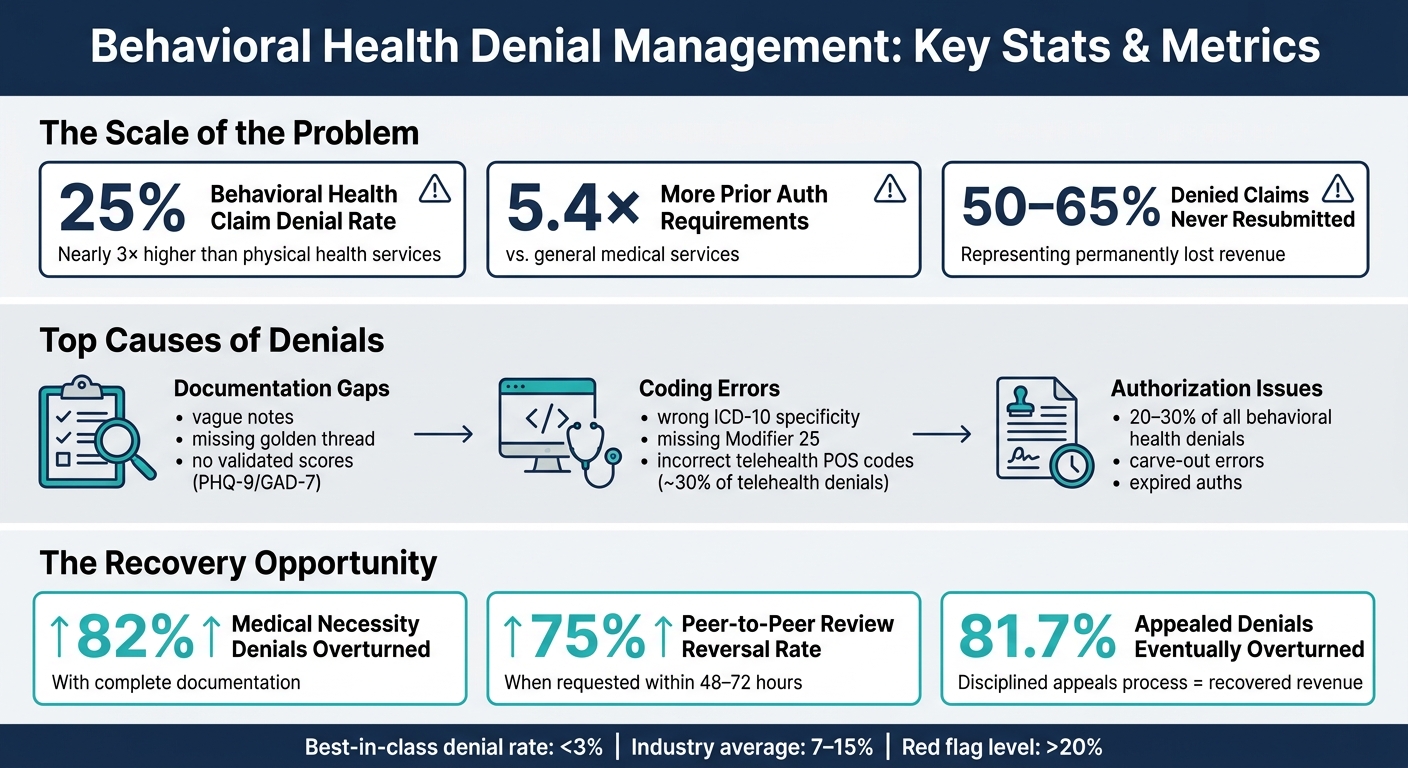
One of the leading reasons behavioral health claims get denied isn’t due to coding errors – it’s incomplete clinical documentation. Progress notes with vague phrases like “patient is doing well” or “supportive counseling provided” fail to provide payers with enough information to assess the necessity or appropriateness of the service. Without clear details, a reviewer won’t be able to determine how a session stands apart from previous ones or why it was necessary.
A missing “golden thread” – where diagnosis, treatment goals, interventions, and outcomes fail to align – further weakens the justification for a claim. Payers are more likely to challenge claims if progress notes don’t explicitly connect to active treatment plans.
Including objective data, such as validated assessment scores, is critical. For example, omitting tools like PHQ-9 or GAD-7, or failing to document specific functional impairments, can make a claim more vulnerable to automated audits. For time-based CPT codes like 90832, 90834, and 90837, leaving out exact start and stop times can lead to automatic down-coding.
Even when documentation is thorough, mismatched codes can derail a claim. Coding errors disrupt the alignment between the clinical narrative and billing data, creating doubts about medical necessity. For instance, billing F32.9 (unspecified major depressive disorder) when the notes describe moderate severity gives reviewers an easy reason to question the necessity of more intensive services.
Modifier mistakes are another common pitfall. For example, if a clinician bills an E/M service (like medication management) on the same day as psychotherapy, Modifier 25 must be added to the E/M code. Forgetting this modifier often results in CO-97 denials. Similarly, telehealth claims frequently get rejected due to incorrect Place of Service (POS) codes – like using POS 11 instead of POS 10 for a patient at home – or missing required modifiers such as -95 or -GT. In fact, these types of errors account for about 30% of telehealth denials [6].
Denial Code | Meaning | Common Root Cause |
|---|---|---|
CO-16 | Claim lacks information | Missing modifiers, incorrect POS, or mismatched CPT codes [3][9] |
CO-97 | Service bundled | Modifier 25 omitted when billing E/M with psychotherapy add-on [3][5] |
CO-167 | Diagnosis not covered | |
CO-4 | Inconsistent modifier | Telehealth modifier mismatch [1] |
Even with proper documentation and coding, authorization issues can lead to denials. Behavioral health services require prior authorization 5.4 times more often than medical services [3]. Failing to manage these authorizations carefully can quickly result in claim denials.
One preventable issue is a carve-out error, where the claim is mistakenly billed to the medical insurer (e.g., Anthem) instead of the Managed Behavioral Health Organization (MBHO) responsible for behavioral health benefits, such as Optum, Carelon, or Magellan. These claims are often denied outright or lost entirely. This oversight typically occurs during intake when staff verify general coverage but miss the behavioral health carve-out information on the back of the insurance card.
Authorization tracking failures are another costly problem. When session counts, expiration dates, or staff changes aren’t monitored in a centralized system, providers might unknowingly deliver services under an expired authorization. By the time the denial is received, the timely filing window may have already passed. Prior authorization denials make up 20% to 30% of all behavioral health denials [2], but many of these can be avoided with effective tracking systems. Keeping a close eye on authorizations is essential to maintaining the integrity of the medical necessity narrative and ensuring reimbursement stays on track.
When it comes to documentation, clarity and connection are key. Every progress note should clearly tie the diagnosis, treatment goals, and the interventions used during that session. This continuity – often referred to as the “golden thread” – is essential. If a reviewer can’t follow this thread through your documentation, the claim becomes vulnerable to denial.
Details matter. Instead of writing something vague like “client reports anxiety”, include specifics such as: “Client experiences intrusive worry 3–4 times daily, lasting approximately 60 minutes and significantly affecting work performance.”
Adding validated tool scores – like PHQ-9, GAD-7, or ASAM dimensional prompts for substance use disorder – can further strengthen your notes. Also, for time-based CPT codes like 90832, 90834, and 90837, always include exact start and stop times. Without this level of detail, payer systems may automatically down-code your claim.
Another critical element is documenting the risks of discontinuing treatment. Clearly outline potential risks, such as deterioration or safety concerns, if services were to stop. This not only reinforces the clinical necessity of treatment but also strengthens your claim.
Strong documentation goes hand-in-hand with accurate coding. When your notes are thorough, they pave the way for precise coding, which helps protect your claims from scrutiny.
Accurate coding is just as important as solid documentation. Always use the most specific ICD-10 F-code that matches the documented severity. For instance, don’t bill F32.9 for “unspecified depression” if your notes clearly describe moderate depression.
Regular audits can help you stay on track. Conduct quarterly internal reviews, examining around 10 claims per clinician. This allows you to catch errors or inconsistencies before they become patterns. Ensure that session notes align with the billed CPT codes and that the “golden thread” remains intact throughout the chart. Fixing issues during these audits takes far less time than dealing with denied claims later.
If you need to resubmit a corrected claim, use frequency code 7 and include the original claim number (ICN/TCN) to avoid triggering a CO-18 duplicate claim denial.
Even with flawless documentation and coding, managing prior authorizations is essential to avoid denials. A centralized tracking log can help you stay organized by recording authorization numbers, approved visits, start and end dates, and remaining sessions.
Start the renewal process when only 2 to 3 sessions remain on the current authorization. Waiting until the last session often leads to providing services under an expired authorization. Automated reminders – set for 21 days and 7 days before an authorization expires – can help you stay ahead [5].
When requesting renewals, use specific, measurable language. Include dates, durations, and outcomes of prior interventions instead of vague phrases like “patient failed prior treatment.” Starting in January 2026, new CMS rules (CMS-0057-F) will require payers to provide specific clinical reasons for denying prior authorizations, making it easier to prepare appeals [12].
These rules also mandate that payers respond to standard prior authorization requests within 7 calendar days and urgent requests within 72 hours [12].
Start by distinguishing between rejections (technical errors flagged before adjudication) and denials (coverage or clinical decisions made post-adjudication). This step prevents wasting time on issues that don’t require formal appeals.
Once you confirm a true denial, use these four key questions to decide your next steps:
Is this a soft denial (fixable administrative error) or a hard denial (clinical dispute needing an appeal)?
Does the claim’s value justify the appeal cost (estimated at $62.40–$118 in 2026) [3]?
Are the clinical notes and the payer’s medical policy for the procedure readily available?
Is this denial part of a recurring issue that could set a precedent, even if the dollar amount is low [13]?
The table below helps prioritize your response based on the denial scenario:
Priority Level | Denial Scenario | Recommended Action |
|---|---|---|
Highest | Approved prior authorization ignored by the payer | File a formal appeal and report to the State Insurance Commissioner |
High | Medical necessity (Claim >$200) | Start with a peer-to-peer review, then proceed to a Level 1 appeal |
Medium | Pattern or precedent cases | Appeal to establish future coverage rules |
Low | Timely filing issues (insufficient proof) | Write off the claim and fix upstream processes |
None | Soft denial (coding/administrative) | Correct and resubmit without a formal appeal |
One common mistake is overlooking who issued the denial. Some payers outsource utilization reviews to third parties like AIM Specialty Health or Carelon. In these cases, direct peer-to-peer review requests to the appropriate reviewer, not the payer [15].
After triaging, move quickly to craft a strong appeal strategy.
Did you know that about 60% of denied claims never get appealed [16]? That’s a lot of missed revenue, especially since 82% of medical necessity denials can be overturned with complete documentation [13].
Peer-to-peer reviews are especially effective, reversing up to 75% of denials if requested within 48–72 hours [16]. However, the window for requesting these reviews is often narrow – usually 14 to 30 days. Missing this timeframe pushes you into formal appeals, which tend to have lower success rates.
For formal appeals, structure matters. Your appeal packet should include:
A cover letter
A copy of the denial
A provider’s letter of medical necessity
Relevant chart notes
A list of supporting attachments
Address each clinical criterion cited in the denial. Reference the payer’s policy and back your argument with objective data. For example, if the payer applies stricter standards to behavioral health services, cite the Mental Health Parity and Addiction Equity Act (MHPAEA). Use measurable data like PHQ-9 scores, GAD-7 scores, or functional outcomes instead of vague narratives.
To ensure precision, request the exact criterion number and the specific documentation gaps identified by the reviewer within 24 hours of receiving the denial [15].
Submitting appeals is just one part of the equation. To improve denial management long-term, track outcomes and use the data to refine your processes.
Here are some key metrics to monitor:
Metric | Behavioral Health Target | Red Flag Level |
|---|---|---|
Overall Denial Rate | <10% | >20% |
First Pass Resolution Rate | 90–95% | <85% |
Denial Recovery Rate | >50% | <35% |
Days in Accounts Receivable | <50 days | >60 days |
Net Collection Rate | >96% | <92% |
Track these metrics by payer, denial reason, and provider [11]. A sudden spike in denials from a specific payer could indicate policy or coding changes. Regular audits – such as reviewing 10 claims per clinician each quarter – can help catch these trends early and maintain a high first pass resolution rate.
Relying on manual processes to catch errors before claim submission often falls short. Automated tools step in to address this gap, verifying claims against payer rules upfront, rather than waiting for denials to occur.
One of the most effective tools is automated eligibility verification. Running real-time EDI 270/271 checks at least 72 hours before an appointment helps identify issues like coverage lapses, behavioral health carve-outs (e.g., claims that need routing to Optum or Magellan), or session limit exhaustion – all before care is provided [3][4].
Claim scrubbing adds another layer of protection by validating CPT/ICD-10 codes, ensuring proper time-to-code alignment, and checking modifier logic. For example, it flags problems like insufficient session documentation for code 90837 or a missing Modifier 25 when E/M codes are paired with psychotherapy add-ons [3]. Advanced billing technology with robust scrubbing capabilities can push first-pass clean claim rates to over 97%, outperforming the typical behavioral health benchmark of 92% to 95% [3].
Another key tool is the auth-lock protocol, which prevents sessions from starting without a valid prior authorization. This eliminates “missing authorization” denials before they can happen [3].
Even with strong prevention measures, denials can still occur. Advanced AI tools have become invaluable for strengthening the appeal process.
These tools analyze unstructured clinical notes to extract relevant data – like PHQ-9 scores, GAD-7 results, or language pointing to functional impairment – and link it directly to the denial reason.
They then generate appeal letters that incorporate payer policy language and reference important regulations such as the Mental Health Parity and Addiction Equity Act (MHPAEA) or ASAM criteria [3][1]. Research shows that AI-driven platforms can reduce appeal preparation time by 70% and boost success rates by 45% [17].
AI also goes beyond individual appeals. Machine learning algorithms can spot patterns in denial data – tracking payer trends, reason codes, and service types. By identifying subtle changes in payer rules weeks before they become obvious through manual review, these tools shift denial management from being reactive to proactive [11]. Combining prevention and appeal support ensures claims meet medical necessity standards more consistently.
Automated and AI-driven tools are particularly well-suited for behavioral health revenue cycle management (RCM), where challenges differ significantly from general medicine.
Behavioral health providers face prior authorization demands 5.4 times higher than other medical services [3] and experience denial rates between 15% and 25%, nearly triple the rates seen in general healthcare [3].
BHRev’s platform directly addresses these challenges. It integrates automated eligibility verification, behavioral-health-specific claim scrubbing, denial tracking, and AI-powered appeal tools into one comprehensive system. By focusing on both pre-submission checks and efficient denial resolution, the platform minimizes the likelihood and impact of denials. For providers juggling Medicaid, Medicare, and private payers, BHRev’s payer-specific compliance workflows help avoid routing errors and missed authorization deadlines.
For practices that prefer outsourcing, BHRev offers full-service RCM management on a performance-based fee model. They also provide targeted support services, such as prior authorization assistance and aged accounts receivable recovery, which can complement an in-house billing team. The aim is simple: reduce the number of denials providers face and resolve those that occur as quickly as possible.
Medical necessity denials often stem from predictable issues like documentation gaps, coding mistakes, or missed authorizations – and the good news is, these are largely preventable.
The strategies outlined in this article work together as a cohesive system: stronger intake documentation sets the foundation for revenue, accurate coding ensures claims stay on track, and proactive authorization management prevents common denial triggers before they occur.
The financial impact of denials is undeniable. Studies show that 50% to 65% of denied behavioral health claims are never resubmitted [7], meaning every unchallenged denial represents revenue that’s permanently lost.
To put it into perspective, reducing your denial rate by just 15% can deliver the same financial benefit as increasing your marketing budget by 15% – but at a fraction of the cost [11].
The difference between an average denial rate of 7%–15% and a best-in-class rate below 3% [5] often lies in whether a practice views denials as isolated billing issues or as symptoms of deeper process failures, such as those tied to intake documentation and authorization management.
Technology plays a key role in addressing these challenges. Beyond improved documentation and coding practices, advanced tools can streamline denial management. Automated eligibility checks, claim scrubbing, and auth-lock protocols tackle issues on the front end, while AI-powered appeal tools enhance the back end.
Together, they shift denial management from reactive problem-solving to a proactive, structured workflow. With 81.7% of appealed behavioral health denials eventually overturned [7], having a disciplined appeals process can recover significant revenue that would otherwise be lost.
This integrated approach – combining robust documentation, accurate coding, and advanced technology – ensures continuous improvement in denial management. By catching problems early, resolving them efficiently, and learning from each denial cycle, practices can turn a common financial drain into an opportunity for measurable growth and stability.
Medical necessity denials often happen when documentation fails to clearly link the patient’s condition to the service being requested. Some frequent problems include clinical notes that are too vague, leaving out critical details like the severity of symptoms, how long they’ve lasted, or how they impact the patient’s daily life. Another common issue is not documenting failed attempts at conservative treatments. Other warning signs include mismatched ICD-10 and CPT codes, missing information about comorbidities, or inconsistencies across visit notes. BHRev provides AI-powered tools designed to help providers enhance their documentation and minimize these denials.
Rejections happen right at the start, during the initial check before the payer even processes the claim. These are often caused by issues like missing information, formatting mistakes, or duplicate submissions. On the other hand, denials occur after the claim has been processed. This happens when the payer decides that the service isn’t covered, isn’t deemed medically necessary, or doesn’t align with the plan’s requirements. To understand the payer’s reasoning, review the Electronic Remittance Advice (ERA), which includes specific codes explaining their decision.
A well-prepared medical necessity appeal packet needs to be clear, organized, and backed by strong evidence. It should directly address the reasons for the insurance denial. Here’s what to include:
Cover letter: Provide the patient’s details, claim information, a concise request for approval, and a clinical argument countering the denial.
Clinical documentation: Include chart notes, evaluations, and progress notes that highlight the severity of symptoms and functional impairments.
Failed treatment history: Document previous treatments to demonstrate that conservative options have been tried without success.
Payer criteria: Reference the insurer’s specific policies and guidelines to align your case with their requirements.
Physician letter: Submit a signed letter from the doctor, clearly connecting the proposed care to the patient’s clinical needs.
Each piece of the packet should work together to present a compelling case for why the treatment is necessary.
One email a month, no fluff. Unsubscribe anytime.