
Home / Top AI Uses in Medicaid Billing for Behavioral Health
If you want fewer Medicaid denials in behavioral health, start at the front end.
The biggest gains usually come from AI tools that catch coverage issues, prior auth gaps, coding mismatches, and claim errors before submission.
SUMMARY:
Eligibility review helps stop denials tied to inactive coverage, wrong MCO assignment, and benefit issues.
Prior auth checks help catch missing, expired, or mismatched approvals before billing.
Coding support helps spot modifier, CPT/HCPCS, diagnosis, and NCCI conflicts.
Denial prediction helps find high-risk claims before they turn into rework.
Underpayment review helps compare paid amounts to expected reimbursement and spot missed revenue.
Clean-claim scoring works as a final pre-submit check to hold claims with likely errors.
End-to-end AI RCM tools like BHRev pull these tasks into one billing flow with staff review for edge cases.
Why does this matter?
Because even small billing errors can slow payment by weeks and add avoidable staff work. In high-volume Medicaid behavioral health billing, a small lift in first-pass acceptance or a small drop in denials can affect cash flow, A/R days, and net collections.
The Main Takeaway: start with the denial pattern you see most.
If denials come from eligibility or auth issues, fix those first. If claims already go out clean but cash still falls short, look at denial trends and underpayments next.
Use Case | What It Helps Catch | Best Stage |
|---|---|---|
Eligibility Review | Coverage and payer mismatches | Pre-appointment |
Prior Auth Checks | Missing or expired authorizations | Pre-service |
Coding Support | Code, modifier, and edit conflicts | Post-encounter |
Denial Prediction | High-risk claims | Pre-submission |
Clean-Claim Scoring | Final claim errors | Pre-submission |
Underpayment Review | Paid-vs-expected gaps | Post-payment |
I’d use AI for repeat checks and pattern spotting, then send unclear cases to staff. That mix helps cut denials without losing billing oversight.
Medicaid behavioral health billing is tough for a reason. Coverage can shift fast. Documentation rules are strict. Coding has to line up across several fields. And each payer has its own edits. Miss just one detail, and a claim can deny.
That’s where AI can help most: before the claim goes out the door.
Medicaid enrollment doesn’t stay the same for long. A patient’s coverage, plan assignment, or carve-out status can change close to the date of service. If staff check eligibility too early, a claim may go out under inactive or mismatched coverage. The denial that follows is often avoidable.
AI-based eligibility checks help spot those changes before submission. [1]
That same problem carries into prior auth work.
Many behavioral health services need prior authorization. If an auth is missing or has expired, the claim can stall or deny. In a busy billing team, those misses happen more often than people want to admit.
AI can flag missing or expired authorizations before they block the claim. [1]
Outpatient behavioral health teams process a high volume of claims, and that makes coding errors easier to miss. Diagnosis codes, CPT/HCPCS codes, modifiers, and place of service all need to match coding rules, payer edits, and NCCI requirements. It’s a lot to keep straight by hand.
AI scrubbing checks those fields before submission and catches conflicts early. [1][6]
At this stage, even a small mismatch can turn into an avoidable denial.
When claim volume gets high, patterns can hide in plain sight. Maybe one payer keeps underpaying the same procedure code. Maybe one modifier keeps setting off denials across dozens of claims. A person may not spot that pattern right away, especially when they’re buried in daily work.
AI analytics can surface those trends across A/R and make the root causes easier to fix. [3]
AI works best when it handles routine checks and pattern detection. Billing staff still need to step in for exceptions, documentation review, and appeal validation.
That split sets up the use cases that come next.
One example of this end-to-end setup is BHRev.
It brings eligibility checks, claim scrubbing, prior auth support, and denial analytics into a single Medicaid-focused RCM workflow for behavioral health providers.
BHRev checks claims against Medicaid and payer rules before submission so teams can catch errors early and cut avoidable denials. In plain terms, it helps stop preventable denials before they ever hit the queue. [1][2]
This only works if it fits the way billing teams already operate. BHRev connects with common EHR and practice management systems to support existing behavioral health billing workflows, which can reduce manual handoffs and missed follow-up. [5]
By taking care of routine checks and scrubbing, BHRev gives billing staff more time to focus on exceptions and higher-risk claims. Human staff still review exceptions, complex payer rules, and compliance issues, so teams keep the speed of automation without losing the oversight Medicaid compliance calls for. [2][4]
The next use case breaks these functions into individual AI billing tasks.
AI eligibility review checks coverage before the visit, so avoidable denials don’t get a chance to start. That’s why it’s often the first high-value AI use case in Medicaid behavioral health billing.
AI eligibility tools can check active coverage, MCO assignment, benefit limits, and prior authorization requirements before each appointment. [1] [9] If something’s off – like inactive coverage or the wrong payer assignment – the issue gets flagged at the front end instead of showing up later as a denial.
When AI connects with the EHR and CRM, staff don’t have to keep reentering the same data. That cuts down on manual entry mistakes that often lead to eligibility denials. [10]
The payoff shows up fast: fewer eligibility-related denials, less rework for staff, and faster clean claim submission. Early verification helps billing teams fix problems before they hit cash flow.
Some cases still need a person to step in. Conflicting coverage responses, unclear coverage details, and service authorization questions should go to staff for review. [2] [4] That keeps the process moving while preserving the compliance oversight Medicaid billing calls for.
After eligibility, prior authorization is the next front-end checkpoint for Medicaid behavioral health claims. The rules can shift by state, MCO, and service type. Miss one requirement, and care can get delayed or the claim can be denied.
AI monitors Medicaid managed care prior authorization rules by service type and flags missing requirements before submission [1]. That includes intensive outpatient (IOP), partial hospitalization (PHP), and standard outpatient therapy. It also checks that the units billed match the units authorized, which helps stop denials tied to unit mismatches [1][5].
This kind of front-end review works best when the system also pulls the needed documentation into the authorization workflow on its own. That cuts down on small misses that can turn into claim problems later.
When AI connects straight to the EHR and CRM, it can pull the records needed to back up the request without forcing staff to enter the same data in more than one place [10]. In behavioral health, that matters a lot. The documentation has to line up with the authorization request, and duplicate entry is where errors tend to creep in.
Authorization gaps are a common reason for denials and delayed payment. AI helps by catching missing or mismatched authorizations before submission [3]. That means fewer incomplete claims, less back-and-forth on Additional Information Requests (AIRs), and less time spent chasing appeals.
Some cases still need a person to step in. But for routine checks, AI can catch the usual misses before they slow payment.
Retro-auth requests, payer conflicts, and cases that need medical-necessity documentation still call for a billing expert [2][5]. The best setup is pretty simple:
Use automation for routine authorization checks
Use human review for edge cases and judgment calls
That split keeps the workflow moving without giving up oversight where it matters most.
After eligibility and prior authorization checks, coding is where many Medicaid claims fall apart. One wrong modifier or a diagnosis that doesn’t line up can lead to a rejection before the payer even looks at the clinical record.
AI coding tools check claims against NCCI edits, CPT/HCPCS-modifier pairings, and state Medicaid billing rules before submission [6][8]. That helps cut denials tied to modifiers and bundling.
In behavioral health, the rules can get tricky fast. IOP, PHP, telehealth, and same-day billing each come with their own payer rules and documentation needs. Tools built for this work shape claims to fit payer rules and pull clinical documentation straight from the EHR into the coding workflow, which cuts data-entry mistakes [10].
BHRev’s coding workflow is built around behavioral health payer rules, documentation, and compliance, while also automating routine coding tasks [5].
Cleaner coding helps more claims get accepted on the first pass and can shorten billing turnaround [2][4]. When claims still fail at this stage, they often show the same denial patterns covered next.
Some cases still need a trained person to step in. Complex billing scenarios and questions about whether documentation is sufficient still call for human review [2][4]. In practice, staff should focus on exceptions and more complicated claims.
After eligibility, authorization, and coding checks, AI can rank the claims most likely to be denied. Denials usually follow repeatable patterns that show up across claims [1][3]. That’s where denial prediction helps: it scores claims before submission and flags the ones most likely to run into trouble, so staff can fix high-risk issues early and avoid rework, delays, and extra back-and-forth [5][9].
AI checks claims against Medicaid and payer rules, then flags high-risk mismatches like missing authorizations, unsupported levels of care, and payer-specific edits. It can also scan pre-bill data for patterns that often lead to Medicaid denials [11].
Behavioral health billing tends to produce dense denial patterns because policy updates, documentation rules, and coding requirements can shift by service and payer. BHRev puts predictive analytics and denial management right in the middle of those workflow demands.
When AI catches a likely denial before submission, teams can correct the issue early instead of dealing with appeals and resubmissions later. Dashboards show which payers and procedure codes have the highest denial rates, so teams can go after root causes instead of making the same mistakes again [5][9]. Those same payment patterns can also support underpayment review.
Some alerts still need a person to step in. Staff should review alerts tied to medical necessity, state policy changes, or missing documentation before any appeal or resubmission. High-risk alerts should also be checked by staff before the claim moves forward again.
After denial prediction, the next place AI can help is post-payment recovery.
A paid claim isn’t always a properly paid claim. AI underpayment review checks what the payer actually paid against what should have been paid. To do that, it looks at fee schedules, modifiers, units, place of service, and contract terms.
AI platforms can take in 835 ERA files and pull out paid amounts, CARC and RARC codes, and filing deadlines. They can then match those details against submitted claims and expected reimbursement to flag payment gaps and missed reimbursement [1][6].
This matters most when Medicaid remits come in at high volume and underpayments are hiding in small dollar differences. Behavioral health claims are often vulnerable to underpayment because even minor coding or documentation mismatches can change reimbursement. BHRev supports post-payment review by matching ERA data to billed claims, contract terms, and payer edits.
Teams can use dashboards and drill-down analytics to spot repeat payment problems before filing limits run out [7].
Finding underpayments early helps teams move on variances that might otherwise slip by. Tracking CARC and RARC patterns can also show which payers or service types are driving the most missed revenue. That gives leadership data they can use when deciding where to push follow-up at the contract level [6][7].
AI does a good job of surfacing possible underpayments, but people still need to step in for retroactive eligibility changes, documentation-dependent services, Medicaid carve-outs, and payer policy exceptions [2][4]. In those cases, AI flags the issue, and a billing specialist checks the context and handles the appeal.
After denial prediction, clean-claim scoring adds one more front-end safeguard before submission. It acts as the last check before a claim goes out, catching coding conflicts, payer-rule mismatches, and other denial triggers while the claim is still in the queue.
Here’s the simple way to think about it: if coding support finds rule conflicts and denial prediction spots risk, clean-claim scoring is the step that stops the claim from leaving until those issues are fixed. And unlike denial prediction, this isn’t a trend model. It’s a claim-level edit check.
In behavioral health, these systems deal with complex Medicaid regulations, mental health-specific coding requirements, and strict documentation requirements [1][4]. AI scoring tools apply payer-specific rules that change with policy updates, helping teams catch formatting and billing issues before they turn into denials.
That matters because Medicaid billing can get messy fast. A small rule mismatch or missing detail can hold up payment, even when the service itself was fine.
Clean-claim scoring works best as a built-in pre-submit gate. When it connects with the EHR, clinical and billing data stay aligned before submission, which cuts down on the mismatches that lead to avoidable denials.
In practice, this means staff aren’t left piecing things together at the last minute. The claim gets checked while the data is still close at hand, and that makes fixes easier.
Every clean claim avoids rework later. That means less time spent on appeals and follow-up, and a shorter gap between service delivery and payment.
For behavioral health providers billing Medicaid at high volume, even small gains in first-pass rates can add up fast. A few fewer errors per batch may not sound like much, but across hundreds or thousands of claims, the effect is hard to miss.
AI can flag the problems, but staff still have to fix them. Teams should review flagged exceptions, documentation gaps, and payer-policy edge cases.
Some claims are straightforward. Others sit in the gray area, where a rule may apply differently based on the payer, the service, or the note in the chart. That’s where human judgment still matters.
Because it stops errors before submission, clean-claim scoring often delivers the fastest front-end gains. These gains usually show up first, which is why the next section looks at where AI returns come quickest.
Once the main use cases are clear, the next step is simple: figure out which ones help cash flow first.
Not every AI billing tool pays back on the same schedule. Front-end tools usually show results first. Coding support tends to come next. Denial and payment analytics often need more time before they start paying off. That matters, because it helps you pick a starting point instead of trying to fix everything at once.
Front-end tools usually pay off first because they stop denials before a claim ever goes out the door.
That early check can make a big difference. If a tool catches an eligibility problem or a missing authorization before submission, your team avoids rework, delays, and the back-and-forth that drains staff time.
Coding support mostly cuts rework and rejections on high-volume claims.
It can still be a fairly fast win, but it usually takes a bit longer than front-end tools to show its full effect. In most cases, the upside comes from cleaner coding, fewer claim fixes, and less audit exposure over time.
Denial prediction and underpayment review depend on claim and payment patterns, so they usually need more time to tune. But once they’re dialed in, they can point to system-level problems that manual review may miss: recurring payer underpayments, staff training gaps, and coding patterns that quietly erode reimbursement month after month [5].
A good place to start is with CARC patterns. They show you what’s driving denials in the first place.
A CARC lookup can turn those codes into plain-English root causes, which makes it easier to see whether the issue starts at the front end with eligibility and authorization or later in the revenue cycle [9]. If your denials are piling up around eligibility failures or authorization gaps, front-end tools should come first [3]. If your first-pass acceptance rate is already strong but you still don’t have a clear view into A/R and denials, denial prediction and underpayment review should be next [3].
The table below compares each use case by rollout speed and main metric affected.
AI Use Case | Speed of Return | Primary Metric Impacted |
|---|---|---|
Eligibility Review | Fastest to implement | Eligibility and authorization denial rate |
Prior Auth Checks | Fastest to implement | Authorization denial rate |
Clean-Claim Scoring | Moderate rollout | First-pass acceptance rate |
Coding Support | Moderate rollout | Rework rate and audit risk |
Denial Prediction | Longer-term | DSO; denial trend patterns |
Underpayment Review | Longer-term | Net collections |
Use these timelines to read the comparison table below.
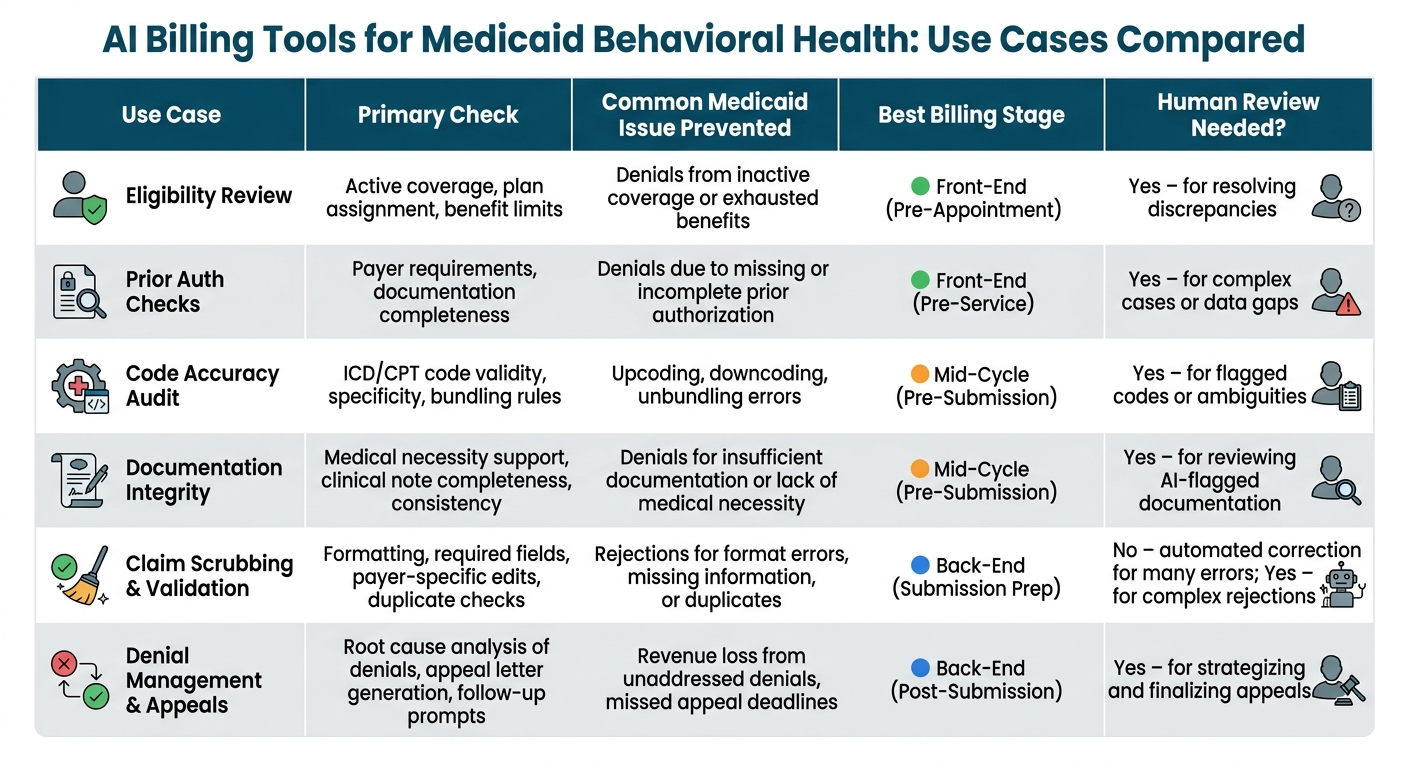
Each AI billing tool is built to catch a different type of billing problem at a different stage of the revenue cycle. That matters because the right tool at the wrong stage won’t help much. When you understand where each one fits, it gets easier to match the workflow to the billing task in front of you.
Use this table to compare tools by timing, function, and review burden.
Use Case | Primary Check | Common Medicaid Issue It Helps Prevent | Best Point in the Billing Cycle | Manual Review Still Necessary? |
|---|---|---|---|---|
Eligibility Review | Active coverage, plan assignment, and benefit limits | Denials from inactive coverage or exhausted benefits | Front-end (pre-appointment) | Yes, for resolving discrepancies. |
Prior Auth Checks | Payer requirements, documentation completeness, and packet completeness | “No authorization” denials and treatment delays | Front-end (pre-service) | Yes, for exceptions and additional documentation. |
Coding Support | CPT/ICD-10 accuracy, HCPCS selection, NCCI edits, and coding conflicts | Upcoding, downcoding, and coding conflicts | Mid-cycle (post-encounter) | Yes, for high-risk or complex claims. |
Denial Prediction | Claims against historical denial patterns and payer edits | Preventable first-pass rejections | Pre-submission | Yes, to act on flagged claims. |
Underpayment Review | Contracted rates vs. actual paid amounts | Revenue leakage and silent underpayments | Back-end (post-payment) | Yes, for appeals and recoupment. |
Clean-Claim Scoring | Data integrity, formatting, and mandatory field completion | Technical rejections and incomplete or invalid claims | Pre-submission | Minimal, for flagged exceptions only. |
This comparison makes one thing clear: each tool belongs to a different point in the billing cycle, and each one asks for a different amount of staff attention.
Timing, automation level, and staff review burden are the main factors to look at. Front-end and pre-submission tools help stop problems before they move downstream. That means fewer issues hitting the back end, and less denial and underpayment work after adjudication.
There’s also a simple tradeoff here. The more automated the tool is, the less staff time it usually needs for routine checks. But automation doesn’t remove people from the process. Every tool still flags exceptions, and those cases still need human judgment.
Each AI tool tackles a different billing weak spot, but the end goal is the same: fewer avoidable denials and fewer missed payments.
After looking at the use cases, the next move is pretty clear. Start with the denial pattern that shows up most often. If authorization gaps are driving denials, put prior auth automation first. If coding conflicts are causing rejections, coding support should be at the top of the list.
For providers ready to put these checks into day-to-day work, BHRev brings the main functions into one workflow. It combines automated eligibility verification, claim scrubbing, denial management, and predictive analytics with human oversight for Medicaid behavioral health billing.
That’s the value of AI in Medicaid billing: the right check, at the right time.
Start with automated eligibility verification. The revenue cycle starts the moment a patient books an appointment, so checking coverage early can stop front-end mistakes before they turn into denials down the line.
Using BHRev at this stage helps collect accurate patient and coverage details before care is delivered. That means less admin work for staff and a cleaner path to billing.
Even with advanced AI billing tools, human oversight still matters. AI can automate up to 80% of routine revenue cycle management tasks, but staff still need to step in for exceptions, nuanced billing work, and day-to-day compliance.
That mix helps keep claim scrubbing accurate, supports more involved eligibility checks, and strengthens denial management. At the same time, it frees administrative teams to spend more time on complex financial workflows and patient care.
AI tools can cut Medicaid denials by taking over revenue cycle work that often leads to mistakes. They check eligibility in real time, scrub claims before submission, and use predictive analytics to spot denial risk early.
They can also help with appeals and resubmissions. BHRev pairs this automation with human oversight to manage complex documentation and payer-specific compliance rules.
One email a month, no fluff. Unsubscribe anytime.